

Black static 58 may june.., p.1
Black Static #58 (May-June 2017), page 1
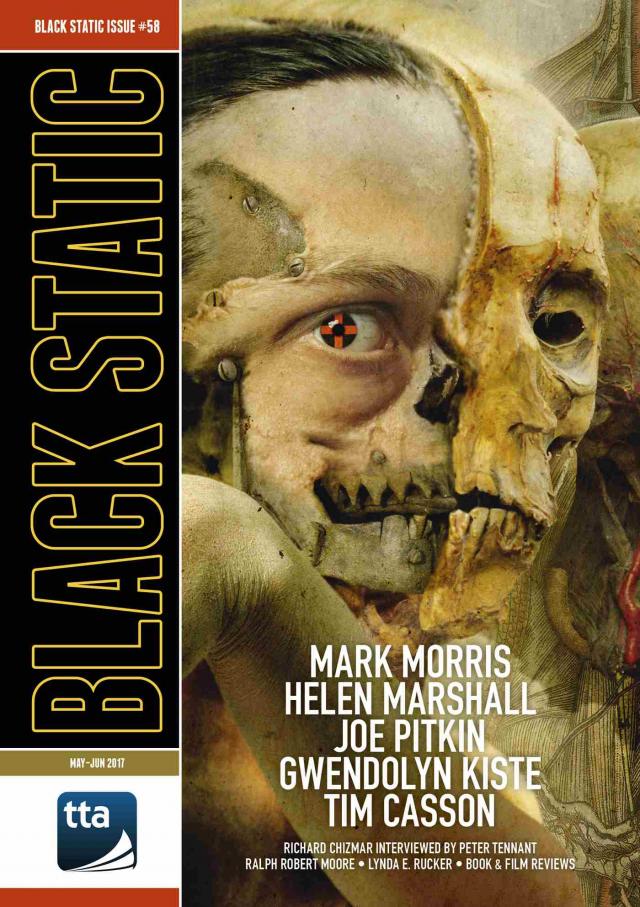


BLACK STATIC 58 (THE 100TH ISSUE)
MAY–JUNE 2017
© 2017 Black Static and its contributors
PUBLISHER
TTA Press, 5 Martins Lane, Witcham, Ely, Cambs CB6 2LB, UK
ttapress.com
EDITOR
Andy Cox
andy@ttapress.com
BOOKS
Peter Tennant
whitenoise@ttapress.com
FILMS
Gary Couzens
gary@ttapress.com
SUBMISSIONS
Unsolicited submissions of short stories are always very welcome, but please follow the guidelines: tta.submittable.com/submit
SMASHWORDS REQUESTS THAT WE ADD THE FOLLOWING:
LICENSE NOTE: THIS EMAGAZINE IS LICENSED FOR YOUR PERSONAL USE/ENJOYMENT ONLY. IT MAY NOT BE RE-SOLD OR GIVEN AWAY TO OTHER PEOPLE. IF YOU WOULD LIKE TO SHARE THIS MAGAZINE WITH OTHERS PLEASE PURCHASE AN ADDITIONAL COPY FOR EACH RECIPIENT. IF YOU POSSESS THIS MAGAZINE AND DID NOT PURCHASE IT, OR IT WAS NOT PURCHASED FOR YOUR USE ONLY, THEN PLEASE GO TO SMASHWORDS.COM AND OBTAIN YOUR OWN COPY. THANK YOU FOR RESPECTING THE HARD WORK OF THE CONTRIBUTORS AND EDITORS.
BLACK STATIC 58 MAY-JUNE 2017
TTA PRESS
COPYRIGHT TTA PRESS AND CONTRIBUTORS 2017
PUBLISHED BY TTA PRESS AT SMASHWORDS
CONTENTS
COVER ART
AT THE DRUG’S CORE
JOACHIM LUETKE
LET’S GET LOST
NOTES FROM THE BORDERLAND
LYNDA E. RUCKER
NEW WORLD, SEARCHING
INTO THE WOODS
RALPH ROBERT MOORE
NOVELETTE
HOLIDAY ROMANCE
MARK MORRIS
NOVELETTE ILLUSTRATED BY WARWICK FRASER-COOMBE
THE PROCESS OF CHUDDAR
TIM CASSON
STORY
NONESUCH
JOE PITKIN
NOVELETTE ILLUSTRATED BY VINCE HAIG
SURVIVAL STRATEGIES
HELEN MARSHALL
STORY ILLUSTRATED BY JOACHIM LUETKE
SONGS TO HELP YOU COPE WHEN YOUR MOM WON’T STOP HAUNTING YOU AND YOUR FRIENDS
GWENDOLYN KISTE
FILM REVIEWS
BLOOD SPECTRUM
GARY COUZENS
BOOK REVIEWS + RICHARD CHIZMAR INTERVIEW
CASE NOTES
PETER TENNANT
NOTES FROM THE BORDERLAND
LYNDA E. RUCKER
LET’S GET LOST
Missing women and girls are a storytelling staple. They populate some of the earliest tales we read for ourselves or are told: they become lost in the underworld, like Persephone, or Psyche, or the twelve dancing princesses; or they go to Narnia or Oz or Wonderland like Lucy Pevensie and Dorothy Gale and Alice Liddell.
Later, we begin to encounter stories where they meet a less salubrious fate. Mysteries, crime fiction, and thrillers are rife with lost girls who are actually dead girls. They often exist largely to be dead, in order to drive the plot. But the more interesting tales of lost girls are those whose fate remains ambiguous, or who are on the cusp of being lost like the narrator of Joyce Carol Oates’s ‘Where Are You Going, Where Have You Been?’ or who are back from being lost, like Tara in Graham Joyce’s Some Kind of Fairytale. Arthur Machen’s ‘The White People’ is narrated by a lost girl; there’s a lost girl in his story ‘The Great God Pan’ as well, or was, until Rosanne Rabinowitz seized the narrative back in her novella ‘Helen’s Story’ and, reminded us that, like so many lost girls, the girl is not necessarily lost from her perspective. This is important: who is telling the story of the lost girl? They aren’t always as lost as they seem, and not just in a Gone Girl way.
Sometimes, before a girl is lost literally, she is lost figuratively.
Laura Palmer in Twin Peaks was that kind of lost girl. Often no one around the lost girl realizes she is grappling with this sense of having lost herself until it is too late, like the husband in Tim Winton’s The Riders; sometimes the girls themselves do not appear to fully grasp the complexities of their own psyche until something happens to them, as in Picnic at Hanging Rock. And as with Laura Palmer, and Connie of the Oates story, and Evie in Megan Abbott’s The End of Everything, and, I think, the girls in Picnic at Hanging Rock, there is often a recognition of a dark sexuality at the heart of the disappearance.
It is in the shadow of Picnic at Hanging Rock that one of a pair of recent-ish films by women directors about lost girls suffers.
The little-known 2015 Australian film Strangerland, the directorial debut of Kim Farrant (and also co-written by a woman, Fiona Seres, along with Michael Kinirons), was widely panned on its release by both audiences and critics, but it was, I think, also widely misunderstood. Critics used disparaging words like “melodrama” to disparage it – as if melodrama itself is inherently bad – and no one talked much about the real heart of the film, which is the dark and consuming power of unchecked female sexuality – but, significantly, from the female, not the male, point of view. If, for all its clear awareness of Picnic at Hanging Rock, Strangerland couldn’t touch it – and it couldn’t – it also doesn’t deserve indifference and obscurity.
Most likely, one of the very things I loved most about the film is probably another element that damaged its commercial appeal: its ambiguity makes it impossible to slot neatly into a genre. Is it a horror film, a thriller, or a family drama? Is it supernatural, or relentlessly, depressingly, naturalistic?
The film is also about a female promiscuity that is impenetrable to the men around it because they cannot seem to grasp its origins or purpose and because it seems, ultimately, to have very little to do with them. Accustomed to being subjects, they have become objects of the all-encompassing sexuality of the mother and daughter in the film.
There’s a powerful subtext here about men’s efforts to contain unfettered female sexuality, and the brutality that their terror of that sexuality can unleash. Lily is our lost girl in this film, and her scrapbook of her sexual encounters feels like the heart of the film to me, sordid hookups that turn into dark magic in her imagination.
There is also an Aboriginal tale of the serpent Ngatyi that may or may not hold the key to Lily’s fate. One of the more powerful elements of the lost girl is that it is a tale that can become a kind of Rorschach; you can read almost any fate into it, and are invited to do so in Strangerland, although the last we hear from Lily are from her own words of adolescent, sexually-charged poetry: “I’m not lost.”
Bea of Honeymoon (2014, not to be confused with a 2015 Mexican film of the same name) is a different kind of lost girl, and unlike Strangerland, Honeymoon isn’t coy about its genre. This is unmistakably a horror film.
Co-written by director Leigh Janiak along with Phil Graziadei, Honeymoon begins with a newlywed couple whose intimacy feels so real that watching it seems almost voyeuristic. Bea and Paul are intensely bonded both emotionally and sexually, and it’s this that makes her mental and physical deterioration over the course of the film so painful. As was the case with Lily in Strangerland, Bea’s body, and, it is implied, her sexuality, becomes a kind of battleground, in this case between her new husband and the force that is taking her away, piece by piece; in neither case does it appear to occur to any of the other characters that these women’s bodies, their sexuality, and what they choose to do with it belongs to anyone but them. Even as Paul’s response to whatever has possessed Bea is a desperate attempt by a terrified man to save the woman he loves – I do not think, as the audience, that we generally feel that we would have handled it any better – there’s still an unmistakable streak of possessiveness in his actions as well. Honeymoon eventually takes a turn into some of the more disturbing scenes of body horror I’ve ever seen; the also-excellent and more recent female-focused horror film Raw might be getting all the hype for making audiences sick, but there’s nothing quite like a monstrous pregnancy to turn me squeamish.
For all of Honeymoon’s disturbing and visceral moments, it’s not entirely clear that what is happening to Bea is non-consensual. There’s certainly a part of her that’s fighting it, as fiercely as she can, but there’s another part that appears to embrace it, and there’s even an implication that whatever is happening is ongoing, stretching back to her childhood.
Despite the closeness of Bea’s relationship with Paul, Honeymoon also reminds us that we are all ultimately alone, and unknowable to one another. This, too, is a characteristic of Lost Girls; they so often are revealed to lead double lives or harbor unexpected depths. Like Strangerland, Honeymoon lets its lost girl have the final words on her fate, and as with Strangerland, they are not necessarily the words the audience expects.
I’ve been struggling and failing to think of much in the way of corresponding stories of Lost Boys. Men and boys in stories tend to go missing in a much more straightforward manner. While too many stories – and pop culture in general – elide the psychological complexities of girls, these are not among them. Even when their subjects are older, these stories are largely mining the dark terrain of adolescent girlhood, a far richer landscape than the girl as victim. Stories about lost girls can be so much better when the lost girl herself is the subject rather than the object, a mere catalyst to launch a story about something else. What’s amazing is how often, when you scratch beneath that surface, they’re participants in getting themselves lost. That doesn’t mean their fate isn’t ultimately a dark one – it’
INTO THE WOODS
RALPH ROBERT MOORE
NEW WORLD, SEARCHING
Norman Saylor, professor of ethnology at a local college, is creating a brochure to be used by the War Office, and with a “final staccato burst of typing”, completes it. Good for him. He decides to celebrate his accomplishment in a rather odd way, by “snooping around in his wife’s dressing room”. It’s an act of intimacy, albeit a one-sided intimacy, like reading someone’s diary in the silence of their absence, or watching someone through a window without their knowledge. And he’s smug as he does it. He’s the type of man who is “sure nothing could touch the security of the relationship between him and Tansy”, that anything he does find among his wife’s personal effects, if it does involve him, will be flattering. He’s that happy.
He has no idea, of course, that he’s a character in a novel, in this case Conjure Wife, by Fritz Leiber. Leiber has another work which begins in a similar fashion, with a husband wandering around his home, wife temporarily absent, feeling happy, but not wanting to examine his happiness too closely, because he knows if he does, he’s going to find reasons not to be happy.
Horror stories usually begin in one of two ways.
We meet the protagonist when they are already in the midst of horror, or meet them before the horror in their life starts.
Henry: Portrait of a Serial Killer, a movie I much admire, starts with a woman’s corpse lying naked in a creek. So we know right from the beginning what we’re in for.
By contrast, Takashi Miike’s movie Audition (Odishon) is a happy, Cary Grant screwball comedy for its first reel. A widower interviews different women to find a new wife. And then it turns into one of the most unsettling horror films of the past few decades. And I prefer this approach.
If a horror story has horror right from the first scene, it loses some of its power. I love seeing things fall apart. If the pieces are already scattered across the floor at the beginning, it’s not as interesting to me. I want to see that moment, and there is always that moment, when things go bad. A guy sitting on the bar stool next to you, after a pleasant enough conversation, says something demented. You exit the glass front of a store in a mall, happy with what you’ve bought, and people are running past, speckled with blood. One of the lessons taught early in painting is that if you want to show true darkness on your canvas, you have to add some lighter pigments, for contrast.
When Scream starts, Drew Barrymore isn’t fearfully locking her doors and windows. She’s making popcorn. What could be a happier activity?
Back in 2002, the company I was working at downsized. In a big way. Most employees were let go. I was asked to stay on, with the condition that I would now work from home. For years, Mary and I would commute together into Dallas each day, spending an hour and a half each morning in rush hour traffic, and about the same amount of wasted time at the end of the work day, slowly making our way, over different highways, home.
Now I would be home all the time, and Mary would have to make that brutal commute each day by herself. We hated being separated for so much of each workday.
In April of 2002, on a Wednesday, we talked over the phone, as we always did, at lunch. It was Spring, cool air scented with the reemergence of flowers. We decided to have a barbeque on our back patio that evening, once Mary was back home. I asked her what meat she wanted to barbeque, and there were long pauses in her answer. I thought that was a little odd at the time, but we could decide later. She told me she loved me, I told her I loved her, and we ended the call.
I went back to work at the computer in our bedroom, and five minutes later the phone rang again. Checking caller ID, I saw it was Mary’s number, so I immediately picked up the phone. Figuring she had decided what she wanted us to cook.
But instead it was Gayle, one of the women on Mary’s staff. “Rob, I went into Mary’s office to get her for lunch, and she was just sitting in her chair. She didn’t acknowledge my presence, and her eyes were staring straight ahead. I think she’s had a stroke.”
By the time I arrived in the city, at the emergency room where she had been rushed by ambulance, Mary was being wheeled on a gurney from one curtained cubicle in the back rooms of the intensive care unit to another, for further tests. Her frightened eyes rolled around, saw mine in a swirl of strangers’ eyes, and stayed with mine, as I held her hand, walking alongside her stretcher. Her sad face looking up at me, not comprehending.
It had been a stroke. A severe stroke. Afterwards, the neurologist who did a follow-up MRI told me that if he only had the radiographs to go by, he would have assumed the patient – Mary – had died. He said the clot in her brain at the time of her stroke was “the size of an egg”.
Mary no longer knew my name. No longer knew her own name. Because it was a left-side stroke, the entire right side of her body was paralyzed. Mary couldn’t lift her right hand, couldn’t wiggle her right toes.
Could not speak. Severe aphasia, a destruction of her language center. Words no longer made sense. Have you ever tried to remember the name of an actor, and it stays on the tip of your tongue? Every word in the English language was like that for Mary. When she was finally released from the hospital, nine days after her emergency admission, I drove her home and she immediately stroked the backs of our cats, happy to again be able to do something normal, but she had no idea what these loving, purring animals were called. “Cat” was far too complex a sound, a concept, for her to be able to enunciate.
Those first few years after her stroke were a real struggle. Everything in our lives – everything – changed. Forever. It all suddenly got a lot more complicated than just making popcorn.
Mary did eventually get better, after years of speech and physical therapy. Never returned to the level she was at before, the head of her department, an officer of the company, someone who would routinely give speeches before large audiences, but she did at least return enough for us to be able to communicate with each other, in our own, new, way. And that’s enough. It’s more than enough.
I remember when I first read Leiber as a child thinking that idea of his about not questioning happiness too much, because there’s always something to be sad about, now or looming, was good advice. And it helped me over the years, as art often can.
There’s a passage by a contemporary of Leiber’s, Richard Matheson, that also helped me a lot, particularly after Mary’s stroke.
It occurs in his novel, The Shrinking Man. Scott Carey begins to shrink, and has to face terrible battles as he gets smaller and smaller, first with his pet cat, and then with the spider who lives in the basement with him. As he shrinks even further, it looks as if he might wink out, but then, in the beautiful epiphany of the last page of the novel, he realizes he will still exist, in a microscopic and submicroscopic world.
The love Mary and I had shared for decades wouldn’t wink away because of her stroke. It would continue to exist, just in different ways.
“There was much to be done and more to be thought about. His brain was teeming with questions and ideas and – yes – hope again… Scott Carey ran into his new world, searching.”
HOLIDAY ROMANCE
MARK MORRIS
Skelton could hear the sea from his room. As a teenager he had found the breath of the tide more soothing than a lullaby, but now, with disappointment filling up the years in between like accumulated grime, it seemed like nothing more than the death-bed respiration of a sick old man, struggling to draw air in to atrophied lungs.


