

Invoking destiny, p.1
Invoking Destiny, page 1


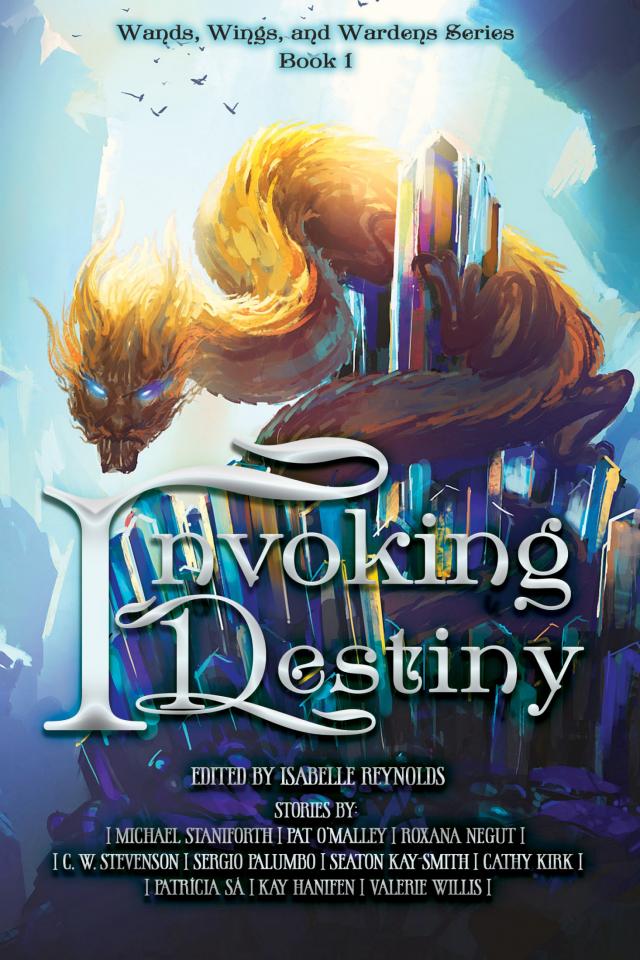
Table of Contents
Dedication
Introduction
In the Garden of Erolkin
The Audit
The Story of the Little Goblin, Art, from the Iron Land
The Last Patrol
The Calling Sea
The Wall
The Azure Knight and The Swamp of Sleep
Beyond the Shadows
Mother Drauga
A Fisherman’s Tail
Book Club Questions
Editor Bio
Invoking Destiny
Copyright © 2024 4 Horsemen Publications. All rights reserved.
4 Horsemen Publications, Inc.
PO Box 417
Sylva, NC 28779
4horsemenpublications.com
info@4horsemenpublications.com
All rights to the work within are reserved to the author and publisher. No part of this publication may be reproduced, stored in a retrieval system, or transmitted in any form or by any means, electronic, mechanical, photocopying, recording, scanning, or otherwise, except as permitted under Section 107 or 108 of the 1976 International Copyright Act, without prior written permission except in brief quotations embodied in critical articles and reviews. Please contact either the Publisher or Author to gain permission.
This is a work of fiction. All characters, organizations, and events portrayed in this novel are either products of the author’s imagination or are used fictitiously.
Library of Congress Control Number: 2023944908
Paperback ISBN-13: 979-8-8232-0299-2
Ebook ISBN-13: 979-8-8232-0298-5
Dedication
To the entire 4 Horsemen Publications team for your constant support and encouragement
Introduction
Magic and fantastical creatures have always been an interest for humans. We make stories to teach children lessons or to warn people away from certain areas of the ocean. Maybe even to help explain the unexplainable. We create creatures that we wish were real. Even though those same creatures would probably be major threats to humanity, it is still entertaining for us to imagine a world in which they exist.
We would love to be the heroes of these fantastical stories. I mean, who doesn’t want to sacrifice themselves by being melted into a city wall to protect the inhabitants from demonic creatures? Wait. That sounds terrible. Maybe that is a bad example…
How about entering into a fairy’s garden that is spelled to prevent you from reaching the coveted apple tree by impaling you with thorns in a maze made of sweet-smelling rosebushes? Huh. That one also sounds painful.
Let’s try again.
A small band of border protectors investigates a series of gruesome murders in a forest in the dead of winter, but they find that the culprits are more than any of them are willing to risk their lives handling. Hmm. That also doesn’t sound like the best set of circumstances.
So maybe we don’t want to be the heroes of those stories. But they sure are fun to read.
But there are other situations in these pages that may sound more appealing to the average person. Such as being raised by a motherly dragon in the mountains with a small village nearby and plenty of company. Or maybe you can go fishing and catch a nice gift for your loved one. Sometimes asking the void for help with your magic means you get a cute little bunny rabbit that can talk and do your bidding. Just ignore its sharp teeth; we’re pretty sure it’s harmless.
You can find a nice place to rest in the mountains after a long walk and enjoy the view with a friendly spirit. You can live a provincial life as the Queen’s favorite florist with a sweetheart you are planning on marrying soon. You can sail the ocean wide with your friends and family in order to make alliances with the neighboring villages, and maybe you make a stop on a tropical island along the way. You could even gain immortality to travel the world and enjoy the beauty of all creatures and civilizations.
You can do anything you want to inside the pages of a fantasy story. So, enter the realm of dragons, magic, knights, and fairies to live out your dreams. Or maybe just read about others living those dreams. Some of them may turn out to be nightmares.
In the Garden of Erolkin
by Michael Staniforth
A three-foot storm of chaos and sticky fingers descended upon Frida’s home, far too soon after the first rays of the morning sun for her liking. Children, to her experience, existed exponentially. One was one and that was fine, but two were more like four, and three might as well have been ten. There were five in her home presently, and it was not a large place. She sighed as dust and hay whipped around the cyclone of little bodies before her. At least they were occupied, Frida thought to herself.
The children were fashioning their offerings, laid outside of their homes at the height of winter as a humble request for spring to come soon. Wicker effigies of what Frida presumed to be horses—or maybe pigs, it was hard to tell—were surrounded by offerings of food and stick figure images of a more verdant land than the snow-covered mud outside promised. The children were in Frida’s house because she was old; old enough to know the stories, old enough to know the traditions and their origins by heart. And the village thought it would do her good, the crazy old spinster on the outskirts of life, to have their energy tear her home to pieces. In truth, for Frida, it did.
“Nana Frida?” one particularly rambunctious six-year-old girl asked. “Why do we make the offering?”
Nana was an honorary title, as Frida had no children of her own, let alone grandchildren, but it was one she took with pride, though she would never show it. The child knew the answer to her question, but she wanted to hear the tale, and that suited Frida, who wanted to tell it, just fine.
“Settle down!” she called to the storm, and it obeyed. “Settle down and I shall tell you all a story.”
In the middle of the wood on the edge of the village, there lies a maze that cannot be solved, which leads to a gate of silver that cannot be opened, behind which lies a garden that cannot be seen: the garden of the Elf King, Erolkin.
Erolkin loves the winter. He loves the bite of the cold on his nose and toes, the crisp, clean air on a cloudless night, the hiding fogs of dusk and dawn, the sugar coating of frozen morning dew. He loves the bright reds and whites of the winter berries and the sharp cutting edges of the evergreen leaves. Winter is Erolkin’s favorite time of year for all these reasons, but for one more besides, and above, all the others. Winter is a time of magic, a time when the barrier between his world and the world of Man is at its thinnest, and the doorway to his garden is open to the mortal realm: winter is the harvest time for Erolkin.
Erolkin’s garden would be an imposing site to anyone who made it inside the large silver gates, ornate with metal flowers and vines, bees and ladybirds. Around the broad, heptagonal perimeter stands a border of tall spruce, straight and proud, and in the winter, the green needles spike out from underneath the snow in a display of their immutable life. The rosebush maze leading to the gates is, underneath the winter sheets, a gauntlet of dry, icy sticks and thorns. Under the warm rays of the summer sun, the scent of roses on the outside of the silver gates blends pleasantly with the lavender that blooms beyond. But the winter winds blow clean the stems of the rosoideae and the nepetoideae, allowing the more savory scents of thyme and sage—evergreen and ever present—to come through.
In winter, the floral nose of summer is preserved only in Erolkin’s perfume, great tubs of which he swans about in; rose oil every morning to bring his loves to his garden for the day and lavender every night to bring them again in his dreams. Each night, Erolkin crows loud into the sky, calling his hundred children to him. Flitting through the leaves and moon beams, they gather the herbs and burn them at two small stone altars adorned with sliver wreaths of winter blooms, filling the Garden with their earthy smells. The smoke of those fires brings happy memories of times gone by to Erolkin as he cranes over them to swallow deep lungfuls of his enchanted past.
Upon Erolkin’s radiant brow sits a wreath of bay laurel, a crown for a king. His little bay tree forest suffers so in the deep cold of winter, but the crown connects his spirit and that of the forest, and so long as both are living, both will thrive in any weather, through any storm. Not so endangered though are his forests of cedar and pine, which are strong and prosperous all the year round, just like Erolkin himself; the wealthy king of the woods who has all of nature’s bounty at his disposal. Around his neck, Erolkin bears a cone each of the cedar and the pine, and with these tokens he is free to raven his garden, as well as any mortal wood, at his will.
These are the flora of Erolkin’s garden, the secrets of his magic and the source of his power, which are with him at all times: the rose and the lavender on his flesh, the sage and the thyme in his lungs, the cedar and the pine around his neck, and the bay laurel upon his head. These natural gifts drive mortal men to jealousy, but it is at the center of his garden that lies the prize which sends those men to their deaths. For at the very focal point of his domain, equidistant from each apex of the seven-pointed star, drawing ancient and arcane energies from each of Erolkin’s gifts, stands an apple tree which boasts a single perfect fruit: a smooth, silver-skinned apple with golden flesh. A single bite from this wondrous fruit, so the stories tell, will bestow on a mortal person all the gifts of Erolkin and his kingdom besides. It is the seat of his power, the distillation of
his will, and it is this that tempts so many to risk death for eternal life, at the height of winter’s shortest day, when night’s magic opens Erolkin’s garden to the world.
One midwinter night, cold and dark and full of magic, Erolkin larked about in the sky, high above his pristine Garden, admiring its snow-white blanket which softened the edges of his world to cotton. That night, at the height of the moon—which is never so high as the trees in the garden—a ghostly, evanescent light was cast on his world, illuminating the path for one unwary hero who would taste Erolkin’s apple for herself.
Erolkin’s ears pricked, and, eagle-eyed, he gandered at his prey who fought her way through his rosebush maze. Erolkin hawked down upon his quarry from the skies, and at the last moment before being spotted, he ferreted himself amongst the rosebushes to conceal himself from the hero’s watchful eyes. He snaked his way down to the ground through the branches and bark, but Erolkin has the protection of the cedar and the pine, and so he was not cut by the thorns that might nick at his skin. Upon reaching the garden floor, he wormed away under the snow so as not to disturb its pristine coating and give himself away. He wanted to watch the sport, he wanted to savor the attempt and the folly of this adventurer.
This mortal hero wore shining armor of pure iron; heavy, inflexible, and foolish. She needed no protection from Erolkin, for he was quite content to observe from the undergrowth, and she would have been better served by warmth and the freedom to move swiftly. She might have hoped at least for protection from the roses’ thorns, but the branches of Erolkin’s bushes are slender, and the gaps in the hero’s armor were wide. Soon enough, her metal skin concealed one thousand tiny cuts that might have led a lesser person to death right there in the maze. Indeed, she struggled to keep her footing as she trod on along a path paved with the smooth, round skulls of her predecessors who had fallen at this first defense.
This hero had some wisdom about her, however. Thwarted at first by Erolkin’s labyrinth, unable to find the true path, she held her arm out to the western wall, closed her eyes, and allowed the pinprick of the thorns to guide her. By this method, slowly but steadily, she eventually reached the end of Erolkin’s maze and found herself face to face with the gateway to Erolkin’s garden. The hero placed her iron gauntlets against the lock of the silver gates before her and pulled. Natural met supernatural, and the metal of the gate heated and popped until she could force open the gateway and enter Erolkin’s garden.
The fumes of the burning sage and thyme immediately burst forth upon her, merged thick with the icy mist that hung in the winter air, and scorched the hero’s lungs with a stabbing fusion of hot and cold. She hacked and retched, throwing her helmet to the ground and falling to her knees to take gulps of lower, cleaner air. But the herbs were already making their magic in her veins, and her head swam as the gases seeped into her blood. Hounding his prey from the shadows, Erolkin foxed the hero further with a spritz of his own perfume, lulling her into her dreams.
Opening her eyes now, the hero saw in those dreams her loves and her lovers from warmer times. She saw the faces of people she had lost years before, and desperately wanted to reach out and touch them, to embrace them to her bosom. The armor that she clung so tight to her breast, the shield on which she had bet her life, became a burden to her, a barrier between her and those she had lost and left behind. Reaching up, she unclasped both her breastplate and backplate, cast off the heavy metal carapace, and rose to her feet to run to her family and friends. She progressed four, maybe five, steps before her legs buckled and she tumbled back to her knees, her limbs weak and shaking. Her face sank into the snow, and the ice cut coldness into her flesh and shook her from her fantasia. The images of her loved ones scattered on the wind and the hero awoke to find herself once more in the garden, now without her armor, exposed to the elements, her legs quivering, and her fingers numb from the cold.
The armor was lost and left behind, its crest as fallen as the snow. To turn back even one step would mean death to the hero. Moving forward and the sweet flesh of the silver apple were her only chances for survival now. Forcing herself to her feet, the hero pushed her mortal legs one step after another deep into the wooded regions of Erolkin’s garden. She moved slowly through the bay trees, fighting against the cold and growing weaker with every step. Her heart beating in her chest began to slow, and she felt the creeping fingers of death clutching at her shoulders, trying to drag her down into the underworld beneath the dirt at her feet, down to the devouring worms. Fear began to well up inside of her; fear of death, fear of eternal torment, but most of all, fear of her own failure, that she might fall here without tasting of that revitalizing fruit. The hero dove down into this fear. She embraced it, felt every drop of it pumping adrenaline through her system. Using the power of her fear, she forced her heart to pick up its natural pace once more, and she moved in step with it, one foot forward for one beat.
A forest of pine trees now stretched away from the hero in every direction. She could not say how or when she had come to be surrounded by this woodland, nor could she see through the dense trunks about her to a path, a direction, or an ending. Her world had become a kaleidoscope of repeating greens and browns, fractal, endless, unfathomable. With no wall to follow and no thread to pull, she stopped dead in her tracks, unsure of where to head next. The hero closed her eyes and stood for a moment, shaking in the cold. She could not trust her senses in this realm. They would play tricks, or tricks would be played on them. She must keep moving or she would perish from exposure, but she could not look ahead at a path she could not see. She closed her eyes tight, breathed the scent of the path before her and walked steadily forward, trusting in her idea of the road more than the fact of it, seeing beyond her sight. This way she made headway, slow but continuous, and though her strength continued to wane, her courage did not as each step became more an act of will than of muscle. Cowed at the cleverness and determination of this intruder unlike any that had come before, Erolkin beetled ahead of the mortal woman to watch her fall into his final trap.
The truth about the Fay Folk is that they do not play fair, and they do not leave things to chance, no matter what the stories may say. So, to call the cedar woods of Erolkin’s garden a trial to mortal heroes would be unjust. Without the protections with which Erolkin covers himself, no mortal could ever have the strength to break through the barrier that the cedar wood forms and come out into the orchard beyond to find the silver fruit. Thus, though the hero was valiant to reach it, and though she gathered unknown strengths to push hard against it, the magics which protect the center of Erolkin’s garden pushed back harder, crushing against her, snapping her bones, and splitting her muscles. She was the strongest of her kingdom, perhaps of her world, and Erolkin turtled into the trunk of the apple tree, amazed, even impressed, as she forced against his magic. She could not break through, and yet she pushed on, the barrier could not break under mortal hands, and yet it strained. The hero strained back, her arms turned to steel, her mind gained the resolve of a falling stone, and with a final impossible effort, the branches of the cedar wood gave, and she fell into the clearing of the apple tree. Yet as she broke through the barrier, it too broke through her. A branch of cedar pressed against her breast as she had pushed against the trees, and a fragment of it forced its way through her tunic and into her heart.
The damage to the hero’s body was fatal. The only thing that could save her was the glistening silver fruit, so tantalizingly close to her grasp. She rose on what was left of herself, half her full height, a tenth her full strength, a fraction of her mortal life left within her. Each step she took brought her closer to the earth at her feet. Each inch she moved forward was an inch she fell down. Finally, all life within her spent, all hope within her gone, she succumbed to the cold and to mortality as she collapsed beneath the bough of the apple tree. As she fell, she stretched out her hand in one last desperate clutch at her prize. Her fingers dusted the surface of the apple, so close to the end, the closest that any mortal had ever come. Yet despite all her efforts, there in the snow, she died.


