Destination universe 195.., p.1
Destination: Universe! (1952) SSC, page 1


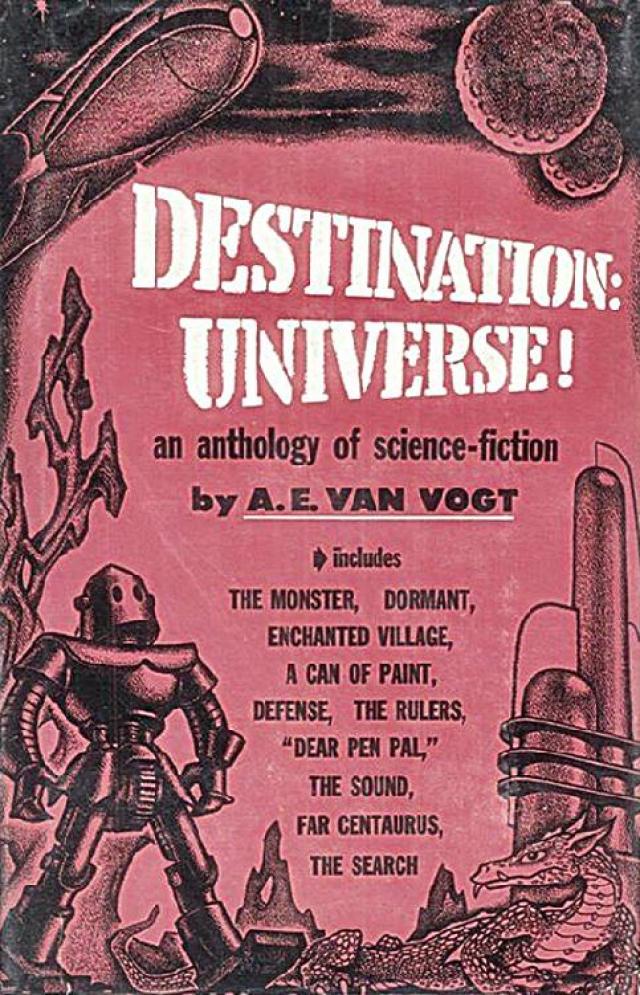
Destination: Universe!
A. E. Van Vogt
INTRODUCTION
To my readers:
Science fiction is a field of writing where, month after month, every printed word implies to hundreds of thousands of people: ‘There is change. Look, today’s fantastic story is tomorrow’s fact.’
I admit we authors missed some of the main streams of scientific development. Science fiction writers were woefully unimaginative in predicting the work that was being done even as they wrote their stories. But, after all, a few score of writers turn out about eighty per cent, of the science fiction that is printed. They are outnumbered thousands to one by scientists doing research.
I don’t think the misses or near-misses are important. The hits outnumber them by a great deal. But what really matters is the attitude that is being fostered. Science fiction has helped, and will–I am sure–continue to help form the forward-looking attitude. It has fostered and will–again, I feel sure of this–continue to foster the great notion that the universe is an area of endless potentiality. Science fiction, as I personally try to write it, glorifies man and his future.
Man over most of the world is in chains. Every where, powerful retrogressive forces are at work to keep him enslaved, or are fashioning new, more binding chains. All the powers of misused positivism are arrayed against him. But he will free himself if scientific knowledge can ever penetrate into his prison.
It may seem arrogant for me to claim that science fiction is the medium best able to infiltrate the individual’s instinctive defenses against the knowledge that can save him. But I do claim it. Almost without knowing it, the reader will find himself accepting new ideas. He will become familiar with thou sands of scientific facts which have slipped past the censor he or she carefully maintains against anything as modern and essential is science. He can be rescued because the sugar-coated pill is still the most effective method of breaking down the resistances inflexible personality.
A. E. van Vogt.
THE MONSTER
THE great ship poised a quarter of a mile above one of the cities. Below was a cosmic desolation. As he floated down in his energy bubble, Enash saw that the buildings were crumbling with age.
“No sign of war damage!” The bodiless voice touched his ears momentarily. Enash tuned it out.
On the ground he collapsed his bubble. He found himself in a walled enclosure overgrown with weeds. Several skeletons lay in the tall grass beside the rakish building. They were of long, two-legged, two-armed beings with the skulls in each case mounted at the end of a thin spine. The skeletons, all of adults, seemed in excellent preservation, but when he bent down and touched one, a whole section of it crumbled into a fine powder. As he straightened, he saw that Yoal was floating down nearby. Enash waited until the historian had stepped out of his bubble, then he said:
“Do you think we ought to use our method of reviving the long dead? “
Yoal was thoughtful. “I have been asking questions of the various people who have landed, and there is something wrong here. This planet has no surviving life, not even insect life. We’ll have to find out what happened before we risk any colonization.”
Enash said nothing. A soft wind was blowing. It rustled through a clump of trees nearby. He motioned toward the trees. Yoal nodded and said, “Yes, the plant life has not been harmed, but plants after all are not affected in the same way as the active life forms. “
There was an interruption. A voice spoke from Yoal’s receiver: “A museum has been found at approximately the center of the city. A red light has been fixed on the roof.”
Enash said, “I’ll go with you, Yoal. There might be skeletons of animals and of the intelligent being in various stages of his evolution. You didn’t answer my question. Are you going to revive these beings?”
Yoal said slowly: “I intend to discuss the matter with the council, but I think there is no doubt. We must know the cause of this disaster.” He waved one sucker vaguely to take in half the compass. He added as an afterthought, “We shall proceed cautiously, of course, beginning with an obviously early development. The absence of the skeletons of children indicates that the race had developed personal immortality.”
The council came to look at the exhibits. It was, Enash knew, a formal preliminary only. The decision was made. There would be revivals. It was more than that. They were curious. Space was vast, the journeys through it long and lonely, landing always a stimulating experience, with its prospect of new life forms to be seen and studied.
The museum looked ordinary. High-domed ceilings, vast rooms, plastic models of strange beasts, many artifacts – too many to see and comprehend in so short a time. The life span of a race was imprisoned here in a progressive array of relics. Enash looked with the others, and was glad when they came to the line of skeletons and preserved bodies. He seated himself behind the energy screen, and watched the biological experts take a preserved body out of a stone sarcophagus. It was wrapped in windings of cloth, many of them. The experts did not bother to unravel the rotted material. Their forceps reached through, pinched a piece of skull – that was the accepted procedure. Any part of the skeleton could be used, but the most perfect revivals, the most complete reconstructions resulted when a certain section of the skull was used.
Hamar, the chief biologist, explained the choice of body. “The chemicals used to preserve this mummy show a sketchy knowledge of chemistry. The carvings on the sarcophagus indicate a crude and unmechanical culture. In such a civilization there would not be much development of the potentialities of the nervous system. Our speech experts have been analyzing the recorded voice mechanism which is a part of each exhibit, and though many languages are involved – evidence that the ancient language spoken at the time the body was alive has been reproduced – they found no difficulty in translating the meanings. They have now adapted our universal speech machine, so that anyone who wishes to, need only speak into his communicator, and so will have his words translated into the language of the revived person. The reverse, naturally, is also true. Ah, I see we are ready for the first body.”
Enash watched intently with the others, as the lid was clamped down on the plastic reconstructor, and the growth processes were started. He could feel himself becoming tense. For there was nothing haphazard about what was happening. In a few minutes a full-grown ancient inhabitant of this planet would sit up and stare at them. The science involved was simple and always fully effective.
. . . . Out of the shadows of smallness, life grows. The level of beginning and ending, of life and – not life; in that dim region matter oscillates easily between old and new habits. The habit of organic, or the habit of inorganic.
Electrons do not have life and un-life values. Atoms know nothing of inanimateness. But when atoms form into molecules, there is a step in the process, one tiny step, that is of life – if life begins at all. One step, and then darkness. Or aliveness.
A stone or a living cell. A grain of gold or a blade of grass, the sands of the sea or the equally numerous animalcules inhabiting the endless fishy waters – the difference is there in the twilight zone of matter. Each living cell has in it the whole form. The crab grows a new leg when the old one is torn from its flesh. Both ends of the planarian worm elongate, and soon there are two worms, two identities, two digestive systems, each as greedy as the original, each a whole, unwounded, unharmed by its experience. Each cell can be the whole. Each cell remembers in a detail so intricate that no totality of words could ever describe the completeness achieved.
But – paradox – memory is not organic. An ordinary wax record remembers sounds. A wire recorder easily gives up a duplicate of the voice that spoke into it years before. Memory is a physiological impression, a mark on matter, a change in the shape of a molecule, so that when a reaction is desired the shape emits the same rhythm of response.
Out of the mummy’s skull had come the multi-quadrillion memory shapes from which a response was now being evoked. As ever, the memory held true.
A man blinked, and opened his eyes.
“It is true, then,” he said aloud, and the words were translated into the Ganae tongue as he spoke them. “Death is merely an opening into another life – but where are my attendants?” At the end, his voice took on a complaining tone.
He sat up, and climbed out of the case, which had automatically opened as he came to life. He saw his captors. He froze, but only for a moment. He had a pride and a very special arrogant courage, which served him now.
Reluctantly, he sank to his knees, and made obeisance, but doubt must have been strong in him. “Am I in the presence of the gods of Egyptus?” He climbed to his feet. “What nonsense is this? I do not bow to nameless demons.”
Captain Gorsid said, “Kill him!”
The two-legged monster dissolved, writhing, in the beam of a ray gun. The second revived man stood up, pale, and trembled with fear. “My God, I swear I won’t touch the stuff again. Talk about pink elephants – “
Yoal was curious. “To what stuff do you refer, revived one?”
“The old hooch, the poison in the hip pocket flask, the juice they gave me at that speak . . . my lordie!”
Captain Gorsid looked questioningly at Yoal, “Need we linger?”
Yoal hesitated. “I am curious.” He addressed the man. “If I were to tell you that we were visitors from another star, what would be your reaction?”
The man stared at him. He was obviously puzzled, but the fear was stronger. “Now, look,” he said, “I was driving along, minding my own business. I admit I’d had a shot or two too many, but it’s the liquor they serve these days. I swear I didn’t see the other car– and if this is some new idea of punishing people who drink and drive, well, you’ve won. I won’t touch another drop as long as I live, so help me.”
Yoal said. “He drives a ‘car’ and thinks nothing of it. Yet we saw no cars. They didn’t even bother to preserve them in the museums.”
Enash noticed that everyone waited for everyone else to comment. He stirred as he realized the circle of silence would be complete unless he spoke. He said:
“Ask him to describe the car. How does it work?”
“Now, you’re talking.” said the man. “Bring on your line of chalk, and I’ll walk it. And ask any questions you please. I may be so tight that I can’t see straight, but I can always drive. How does it work? You just put her in gear, and step on the gas.”
“Gas,” said engineering officer Veed. “The internal combustion engine. That places him.”
Captain Gorsid motioned to the guard with the ray gun.
The third man sat up, and looked at them thoughtfully. “From the stars?” he said finally. “Have you a system, or was it blind chance?”
The Ganae councilors in that domed room stirred uneasily in their curved chairs. Enash caught Yoal’s eye on him. The shock in the historian’s eyes alarmed the meteorologist. He thought: “The two-legged one’s adjustment to a new situation, his grasp of realities, was unnormally rapid. No Ganae could have equaled the swiftness of the reaction.”
Hamar, the chief biologist, said, “Speed of thought is not necessarily a sign of superiority. The slow, careful thinker has his place in the hierarchy of intellect.”
But, Enash found himself thinking, it was not the speed; it was the accuracy of the response. He tried to imagine himself being revived from the dead, and understanding instantly the meaning of the presence of aliens from the stars. He couldn’t have done it.
He forgot his thought, for the man was out of the case. As Enash watched with the others, he walked briskly over to the window and looked out. One glance, and then he turned back.
“Is it all like this?” he asked.
Once again, the speed of his understanding caused a sensation. It was Yoal who finally replied.
“Yes. Desolation. Death. Ruin. Have you any idea as to what happened?”
The man came back and stood in front of the energy screen that guarded the Ganae. “May I look over the museum? I have to estimate what age I am in. We had certain possibilities of destruction when I was last alive, but which one was realized depends on the time elapsed.”
The councilors looked at Captain Gorsid, who hesitated; then: “Watch him,” he said to the guard with the ray gun. He faced the man. “We understand your aspirations fully. You would like to seize control of this situation and insure your own safety. Let me reassure you. Make no false moves, and all will be well.”
Whether or not the man believed the lie, he gave no sign. Nor did he show by a glance or a movement that he had seen the scarred floor where the ray gun had burned his two predecessors into nothingness. He walked curiously to the nearest doorway, studied the other guard who waited there for him, and then, gingerly, stepped through. The first guard followed him, then came the mobile energy screen, and finally, trailing one another, the councilors. Enash was the third to pass through the doorway. The room contained skeletons and plastic models of animals. The room beyond that was what, for want of a better term, Enash called a culture room. It contained the artifacts from a single period of civilization. It looked very advanced. He had examined some of the machines when they first passed through it, and had thought: Atomic energy. He was not alone in his recognition. From behind him, Captain Gorsid said:
“You are forbidden to touch anything. A false move will be the signal for the guards to fire.”
The man stood at ease in the center of the room. In spite of a curious anxiety, Enash had to admire his calmness. He must have known what his fate would be, but he stood there thoughtfully, and said finally, deliberately:
“I do not need to go any farther. Perhaps you will be able to judge better than I of the time that has elapsed since I was born and these machines were built. I see over there an instrument which, according to the sign above it, counts atoms when they explode. As soon as the proper number have exploded it shuts off the power automatically, and for just the right length of time to prevent a chain explosion. In my time we had a thousand crude devices for limiting the size of an atomic reaction, but it required two thousand years to develop those devices from the early beginnings of atomic energy. Can you make a comparison?”
The councilors glanced at Veed. The engineering officer hesitated. At last, reluctantly: “Nine thousand years ago we had a thousand methods of limiting atomic explosions.” He paused, then even more slowly, “I have never heard of an instrument that counts out atoms for such a purpose.”
“And yet,” murmured Shuri, the astronomer, breathlessly, “the race was destroyed.”
There was silence – that ended as Gorsid said to the nearest guard, “Kill the monster!”
But it was the guard who went down, bursting into flame. Not just one guard, but the guards! Simultaneously down, burning with a blue flame. The flame licked at the screen, recoiled, and licked more furiously, recoiled and burned brighter. Through a haze of fire, Enash saw that the man had retreated to the far door, and that the machine that counted atoms was glowing with a blue intensity.
Captain Gorsid shouted into his communicator, “Guard all exits with ray guns. Spaceships stand by to kill alien with heavy guns.”
Somebody said, “Mental control. Some kind of mental control. What have we run into?”
They were retreating. The blue flame was at the ceiling, struggling to break through the screen. Enash had a last glimpse of the machine. It must still be counting atoms, for it was a hellish blue. Enash raced with the others to the room where the man had been resurrected. There, another energy screen crashed to their rescue. Safe now, they retreated into their separate bubbles and whisked through outer doors and up to the ship. As the great ship soared, an atomic bomb hurtled down from it. The mushroom of flame blotted out the museum and the city below.
“But we still don’t know why the race died,” Yoal whispered into Enash’s ear, after the thunder had died from the heavens behind them.
The pale yellow sun crept over the horizon on the third morning after the bomb was dropped – the eighth day since the landing. Enash floated with the others down on a new city. He had come to argue against any further revival.
“As a meteorologist,” he said, “I pronounce this planet safe for Ganae colonization. I cannot see the need for taking any risks. This race has discovered the secrets of its nervous system, and we cannot afford – “
He was interrupted. Hamar, the biologist, said dryly, “If they knew so much why didn’t they migrate to other star systems and save themselves?”
“I will concede,” said Enash, “that very possibly they had not discovered our system of locating stars with planetary families.” He looked earnestly around the circle of his friends. “We have agreed that was a unique accidental discovery. We were lucky, not clever.”
He saw by the expressions on their faces that they were mentally refuting his arguments. He felt a helpless sense of imminent catastrophe. For he could see that picture of a great race facing death. It must have come swiftly, but not so swiftly that they didn’t know about it. There were too many skeletons in the open, lying in the gardens of magnificent homes, as if each man and his wife had come out to wait for the doom of his kind.
He tried to picture it for the council, that last day long, long ago, when a race had calmly met its ending. But his visualization failed somehow, for the others shifted impatiently in the seats that had been set up behind the series of energy screens, and Captain Gorsid said:
“Exactly what aroused this intense emotional reaction in you, Enash?”
The question gave Enash pause. He hadn’t thought of it as emotional. He hadn’t realized the nature of his obsession, so subtly had it stolen upon him. Abruptly now, he realized.