The seesaw, p.1
The Seesaw, page 1


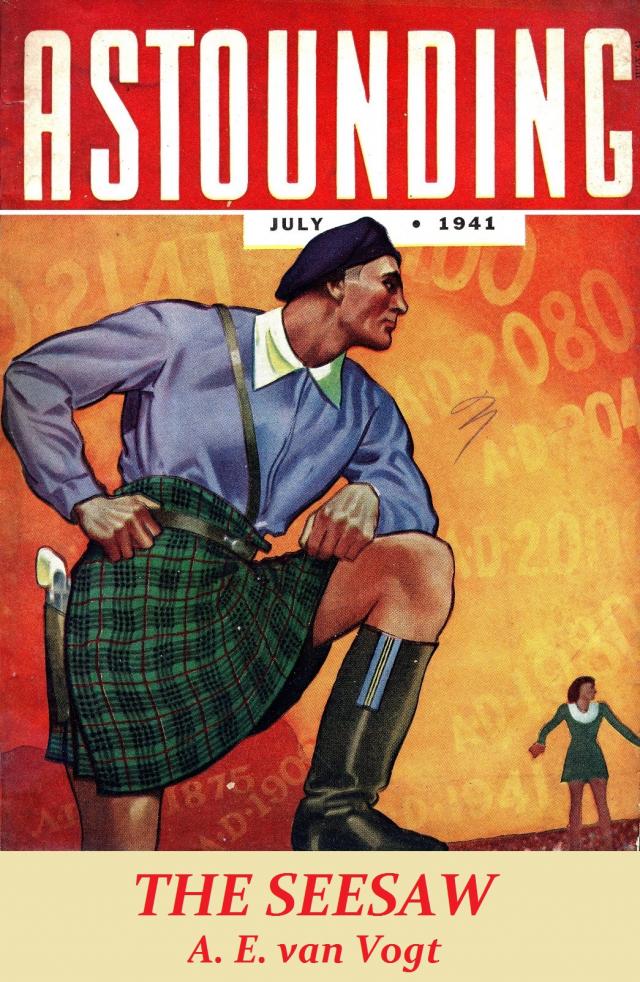
THE SEESAW
By A. E. van Vogt
Action and reaction must be equal—even in Time. And
one man. if he’s hurled far enough, can save a civilization—
From : Astounding Science-Fiction, July 1941
Illustrated by Charles Schneeman
Synopsis: An explosion can be too immense to leave a scar or cater too
Violent foe any ordinary sort of mark – and let leave a record
MAGICIAN BELIEVED TO HAVE
HYPNOTIZED CROWD!
June 11, 1041—Police and newspapermen believe that Middle City will shortly be advertised as the next stopping place oi a. master magician, and they are prepared to extend him a hearty welcome if he will condescend to explain exactly how he fooled hundreds of people into believing they saw a strange building, apparently a kind of gunshop.
The building appeared to appear on the space formerly, and still, occupied by Aunt Sally’s Lunch and Patterson Tailors. Only employees were inside the two aforementioned shops, and none noticed any untoward event. A large, brightly shining sign featured the front of the gunshop, which had been so miraculously conjured out of nothingness; and the sign constituted the first evidence that the entire scene was nothing but a masterly illusion. For from whichever angle one gazed at it, one seemed to be staring straight at the words, which read:
FINE WEAPONS
THE RIGHT TO BUY WEAPONS IS THE
RIGHT TO BE FREE
The window display was made up of an assortment of rather curiously shaped guns, rifles as well as small arms; and a glowing sign in the window stated:
THE FINEST ENERGY WEAPONS IN THE
KNOWN UNIVERSE
Inspector Clayton of the Investigation Branch, attempted to enter the shop, but the door seemed to be locked; a few moments later, C. J. (Chris) McAllister, reporter of the Gazette-Bulletin, tried the door, found that it opened, and entered.
Inspector Clayton attempted to follow him, but discovered that the door was again locked. McAllister emerged alter some time, and was seen to be in a dazed condition. All memory of the action had apparently been hypnotized out of him, for he could make no answer to the questions of the police and spectators.
Simultaneous with his reappearance, the strange building vanished as abruptly as it had appeared.
Police state they are baffled a* to how the master magician created so detailed an illusion for so long a period before so large a crowd. They are prepared to recommend his show, when it comes, without reservation.
Author’s Note: The foregoing account
did not mention that the police, dissatisfied with the affair, attempted to contact McAllister for a further interview, but were unable to locate him. Weeks passed; and he was still not to be found.
Herewith follows the story of what happened to McAllister from the instant that he found the door of the gunshop unlocked:
There was a curious quality about the gunshop door. It was not so much that it opened at his first touch, as that, when he pulled, it came away like a weightless thing. For a bare instant, McAllister had the impression that the knob had freed itself into his palm.
He stood quite still, startled. The thought that came finally had to do with Inspector Clayton, who a minute earlier, had found the door locked.
The thought was like a signal. From behind him boomed the voice of the inspector:
“Ah, McAllister, I’ll handle this now.”
It was dark inside the shop beyond and, somehow, his eyes wouldn’t accustom themselves to the intense gloom—
Pure reporter’s instinct made him the door, too dark to see anything, step forward toward the blackness that pressed from beyond the rectangle of door. Out of the corner of one eye, he saw Inspector Clayton’s hand reaching for the door handle that his own fingers had let go a moment before; and quite simply he knew that if the police officer could prevent it, no reporter would get inside that building.
His head was still turned, his gaze more on the police inspector than on the darkness in front; and it was as he began another step forward that the remarkable thing happened.
The door handle would not allow Inspector Clayton to touch it. It twisted in some queer way, in some energy way, for it was still there, a strange, blurred shape. The door itself, without visible movement, so swift it was, was suddenly touching McAllister’s heel.
Light almost weightless was that touch; and then, before he could think or react to what had happened, the momentum of his forward movement had carried him inside.
As he breasted the darkness, there was a sudden, enormous tensing along his nerves. Then the door shut light, the brief, incredible agony faded. Ahead was a brightly lit shop; behind—were unbelievable things!
For McAllister, the moment that followed was one of blank impression. He stood, body twisted awkwardly, only vaguely conscious of the shop’s interior, but tremendously aware in the brief moment before he was interrupted, of what lay beyond the transparent panels of the door through which he had just come.
There was no unyielding blackness anywhere, no Inspector Clayton, no muttering crowd of gaping spectators, no dingy row of shops across the way.
It wasn’t even remotely the same street. There was no street.
Instead, a peaceful park spread there. Beyond it, brilliant under a noon sun, glowed a city of minarets and stately towers—
From behind him, a husky, musical, woman’s voice said:
“You will be wanting a gun?” McAllister turned. It wasn’t that he was ready to stop feasting his eyes on the vision of the city. The movement was automatic reaction to a sound. And because the whole affair was still like a dream, the city scene faded almost instantly; his mind focused on the young woman who was advancing slowly from the rear section of the store.
Briefly, his thought wouldn’t come clear. A conviction that he ought to say something was tangled with first impressions of the girl’s appearance. She had a slender, well-shaped body; her face was creased into a pleasant smile. She had brown eyes, neat, wavy, brown hair. Her simple frock and sandals seemed so normal at first glance that he gave them no further thought. He was able to say:
“What I can’t understand is why the police officer, who tried to follow me, couldn’t get in? And where is he now?”
To his surprise, the girl’s smile became faintly apologetic: “We know that people consider it silly of us to keep harping on that ancient feud.” Her voice grew firmer: “We even know how clever the propaganda is that stresses the silliness of our stand. Meanwhile, we never allow any of her men in here. We continue to take our principles very seriously.”
She paused as if she expected dawning comprehension from him, but McAllister saw from the slow puzzlement creeping into her eyes that his (ace must look as limp as were the thoughts behind it.
Her men! The girl had spoken the words as if she was referring to some personage, and in direct reply to his use of the word, police officer. That meant her men, whoever she was, were policemen; and they weren’t allowed in this gunshop. So the door was hostile, and wouldn’t admit them.
A strange emptiness struck into McAllister’s mind, matching the hollowness that was beginning to afflict the pit of his stomach, a sense of unplumbed depths, the first, staggering conviction that all was not as it should be. The girl was speaking in a sharper tone:
“You mean you know nothing of all this, that for generations the gun-maker’s guild has existed in this age of devastating energies as the common man’s only protection against enslavement. The right to buy guns—”
She stopped again, her narrowed eyes searching him; then: “Come to think of it, there’s something very illogical about you. Your outlandish clothes—you’re not from the northern farm plains, are you?”
He shook his head dumbly, more annoyed with his reactions every passing second. But he couldn’t help it. A tightness was growing in him, becoming more unbearable instant by instant, as if somewhere a vital mainspring was being wound to the breaking point.
The young woman went on more swiftly: “And come to think of it, it is astounding that a policeman should have tried the’ door, and there was no alarm.”
Her hand moved; metal flashed in it, metal as bright as steel in blinding sunlight. There was not the faintest hint of the apologetic in her voice as she said:
“You will stay where you are, sir, till I have called my father. In our business, with our responsibility, we never take chances. Something is very wrong here.”
Curiously, it was at that point that McAllister’s mind began to function clearly; the thought that came paralleled hers: How had this gunshop appeared on a 1941 street? How had he come here into this fantastic world?
Something was very wrong indeed!
It was the gun that held his attention. A tiny thing it was, shaped like a pistol, but with three cubes projecting in a little half circle from the top of the slightly bulbous firing chamber.
And as he stared, his mind began to quiver on its base; for that wicked little instrument, glittering there in her browned fingers, was as real as she herself.
“Good Heaven!” he whispered. “What the devil kind of gun is it. Lower that thing and let’s try to find out what all this is about.”
She seemed not to be listening; and abruptly he noticed that her gaze was flicking to a point on the. wall somewhat to his left. He followed her look—in time to see seven miniature white lights flash on.
Curious lights! Briefly, he was fascinated by the play of light and shade, the waxing and waning from one tiny globe to t he next, a rippling movement of infinitesimal increments and decrements, an incredibly delicate effect of instantaneous reaction to some supersensitive barometer.
The lights steadied; his gaze reverted to the girl. To his surprise, she was putting away her gun. She must have noticed his expression.
“It’s all right,” she said coolly. “The automatics are on you now. If we’re wrong about you, we’ll be glad to apologize. Meanwhile, if you’re still interested in buying a gun, I’ll be happy to demonstrate.”
So the automatics were on him, McAllister thought ironically. He felt no relief at the information. Whatever the automatics were, they wouldn’t be working in his favor; and the fact that the young woman could put away her gun in spite of her suspicions, spoke volumes for the efficiency of the new watchdogs.
There was absolutely nothing he could do but play out this increasingly grim and inexplicable farce. Either he was mad, or else he was no longer on Earth, at least not the Earth of 1941—which was utter nonsense.
He’d have to get out of this place, erf course. Meanwhile, the girl was assuming that a man who came into a gunshop would, under ordinary circumstances, want to buy a gun.
It struck him, suddenly, that, of all the things he could think of, what he most wanted to see was one of those strange guns. There were implications of incredible things in the very shape of the instruments. Aloud he said:
“Yes, by all means show me.”
Another thought occurred to him. He added: “I have no doubt your father is somewhere in the background making some sort of study of me.”
The young woman made no move to lead him anywhere. Her eyes were dark pools of puzzlement, staring at him.
“You may not realize it,” she said finally, slowly, “but you have already upset our entire establishment. The lights of the automatics should have gone on the moment father pressed the buttons, as be did when I called to him. They didn’t! That’s unnatural, that’s alien.
“And yet”—her frown deepened— “if you were one of them, how did you get through that door? Is it possible that her scientists have discovered human beings who do not affect the sensitive energies? And that you are but one of many such, sent as an experiment to determine whether or not entrance could be gained.
“Yet that doesn’t make logic, either.
“If they had even a hope of success, they would not risk so lightly the chance of an overwhelming surprise. Instead you would be the entering wedge of an attack on a vast scale. She is ruthless, she’s brilliant; and she craves all power during her lifetime over poor saps like you who have no more sense than to worship her amazing beauty and the splendor of the Imperial Court.”
The young woman paused, with the faintest of smiles. “There I go again, off on a political speech. But you can see that there are at least a few reasons why we should be careful about you.”
There was a chair over in one corner; McAllister started for it. His mind was calmer, cooler.
“Look,” he began, “I don’t know what you’re talking about. I don’t even know how I came to be in this shop. I agree with you that the whole thing requires explanation, but I mean that differently than you do. In fact—”
His voice trailed. He had been half lowered over the chair, but instead of sinking into it, he came erect like an old, old man. His eyes fixed on lettering that shone above a glass case of guns behind her. He said hoarsely:
“Is that—a calendar?”
She followed his gaze, puzzled: “Yes, its June 3rd. What’s wrong?”
“I don’t mean that. I mean—” He caught himself with a horrible effort. “I mean those figures above that. I mean—what year is this?”
The girl looked surprised. She started to say something, then stopped and backed away. Finally: “Don’t look like that! There’s nothing wrong. This is eighty-four of the four thousand seven hundredth year of the Imperial House of the Isher. Its quite all right.”
There was no real feeling in him. Quite deliberately, he sat down, and the conscious wonder came: exactly how should he feel?
Not even surprise came to his aid. Quite simply, the whole pattern of events began to make a sort of distorted logic.
The building front superimposed on those two 1941 shops; the way the door had acted: the great exterior sign with its odd linking of freedom with the right to buy weapons; the actual display of weapons in the window, the finest energy weapons in the known universe!
He grew aware that minutes had passed while he sat there in slow, dumb thought. And that the girl was talking earnestly with a tall, gray-haired man who was standing on the open threshold of the door through which she had originally come.
There was an odd, straining tenseness in the way they were talking. Their low-spoken words made a curious blur of sound in his ears, strangely unsettling in effect—McAllister could not quite analyze the meaning of it until the girl turned; and, in a voice dark with urgency, said: -
“Mr. McAllister, my father wants to know what year you’re from!”
Briefly, the sense of the sentence was overshadowed by that stark urgency; then:
“Huh!” said McAllister. “Do you mean that you’re responsible for— And how the devil did you know my name?”
The older man shook his head. “No, we’re not responsible.” His voice quickened, but lost none of its gravity. “There’s no time to explain. What has happened is what we gunmakers have feared for generations: that sooner or later would come one who lusted for unlimited power; and who, to attain tyranny, must necessarily seek first’ to destroy us.
“Your presence here is a manifestation of the energy force that she has turned against us—something so new that we did not even suspect it was being used against us. But now —I have no time to waste. Get all the information you can, Lystra, and warn him of his own personal danger.”
The man turned. The door closed noiselessly behind his tall figure.
McAllister asked: “What did he mean—personal danger?”
He saw the girl’s brown eyes were uneasy as they rested on him.
“It’s hard to explain,” she began in an uncomfortable voice. “First of all, come to the window, and I’ll try to make everything clear. It’s all very confusing to you, I suppose.”
McAllister drew a deep breath. “Now, we’re getting somewhere.”
His alarm was gone. The older man seemed to know what it was all about; that meant there should be no difficulty getting home again. As for all this danger to the gun-makers guild, that was their worry, not his. Meanwhile—
He stepped forward, closer to the girl. To his amazement, she cringed away as if he had struck at her.
As he stared blankly, she turned, and laughed a humorless, uncertain laugh; finally she breathed:
‘‘Don’t think I’m being silly, don’t be offended—but for your life’s sake, don’t touch any human body you might come into contact with.” McAllister was conscious of a chill. It struck him with a sudden, sharp dismay that the expression of uneasiness in the girl’s face was—fear!
His own fear fled before a wave of impatience. He controlled himself with an effort.
“Now, look,” he began. “I want to get things clear. We can talk here without danger, providing I don’t touch you, or come near you. Is that straight?”
She nodded. “The floor, the walls, every piece of furniture, in fact the entire shop is made of perfect nonconducting material.”
McAllister had a sudden sense of being balanced on a tight rope over a bottomless abyss. The way this girl could imply danger without making clear what the danger was, almost petrified him.
He forced calm into his mind. “Let’s start,” he said, “at the beginning. How did you and your father know my name, and that I was not of”—he paused before the odd phrase, then went on—“of this time?”
“Father X-rayed you,” the girl said, her voice as stiff as her body. “He X-rayed the contents of your pockets. That was how he first found out what was the matter. You see, the X-rays themselves became carriers of the energy with which you’re charged. That’s what was the matter; that’s why the automatics wouldn’t focus on you, and—”