The great engine ss, p.1
The Great Engine (ss), page 1


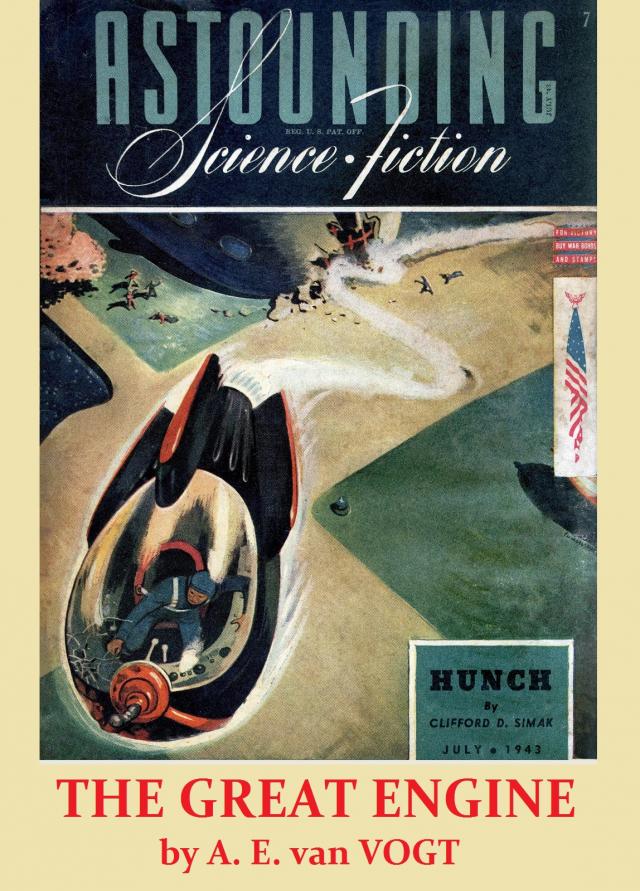
The Great Engine
by A. E. van Vogt
There are times when—even in peacetime—science serves better in silence and by stealth.
The man who found the mighty engine, dropped tram a spaceship, had a chance to do that.
Illustrated by Fax
There are times – and ways – in which scientist can best serve progress
By keeping that progress unknown to the world. Even though the progress
involves a thing as spectacular as The Great Engine
From : Astounding Science-Fiction, July 1943 edition - Novelette
Illustrated by E. Fax
The blue-gray engine lay half buried in a green hillside.
It lay there in that summer of 1948, a soulless thing of metal and of forces more potent than life itself. Rain washed its senseless form. A July, then an August sun blazed down upon it. In the night the stars looked down wanly, caring nothing for its destiny.
The ship it drove had been nosing down into Earth’s atmosphere when the meteorite plowed through the metal that held it in place. Instantly, in the irresistibleness of its terrible strength, the engine tore to shreds what remained of the framework and plunged through the gaping meteorite hole, down, down.
For all the weeks since then it had Iain in the hillside seemingly lifeless but. actually, in its great fashion, utterly alive.
There was dirt in its force field, so tightly packed that it would have taken eagle eyes to see how swiftly it was spinning. Not even the boys who sat one day on a flange of the engine noticed the convulsions of the dirt.
If one of them had poked a grimy hand into the inferno of energy that was the force field, muscles, bones, blood would have .spurted like gas exploding.
But the boys went away; and the engine lay there until the day the searchers passed along the bottom of the hill. Discovery was as close as that. There were two of them, two alert, trained observers who anxiously scanned the hillside. But a cloud was veiling the brightness of the sun, and they passed on unseeing.
It was more than a week later, late in the afternoon, when a horse climbing the hill straddled the protruding bulge of the engine. The horse’s rider proceeded to dismount in an astounding fashion.
With his one hand he grasped the saddlehorn and lifted himself clear of the saddle. Casually, easily, he brought his left leg over, held himself poised in midair, and then dropped to the ground.
The display of strength seemed all the more effortless because the action was entirely automatic; his attention was concentrated the whole while on the thing in the ground.
His lean face twisted as he examined the machine. He glanced around, eyes suddenly narrowed; then he smiled sardonically as he realized the thought in his mind.
Finally, he shrugged. Fat chance of anybody seeing him out here. The town of Crescentville w as more than a mile away; and there was no sign of life around the big white house which stood among trees a third of a mile to the northwest.
He was alone with his horse and the machine; and, after a moment, his voice echoed with cool irony on the twilight air:
“Well, Dandy, here’s a job for us. This scrap should buy you quite a bit of feed. We’ll haul it to the junk dealer after dark. That way she won’t find out and we’ll save some remnant of our pride. She—”
He stopped. Involuntarily, he turned to stare at the gardenlike estate whose width stretched for nearly a mile between himself and the town. A white fence, misty and halo-ish in the twilight, made a vast circuit around a green, verdant land of trees and pasture. The fence kept disappearing down gullies and into brush. It vanished finally in the north beyond the stately white house.
The man shook himself impatiently. “What a fool I’ve been, hanging abound Crescentville waiting for her to—” He cut the words with a mental effort and turned to stare down at the engine. “Have to get some idea of its weight— wonder what it is.”
He climbed to the top of the hill and came down again carrying a piece of deadwood about four feet long and three inches in diameter. He began to pry the engine loose from the ground.
It was awkward work with only a left arm; and so, when he noticed the dirt-plugged hole in the center, he jabbed the wood into it to get better leverage.
His shout of surprise and pain echoed hoarsely on the evening air.
For the wood jerked. Like a shot twisted by the rifled barrel of a gun, like a churning knife, it wrenched in his hand, tearing like a shredder, burning like fire.
He was lifted up, up—and flung twenty feet down the hill. Groaning, clutching his tattered hand to his body, he stumbled to his feet.
The sound died on his lips, then, as his gaze fastened on the throbbing, whirling thing that had been a dead branch of tree.
He stared. Then he climbed, trembling, onto the black horse. Nursing his bloodied hand, blinking from sheer agony, he raced the animal down the hill and toward the highway that led to the town.
A stone boat and harness for Dandy rented from a farmer—rope and tackle —a hand stiff with bandages, still numb with pain—a trek through darkness with a thrumming thing on the stone boat— for three hours Pendrake felt himself a creature in a nightmare, running madly in all directions.
But here was the engine now, on the floor of his stable, safe from discovery except for the sound that was pouring forth from the wood in its force field.
It was funny how his mind had worked. The determination to transport the engine secretly to his own cottage had been like choosing life instead of death, like swiftly picking up a hun-dred-dollar bill lying on. a deserted street: so automatic as to be beyond the need of logic.
It still seemed as natural as living.
The yellow glow from the lantern filled the interior of what had once been a large private garage and workshop. In one comer Dandy stood, black hide aglint, eyes glistening, as he turned his head to stare at the thing that shared his quarters.
The not unpleasant smell of horse was thick now that the door was closed.
The engine lay on its side near the door; and the main trouble was that the wood in it wasn’t straight. It slogged away against the air like some caricature of a propeller, beating a sound out of the atmosphere by the sheer violence and velocity of its rotation.
About eight thousand revolutions a minute, Pendrake estimated and stood stunned, striving to grasp the kind of machine that could snatch a piece of wood, and—
His mind sagged before the mystery; and he gave it up. But a black frown creased his face as he stared down at the speed-blurred wood.
He couldn’t just grab it. And, while undoubtedly there were a number of tools in the world that could grip a whirling bar and pull on it, they were not available here in this lantern-lighted stable.
He thought: “There must be a control. something to switch off the power.”
But the bluish-gray, doughnut-shaped outer shell was glass smooth. Even the flanges that projected from four ends, and in which were the holes for bed bolts, seemed to grow out of the shell, as if they had been molded from the same block of metal, as if there had been a flowing, original design that spurned anything less than oneness.
Baffled, Pendrake walked around the machine. He had the empty conviction that the problem was beyond the solution of a man who had as his working equipment one badly maimed and bandaged hand.
He noticed something. The machine lay solidly, heavily, on the floor. It neither jogged nor jumped. It made not the slightest effort to begin a sedate, reactionary creep in opposition to the insanely whirling thing that bristled from its middle.
The engine was ignoring the law that action and reaction are equal and opposite.
With abrupt realization of the possibilities, Pendrake bent down and heaved at the engine. Instantly, knives of pain hacked at his hand. Tears shocked into his eyes. But when he finally let go the engine was standing on one of its four sets of flanges; and the crooked wood was spinning, no longer vertically, but roughly horizontal to the floor.
The pulse of agony in Pendrake’s hand slowed. He wiped the tears from his eyes and proceeded to the next step in the plan that had occurred to him.
Nails! He drove them into the bed bolt holes, and bent them over the metal. That was just to make sure the narrow-based engine wouldn’t topple over in the event that he bumped too hard against the outer shell.
An apple box came next. Laid lengthwise on its side, it reached up to within half an inch of the exact center of the large hole, from the opposite side of which the wood projected. Two books held steady a piece of one-inch piping about a foot long. It was painful holding the small sledge hammer in that lame hand of his, but he struck true.
The piece of piping recoiled from the hammer, banged into the wood where it was held inside the hole of the engine, knocked it out.
There was a crash that shook the garage. After a dazed moment. Pendrake grew aware of a long, splintered slash in the ceiling, through which the four-foot piece of deadwood had bounced after striking the floor.
Slowly, his reverberating mind gravitated into a rhythm with the silence that was settling. Pendrake drew a deep breath. There were still things to discover, a whole, new machine world to explore. But one thing was clear:
He had conquered the engine.
At midnight he was still awake. He kept getting up, dropping the magazine he was reading, and going into the dark kitchen of the cottage to peer out at the darker garage.
But the night was quiet. No marauders disturbed the peace of the town. Occasionally, a car motor sounded far away.
The dozenth time he found himself pressing his face against the cool pane of the kitchen window, Pendrake cursed aloud and went back into the living room muttering invective.
What was lie trying to do! He couldn’t hope to keep that engine. It must be a new invention, a radical post-war development—lying on that hillside because of an accident that a silly ass who never read papers, or listened to the radio, wouldn’t know anything about.
Somewhere in the house, he remembered, was a New York Times he’d bought not so long ago. He found the paper on his magazine rack with all the other old and unread papers and magazines he’d bought from time to time.
The date at the top was June 7, 1947; and this was August 16th. Not too great a difference. It—
But this wasn’t 1917. This was 1948! With a cry Pendrake leaped to his feet, then slowly sank back into his chair. It was an ironic picture that came then, a kaleidoscope of the existence of a man so untouched by the friction of time that fourteen months had glided by like so many days.
Lazy, miserable hound, Pendrake thought in a blaze of fury, using his lost arm and an unforgiving woman as an excuse for lying down on life. That was over. All of it. He’d start again— He grew aware of the paper in his hand; and all the irony went out of him as in a gathering excitement he began to glance at the headlines:
PRESIDENT CALLS ON NATION
FOR NEW INDUSTRIAL EFFORT
Two Hundred Billion Dollar National Income
Only Beginning, He Says.
GERMANY RECOVERING
SWIFTLY UNDER
UNITED NATIONS PLAN
Shaposhenko Punishment for Leaders
Having Rejuvenating Effect on People,
Occupation Authorities State.
350,000 FAMILY PLANES SOLD
FIRST FIVE MONTHS OF 1947
IS THERE LIFE ON
OTHER PLANETS?
Expect 200 Inch Telescope To Provide
New Evidence—To Be Completed Next
Year.
Pendrake ’s mind froze at that point, froze so hard on the thought that came that a pain stabbed through his head. He shook himself. He thought: “It was impossible! An engine that merely turned an axle in however wonderful a fashion wasn’t a spaceship drive whatever else it might be.”
No, no—the situation was really simple. He had crept away into this little cottage of his, almost right out of the world. Life had gone on dynamically ; and somewhere not so long ago a tremendous invention had spawned out of that surging tide of will and ambition and creative genius.
Tomorrow he would try to get a mortgage on this cottage: that would provide him with a little cash, and break forever the thrall of the place. Dandy he’d send over to Eleanor in the same fashion that she had sent him three years ago—without a word. The green pastures of the estate would be like heaven for an animal that had starved too long now on an ex-airman’s pension. As for the engine—
He must have slept at that point. Because he woke up at 3:00 a. m., sweating with fear. He was out in the night and clawing open the door of the garage-stable—before realization penetrated that he had had a had dream.
The engine was still there, the foot-long piece of piping in its force field. In the beam of his flashlight the piping glinted as it turned, shone with a brown glow that was hard to reconcile with the dirty, rusted, extruded metal thing he had ransacked out of his basement.
It struck Pendrake after a moment, and for the first time, that the pipe was turning far more slowly than had the piece of wood, not a quarter so fast, not more than fourteen or fifteen hundred revolutions per minute. The rate of rotation must be governed by the kind of material—based on atomic weight, or density, or something.
Slowly, conscious that he mustn’t be seen abroad at thi? hour, Pendrake shut the door and returned to the house. He felt no anger at himself, or at the brief frenzy that sent him racing into the night. But the implications were troubling.
It was going to be hard to give the engine up to its rightful owner. Damned hard!
Forty issues of the weekly Crescent-ville Clarion yielded exactly nothing. Pendrake read the first two news pages of each edition, missing not a single heading. But there was no report of an air crash, no mention of a great new-engine invention.
He went out, finally, into the hot August morning, a haze of exhilaration tingling along his nerves. It couldn’t be. it couldn’t be; and yet—
If this kept on the engine was his.
The bank manager said: “A mortgage on the cottage. It isn’t necessary. You have a large account here.”
“Eli?” Pendrake said.
It was the expression on the man’s smooth-jowled face, the faint, secret smile that warned him. The manager, whose name Pendrake remembered as Roderick Clay, said easily:
“As you know, when you went to China with the Army Air Force, you signed all your possessions over to your wife, with the exception of the cottage where you now live; and that, as I understand it. was omitted accidentally.” Pendrake nodded, not trusting himself to speak. He knew now what was coming; and the manager’s words only verified his realization. The manager said:
“At the end of the war, a few months after you and your wife separated, she secretly reassigned to you the entire property, including bonds, shares, cash, real estate, as well as the Pendrake estate, with the stipulation that you not be advised of the transfer until you actually inquired, or in some other fashion indicated your need for money.
She further stipulated that, in the interim, she be given a minimum living allowance with which to provide for the maintenance of herself and the Pendrake home.
“I may say”—the man was bland, smug, satisfied with the way he had carried off an interview that he must have planned in his idle moments with anticipatory thrills—“your affairs have prospered with those of the nation. Stocks, bonds and cash on hand total about two hundred and ninety-four thousand dollars. Would you like me to have one of the clerks draw up a check for your signature ? How much ?”
It was hotter outside. Pendrake walked back to the cottage, thinking: He should have known Eleanor would pull something like that. These passionate, introvert women— Sitting there that day he had called, cold, remote, unable to break out of her shell of reserve—sitting there knowing she had placed herself financially at his mercy.
He’d have to think out the implications, plan his approach, his exact words, actions—meanwhile there was the engine.
It was still there. He glanced cursorily in at it, then padlocked the door again. On the way to the kitchen entrance he patted Dandy, who was staked out on the back lawn.
Inside, he searched for, and found, the name of a Washington patent firm. He’d gone to China with the son of a member. Awkwardly, he wrote his letter. On his way to the post office to mail it, he stopped off at the only machine shop in town and ordered a wheel-like gripping device, a sort of clutch, the wheel part of which would whirl with anything it grasped.
The answer to his letter arrived two days later, before the “clutch” was completed. The letter said:
Dear Mr. Pendrake:
As per your request, we placed the available members of our Research Department on your problem. All patent office records of engine inventions during the past three years were examined. In addition, I had a personal conversation with the director in charge of that particular department of the patent office. Accordingly, I am in a position to state positively that no radical engine inventions have been patented in any field since the war.
For your perusal, we are inclosing herewith copies of ninety-seven recent engine patents, as selected by our staff from thousands.
Our bill is being sent to you by separate mail. Thank you for your advance check for two hundred dollars.
Sincerely yours,
N. V. Hoskins.
P. S.: I thought you were dead. I’ll swear I saw your name in a casualty list after I was rescued, and I’ve been mourning you for three years. I’ll write you a longer letter in a week or so. I’m holding up the patent world right now, not physically—only the great Jim Pendrake could do a stunt like that. However, I’m playing the role of mental Atlas, and I sure got a lot of dirty looks rushing your stuff through. Which explains the big bill. ‘By for now.