The search, p.1
The Search, page 1
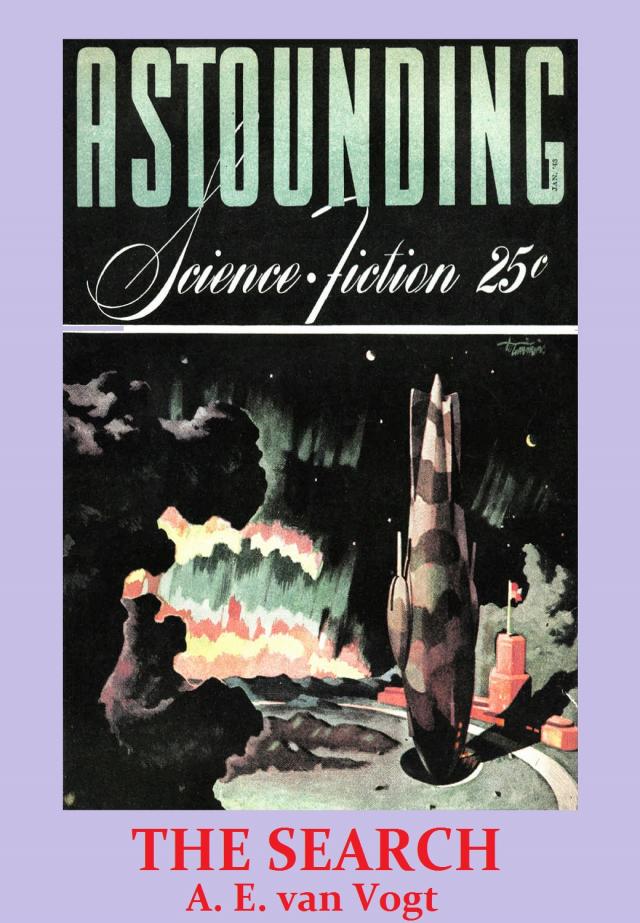


THE SEARCH
By A. E. van Vogt
Ten days of memory gone. Ten days dropped out of his life.
To find those ten days he tried to retrace his path and found it never had been!
Illustrated by Orban
Astounding Science-Fiction, January 1943 – Novelette
Illustrated by Paul Oban
The hospital bed was hard under his body. For a tense moment it seemed to Drake that that was what was bothering him. He turned over into a more comfortable position—and knew it wasn’t physical at all. It was something in his mind, the sense of emptiness that had been there since they had told him the date.
After what seemed a long time, the door opened, and two men and a nurse came in. One of the men said in a hearty voice:
“Well, how are you, Drake? It’s a shame to see you down like this.”
The man was plumpish, a good-fellow type. Drake took his vigorous handshake, lay very still for a moment, and then allowed the awkward but necessary question to escape his lips:
“I’m sorry,” he said stiffly, “but do I know you?” The man said: “I’m Bryson, sales manager of the Quik-Rite Co. We manufacture fountain pens, pencils, ink, writing paper and a dozen kindred lines that even grocery stores handle.
“Two weeks ago, I hired you and put you on the road as salesman. The next thing I knew you were found unconscious in a ditch, and the hospital advised me you were here.”
He finished: “You had identification papers on you connecting you with us.”
Drake nodded. But he felt tense. It was all very well to have someone fill a gap in your mind, but— He said finally:
“My last remembrance is my decision to apply for a job with your firm, Mr. Bryson. I had just been turned down by the draft board for an odd reason. Apparently, something happened to my mind at that point and—”
He stopped. His eyes widened at the thought that came. He said slowly, conscious of an unpleasant sensation:
“Apparently, I’ve had amnesia.”
He saw that the house doctor, who had come in with Bryson, was looking at him sharply. Drake mustered a wan smile.
“I guess it’s all right, doc. What gets me is the kind of life I must have lived these last two weeks. I’ve been lying here straining my brain. There’s something there in the back of my mind that—”
The doctor was smiling behind his pince-nez. “I’m glad you’re taking it so well. Nothing to worry about, really. As for what you did, I assure you that our experience has been that the victim usually lives a reasonably normal life. One of the most frequent characteristics is that the victim takes up a different occupation. You didn’t even do that.”
He paused, and the plump Bryson said heartily: “I can clear up the first week for you. I had discovered, when I hired you, that you’d lived as a boy in some village on the Warwick Junction-Kissling branch line. Naturally, I put you on that route.
“We had orders from you from five towns on the way, but you never got to Kissling. Maybe that will help you… . No!” Bryson shrugged. “Well, never mind. As soon as you’re up, Drake, come and see me. You’re a good man, and they’re getting scarce.’’
Drake said: “I’d like to be on the same territory, if it’s all right.”
Bryson nodded. “Mind you, it’s only a matter of finishing up what you missed before, and then moving farther along the main line. But it’s yours, certainly. I guess you want to check up on what happened to you.”
“That,” said Drake, “is exactly what I have in mind. Sort of a search for my memory.” He managed a smile. “But now … but now, I want to thank you for coming.”
“S’all right. S’long.”
Bryson shook hands warmly, and Drake watched him out of the door.
Two days later, Drake climbed off the Transcontinental at Warwick Junction, and stood blinking in the bright sun of early morning. His first disappointment had already come. He had hoped that the sight of the cluster of houses silhouetted against a canyon would bring back memories.
It had, but only from his boyhood when he and his parents had passed through the Junction on various trips. There were new houses now, and the railway station hadn’t been there twenty years before.
Too obviously his mind was not being jarred into the faintest remembrance of what he had done or seen sixteen days earlier.
Drake shook his head in bewilderment. “Somebody knew me,” he thought. “Somebody must have seen me. I talked to storekeepers, travelers, trainmen, hotel men. I’ve always had a sociable bent, so—”
“Hello, there, Drake, old chap,” said a cheerful voice beside him. “You look as if you’re thinking about a funeral.”
Drake turned, and saw a rather slender young chap, dark-faced and dark-haired, about thirty years old. He had the slouch of too-thin people who walk too much carrying sample cases, and he must have noticed something in his, Drake’s, eyes, for he said quickly:
“You remember me, don’t you—Bill Kellie!” He laughed easily “Say, come to think of it, I’ve got a bone to pick with you. What did you do with that girl, Selanie? I’ve been twice past Piffer’s Road since I last saw you, and she didn’t come around either time. She—”
He stopped, and his gaze was suddenly sharp. “Say, you do remember me, don’t you?”
To Drake, the astounding if not notable fact was that Piffer’s Road should be the place name. Was it possible that he had got the idea of going to the farmhouse where he had been born, to look the old homestead over? He emerged from his intense inner excitement, and realized from the expression on Kellie’s face that it was time to explain. He finished finally:
“So you see, I’m in quite a mental fix. Maybe, if you wouldn’t mind, you could give me some idea of what happened while I was with you. Who is this girl, Selanie?”
“Oh, sure,” said Kellie, “sure, I’ll—” He paused, frowned. “You’re not kiddin’ me, are you?” He waved Drake silent. “O. K., O. K., I’ll believe you. We’ve got a half-hour before the Kissling local is due. Amnesia, eh? I’ve heard about that stuff, but— Sa-a-ay, you don’t think that old man could have had anything to do with—” He banged his right fist into his left palm. “I’ll bet that’s it.”
“An old man!” Drake said. He caught himself, finished firmly: “What about this story?”
The train slowed. Through the streaky window, Drake could see a rolling valley with patches of green trees and a gleaming, winding thread of water. Then some houses came into view, half a dozen siding tracks, and finally the beginning of a wooden platform.
A tall, slim, fine-looking girl walked past his window carrying a basket. Behind Drake, the traveling salesman, who had got on at the last stop, and to whom he had been talking, said:
“Oh, there’s Selanie. I wonder what kind of supergadget she’s got for sale today.”
Drake leaned back in his scat, conscious that he had seen all of Piffer’s Road that he cared to. It was queer, that feeling of disinterest. After all, he had been born three miles along the road. Nevertheless, there it was. He didn’t give a darn. His mind fastened only slowly on what the other had said.
“Selanie!” he echoed then. “Curious name! Did you say she sells things?”
“Does she sell things!” the man, Kellie, exploded.
He must have realized the forcefulness of his words, for he drew a deep, audible breath; his blue eyes looked hard at Drake. He started to say something, stopped himself, and finally sat smiling a secret smile.
After a moment, he said: “You know I really must apologize. I’ve just now realized that I’ve monopolized the conversation ever since we started talking.”
Drake smiled with polite tolerance. “You’ve been very entertaining.”
Kellie persisted: “What I mean by that is, it’s just penetrated to me that you told me you sold fountain pens, among other things.”
Drake shrugged. He wondered if he looked as puzzled as he was beginning to feel. He watched as Kellie drew out a pen, and held it out for him to take. Kellie said:
“See anything queer about that?”
The pen was long, slender, of a dark, expensive-looking material. Drake unscrewed the cap slowly —slowly, because in his mind was the sudden, wry thought that he was in for one of those pointless arguments about the relative merits of the pens he was selling and—
He said quickly: “This looks right out of my class. My company’s pens retail for a dollar.” The moment he had spoken, he realized he had left himself wide open. Kellie said with a casual triumph:
“That’s exactly what she charged me for it.” “Who?”
“Selanie! The girl who just got on the train. She’ll be along in a few minutes selling something new. She’s always got an item that’s new and different.”
He grabbed the pen from Drake’s fingers. “I’ll show you what’s queer about this pen.”
His fingers reached toward a paper cup that stood on the window sill. He said with an irritating smugness: “Watch!”
The pen tilted over the cup; Kellie seemed to press with his finger on the top—and ink began to flow.
After about three minutes, it filled the cup to the brim. Kellie opened the window, carefully emptied the blue liquid onto the ground between the coach and the platform—and Drake erupted from his paralysis.
“Good heavens!” he gasped. “What kind of a tank have you got inside that pen? Why, it—” “Wait!”
Kellie’s voice was quiet, but he was so obviously enjoying himself that Drake pulled himself together with a distinct ef fort. His brain began to whirl once more, as Kellie pressed the top again, and once again ink began to flow from the fantastic pen. Kellie said:
“Notice anything odd about that ink?”
Drake started to shake his head, then he started to say that the oddness was the quantity, then he gulped hoarsely:
‘‘Red ink!”
“Or maybe,” Kellie said coolly, “you’d prefer purple. Or yellow. Or green. Or violet.”
The pen squirted a tiny stream of each color, as he named it. In each case, he turned the part he was pressing ever so slightly. Kellie finished with the triumphant tone of a man who has extracted every last drop of drama from a situation: “Here, maybe you’d like to try it yourself.” Drake took he remarkable thing like a connoisseur caressing a priceless jewel. As from a great distance he heard Kellie chattering on:
“—her father makes them,” Kellie was saying. “He’s a genius with gadgets. You ought to see some of the stuff she’s been selling on this train the last month. One of these days, he’s going to get wise to himself, and start large-scale manufacture. When that day comes, all fountain pen companies and a lot of other firms go out of business.”
It was a thought that had already occurred to Drake. Before he could muster his mind for speech, the pen was taken from his fingers; and Kellie was leaning across the aisle toward a handsome gray-haired man who sat there. Kellie said:
“I noticed you looking at the pen, sir, while I was showing it to my friend. Would you like to examine it?”
“Why, yes,” said the man.
He spoke in a low tone, but the sound had an oddly rich resonance that tingled in Drake’s ears. The old man’s fingers grasped the extended pen and—just like that—the pen broke.
“Oh!” Kellie exclaimed blankly.
“I beg your pardon,” said the fine-looking old man. A dollar appeared in his hand. “My fault. You can buy another one from the girl when she comes.”
He leaned back, and buried himself behind a newspaper,
Drake saw that Kellie was biting his lip. The man sat staring at his broken pen, and then at the dollar bill, and then in the direction of the now hidden face of the gray-haired man. At last, Kellie sighed:
“I can’t understand it. I’ve had the pen a month now. It’s already fallen to a cement sidewalk, and twice onto a hardwood floor—and now it breaks like a piece of rotted wood.”
He shrugged, but his tone was complaining as he went on after a moment: “I suppose actually you can’t really expect Selanie’s father to do a first-rate job with the facilities he’s got—”
He broke off excitedly: “Oh, look, there’s Selanie now. I wonder what she’s featuring today.”
A sly smile crept into his narrow face. “Just wait till I confront her with that broken pen. I kidded her when I bought it, told her there must be a trick to it. She got mad then, and guaranteed it for life— What the devil is she selling, anyway? Look, they’re crowding around her.”
Quite automatically, Drake climbed to his feet. He craned his neck the better to see over the heads of the crowd that was watching the girl demonstrate something at the far end of the car.
“Good heavens!” a man’s deep voice exclaimed. “How much are you charging for those cups? How do they work?”
“Cups!” said Drake, and moved toward the group in a haze of fascination. If he had seen right, the girl was handing around a container which kept filling full of liquid. And people would drink, and it would fill again instantly.
Drake thought: The same principle as the fountain pen. Somehow, her father had learned to precipitate liquids and—
His brain did a twisting dive, then came up spinning. What … in … kind of gadget genius was there behind this … this priceless stuff? Why, if he, Drake, could make a deal with the man for the company, or for himself, he was made. He—
He was trembling violently; and the tremendous thought ended, as the girl’s crystal-clear voice rose above the excited babble:
“The price is one dollar each. It works by chemical condensation of gases in the air; the process is known only to my father—but wait, I haven’t finished my demonstration.”
She went on, her voice cool and strong against the silence that settled around her:
“As you see, it’s a folding drinking cup without a handle. First, you open it. Then you turn the top strip clockwise. At a certain point, water comes. But now—watch. I’m turning it farther. The liquid is now turning green, and is a sweet and very flavorsome drink. I turn the strip still farther, and the liquid turns red, becomes a sweet-sourish drink that is very refreshing in hot weather.”
She handed the cup around; and it was while it was being passed around from fingers to clutching fingers that Drake managed to wrench his gaze from the gadget, and really look at the girl.
She was tall, about five feet six, and she had dark-brown hair. Her face was unmistakably of a fine intelligence. It was thin and good-looking, and there was an odd proud tilt to it that gave her a startling appearance of aloofness in spite of the way she was taking the dollar bills that were being thrust at her.
Once again, her voice rose: “I’m sorry, only one to a person. They’ll be on the general market right after the war. These are only souvenirs.”
The crowd dissolved, each person retiring to his or her individual seat. The girl came along the aisle, and stopped in front of Drake. He stepped aside instinctively, and then abruptly realized what he was doing.
“Wait!” he said piercingly. “My friend showed me a fountain pen you were selling. I wonder—” “I still have a few,” she nodded gravely. “Would you like a cup, also?”
Drake remembered Kellie. “My friend would like another pen, too. His broke and—”
“I’m sorry, I can’t sell him a second pen.” She paused there. Her eyes widened ; she said with a weighty slowness. “Did you say—his broke?” Astoundingly, she swayed. She said wildly: “Let me see that. Where is your friend?”
She took the two pieces of fountain pen from Kellie’s fingers, and stared at them. Her mouth began to tremble. Her hands shook. Her face took on a gray, drawn look. Her voice, when she spoke, was a whisper:
“Tell me … tell me, how did it happen? Exactly how?”
“Why”—Kellie drew back in surprise—“I was handing it to that old gentleman over there when—”
He stopped because he had lost his audience. The girl spun on her heel—and that was like a signal. The old man lowered his paper, and looked at the girl.
She stared back at him with the fascinated expression of a bird cornered by a snake. Then, for a second time within two minutes, she swayed. The basket nearly dropped from her hand as she ran, but, somehow, she hung on to it, as she careened along the aisle.
A moment later, Drake saw her racing across the platform. She became a distant, running form on Piffer’s Road.
“What the hell!” Kellie exploded.
He whirled on the old man. “What did you do to her?” he demanded fiercely. “You—”
His voice sank into silence, and Drake who had been about to add his hard words to the demand remained quiet, also.
The salesman’s voice there under the bright sun, on the platform at Warwick Junction, faded. It required a moment for Drake to grasp that the story was finished.
“You mean,” he demanded, “that’s all? We just sat there like a couple of dummies out-faced by an old man? And that was the end of the business? You still don’t know what scared the girl?”
He saw that there was the strange look on Kellie’s face of a man who was searching mentally for a word or phrase to describe the indescribable. Kellie said finally:
“There was something about him like … like all the tough sales managers in the world rolled into one, and feeling their orneriest. We just shut up.”
It was a description that Drake could appreciate. He nodded grimly, said slowly: “He didn’t get off?”
“No, you were the only one who got off.”
“Eh?”
Kellie looked at him. “You know, this is the damnedest, funniest thing. But that’s the way it was. You asked the trainman to check your bags at Inchney. The last thing I saw of you before the train pulled out, you were walking up Piffer’s Road in the direction the girl had gone and— Ah, here comes the Kissling local now.”