

Complete works of a e w.., p.1
Complete Works of a E W Mason, page 1


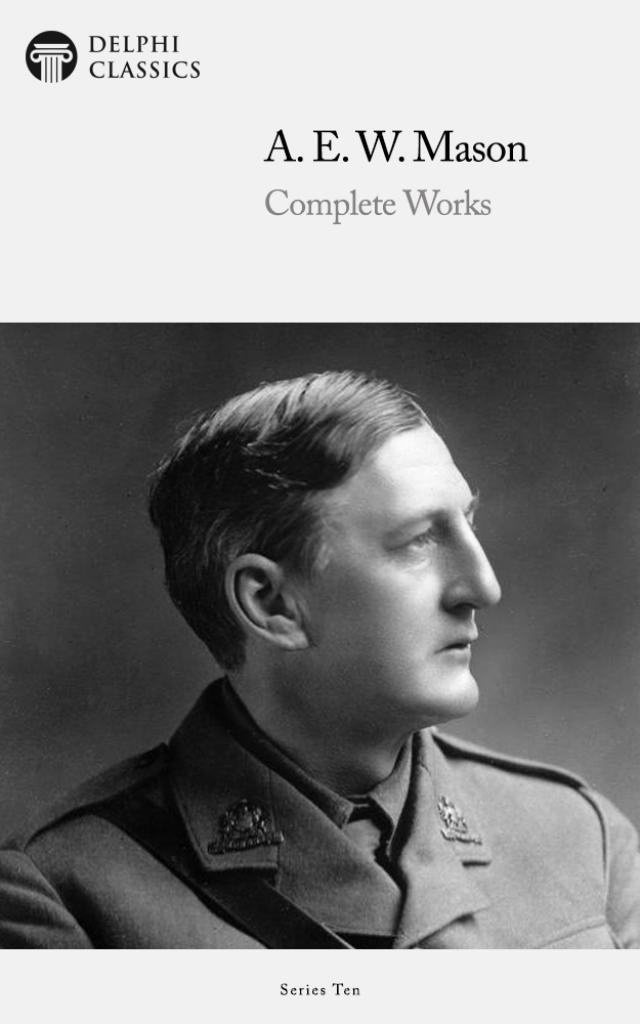
The Complete Works of
A. E. W. MASON
(1865-1948)
Contents
Inspector Hanaud Series
At the Villa Rose (1910)
The Affair at the Semiramis Hotel (1917)
The House of the Arrow (1924)
No Other Tiger (1927)
The Prisoner in the Opal (1928)
They Wouldn’t Be Chessmen (1934)
The Ginger King (1940)
The House in Lordship Lane (1946)
Other Novels
A Romance of Wastdale (1895)
The Courtship of Morrice Buckler (1896)
Lawrence Clavering (1897)
The Philanderers (1897)
Parson Kelly (1899)
Miranda of the Balcony (1899)
The Watchers (1899)
Clementina (1901)
The Four Feathers (1902)
The Truants (1904)
Running Water (1906)
The Broken Road (1907)
The Turnstile (1912)
The Witness for the Defence (1913)
The Summons (1920)
The Winding Stair (1923)
The Dean’s Elbow (1930)
The Three Gentlemen (1932)
The Sapphire (1933)
Fire over England (1936)
The Drum (1937)
Königsmark (1938)
Musk and Amber (1942)
The Shorter Fiction
Ensign Knightley: And Other Stories (1901)
The Four Corners of the World (1917)
Dilemmas (1934)
The Short Stories
List of Short Stories in Chronological Order
List of Short Stories in Alphabetical Order
The Non-Fiction
The Royal Exchange (1920)
Sir George Alexander and the St. James’ Theatre (1935)
The Life of Francis Drake (1941)
The Delphi Classics Catalogue
© Delphi Classics 2019
Version 1
Browse our Main Series
Browse our Ancient Classics
Browse our Poets
Browse our Art eBooks
Browse our Classical Music series
The Complete Works of
A. E. W. MASON
with introductions by Gill Rossini
By Delphi Classics, 2019
COPYRIGHT
Complete Works of A. E. W. Mason
First published in the United Kingdom in 2019 by Delphi Classics.
© Delphi Classics, 2019.
All rights reserved. No part of this publication may be reproduced, stored in a retrieval system, or transmitted, in any form or by any means, without the prior permission in writing of the publisher, nor be otherwise circulated in any form other than that in which it is published.
ISBN: 978 1 78877 959 3
Delphi Classics
is an imprint of
Delphi Publishing Ltd
Hastings, East Sussex
United Kingdom
Contact: sales@delphiclassics.com
www.delphiclassics.com
Parts Edition Now Available!
Love reading A. E. W. Mason?
Did you know you can now purchase the Delphi Classics Parts Edition of this author and enjoy all the novels, plays, non-fiction books and other works as individual eBooks? Now, you can select and read individual novels etc. and know precisely where you are in an eBook. You will also be able to manage space better on your eReading devices.
The Parts Edition is only available direct from the Delphi Classics website.
For more information about this exciting new format and to try free Parts Edition downloads, please visit this link.
Explore classic thrillers with Delphi Classics
For the first time in digital publishing history, Delphi Classics is proud to present the complete works of these thrilling authors.
Browse our Thriller authors
Inspector Hanaud Series
Camberwell Green, London — A. E. W. Mason was born in Camberwell, a southern suburb of London, in 1865.
Grove Lane, Camberwell — Mason was born in Enfield House on Upper Grove Lane.
At the Villa Rose (1910)
Published in 1910 in Britain by Hodder & Stoughton, in Canada by The Musson Book Company and in America by Charles Scribner’s Sons, this is the first of six novels and a short story featuring Inspector Gabriel Hanuad, the French detective. By this time, Mason had been a published novelist for fifteen years and despite being the first book in the Hanaud series, it was a best seller.
In creating the character of Inspector Hanaud, Mason was determined to create a detective as unlike his fictional contemporary, Sherlock Holmes, as possible. Where Holmes is tall and gaunt, Hanuad is ‘stout and broad shouldered with a full and almost heavy face’ and thick black hair, (one character describes him as being like a Newfoundland dog), affable by nature and he is also a professional police detective working for the Sûreté, not a gifted amateur like the cool mannered Englishman. In addition, Hanaud uses psychological insights to catch culprits, rather than gathering scientific evidence in the manner of Holmes – although neither man is prone to moral judgements. However, Hanaud can be light of foot for a large man – he ‘moves as lightly as an antelope’ – his insights are equally incisive as those of Holmes and he will brook no lack of co-operation from witnesses. His quiet eyes miss nothing and his periodic buffoonery has a purpose and disguises an incisive mind. As Mason says in the novel House of the Arrow, those who encounter Hanaud must be prepared ‘to be awed at one moment, leaped upon unpleasantly at the next, ridiculed at a third and treated with great courtesy and friendship at the fourth.’ Hanuad is also like Holmes — with both men, we can never fully know or understand them, perhaps because of their mercurial temperament and superior skills. It has been suggested that Mason was influenced in the creation of Hanaud by Robert Barr’s French policeman detective, Eugene Valmont (1907).
Whilst Holmes clearly was not the inspiration for Mason’s detective, two real life police officers were — Macé and Goron both led the Parisian Sûreté and it is known that Mason studied their respective memoirs. It has been suggested that he was also influenced by novelist Émile Gaboriau’s fictional detective, Monsieur Lecoq. In his turn, Mason and his character are thought to have been an inspiration for Agatha Christie when she developed her own Belgian detective, Hercules Poirot – as an example, Hanaud refers to himself in the third person, something Poirot also does and both men have an occasional slip in their use of spoken English.
Mason’s strong belief in the necessity for outstanding characterisation was evident in the preface he wrote to an omnibus collection of the first three Hanaud novels: ‘Detective fiction… has been judged not so much by the ingenuity of its plots, but by the higher standard of its characterisation.’ His efforts did not go unnoticed by his peers – contemporaries such as fellow mystery author Dorothy L. Sayers and literary critic Howard Haycraft, both praised his use of psychology in the development of characters and stories, the latter stating Mason was the first such writer after Wilkie Collins to do so effectively; he also wrote ‘… among the most subtly conceived and described in the genre…Hanaud easily stands out as one of the indisputable ‘greats’ among fictional sleuths.’
In 1931, The A. E. W. Mason Omnibus: Inspector Hanaud’s Investigations was published. In the preface, Mason expanded on his approach to writing detective fiction:
‘I was haunted by a desire to make the story of what actually happened more intriguing and dramatic than the unravelling of the mystery and the detection of the criminal. I wanted that the surprise which is the natural end of a detective story should come in the middle and that the victims and criminals should between them, when brought into the witness-box, tell a story which, while explaining, should transcend in interest all the doubts and even the alarms which a good mystery is able to provoke. I wanted… to combine the crime story which produces a shiver with the detective story which aims at a surprise.’
The novel was adapted for film in 1920, the same year a stage version debuted at the Strand Theatre in London’s West End. Following this silent movie, a sound version was released in 1930, filmed in both in English and in French (as Le mystère de la villa rose) at Twickenham Studios — this was the first ever British bi-lingual film production. The film was released in America as The Mystery of the Villa Rose. This marked the film debut of Irish actor Austin Trevor, who played Mr Ricardo, Hanaud’s friend and the loose equivalent of Dr. Watson in the Sherlock Holmes stories (Trevor later became the first actor to play Agatha Christie’s detective, Hercule Poirot, on screen). Another moderately successful film version was released in 1940, directed by Walter Summers and starring Kenneth Kent as Hanaud and Walter Rilla as Mr Ricardo – this film version was also known as The House of Mystery.
The story opens not with Inspector Hanuad, but with his friend, Mr. Ricardo, who is taking his customary long summer holiday in Aix le Bains, in Savoy. The small town is pleasant and the other holiday makers seemingly affluent, but Ricardo is not one to attend social functions and is presented as something of a loner. Despite this, he is a keen ‘people watcher’ and when one evening he is taking a break from observing the gaming tables, he is drawn to the actions of a young woman behaving erratically and a rich young Englishman, Harry Wethermill, who is causing quite a stir at one of the tables. There is clearly a bond of fondness and understanding bet ween the two young people and when Ricardo and Wethermill subsequently socialise together, Ricardo can barely restrain himself from asking many questions about the young woman, whose name is Celia Harland — so great is his curiosity about her.
Less than two days later, Wethermill bursts in on Ricardo early in the morning, in a desperate state and demanding that the older man help him. News has broken that Mme Dauvray, the rich older woman Celia is companion for, has been brutally murdered, her maid drugged and tied up and Celia has disappeared, along with the woman’s car, as has her impressive collection of fine jewellery. The newspapers are describing the crime as ‘brutal and sinister’ and a call has been put out by the police for the public to help apprehend Celia, who is clearly seen as the prime suspect.
Wethermill has fallen in love with Celia and is desperate to prove the innocence he fervently believes of her and he begs Ricardo to approach Inspector Hanaud and ask for help. Ricardo knows Hanuad a little, having dined with him once and because Ricardo is intrigued by the mystery, he agrees to help. There is one problem – Hanaud is at the resort on his holidays, not in his professional capacity as a detective and as he points out, ‘a detective does not take up a case or leave it alone according to his pleasure.’ Indeed, Hanaud has already turned down an offer from the local police to help in the investigation. Nevertheless, he too is intrigued by what he hears from the two men and warns them that the case is a ‘dark’ one. We also learn that the victim was a deeply superstitious woman and had in many ways made herself a target for rogues to exploit her. Was Celia one such person?
Hanuad finally agrees to help investigate the case and consents to have Ricardo and Wethermill as companions as he works, so long as they do not interfere. It is at this point that Ricardo recalls a séance he attended two years before, an accomplished performance by the medium whose appearance he is now able to link to the murder case – for the medium was none other than Celia Harland. For the time being, Ricardo keeps this recollection to himself, as the investigating party accompanies a local police officer to the scene of the crime. Hanaud begins to question the victim’s staff and we witness his sharp intellect and keen intuition at work as he takes in what he is told and analyses it. The three men inspect the murder scene and the exterior of the villa and damning evidence against Celia appears at every turn, something that Ricardo finds increasingly suspicious. Either Celia was an impossibly dim-witted criminal, or she was being set up to take the blame for a murder she did not commit. Is Celia, the sweet natured girl of Wethermill’s dreams, really an angel, or is she a calculating psychopath?
Inspector Hanaud is an appealing personality and Mason has certainly achieved his aim of creating a credible detective character that contrasts with the famous Sherlock Holmes. If anything, Hanaud is more accessible to the reader because of his ‘man next door’ persona, despite his obvious gifts as a detective. This story has hints of contemporary prejudices, such as the initial conviction of the local Judge that Celia must be Jewish (if she is a suspected jewel thief and murderer), but Mason uses his characters to swiftly dismiss such notions and the judge that states this is described as fanatical — ‘behind every crime they see a Jew.’ Whilst such expression of opinions can be uncomfortable to the modern reader, in historical stories such as this it is also a useful insight into the tensions of the times in which the book was written. At the Villa Rose is a strong story that will encourage the aficionado of vintage detective tales to explore the novels that follow.
The first edition
CONTENTS
CHAPTER I
CHAPTER II
CHAPTER III
CHAPTER IV
CHAPTER V
CHAPTER VI
CHAPTER VII
CHAPTER VIII
CHAPTER IX
CHAPTER X
CHAPTER XI
CHAPTER XII
CHAPTER XIII
CHAPTER XIV
CHAPTER XV
CHAPTER XVI
CHAPTER XVII
CHAPTER XVIII
CHAPTER XIX
CHAPTER XX
CHAPTER XXI
Mason as a young man, close to the time of publication
CHAPTER I
SUMMER LIGHTNING
IT WAS MR. Ricardo’s habit as soon as the second week of August came round to travel to Aix-les-Bains, in Savoy, where for five or six weeks he lived pleasantly. He pretended to take the waters in the morning, he went for a ride in his motor-car in the afternoon, he dined at the Cercle in the evening, and spent an hour or two afterwards in the baccarat-rooms at the Villa des Fleurs. An enviable, smooth life without a doubt, and it is certain that his acquaintances envied him. At the same time, however, they laughed at him and, alas with some justice; for he was an exaggerated person. He was to be construed in the comparative. Everything in his life was a trifle overdone, from the fastidious arrangement of his neckties to the feminine nicety of his little dinner-parties. In age Mr. Ricardo was approaching the fifties; in condition he was a widower — a state greatly to his liking, for he avoided at once the irksomeness of marriage and the reproaches justly levelled at the bachelor; finally, he was rich, having amassed a fortune in Mincing Lane, which he had invested in profitable securities.
Ten years of ease, however, had not altogether obliterated in him the business look. Though he lounged from January to December, he lounged with the air of a financier taking a holiday; and when he visited, as he frequently did, the studio of a painter, a stranger would have hesitated to decide whether he had been drawn thither by a love of art or by the possibility of an investment. His “acquaintances” have been mentioned, and the word is suitable. For while he mingled in many circles, he stood aloof from all. He affected the company of artists, by whom he was regarded as one ambitious to become a connoisseur; and amongst the younger business men, who had never dealt with him, he earned the disrespect reserved for the dilettante. If he had a grief, it was that he had discovered no great man who in return for practical favours would engrave his memory in brass. He was a Maecenas without a Horace, an Earl of Southampton without a Shakespeare. In a word, Aix-les-Bains in the season was the very place for him; and never for a moment did it occur to him that he was here to be dipped in agitations, and hurried from excitement to excitement. The beauty of the little town, the crowd of well-dressed and agreeable people, the rose-coloured life of the place, all made their appeal to him. But it was the Villa des Fleurs which brought him to Aix. Not that he played for anything more than an occasional louis; nor, on the other hand, was he merely a cold looker-on. He had a bank-note or two in his pocket on most evenings at the service of the victims of the tables. But the pleasure to his curious and dilettante mind lay in the spectacle of the battle which was waged night after night between raw nature and good manners. It was extraordinary to him how constantly manners prevailed. There were, however, exceptions.
For instance. On the first evening of this particular visit he found the rooms hot, and sauntered out into the little semicircular garden at the back. He sat there for half an hour under a flawless sky of stars watching the people come and go in the light of the electric lamps, and appreciating the gowns and jewels of the women with the eye of a connoisseur; and then into this starlit quiet there came suddenly a flash of vivid life. A girl in a soft, clinging frock of white satin darted swiftly from the rooms and flung herself nervously upon a bench. She could not, to Ricardo’s thinking, be more than twenty years of age. She was certainly quite young. The supple slenderness of her figure proved it, and he had moreover caught a glimpse, as she rushed out, of a fresh and very pretty face; but he had lost sight of it now. For the girl wore a big black satin hat with a broad brim, from which a couple of white ostrich feathers curved over at the back, and in the shadow of that hat her face was masked. All that he could see was a pair of long diamond eardrops, which sparkled and trembled as she moved her head — and that she did constantly. Now she stared moodily at the ground; now she flung herself back; then she twisted nervously to the right, and then a moment afterwards to the left; and then again she stared in front of her, swinging a satin slipper backwards and forwards against the pavement with the petulance of a child. All her movements were spasmodic; she was on the verge of hysteria. Ricardo was expecting her to burst into tears, when she sprang up and as swiftly as she had come she hurried back into the rooms. “Summer lightning,” thought Mr. Ricardo.


