

By treason we perish, p.1
By Treason We Perish, page 1


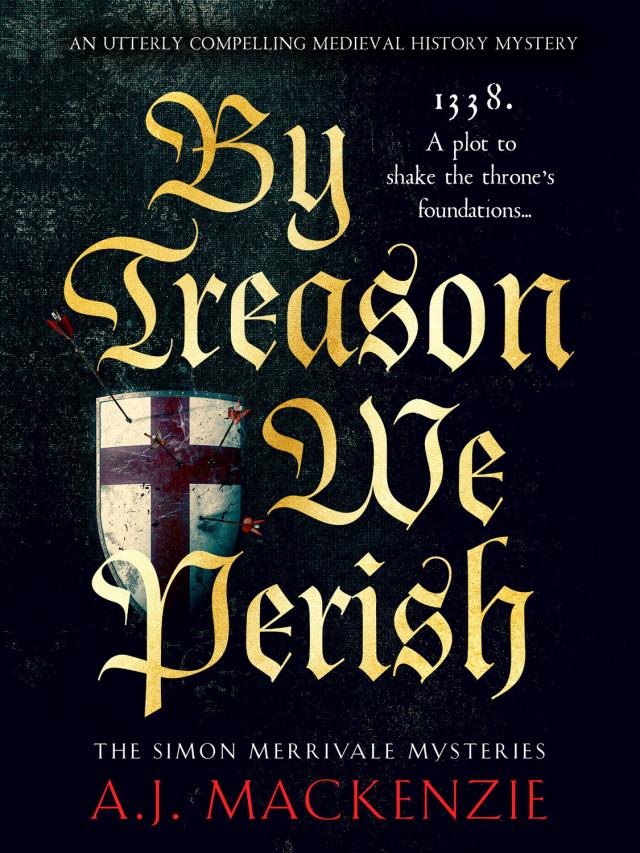
By Treason We Perish
Cover
Title Page
Dedication
Epigraph
Map of England
Map of Northern France and the Low Countries
Dramatis personae
A note on measures, money and names
Flight
1
Saffron
2
3
4
5
6
7
8
9
Wool
10
11
12
13
14
15
Money
16
17
18
19
20
21
22
23
24
25
26
Blood
27
28
29
30
31
Acknowledgements
Newsletter
About the Author
Also by A.J. MacKenzie
Copyright
Cover
Table of Contents
Start of Content
This book is dedicated to all NHS staff, especially to those working with cancer patients.
A king ought not to go out of his kingdom to make war
Unless the commons of his land will consent
By treason we often see very many perish
No one can tell in whom to trust with certainty
Let not the king go out of his kingdom without counsel
—English protest song,
mid-fourteenth century
Dramatis personae
In the household of King Edward III
Edward III, king of England
Philippa of Hainault, his wife and queen of England
Simon Merrivale, King’s Messenger
Edmund Gonville, king’s clerk
Sir John Moleyns, lord of Stoke Poges and treasurer of the king’s chamber
Sir Geoffrey Scrope, lawyer, man-at-arms and royal advisor
Henry Burghersh, bishop of Lincoln and royal advisor
Alice Bedingfield, the queen’s lady-in-waiting
In the household of the queen mother
Isabella of France, former queen of England and mother of Edward III
John Hull, chaplain
Peter Ellerker, treasurer
John Stanton, sarjeant
Ralph Dunham, clerk
Robert Brigget, marshal
Warin of Hexworthy, groom
Administrators in London
John Stratford, Archbishop of Canterbury
Robert Stratford, his brother, bishop of Chichester and Lord Chancellor
Edmund Grimsby, senior official at the Chancery
William de la Zouche, Lord High Treasurer and later Archbishop of York
William Kildesby, Keeper of the Privy Seal
Physicians and apothecaries
Mercuriade of Salerno, physician
Cassandra Wesenham, apothecary
Jordan of Canterbury, physician to the king of England
Saffron growers and dealers
Nicholas le Flemyng (Nicolaes Engels), croker
Juan Moreno, croker
James Westacre, croker and former shipmaster
William (Guillaume) Gonville, spice merchant
Englishmen involved in the wool trade
William de la Pole, merchant and banker from Hull
Robert Denton, Pole’s agent and attorney, controller of customs
John Wesenham, collector of customs in Bishop’s Lynn
Roger Wolsthorp, collector of customs in Boston
Reginald Conduit, merchant of London, vintner and banker
Other bankers and financiers
Sir John Pulteney, formerly Lord Mayor of London
Donato di Pacino de’ Peruzzi, banker from Florence
Aufrej Solaro, partner in the banking house of Solaro, Antwerp branch
Orland Turc de Castel, head of the Company of the Leopard in Antwerp
Anton Turc, partner in the Company of the Leopard
Sinibald Solaro, partner in the banking house of Solaro, Strassburg branch
Velvl Roth (Vivelin Rus), banker from Strassburg
Other clerics and religious leaders
Raimon Vidal, secretary to Étienne Aubert, Bishop of Noyon
John Courtenay, abbot of Tavistock
Balduin of Luxembourg, Archbishop of Trier
Rabbi Levi ben Gershon, philosopher, mathematician and astronomer
Knights, pirates, dukes, counts and archers
Sir John Sully of Iddesleigh, friend and patron of Merrivale
Enric, man-at-arms from Savoy
Sgond, man-at-arms from Savoy
John Crabbe, Anglo-Flemish shipmaster, engineer and pirate
Jan III Reginar, Duke of Brabant (Cousin Jan)
Willem II Avesnes, Count of Hainault (Brother Willem)
Jacob van Artevelde, captain general of the League of Three
Robin Pinn, archer from Sidmouth in Devon
Jack Giffard, archer from Torrington in Devon
A note on measures, money and names
Two similar terms appear in this book, but they have slightly different meanings. A woolsack is a large and durable cloth sack which is filled with raw wool. A sack of wool on the other hand is a unit of weight, the amount of wool each sack should contain when filled. According to the Assize of Weights and Measures, each sack of wool should have weighed twenty-six stone, that is, 364 pounds or slightly over 165 kilograms. A wey was half a sack. A stone was, and still is, fourteen pounds.
Saffron was measured using the apothecaries’ system of weights. Without going into detail, an apothecaries’ pound weighed three-quarters of a Tower pound (later known as avoirdupois), or around 340 grams.
Money in medieval England was accounted for in two ways. The first and most common for smaller transactions was pounds, shillings and pence, written as £, s and d. There were 12d in a shilling, and 20s or 240d to the pound. The second was the mark, purely a unit of account worth 13s 4d or two-thirds of a pound.
The largest coin in common circulation in England was the groat, worth 4d. There were also half-groats (2d), pennies, half-pennies and farthings, the latter worth a quarter d. The most common gold coin was the florin, minted in the city of Florence. The value of gold versus silver fluctuated depending on political and economic issues, the relative scarcity of each metal and the purity of the coinage itself, but data compiled at the London School of Economics and Political Science suggests that in the mid-fourteenth century the value of a florin ranged from three to four shillings, or 36d to 48d.
Some of the places we mention had names different from those they bear today. The port of Bishop’s Lynn changed its name to King’s Lynn following the sixteenth-century reformation, and the market town of Chipping Walden eventually became Saffron Walden after the establishment of saffron growing in the area. Otherwise, we have used modern English names such as Antwerp, Ghent, Turin and Florence. The exceptions are where the medieval place was named in a language different from the modern name; for example in Chapter 1 we use several Provençal names including the river Isèra instead of Val d’Isère, and La Chasa Dieu instead of the French La Chaise-Dieu. Strasbourg, the capital of modern Alsace, was known throughout the Middle Ages as Strassburg, part of the distinctly Germanic culture of s’Elsàss; the French influence and name only came several centuries later.
The characters in this book would have spoken the usual mix of languages including several dialects of English, north French, west Flemish, east Flemish, Elsàss (Alsatian), various dialects of Occitan, Piedmontese, Tuscan Italian and Czech. As ever, for the most part we have rendered their speech into modern English for the convenience of the reader.
Flight
1
Valley of the Isèra, October 1338
A man was climbing for his life. His hands were bloody from hauling himself up the cliff, and his breath rasped in his throat. His tunic and hose were both soaking wet, their weight dragging at his arms and legs. All his mind and body concentrated on the fissures in the stone a few inches from his face.
A bitter wind whistled around him. He could hear noise in the abyss beneath him; at least two other men were climbing after him. He shifted his weight, trying to traverse across the cliff face towards a stone chimney to his left. The rock beneath his boot broke, fragments clattering away below. For a moment he dangled by his hands, ignoring the pain in his bleeding fingers while he searched desperately for a foothold.
His right boot brushed against a spur of rock. He planted his foot and tested it; this time it held firm. He reached up and found a stone ledge, dragging himself up and using the ledge to move sideways towards the chimney. The men below him were growing closer.
Having reached the chimney he could climb faster, bracing his feet against the stone walls. Once he looked down. And his heart froze in his chest. A group of dismounted men-at-arms stood at the foot of the cliff looking up at him. Their leader wore a blue cloak with a device of a black eagle with spread wings.
He climbed on. The chimney widened and the cliff became less steep. He scrabbled up the slope on all fours, boots scraping and slipping, more shards of stone tumbling down into the void. Sobbing for breath, he reached the top of the cliff and fell on his face for a moment.
He staggered to his feet. Flakes of snow curled like ash on the cold wind. Ahead, a bowshot away, lay a thick dark forest stretching up the lower slopes of the nearest mountain, its shoulders rising like the buttresses of some gigantic cathedral. The man ran towards the woods, looking for shelter, just as a horseman rode up the steep hill to his right and turned, cutting him off from the forest.
The man stopped. The horseman, who wore the same black eagle device on his blue surcoat, dismounted and drew his sword. The climber had no weapons; his sword and dagger had been taken before they put him in the river. He waited, crouching a little, watching the man-at-arms’s face as the latter came closer.
From behind came the scrape of boots on stone; his pursuers nearly at the top.
The man-at-arms raised his sword. ‘Na kolena!’ he snarled. ‘On your knees!’
The other man shook his head. ‘I prefer to die on my feet.’
The sword blade flashed in the dull light, swinging towards his neck. He ducked under it, hurling himself bodily at the man-at-arms and driving him backwards. The other man stumbled and the first man seized his arm and twisted it, wrenching the sword out of his hand. They grappled, each trying to throw the other off his feet. Rocking his head back, the climber butted the man-at-arms hard in the face, breaking his nose. They parted, the man-at-arms streaming blood as he pulled his dagger from his belt. The first man kicked it out of his hand and charged into him again, tackling him low and driving him around in a half circle, back towards the cliff.
The man-at-arms realised the danger. He hit his assailant hard across the side of the head, again and again. The first man staggered but did not loosen his grip, continuing to push the man-at-arms back. For a moment they stood locked on the brink, the man-at-arms with his back to the void. The other man kicked him, loosening his grip, and a fist like a hammer hit the man-at-arms in his bloody face.
The man-at-arms swayed. His knees folded and he fell backwards, body bumping down the steep slope and hurtling off into space. A moment later came a dull thud, his body hitting the ground far below.
A rush of excitement swept through the first man. Reinvigorated for a moment, he turned towards the horse. Spooked perhaps by the scent of blood, the animal whinnied and bolted back down the hill. Cursing, the man turned and ran towards the woods. He was halfway there when three more men climbed over the top of the cliff and raced after him.
The chasers were tired from their climb, but the fugitive was even more exhausted and weighed down by his sodden clothes. His burst of energy quickly faded, and he heard their rapid footsteps behind him and knew he could not outpace them. Despairing, he reached the forest and ran through the pine trees, feet crunching on the dry cones carpeting the ground, looking for a place to hide.
Something reared up in front of him, an enormous dark shape; black eyes, a shining muzzle, an open mouth with rows of enormous pale teeth looming over him. He halted abruptly, clinging to a pine tree. After a long moment the bear dropped onto all fours again, nostrils twitching, staring at him suspiciously. He froze, barely breathing, hoping the creature would forget about him and go away.
The pursuers hurtled through the trees, sliding to a stop when they saw the bear. ‘Ježíš Kristus!’ one of them said sharply, and they turned and fled. The bear paused for a moment, sniffing the wind; deciding it disliked what it smelled, it charged after them, lumbering through the trees with astonishing speed. Screams echoed in the distance, fading slowly away, leaving only the wind roaring in the pines.
Lyon, October 1338
Lights shone from the cathedral of Sant-Jean and the houses in the lower town, but up on the hill above the river Saône, all was dark. Groping through the streets the man found the house he was looking for opposite the church of Sant Irénée, and knocked at the door.
The cold wind whistled in the streets. Around him, the shadows seemed to crawl with motion. The man cursed his imagination and knocked again. Finally, a man’s voice responded.
‘Who is there?’
‘I seek Marcus the Magician.’
The door was unbolted and a servant with a lamp ushered him quickly inside. Securing the door behind him the man led him across a dim courtyard into a small hall. ‘Wait here.’
The fugitive waited. The fire was covered, but a little light still leaked out into the hall. Eight days had passed since his escape in the high Alps. Since then he had hidden by day and travelled by night, always watching the horizon, waiting for the sound of hoofbeats or a rustle in the dark that might warn of an ambush. His only sustenance had been a loaf of bread stolen from a village along the way.
The door opened and a woman entered, holding a lamp. Long white hair framed her face. Her dress was white also, simple with loose sleeves and no adornment.
The servant followed her, waiting by the door. She held up the lamp, studying him. ‘What is your business with Marcus the Magician?’
The servant waited by the door. The man shook his head. ‘Marcus Magus lived a thousand years ago. His name is the password I was given. I was told that if I needed help, I should come to this house.’
Silence fell. The lamp flame burned steadily. ‘Who are you?’ the woman asked finally.
‘I am Simon Merrivale, a messenger in the service of King Edward of England. I am being pursued, and I have no money, no food and no weapons. I am desperate.’
She walked close to him, holding up the lamp. He saw the flame reflected in her eyes, and could almost feel her searching his soul.
‘Yes,’ she said finally. ‘You are telling the truth. The Father of all sees your spirit before his face.’
Relief flooded through him. He folded his hands in prayer at his chest. ‘Grace has descended upon you.’
She made the sign of the cross in the air. ‘I have come to behold all things, those which belong to myself and those which belong to others. Be seated.’ She turned to the servant. ‘Bring food, and a cup of wine.’
Merrivale sank down onto a bench. His hands were shaking a little. ‘May I ask who you are? If you prefer not to tell me, I understand.’
‘My name is Mercuriade of Salerno, and I am a physician. Formerly I practised in Florence, but now I minister to the needs of the Italian bankers in Lyon.’
A thought stirred in Merrivale’s weary mind. ‘Bankers like the Peruzzi?’
‘They have an office here, yes. Why do you ask?’
‘I had some dealings with them recently. It did not end well.’
The servant arrived with cold chicken, a loaf of coarse bread and a cup of well-watered wine. Merrivale began to eat, slowly. Bitter experience had taught him that eating too quickly after being half-starved could be just as dangerous as not eating at all. The woman sat down opposite him. ‘Who is pursuing you?’ she asked.
‘King Jean of Bohemia’s men.’ He took a sip of wine. ‘There may be others.’
She watched him for a long time. ‘There is much that you are not telling me,’ she said finally. ‘Some of it I can guess, and the rest matters not. You need to rest and recover your strength.’
‘I hoped Lyon might offer me a place to hide until I can shake off Bohemia’s hunters. Out in the open country I am exposed.’
‘And where will you go once you have shaken them off?’
‘I must return to England and my king. Ma dòna, if you can aid me I will be grateful, but I don’t wish to put you in danger.’
‘My soul is prepared for God. I am not so sure about yours, however.’
Merrivale said nothing. ‘The best place to hide is usually in plain sight,’ she said. ‘Tomorrow, go to the inn next to the church and ask the landlord for work. Tell him I sent you. He is one of us, and will ask no questions.’
A wave of relief and fatigue washed over him. ‘Thank you.’
‘There is no need to thank me.’ Mercuriade studied him again. Her white hair shone in the lamplight. ‘You spoke the words of our faith,’ she said. ‘Are you also a Marcosian?’
Merrivale shook his head. ‘I respect your faith, as I respect all those who are sincere.’


