

Unbound, p.1
Unbound, page 1


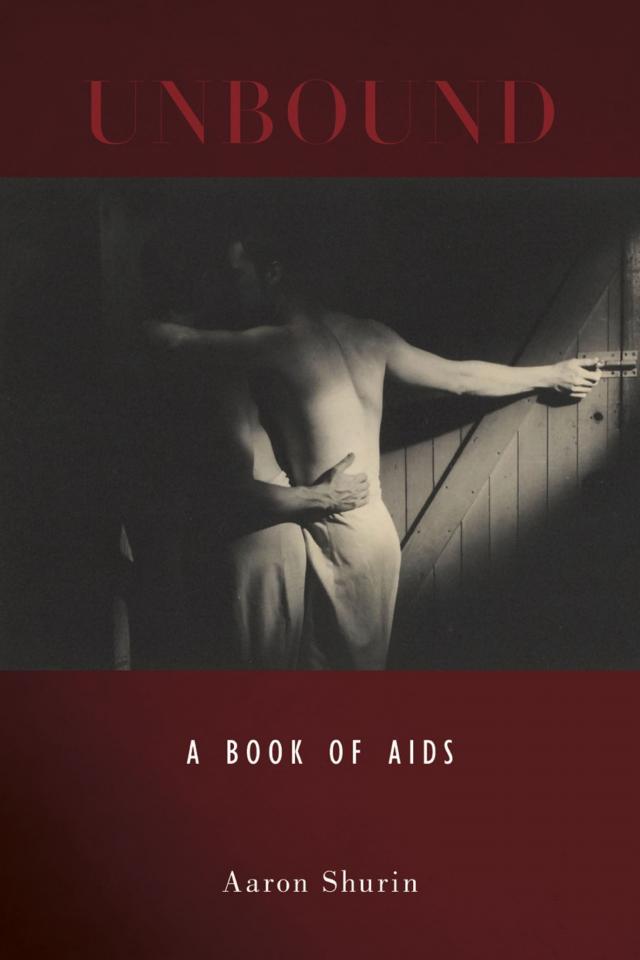
UNBOUND
A BOOK OF AIDS
Aaron Shurin
NIGHTBOAT BOOKS
NEW YORK
ALSO BY AARON SHURIN
The Blue Absolute
Flowers & Sky: Two Talks
The Skin of Meaning: Collected Literary Essays and Talks
Citizen
King of Shadows
Involuntary Lyrics
A Door
The Paradise of Forms: Selected Poems
Into Distances
A’s Dream
The Graces
Giving up the Ghost
The Night Sun
Copyright © 1997, 2023 by Aaron Shurin
All rights reserved
Printed in the United States
Print ISBN: 978-1-64362-154-8
Ebook ISBN: 978-1-64362-191-3
An earlier version of Unbound: A Book of AIDS was published by Sun and Moon Press in 1997.
Cover image: © J. John Priola
Design and typesetting by adam b. bohannon
Typeset in Bodoni
Cataloging-in-publication data is available from the Library of Congress
Nightboat Books
New York
www.nightboat.org
A NOTE ON THE TEXT
The pieces in Unbound: A Book of AIDS came together from various trajectories: as essays, poetics, solo talks, conference presentations, literary criticism, dance-texts, and poems. It was as if every valence in life were commandeered by the virus, so that one needed every form of literary address to meet it. This expanded Nightboat edition marks twenty-five years since the original publication by Sun & Moon Press in 1997; a selection then appeared as part of my essay collection, The Skin of Meaning, in 2016. Consequently, there are three introductions to the work, each trying to catch the overflow of meanings of the epidemic from a slightly different angle; each trying to draw a connective arc across the range of sorrowful and beatific revelations.
The tenor was always one of unfolding incredulity, and the ground a portion of history held in a desperate embrace. The book opens, now, with a new preface, “Rebinding Unbound,” while the two earlier introductions form an Epilogue: the anthology preface first, followed by the original 1997 version. Unbound, then, ends where it began, with sorrow, wonder, memory, history and hope uncharted, open to the wind.
CONTENTS
Preface: Rebinding Unbound
Full Circle: Postscript to “City of Men”
Notes from Under
The Depositories
Strips and Streamers
Further Under
Orphée: The Kiss of Death
Turn Around: A Solo Dance with Voice
A Lull in the Void: Postscript to “Turn Around”
Human Immune
My Memorial
Some Haunting
Inscribing AIDS: A Reflexive Poetics
Shifting Paradise
July
Generation
The Dance that We Made
Epilogue: Two Prefaces
Binding Unbound
Preface to Unbound: A Book of AIDS
Notes
Acknowledgments
Dedication
PREFACE
Rebinding Unbound
A Re-introduction to Unbound: A Book of AIDS
The bristles rising on the back of your neck, a sense of silent footsteps behind you closing in, the bewildering proliferation of medical terminology, a matrix of conjectural timelines and invisible transmissions: As the COVID-19 pandemic rages around us, building its houses of terror, how could I not recall that other epidemic, unrelenting, ferocious, which wiped out much of my extended (gay) family (among 700,000 other U. S. Americans of every race and several sexual persuasions)—all of them extinguished by the relentless acronym: AIDS.
My book of essays, poems, and assorted texts, revived here—Unbound: A Book of AIDS—was originally published in 1997, though the writing had begun a decade earlier. Even then life in San Francisco was well-saturated and transformed by the mysterious viral complex. I, too, was saturated and transformed—by loss, by grief, by constant terror, but also by friends who rose to the occasion of their dying newly empowered, with sudden wisdom and unsentimental clarity. Both the horrors and the graces were overwhelming, the more so because I’d begun to feel something like responsibility—to scale the walls surrounding the LGBTQ (especially the G) communities, and raise the alarm to inform the blindfolded citizens that a cataclysmic illness was being visited upon their (especially) fathers, brothers, and sons. It was as if we were living in an actual walled city—community as quarantine?—and no one on the outside could even conceive of the misery or dignity taking place within. Within, the drama was unrelenting, conflicted; even now I can feel the tense unknowingness, the ball and chain attached to test results, the quiet violence of waiting, the agony of joy. It was as if we were living in an opera, except the high-vaulting arias were our everyday talk, and the wrenching love duets our nightly bedside visits with Robert or Jim.
*
I wasn’t (as I originally noted) an authority—neither a scientist nor a sociologist—but I was/I am a poet, perpetually in search of meaning. I let my friends lead me through the thicket of multiplying symptoms, false cures, and assorted revelations. I found that writing about my friends brought our companionship into greater focus, an ancillary treasure to the duty of bearing witness. Decoding speech and analyzing actions—the care embedded in writing, in paying scrupulous attention—laid bare the common bonds, and open hearts, of friendship. The real geniuses among the infected invited their friends in to the zone of approaching death so they might share not the darkness but the awakenings, and return, enlarged, to their previously normal lives.
The corona pandemic! How could we possibly have imagined a second visitation in such a short time, wielding such a similar scythe, and equally propelled by government indifference and neglect? But the COVID-19 virus moves so fast and AIDS moved so slowly! The mark of this pandemic is how boldly the virus strikes, progressing with uncommon speed, often isolating patients at diagnosis, and instantly exiling loved ones to the outer-lands, hurtling the infected from intubation to tombstone in a matter of days. The mark of AIDS was how stealthily it struck, how it grew in a slow desperate progression, often unmaking the body in protracted stages, so that loved ones endured seeing the disfiguration, the withering away, the sleepless eyes trolling the dark. And yet Unbound mainly pursues the other side, where those with the virus have time to meet their mortality, to absorb the unimaginable and give shape and voice to its lessons, to rise above the falling spirit in tender dramas of salvation—or with a cognizant wink restage in full riot the comedy of errors of terrors. These things I’ve witnessed—humble interlocutor in awe before men of such bravery, such creativity, hilarity, willpower, insight, as to outmaneuver the fatal winds and compose their epitaphs in updrafts. Circles of farewells, organized meals by the hour or day, emergency telephone trees or email loops, and rounds of saintly visitors with large ears and soft voices: How lucky we were to be able to display our affection; how grateful to have the luxury of properly saying goodbye.
*
Twenty-five years later, in the middle of this new pandemic, Unbound’s urgent empathy is renewed. The AIDS-inflected stories of purple bodies and haunted places, of plotted memorials and crushing numbers, of indomitability and attitude-in-the-face-of, speak to the corona virus as from an older brother of terror to a younger, one set of grief and struggle reinforcing the other. COVID-19 calls to HIV in mortal consanguinity: two deathtraps at century’s end and century’s beginning, two agitators inflaming the transit zone between life and death, challenging our concepts of health, vulnerability, guilt, religiosity, solitude, security, community, isolation, and hope.
*
There’s a certain naiveté to some of the writing in Unbound, a gloss of innocence: I knew very little about death at the outset, and very much by the end. Is grief itself developmental? I think it grew as my writing grew, found its measure in the cacophony of names and voices, the roll call of implacable fate. I think it grew as the epidemic grew, from the spectral tremors of first encounter, to the reverberations of impossible extent. I think grief took hold as the virus does, lodged deep in the tissues and fluids and blood. Twenty-five years later it resurfaces intact, comprehensive, unwavering: a background, an imminence.
*
Unbound was the instructional medium through which I attempted to integrate the decimations of AIDS; it rubbed out the sting, licked the wounds, and swallowed the venom. I turned to sentences and narrative to participate in stories that made the invisible malevolence concrete, to put it in a human context, a body, a person: my Jackson, my Johnny, my Chuck. HIV wasn’t a grand figure, caped and marauding; it was the daily news, right in your face, grotesquely demotic. Yet as if by collective agreement there would be no common mass graves here; every perished host would be named out loud (see the Names Project, the Bay Area Reporter obits, or the AIDS memorial grove)— just as the lesbian/gay movement had transitioned from shamed silence to righteous, outspoken rebellion. I learned to act in part as a ventriloquist, through which my infected friends spoke the revelations they wanted to transmit; in part as a scribe, adhering to the malodorous facts; and in part as a writer, seizing on sentences to unknot the congeries of information and emotion, to fold Marshall or Ken into phrases of time and space, and pinch their cheeks to raise the blood and draw them back to a place among the living.
*
Unbound is arranged chronologically and carries some of the detective-like tensions that characterized the early epidemic: the elemental drama of unmasking the virus itself and naming its assault; the grand guignol theater of young men disappearing piece by piece week by week, on the street, at the café, at the gym; the tense narrative progressions of personal struggle and personal reward, of each aching trajectory from hospital to hospice to home.
I’ve added one final piece to the book, written several years after the others but very much a part of the compositional ethos. The Age of AIDS bleeds through running decades. This is the third introduction I’ve written for Unbound, and each iteration casts a different light on what is essentially unfathomable. Grieving, wailing, mourning, missing, weeping, suffering, sighing, crying, seeing, rising, reviving, transcending, overcoming, unbinding, unbending, unbound.
I tried to honor the lives I lost. I tried to make a zone of history quiver. I tried to hold my head above water so I could see farther. I tried to model your tender cheek and the swipe of your neck. I tried to thread idiosyncrasy and predicament and chance to make a day like a day, I tried to hold suspense and find the rhythms of actions and intents. I tried to get out of the way while I was talking, and respect each virus as an adversary, and make the shape of a life discernable—for a moment, at least. I tried to craft a eulogy for a city in time. I tried to make a space where you could unwind your memories, hang them out like linen to dry in the sun, and I hung mine out too, and the air was breathable.
“Common measure in homage to fitting company,” says the poem “Human Immune.”
Here is Unbound: A Book of AIDS:
A.S./2021
UNBOUND
Full Circle
Postscript to “City of Men”
When I read my erotic rampage, “City of Men,” to a group of students a couple of years back, one aw shucks type with wider than ever eyes responded: “Boy, that sure isn’t safe sex!” Chagrined, I held up the pages, pointing to the poem itself, the act of writing it. “No,” I smiled, “this is safe sex!” But—chastened—I’d copped out; it was exactly what I had not intended with “City of Men.”
I did have a hidden agenda. The poem uses only Whitman’s language, culled from poems in the Children of Adam and Calamus groupings from Leaves of Grass. As most careful readers of Whitman know, “Calamus” is his collection of homoerotic love poems, emotional, tender, idealistic, radically political, prophetic, obliquely erotic, but—alas—not sexual. If you want sex, go to the grouping “Children of Adam,” Whitman’s putative heterosexual songs. They are filled with body and body parts, physical material catalogues, paeans to the sex act—but—alas—no love. The body is electric but it is not affectionate.
I have read Whitman’s private journals, the most private parts, where they are written partially in code to keep the secret—perhaps from himself as well as others—of his love for Peter Doyle, the secret—but we’ve heard this many times from the 19th and 20th centuries—torment of his awakening but not yet awake homosexuality, the revelations of his self-expressed desire to (using for homoeroticism his code word “adhesiveness”) “depress the adhesive nature/ It is in excess—making life a torment/ All this diseased, feverish, disproportionate adhesiveness.” Depress it in himself! Anyone who has been there can immediately recognize the call of the closet. This pernicious disregard for truth caught Whitman—in spite of his revolutionary outspokenness about sex and the body as well as male/male affection—and forced him to sever his love poems—his writing of eros—into two mutually exclusive—and incomplete—halves.
My historical period has permitted me to come full circle, to write my eros out of spirit and body, shamelessly, and perhaps for the first time in history from a completely integrated viewpoint. In composing “City of Men” I chose to graft—by interspersing them—words from Whitman’s Calamus poems with those from his Children of Adam. Where the body in Calamus is incessantly hidden, metaphorized as leaves, roots, blossoms, scented herbage, live oak, moss, vines and buds, now it can be revealed in its polymorphous glory as arms, shoulders, lips, fingers, loins, elbows and necks. No more will we hear—as in Calamus—“I dare not tell it in words” or “Here I shade and hide my thoughts;” rather, as in Children of Adam: “Be not afraid of my body.”
It seems essential to me, in the age of AIDS, to keep the body forward, to keep the parts named, to not let ourselves get scared back into our various closets by those who would profit from sexual repression, from sublimation and fear of sex. What losses do we suffer by blindly embracing—if not “compulsive” sex—compulsive dating, compulsive monogamy, compulsive matrimony and domesticity, and when does avoidance of particular sex acts deteriorate into avoidance of creative exploration: dulled nerves, consumerist complacency, couplist or nuclear family paranoia, social scapegoating, stereotyping and moral sanctimony? Didn’t my generation become sexual pioneers not just by increasing the range of permissible sex acts and sex-enacted places but by tying sexual expression to socialism, feminism, national liberation movements, consciousness expansion, legal and individual rights and radical psychologies, and if it gets squashed what else gets squashed with it? The chaotic force of eros—once called desire—is a depth charge for change. Contain it and we may live an ordered existence, sure: following orders.
So I do not propose “City of Men,” or any other creative act, as a substitution for sex. I do of course propose safe sex—medically safe but not politically safe, not socially or even psychically safe. And toward the day when the Human Immunodeficiency Virus is consigned to the dustbins of history, I’ll dream—with Whitman—“Unscrew the locks from the doors!/ Unscrew the doors themselves from their jambs!”
(1988)
Notes from Under
It is alphabetic from the start, as if the full name were too terrible to be spoken, or because we don’t want to know the elaboration that would cause a true and necessary engagement with its nature; prefer a modest, even pleasant-sounding acronym to keep it hidden: AIDS. And so it remains a shark fin disease, barely indicated above, red maw gaping beneath the sight line—for those, that is, who live—marginal—beneath the infested sea. If you live here, you know it. If not, have you heard the drowning screaming your names? If not, what constitutes your privilege, and how will you receive my anger?
I am not, here, talking sex, though certainly that sublime loss of self has been threatened with—at least—self-consciousness. I have been immersed in a more quotidian terror, its brunch and coffee dialogues, or dream analogues, or telephone weepings; in community (the Gay, though clearly others are affected—all are affected—the community of affected I know are Gay) conversation, its local pits and searing elevations. So, a cloud of attendant issues and their griefs. Among friends—dead, dying, or scared, the sorrowful healthy—testimony: what I have seen that you must now know, see, for I have been surrounded and among my friends in adversity creating a life, their rising and falling beauties, deaths and tests and imagined fulfilled acts that have unleashed instructions upon us, the uninitiated.
*
For this, reading the world, new language events by which we measure grief and fear; how the virus has made us talk about it—forms of disclosure, witness, vocabularies, stories. A new literary structure I feared becoming master of: the obituary. One’s sense of the vanishing, people and—struggle against it as we will (buried alive!)—era. How what we look for first, almost perverse in eagerness, in the Gay weekly papers are the names and photos of those who’ve died this week. Who and how many did you know, numbers as stripes of honor. “I knew five people this week.” And I didn’t even know T had been sick till I saw his photo in the obituaries—a thrill with which one engages the paper, surprise building toward their appearance on page 12, to see how much sorrow one can translate into endurance. And cry, continually, because some lover used a nickname for his dead friend—and direct address—and it’s hard to be impersonal when people are calling each other sweetie across that gulf. (I can’t—don’t want to—say the names of endearment here; I/thou is their only proper usage; what signifies is that the form functions while including the dead.) And, as adjunct language, there are lists: how as a young man—a baby homosexual, I say—I kept a tally of the first men I laid, on one hand (with names), two hands, too many for fingers and toes, finally uncountable. Then, around 1982, the list began of who had died, who sick, who sero-positive—soon, too, uncountable. Another fear: the fear of forgetting. With its shadow: the desire to forget.


