Thinking about memoir, p.1
Thinking About Memoir, page 1


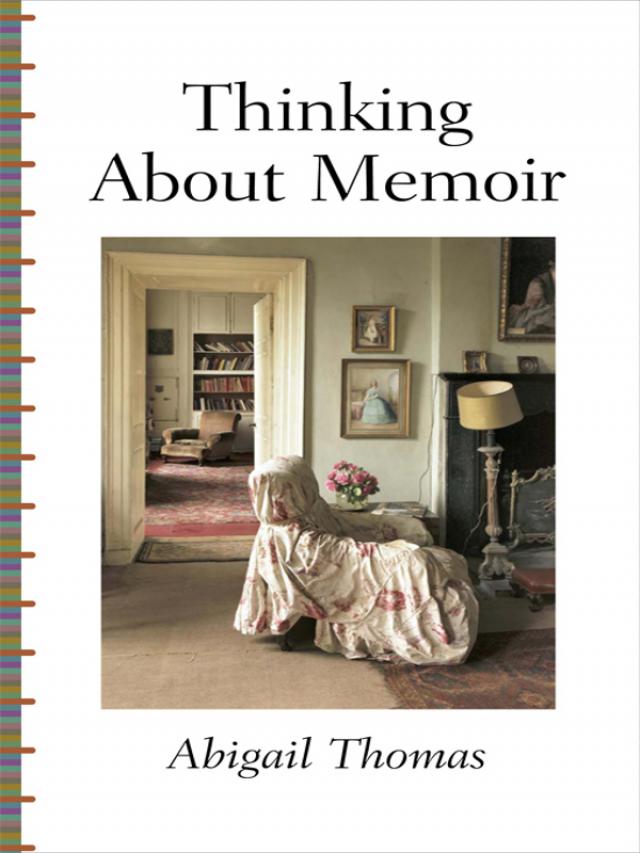
THINKING ABOUT MEMOIR
Thinking
About Memoir
Abigail Thomas
New York / London
www.sterlingpublishing.com
For CTV
Passages from this book appeared first, in slightly different form, in the Washington Post Magazine and The Iowa Review.
Library of Congress Cataloging-in-Publication Data Available
10 9 8 7 6 5 4 3 2
Published by Sterling Publishing Co., Inc.
387 Park Avenue South, New York, N.Y. 10016
The AARP name and logo are registered trademarks of AARP,
used under license to Sterling Publishing Co., Inc.
Copyright © 2008 Abigail Thomas
Distributed in Canada by Sterling Publishing
c/o Canadian Manda Group, 165 Dufferin Street
Toronto, Ontario, Canada M6K 3H6
Distributed in the United Kingdom by GMC Distribution Services
Castle Place, 166 High Street, Lewes, East Sussex, England BN7 1XU
Distributed in Australia by Capricorn Link (Australia) Pty. Ltd.
P.O. Box 704, Windsor, NSW 2756, Australia
Manufactured in the United States of America
All rights reserved
Sterling ISBN 978-1-4027-5235-3
For information about custom editions, special sales, premium and corporate purchases, please contact Sterling Special Sales Department at 800-805-5489 or specialsales@sterlingpublishing.com.
CONTENTS
Preface
one
Writing Memoir
two
The Habit of Writing
three
Memory
four
Structure
five
Writing from Loss
six
More Exercises
A Note About the Series
Index
Preface
This is a book about writing memoir. It doesn’t come with blueprints or a set of instructions—there aren’t any. Memoir can consist of looking back at a single summer, or the span of a whole lifetime. The book is divided into sections that give it a professional look, but don’t be fooled—the sections are leaky, and spill from one to another. This book is also about being in the here-and-now, because memories survive on a wisp of fragrance, or a particular shade of blue, or a song that reminds you of a song, and you don’t want to miss anything. Keep your eyes and ears open, also your heart. This is about letting the mind open up and wander, and about letting one thing lead to another. Follow the details. Detail is the antidote to boredom, and it tends to keep depression at bay.
This book is also about the habit of writing as a way to keep track of what’s going on in the front and the back of your mind. You can write about nothing in particular; just write. An embarrassingly trivial note in my diary this morning about the local coffee tossed me back to Blynn’s on 14th Street in 1958. My friends and I went there every day after school to have serious conversations about I don’t remember what, but we were fueled by cup after cup of black coffee. I remember the waitress calling out, “Adam and Eve on a raft, hold the raft.” I remember the booths were cracked red vinyl, none of us ate much of anything, and I think we all smoked Kents, but I don’t remember what the raft was. Now I remember a small perfect shell I wore on a silver chain in those days. For the first time in ages I remember I buried that shell with a baby. One thing leads to another, like it or not.
Memoir is the story of how we got here from there. I hope this book will inspire different ways to look at the moment you’re in right now, and see how far back it can take you. I hope it will make you admire how surprising life is, and I hope you will write.
Because who knows where that raft is going. Somebody’s got to jump aboard.
THINKING ABOUT MEMOIR
one
Writing Memoir
How to get started, how to keep going. What is memoir? How do you write one? What if you can’t remember anything, or worse, what if you remember it all? What do you put in? Who do you want your readers to be? I can’t write personal stuff, you say, my family will be upset. You have to put those worries aside. You need to feel free to write about the uncomfortable truths, and unless your motive for writing is revenge, you may find that these moments of discomfort are mostly your own. But, you say, I know so much about life now. I want to share my thoughts with all English-speaking peoples, and if lucky, foreign rights will also be sold. A word of caution: If you want to impart wisdom, you might wind up with a 300-page greeting card.
Writing memoir is a way to figure out who you used to be and how you got to be who you are. Still, as Raymond Carver once said, “What good is insight? It only makes things worse.” Why dredge up a lot of dusty memories? Why remind yourself that the old days will never come back? Why remind yourself of your own mortality? (The word memory comes from the same root as the word mourn, and that should tell you something.) You will find there are many reasons to go look in the icebox, or turn on the television, or reread Middlemarch. But pay attention to the little voice that whispers, “This part was interesting.” Pay attention to everything.
Recently I bought a garden statue of the Virgin Mary. I am not a religious person, but her face is beautiful, her blue robe faded, her manner full of grace. I put it in the living room, not wanting her rained on. A friend, Helen Klein Ross, looked at her and smiled. “I used to stare at her when I was little,” she said, “hoping to see movement.” She paused, brightened. “Because then I would be a saint!” If Helen hadn’t already written brilliantly about her upbringing in a large Catholic family in the Midwest, I’d have said, “Helen! Start right there! Write!”
But the jumping-off place isn’t always so obvious. You can’t always find the way in. Sometimes you need a side door. That’s where the exercises come in. Here’s the one I give all my writing students the first week of the class.
Take any ten years of your life, reduce them to two pages, and every sentence has to be three words long—not two, not four, but three words long. You discover there’s nowhere to hide in three-word sentences. You discover that you can’t include everything, but half of writing is deciding what to leave out. Learning what to leave out is not the same thing as putting in only what’s important. Sometimes it’s what you’re not saying that gives a piece its shape. And it’s surprising what people include. Marriage, divorce, love, sex—yes, there’s all of that, but often what takes up precious space is sleeping on grass, or an ancient memory of blue Popsicle juice running down your sticky chin. When you’re done, run your mind over everything the way a safecracker sandpapers his fingers to feel the clicks. If there is one sentence that hums, or gives off sparks, you’ve hit the jackpot. Then write another two pages starting right there.
Another exercise: Write two pages about a time when you were dressed inappropriately for the occasion. What occasion? Who thought you were inappropriate? That’s up to you.
A woman wrote about her first husband’s death, which had happened maybe twenty years ago. He was helping somebody load a truck, a favor for somebody he barely knew—that’s the kind of generous man he was. The truck moved unexpectedly and he was thrown to the ground, and sustained a head injury so severe that when they got him to the emergency room he was declared brain-dead. Hours later she was standing on the roof of the hospital with her husband’s brother, deciding whether or not to take him off life support. She was wearing flip-flops, shorts, and a T-shirt and she remembers thinking how these were the wrong clothes to be wearing at such a moment. She had never written about his death before. Focusing on what she was wearing gave her the distance.
A side door.
I give assignments in my writing classes because it’s hard to make something up out of a clear blue sky. Two pages is all I ask, and it doesn’t have to be a story. It doesn’t have to be an anything. It can contain a character who shows up out of breath. It can contain a lake and a bunch of swans. There can be conversation or silence. It can take place entirely in the dark. I have learned we do better when we’re not trying too hard—there is nothing more deadening to creativity than the grim determination to write. At the very least, assignments can provide a writer with a nicely stocked larder, and some notion of where the mind goes when it’s off its leash. And once in a while, if we’re lucky, an assignment helps you find that side door into a story you’ve been staring too directly in the eye.
Ideas for assignments come from everywhere. I sit down on the train and all around me people are whipping out their cell phones.
“Bob? Bob? Bob? Bob?”
“Alan? Alan? Alan? Alan?”
“Joyce?”
And then once we clear the tunnel I hear everybody saying, “I’m on the train.” Well, I’m on the train too, but so what?
Write two pages in which someone keeps her temper in check.
I do a lot of involuntary eavesdropping on the train. Last week I overheard a young woman who talked all the way from Poughkeepsie to Penn Station on her cell phone. She had an emergency, she said. She needed three platters delivered in the next two hours to a party her boss was throwing. Somebody had forgotten to order food.
“I’ll pay any amount of money,” she said. “Yes, such a rush, I understand. . . . It’s like ten people . . . I need three platters. . . . Do you have tapas? No? Chorizo? . . . you know, those Mexican sausages? Oh . . . how about Greek with stuffed . . . oh . . . I understand. . . .” The negotiations went badl
But that wasn’t the end. She called the deli back with one last request: Don’t send it until she called. She needed to be the person to open the door and receive the food because her boss had wanted it delivered from Food Emporium and she wanted to get it out of the boxes before her boss arrived. So after an hour and ten minutes of negotiations she was going to get off at Penn Station, call the deli, and race to East 68th Street to receive three platters of cheese.
Write two pages in which someone obsesses over something meaningless.
The pact we make My husband, Rich, lost his memory after he was hit by a car and suffered traumatic brain injury. In a moment of perfect clarity he once described his loss like this: “Pretend you are walking up the street with your friend. You are looking in windows. But right behind you is a man with a huge paint roller filled with white paint and he is painting over everywhere you’ve been, erasing everything. He erases your friend. You don’t even remember his name.” It’s terrifying. Because who are we without five minutes ago? Who are we without our stories? Where is the continuum of consciousness? Is it all one big lily pad of a moment? I can’t remember five minutes ago either, most likely, but I still (usually) have a sense of time passing, and if I look out the window I pretty much know what time of day it is, what season. I can locate myself in time and place. Even if I can’t find my glasses or remember what I read this morning or can’t for the life of me figure out what I’m doing in the kitchen, I am still a consciousness aware of her surroundings.
What did Rich know? He stared for a long time at a photograph of himself, and his brother, and an old friend, taken maybe sixty-five years ago. I don’t know what went through his mind. Perhaps he wasn’t thinking, perhaps he was absorbing. There are notebooks he wrote a few things in when he first got hurt, trying to figure things out, things that made no sense to him. It’s what I do too.
Writing is the way I ground myself, and it’s what keeps me sane. Writing is the way I try and make sense of my life, try to find meaning in accident, reasons why what happens happens—even though I know that why is a distraction, and meaning you have to cobble together yourself. Sometimes just holding a pen in my hand and writing milk butter eggs sugar calms me. Truth is what I’m ultimately after, truth or clarity. I think that’s what we’re all after, truth, although I’d never have said such a thing when I was young. And I write nonfiction because you can’t get away with anything when it’s just you and the page. No half-truths, no cosmetics. What would be the point?
Why bother writing at all? Once in a while you come too close to a nerve, and your writing goes flat, and your first thought might be to change the subject. But this is the most interesting of moments. There is so much to be found out. Hiding behind that paragraph is probably something worth knowing. You can stare at the page and realize, “Hot dog—this is a safe to be cracked!”, or you can crawl under the covers and take a nice nap.
So remember: The writer of memoir makes a pact with her reader that what she writes is the truth as best she can tell it. But the original pact, the real deal, is with herself. Be honest, dig deep, or don’t bother.
two
The Habit of Writing
Good writing habits A lot of writing consists of waiting around for the aquarium to settle so you can see the fish. Walking around muttering seems to hasten the process. Taking public transportation nowhere helps. Looking out the bus window lets the back of your mind move forward. Don’t listen to anything but natural sound. Don’t look at anything you have to turn on. This is about the pleasure of silence. This is not meditating; this is reacquainting yourself with yourself. Something interesting might enter your head if you let it alone. We are bombarded by media. We are overstimulated these days. We talk too much.
So there are the hours of mulling, stewing, allowing the mind to let down its guard, but the rest of it is the writing part. It helps to be in the daily habit of scribbling stuff down. I suggest you go to the stationery store and pick out a notebook you actually like. Take your time. This is going to be your companion for a while. I love blank moleskin. I believe the writer Bruce Chatwin bought them 200 at a time before taking off on a journey. Then choose a pen that you find pleasant to write with. Buy two of them. (If you buy ten, they will all be lost within an hour.) I like the kind with a point like a needle, and for me the dragging of a sharp pen across a page is a sensual experience. And, more important, I feel as if I’m actually doing something. You can’t whip out your laptop on the crowded number one train at rush hour, but you can probably get to your notebook when you hear something you want to remember, or glimpse a memory of the kind that vanish so quickly. I once observed a father holding his son on his lap and the little boy sat straight up, like a vase of flowers. I wrote it down, although it went nowhere (until now).
Call it a diary—it is less imposing than a journal, which sounds like an end in itself. I steer clear of the word journal—and its spawn, the verb to journal, as in, “I have been journaling all my life.” If I were to call my notebook a journal I would probably write with the notion that it be published someday, preferably posthumously, and people would marvel. This would make me self-conscious. I would be trying to perfect each sentence before its time. I prefer notes; if I clean it up too fast I lose the spark. Everything goes in: grocery lists, things to do (so I can scratch them off) random observations, knitting patterns, recipes, overheard dialogue, everything. A diary isn’t sacred. Think of it as the written equivalent of singing in the shower. I don’t care what I’m writing and I don’t pay any attention to language. Most of what’s in there is boring, but it keeps me in the habit. Writing doesn’t have to be good, not at first.
By now I am addicted: I need to feel my hand scribbling across a page. A friend wanted to know what I was working on; she was reading the paper and I was writing in my diary. We were having coffee at Bread Alone.
“Nothing,” I said.
“It can’t be nothing,” she said, assuming perhaps that writers were always doing something interesting. She leaned over and read, “It is taking a long time to get my sandwich.”
Case closed.
Write two pages of uninspiring diary entries (to break the ice).
Write two pages, the second sentence of which is “It’s not funny.”
Rules of diary keeping Don’t read anyone else’s.
Don’t leave yours lying around. There should be stuff in your diary that is nobody’s business but your own.
Notes from a diary Speaking of aquariums, a young friend of mine got married, and her husband came with a big fish tank. I guess there were a bunch of fish to start, but at the time of the story there were only two left, Big Boy and Little Girl. The aquarium was dirty, because these fish like murk, they are cave dwellers, they like to hide. They are bright red-gold, and I can just see the glint of their bodies appearing and disappearing into the murk, like those thoughts you can never carry all the way to consciousness. My friend wasn’t crazy about the fish, but her husband had had them a long time. My friend wanted to put a piano where the giant fish tank stood. From time to time her husband brought home small fish and dumped them into the water. A day or two would go by and he’d look at the aquarium and remark, “Not so many anymore.” Little Girl had had thousands of babies over her lifetime. She spent all her time now in the cave my friend’s husband built for her in a corner of the aquarium. Then one day my friend noticed a commotion in the tank. Big Boy had somehow lured Little Girl out of her cave and now he was pounding the life out of her in a corner of the tank. The male has a hump on his head, the better to fight with. Little Girl was dying, my friend saw, and she called for her husband who came and got the old fish out of the water and into a pail of water and put her in the laundry room. Then he went back about his chores, mowing the lawn, I think. “But you can’t leave her in there to die alone,” my friend said, but perhaps he was already out the door. So my friend sat in the laundry room and kept Little Girl company, noticing that as she died the fish got grayer and grayer until finally she floated on top of the water. I don’t know what to do with this story, or why it affects me as it does. Later I looked up these fish, and after the descriptions of habitat and feeding and reproducing and so forth came the heading “Nature” and the word beneath was “beware.” I tell this story because I had my notebook handy at the time, and got it all down. I tell this story here because I have nowhere else to tell it. I tell this story because it made me love my friend even more. Sometimes writing is a way to offer a reader someone to love.