

Halliday 12, p.1
Halliday 12, page 1


The Home of Great Western Fiction!
The three hardcases were after Kirk Nesbitt. And now they had him, they were going to kill him, real slow.
There was just one problem.
The man they’d caught wasn’t Kirk Nesbitt at all. He was Buck Halliday. And Halliday knew just what to do when the deck was stacked against him.
Leaving at least one dead man behind him, he ran straight into the arms of a beautiful young girl who also believed him to be Nesbitt … and now Halliday started to get curious about the man he kept being mistaken for. Who was Nesbitt? Why did so many people want him dead?
As everything started to become clear, and the attempts on his life kept coming, Halliday checked his weapons and went to war … and the body count started to rise.
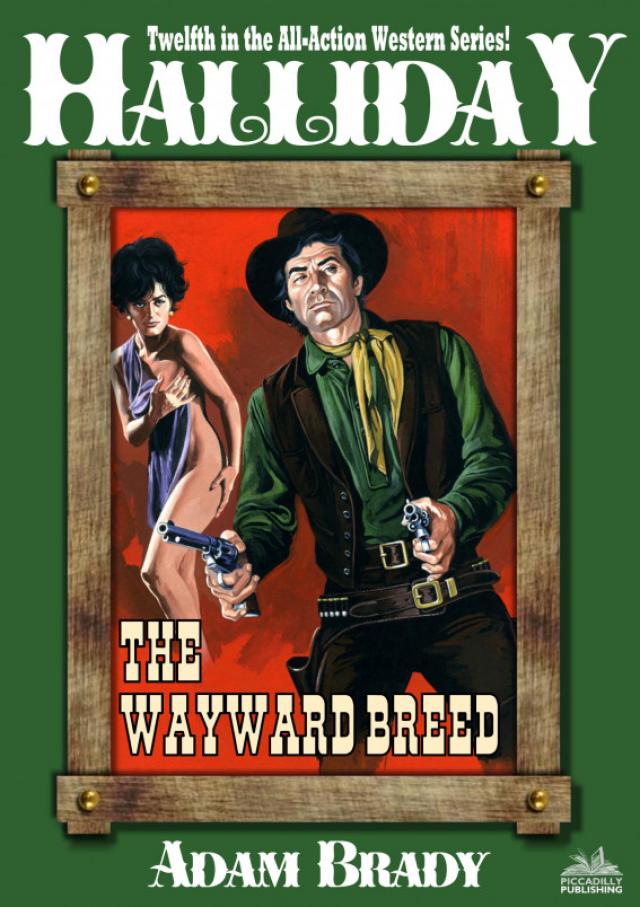
HALLIDAY 12: THE WAYWARD BREED
By Adam Brady
First published by Cleveland Publishing Co. Pty Ltd, New South Wales, Australia
© 2021 by Piccadilly Publishing
First Electronic Edition: November 2021
Names, characters and incidents in this book are fictional, and any resemblance to actual events, locales, organizations, or persons living or dead is purely coincidental.
You may not copy, store, distribute, transmit, reproduce or otherwise make available this publication (or any part of it) in any form, or by means (electronic, digital, optical, photocopying, recording or otherwise), without the prior written permission of the publisher. Any person who does any unauthorized act in relation to this publication may be liable to criminal prosecution and civil claims for damages.
This is a Piccadilly Publishing Book
Series Editor: Ben Bridges
Text © Piccadilly Publishing
Visit www.piccadillypublishing.org to read more about our books
Chapter One – Holed-Up
BUCK HALLIDAY STOPPED at the junction and casually studied the first of two lopsided signs. It read:
CRAG CREEK - 17 MILES
The name meant nothing to him but the distance did. After four days in the saddle, he was bone-weary and fed-up with having his rump continually slapped by leather. The sooner he reached a town, the better.
He looked up where threatening storm clouds had become blacker. He figured one bolt of lightning would see the heavens open up. He heeled his sorrel along to the other sign, which read:
GARROT PRISON - 5 MILES
He had no great desire to visit any prison, so he decided to take the Crag Creek route.
He put his trail-weary sorrel into a walk and headed for a line of hills. Within ten minutes the first spatter of rain fell and before long the spatters had become a deluge.
As he urged his sorrel along, he accepted the fact that he would be sleeping out again in the cold tonight. Bent over, he encouraged the sorrel by slapping its shoulder as he pushed it toward the hills.
The ground soon became slippery and finally turned into a quagmire. Halliday thought of the many times he had cursed the heat and the dust, as now the stinging rain needled his weathered cheeks. Rivulets of water dribbled down his spine to overflow at his gunbelt and soak his Levi’s. If he hadn’t wasted an hour resting back there along the trail, he thought, he would have been at least five miles closer to dry blankets, a bottle of whiskey and a thick, juicy steak.
Dismissing the picture with a shrug, he came to another junction and stopped at yet another sign. It was pointed at an angle to his right and read:
GARROT PRISON - 2 MILES
The two miles couldn’t persuade him to go in that direction. He urged his sorrel around a puddle then kneed it on again. But although he rode hard for almost an hour, the hills seemed to get no closer. Then predictably, his sorrel began to slow and the sound of its tortured breathing rose above the roar of the rain and the whine of the wind.
Halliday came out of the saddle, squelched ankle-deep through mud and slush for another hour before the rain eased and visibility improved. Drying his face on the inside of his hide jacket, he leaned against the sorrel’s heaving side and gave its ears a friendly rub. A half-mile further on was a low hill, the top of which was bare except for a cluster of boulders which gleamed wetly under the wash of pale, cold sunlight.
Halliday led his mount toward the hill and saw where the hoofs of a horse had recently plowed up the ground at its base. He followed the tracks and was within fifty yards of the first of the boulders when a rider came storming down the hill to disappear into a timbered section below.
Halliday stopped and watched the rider, curious that the man seemed to be in such a desperate hurry. He led his horse into the shelter of the biggest of the boulders, removed his coat and sat on a rock, hunched over, eyes closed.
During the next three hours, the rain continued to fall. Then suddenly it let up and stars showed in a clearing sky, followed by the faint light from a half-moon.
Halliday rose, brushed the mud off his coat with water from his canteen, had a drink and swung into the saddle again. Also rested, the sorrel no longer protested.
They traveled the flat country again, making steady progress despite runoffs continually forcing them to detour away from the main trail.
After another hour’s steady riding, the moonlight was blanketed by more fast-sweeping clouds. Then the rain came down again. This time it lashed his body so fiercely that he found it hard to stay in the saddle. The sorrel was suffering, too. It propped and stood, feet planted in the mud, with a mulish gleam in its eye. Halliday came out of the saddle, tugged on the reins and dragged the sorrel behind him.
He followed the line of the hills, keeping himself protected from the driving wind. Head down, he trudged along for what seemed like an eternity. Then pausing for a moment’s rest, he looked up at the hills, eyes searching for some much-needed shelter. He heaved a sigh of relief when he saw the vague shape of a shack, seemingly built into the rock face, silhouetted against the backdrop of the moon.
The narrow track leading up to the shack had been washed away and he had to make his way along a deep rut, with the sorrel slipping and sliding and fighting him all the way again. When he finally reached the side of the shack and pushed the horse against the wall and rope-hobbled it, he was exhausted.
Rain dripped from his coat as he made his way to the front to find the door ajar. Stepping inside, he took off his coat and his hat. Then suddenly the room was flooded with light.
Halliday turned his head, and under the wash of light, he could see the blue-gray glint of a gun barrel. He lifted his hands in token surrender and said easily:
“Whoa now. Take it easy.”
“Close the door, Jase. Bart, get his gun.”
Halliday heard movement to his right, more to his left. Then a big man obliterated most of the light and pushed him back against the wall. Then the door slammed shut. Pinned to the wall, he stared into black eyes and saw hostility lurking there. The man smelled of whiskey and sweat.
“Hold on a minute now!” Halliday called out.
“Welcome home, Nesbitt,” another man said, dressed in the same clothes as the man he saw on the horse earlier.
Halliday looked beyond the man crowding him. Near the door was a fat man, and seated at a table was a mean-eyed hardcase, holding a gun which was pointed straight at Halliday’s chest. The man at the table was thin with long red hair and bushy sideburns. The one at the door, who Halliday figured was Jase, bulged with good food and whiskey. He was heavy-jowled, pig-eyed and had a mean look about him.
Halliday felt his buckle being loosened, then the gunbelt was torn from his waist and thrown across the room. He said to the man at the table:
“You called me Nesbitt?”
“Sure did.”
“Then you’ve got me all wrong.”
The lean man nodded affably, pushed a bottle across the table in Halliday’s direction, and said:
“You must be awful dry after five years.”
“Last drink I downed was in Sorrel Plains, three days ago,” Halliday told him. “But while you realize your mistake, I don’t mind chasin’ the chill from my bones with a drink or two.”
Halliday went to reach for the bottle but the man with the smoldering eyes drove him back.
“If you lie to me, Nesbitt, I might get good and mad,” the man at the table said. “But if you lie to Bart, well, that won’t be good for you a-tall.”
Halliday stared into Bart’s eyes while he rested back against the wall, playing for time. Then the man at the table went on:
“Kirk Leslie Nesbitt, son of Henry Lucas Nesbitt, deceased. Shot and killed one Dean Jepson. Pleaded self-defense. Five years hard labor. Aged then, twenty-nine.”
Halliday shook his head. “Buck Halliday, son of Joseph Louis Halliday, deceased. Shot and killed several men. Pleaded self-defense on each occasion. Never done time. Age now, thirty six.”
Bart drew a huge paw back but held it cocked until the man at the table said:
“Okay, Bart.”
Halliday ducked as Bart’s fist smashed into the wall. Jase came away from the door, put a headlock on Halliday and dragged him toward the table. Halliday relaxed, and when he felt Jase do the same, he flung his body back, breaking the hold.
Bart charged in again and smashed a right to Halliday’s jaw. Halliday fell, instinctively taking the weight of his fall on one hip. He ducked again to avoid Jase’s boot which had been aimed squarely at his nose.
The man at the table came slowly to his feet, lifted his gun and called:
“Enough! You’re makin’ it harder on yourself than it has to be, Nesbit t. Maybe five years in a cell has addled your brain.” He pushed the table out of his way and added, “Back off you two ... fun’s over.”
He pulled the trigger in pure frustration, and the bullet thunked into the wall inches to the left of Halliday’s face. Halliday sprang to his feet and gave Bart a stiff forearm jolt to the throat. As the big man was sent reeling and gasped for breath, he turned on Jase and brought his knee up into the fat man’s groin.
Jase doubled over and Halliday straightened him up again with an uppercut, then plowed two hard punches into his bloated stomach. He was surprised to find that what he thought was fat was in fact solid muscle. Nevertheless, the power of the punches sent the big man back on his heels until his eyes rolled in their sockets.
Halliday grabbed him and threw him at the man with the gun, sending him crashing back over the table. Halliday then drove an elbow hard into the man’s neck and saw the gun fly from his grasp.
Then a noise behind him caused him to jump sideways. Bart was swinging a plank from the smashed table, intent on splitting Halliday’s head open.
Bart swung the plank and was thrown off-balance when the plank missed Halliday by a clear yard. Halliday lashed out savagely and kicked Bart’s feet out from under him. Halliday then grabbed the hardcase by the hair and slammed his head against the floor ... twice. He heard teeth and bone break.
Halliday got to his feet, picked his gunbelt up off the floor and quickly strapped it on. Apart from Bart’s agonized wheezing, there was no sound in the room, and even the pelting of the rain on the tin roof had ceased. He was trying to decide whether to stay around until the trio came to and explain himself, when the lean man rolled over and lay there with a gun in his hand.
Halliday cursed his carelessness as his hand swooped down for his gun. The man on the floor fired first as Halliday dived to the side, but this bullet also missed its mark.
Halliday’s gun cleared leather as the man slid along the floor, triggering as he went. Halliday backed into the doorway and when a shot tore strips from the doorframe inches from his head, he stepped sideways and emptied his gun into the room, hearing a moan come from Bart’s lips. Then he aimed his gun a little higher, more to discourage further opposition than to kill.
Then he ran for his sorrel, tore the rope free and swung into the saddle. Before another sound came from inside, he kicked the sorrel into a run and headed for the track that led to the trail below.
Wild shots came after him as he bent low over the sorrel’s neck, but he kept the animal steady despite the dangers of the slippery surface.
The wind had come up again and the sky became blacker as he turned the sorrel’s head in what he thought was the general direction of Crag Creek.
Then the shape of a figure on horseback loomed up in front of him.
“This way, Kirk. Hurry!”
Halliday realized it was a woman’s voice as she turned her horse away.
Halliday turned the sorrel savagely, and his leg-weary mount lost its footing. It went down, pinning his leg. Ahead of him, the woman let out an anguished cry.
“They’re coming, Kirk. Quick. Get up and follow me!” she shouted almost hysterically.
Halliday dragged his leg out from under the sorrel and once upright, helped the sorrel back to its feet. The horse trotted away a few paces and seemed unhurt, so Halliday went after it and flung himself back into the saddle.
“Kirk, trust me. I know what I’m doing,” the woman called to him.
The roar of a gun behind him told Halliday it was no time to argue. He sent the sorrel after the woman and followed her into a passageway between two giant boulders which loomed suddenly out of the night. A soft, wet hand grabbed his wrist and as the smell of her perfume hit his nostrils, the woman whispered:
“Stay quiet until they’ve gone.”
Halliday put one hand over his horse’s nose and drew his gun with the other. When the horse quietened, he thumbed fresh bullets into each chamber.
The drumming of hoofbeats became louder and then suddenly ceased. Halliday heard a man curse, then snarl:
“He’s got to be here someplace. He couldn’t have disappeared that quick.”
“You lost him ... you find him,” said another voice, laced with bitterness.
There was a long silence before Halliday again heard the sound of hoofbeats, and as they died, he quietly slipped from the saddle and backed his sorrel deeper into the passageway and ground hitched it.
When he came back to the woman, he found that she had also dismounted, but in the darkness, he couldn’t see her face.
When the hoofbeats suddenly rose louder again, then gradually receded into the distance, Halliday stared at the woman’s dim outline and said:
“Now maybe you can tell me what the hell this is all about.”
“Kirk, it’s me, Julie.”
“I’m mighty pleased to meet you, Julie,” Halliday told her. “It’s a fine name, only it doesn’t mean a thing to me.”
“You couldn’t have forgotten me in five years, could you, Kirk? Did I mean that little to you?”
“The name’s Halliday, ma’am ... Buck Halliday,” he told her. “But if it clears things up for you, you’re the fourth person tonight who’s mistaken me for a feller named Kirk.”
A harsher note came into her voice when she said:
“You’re not Kirk?”
“That, ma’am, is what I’ve been trying to tell all you folks all night.”
He heard the woman gasp and thought about striking a match to show her his face, but decided to wait a while longer, just to make sure those hardcases were not around.
“Then who are you?”
“My name’s Buck Halliday, and I’m on my way to Crag Creek.”
“So why were those men chasing you?”
“Because I wounded one of them up in a shack on top of that bluff.”
“You shot one of them?”
“Yes,” Halliday said, making no attempt to soften the word, although he immediately regretted his harsh tone when another gasp came from her.
“I’m sorry, ma’am,” he added quickly. “I have no need to take my anger out on you, but I would like to get to Crag Creek, if you’d be kind enough to point me in the right direction.”
The woman was silent for a short time before she said, in a more composed voice:
“You’d get lost trying to find it at night. The country around here stretches right down to the river in one direction and out into the desert in the other.”
Halliday sighed, removed his coat and shook it, then did likewise with his hat. Flinging the coat across his shoulder, he walked in her direction but saw her quickly back away from him. He stopped and smiled ruefully.
“Ma’am, I reckon then it’s best that we stay here for the night. I’ve been doing it hard for four days now and I’m all but spent. So I aim to get some sleep and tomorrow we can talk some more. In the meantime, it’s cold and likely to get colder, and when I first saw you, I didn’t get the impression you were dressed for weather like this.”
“I’ll be getting myself off home then,” the woman told him.
Halliday smiled to himself, and said, “Then I don’t figure you’ll be running down this Kirk Nesbitt feller tonight. More like you’ll run into those fellers who tried to kill me back there. I’m obliged to you for showing me this hiding place, so if you decide to stay the night, you’ll be warmer wearing my coat.”
Halliday took another step toward her and held the coat out to her. When she did not take it, he put the coat on a rocky ledge and walked back to the end of the passageway and felt the ground for a dry place to sit.
He found a flat rock, sat down, pulled his knees up under his chin, and as the cold wind began to bite through his shirt, he closed his eyes and wondered how pleasant Garrot Prison sounded ...
Chapter Two – A Friendly Welcome
WHEN BUCK HALLIDAY awoke the next morning, he found a slim, extremely attractive young woman brushing her long corn-colored hair. She was so busy that she didn’t notice that he was watching her. When she did, she lowered the brush and straightened her back, lifting her pert face to push her small, dimpled chin out defiantly.
“That’s a sight I wouldn’t mind waking up to every mornin’ of my life, ma’am,” Halliday said boldly.


