

Wilted pages, p.1
Wilted Pages, page 1


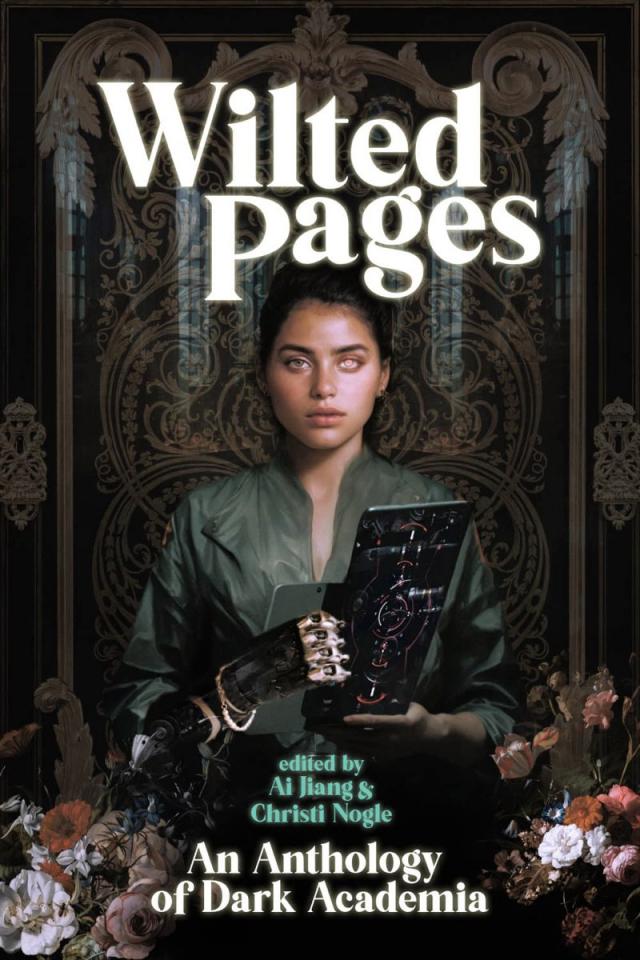
Wilted Pages
An Anthology of Dark Academia
Edited by
Ai Jiang and Christi Nogle
Shortwave
Content Warnings for applicable stories can be found at the back of this book.
WILTED PAGES
Collection Copyright © 2023 Shortwave Media LLC
Individual stories are owned by their respective authors.
All rights reserved. No part of this book may be reproduced in any form or by any electronic or mechanical means, including information storage and retrieval systems, without written permission from the author, except for the use of brief quotations in a book review.
Cover illustration by George Cotronis.
Interior formatting and design by Alan Lastufka.
First Edition published September 2023.
10 9 8 7 6 5 4 3 2 1
Library of Congress Control Number: 2023914815
ISBN 978-1-959565-11-6 (Paperback)
ISBN 978-1-959565-12-3 (eBook)
Contents
Foreword
Ai Jiang
Foreword
Christi Nogle
Haunting
Ijo de Ken Sos Tu?
Jennifer Fliss
The Girls of St. X
Simo Srinivas
Humanities 215
Science, Literature, and Human Insight
Jo Kaplan
Sacrifice
Hugging the Buddha’s Feet
Amber Chen
In Vast and Fecund Reaches We Will Meet Again
Cyrus Amelia Fisher
Applicatio
John Langan
Obsession
Higher Powers
Steve Rasnic Tem
Twisted Tongues
Michael A. Reed
The Allard Residency
Brian Evenson
Knowledge
The Library Virus
Hussani Abdulrahim
The Occupation of the Migratory Library of Oanno
R.B. Lemberg
Tiny Hearts in the Dark
Gabino Iglesias
Revenge
Parásito
Ana Hurtado
The DaVinci Chip
Suzan Palumbo
An Inordinate Amount of Interest
Ayida Shonibar
Preservation of an Intact Specimen
Premee Mohamed
Hope
Those Shining Things Are Out of Reach
Octavia Cade
Her Finished Wings
Marisca Pichette
Those Who Teach Pay Knowledge Forward
R.J. Joseph
About the Authors
About the Editors
Special Thanks
A Note from Shortwave Publishing
Content Warnings
Foreword
Ai Jiang
When I thought back to my own relationship with academia and the way that I’ve seen others collect degrees like badges of honour and success, I couldn’t help but wonder just how much the degrees themselves contributed to my career. The impact didn’t come from the pieces of framed papers but the teachers and instructors and professors themselves.
After my undergraduate studies, I wanted to pursue teaching because of how much my own teachers impacted me. Then I thought about how much I would potentially impact my students and change the direction of their lives, and that thought scared me. I gave up that path. I didn’t feel like a fitting enough guide through the tunnel for students when I, myself, kept dropping my own flashlight and fumbling aimlessly. But I realize how many educators might be in that same position, and I admire them for having the courage I never did.
On books concerning education, the ones that impacted me most are a non-fiction book titled The Smartest Kids in the World: And How They Got That Way, a memoir titled Educated, two novels titled Out of My Mind and Never Let Me Go, and, of course, the pedagogy books from my teaching stream courses at the University of Toronto. But in addition to those, I had my own life experiences and heard stories whispered by others: the dreaded gaokao in China; the time when my kindergarten teacher threatened to lock me in a closet for not sleeping during naptime; the moments I was made fun of because of my name, my accent, and my family at school and cyber bullied outside of it; the time in first grade when a boy spat at my grandmother’s feet; the moment I heard that someone had threw themselves off the railing several floors above in one of the university libraries; the time my friend, who was an hour early to her exam, only to rush out in tears and the horrors of her religious private school and their treatment of their female students; the time our professor decided to experiment with a fifteen-person group essay and caused half the class psychological turmoil; the rumors that were really realities about institutions favouring the younger, the better looking, the pale, the privileged, the connected, the outgoing, and the outspoken.
What had been ingrained in me growing up was the importance of grades and awards and wealth, when truly, street-smarts and practical life skills I learned too late, and am still learning, are far more important than any academic text could have ever taught me. But what school did a good job of was teaching me how to be disciplined and teaching me how to learn on my own, even if these things are what I’ve struggled with and still struggle with, and much of the time. Back when I was still in school, the system did not favour the slow thinkers, the musers, those who were not regurgitators, those who could not afford to study without working parttime or commuting.
Sometimes, simply being hardworking is not enough, and academic glory can be swiped from under calloused hands while sweat and tears obscure our vision. Sometimes, simply connecting and speaking to others—rather than having our heads buried within pages and pages and pages, thinking only words will save us—will allow for broader vision.
But one important thing I’ve learned so far in my journey is that what truly taught me more than anything else is stories.
I see echoes of all the dark memories and experiences—snippets, fractures, insistent whispers of the past that refuse to silence—within the stories we have chosen for Wilted Pages, and as much as they may bring unease, I hope these stories also bring you, the reader, a kind of comfort.
—From a lifelong learner,
Ai Jiang
Foreword
Christi Nogle
When Ai Jiang and I sought a publisher for this project, we said we wanted to compile an anthology inspired by works such as The Secret History by Donna Tartt, Never Let Me Go by Kazuo Ishiguro, Mexican Gothic by Silvia Moreno-Garcia, Catherine House by Elisabeth Thomas, and The Bone Weaver’s Orchard by Sarah Read. Alan Lastufka of Shortwave Publishing was kind enough to take on the project, and George Cotronis provided the gorgeous cover.
Writers from around the world, many of them deeply involved in academia, answered this call, and we and our wonderful first readers were able to consider over five hundred fascinating stories. Finally, we were able to decide on the few we had room for here, all of which exceeded our expectations. These contributors often include the “gloomy buildings, secret societies, futuristic boarding schools, gothic yet modern aesthetics, and occult learning” we sought in the call, but they go beyond that, introducing ideas and taking us to places and times we couldn’t have predicted. Reading the submissions was a wonderful education in itself.
Aside from our interest in the works named above, my co-editor and I discussed our experiences with academia. I mentioned teaching at a university for twenty years, and I think I mentioned having degrees in visual arts, writing, and literature. What I didn’t mention were my complicated feelings about teaching, learning, and educational institutions. I didn’t mention the details of my early years moving around and attending many stifling (and sometimes horrific) religious schools, being kept out of school for periods of time, being bullied and isolated once I entered public school, acting out, dropping out, and years later taking the GED exam to be able to enroll in college, or struggling to find my voice once there. My first attempt at this foreword was a rumination on all those difficulties with academia, but I realized this foreword did not have space to do justice to that topic—not to mention that it’s a bit of a downer.
So I’ll put the focus back on the works here, with the understanding that academia is, to me, and I think to these contributors, a fraught and complicated thing. The sites represented here—schools, universities, libraries, research facilities, and the field—offer microcosms of our social world. Here we yearn, fail, and succeed, in academics as well as in our relationships with peers and authority figures. We grapple with various subtle and overt forms of inequality and oppression; issues of academic freedom, surveillance, and censorship; ethical conundrums; clashes of will and of ego; feelings ranging from inadequacy and humiliation to unadulterated joy; and so much more.
We have ordered the stories in small groups. You might envision a statue in the center of our campus. The statue itself is not important—perhaps it is the skull-headed crow—but the statue’s base is six-sided with the following words:
Haunting—an entity from the past (or the future) intercedes. Featuring the stories of Jennifer Fliss, Simo Srinivas, and Jo Kaplan
Sacrifice—something is given up for an uncertain return. Featuring the stories of Amber Chen, Cyrus Amelia Fisher, and John Langan
Obsession—an idea, tick-like, attaches and will not let go. Featuring the stories of Steve Rasnic Tem, Michael A. Reed, and Brian Evenson
Knowledge—a truth announces itself, or hides. Fe aturing the stories of Hussani Abdulrahim, R.B. Lemberg, and Gabino Iglesias
Revenge—a wrong is answered. Featuring the stories of Ana Hurtado, Suzan Palumbo, Ayida Shonibar, and Premee Mohamed
Hope—a possibility becomes real. Featuring the stories of Octavia Cade, Marisca Pichette, and R.J. Joseph
These stories are dark in many different ways. Sometimes they are bitter and vengeful, sometimes full of longing and pain. They look back to problematic pasts and ahead to bewildering futures. Sometimes they revel in the darkness, making it sparkle, making it beautiful.
We hope you will love them as much as we do.
—Christi Nogle
Haunting
Ijo de Ken Sos Tu?
Jennifer Fliss
The dorm room smelled of burnt heater dust and lemon. Arriving first meant Leyla had her choice of beds, so she decided on the one by the window and dropped her things. Though it was gray outside, the windows reached all the way to the ceiling, so they let in a fair amount of light. Despite the chill, Leyla was sweaty from the walk from the station. The tide had been out, so she was able to walk right up to the school, a luxury Leyla wouldn’t appreciate until later.
Out the window, the sea and sky tumbled in a watercolor of gray. A slow creeping waltz of fog was coming in. She pushed open the window to inhale the saltwater air and instead got a breath full of cigarette smoke.
She headed to the office to collect her welcome packet. Cars crunched the gravel driveway, doors creaked open and slammed closed. Loud but unclear voices reverberated down the corridors. In the doorway of the office, while Leyla stood waiting for the secretary to notice her, an overly tall man in an olive trench coat pushed by her. She caught an earthy whiff of chewing tobacco. The man didn’t even pause and let himself into a back room.
“Dean Toldt,” the secretary said to her and handed Leyla a blue folder emblazoned with the Briarmoor crest. “Welcome packet. Schedule, rules, school history, terms of agreement, that sort of thing.”
“Terms of agreement?”
“Conduct contract. Read, sign, return.”
“Okay.” She wasn’t interested in breaking any, or many rules, but she didn’t like signing things. It was hard for her to explain, but family lore about lists, roundups, and accusations weighed on her subconscious.
“And remember,” the secretary said, tutting her teeth. “No smoking.”
“I wasn’t,” Leyla countered and went off to the back of the building for a smoke. She leaned against the cool limestone.
The fog was dense but held at a perimeter out from the school like a protective ring. The sea lapped at the rough dark rocks that stood in for a beach. Looking up, she noticed she was just under her room’s window. An arm reached out, snapping the window shut. Her roommate, Jane, must’ve arrived.
The hallways bustled with students. In her room, no Jane, but Leyla saw she’d mostly unpacked, and she’d taken the bed by the window. Leyla’s bag now sat on the floor. She reopened the window, and briny air rippled into the room.
Leyla made her bed with the corduroy coverlet and tasseled pillows filched from her parents’ living room. She put away the Briarmoor-approved clothing meant for wet winter days: V-neck sweaters and wool trousers in colors like ash and heather.
In the full-length mirror, Leyla assessed her features. She’d read once that human faces weren’t symmetrical. That if they were, it would look strange to our imperfect brains. Suddenly, in a macabre dance, her lips, nose, and eyes jittered around her face and rearranged themselves into a perfectly symmetrical image.
She brought her hand to her mouth, but her mirror image did not move, hands still at her sides. She gasped and fell onto her roommate’s bed. At that moment, in a huff, Jane blew in.
“My bed,” she said.
“Yeah, sorry.” Leyla scrambled up.
As her roommate patted her blanket, straightening out any proof Leyla had been there at all, Leyla introduced herself. “I’m Leyla.”
“It’s dinner.” Jane grabbed a jacket and left. Leyla fumbled on her shoes and followed, wondering what she had done wrong. She knew little about her roommate. According to the poster on their door, Jane was the English teacher’s daughter, from Boston, her favorite food was lasagna, and she spent summers at Bible Camp.
After grace, Leyla picked at meatloaf and limp asparagus. If she were home, she’d be eating roasted chicken, couscous, bourekas, and vegetables that hadn’t been boiled into strings, because it was Friday night and Friday nights were for candle-lighting, family-gathering, and feasting.
But not anymore, not for Leyla anyway. She hadn’t thought that a one-time experiment with pot would land her exiled at a damp Waspy boarding school. But it did.
“We don’t get snacks.” The girl across from her had dark curly hair and jade green eyes like Leyla, a combination often commented on: Where are you from, from? Leyla blinked, and the girl’s eyes turned brown, hair red.
“I know.”
“I’m Maren.”
“Leyla.”
“You in Ford Wing?”
“Yeah, you?”
“I’m next door. You stopped by?” Maren tilted her head in confusion.
“Yeah, no,” Leyla said. “I haven’t met anyone yet.”
“Yeah, you came by but didn’t say anything. Just like walked in, smiled, and left. I went to follow, but you just went right into your room, closed your door.”
Leyla blinked. She’d done no such thing. Just then someone walking behind her pulled on her hair.
“Nice hair, weirdo,” they said.
A familiar anger pushed against her sternum. She was always the weird one—hence the one-time attempt to be cool and smoke some pot with the girls on the soccer team during a pep rally. They had left her behind in a cloud of smoke, and Nicky said it might cover up her stench. The pot, Leyla claimed later, was to blame for why she punched Nicky.
“Hey,” Maren said. “Weirdos are the good ones.”
In English, they sat together. Ms. Lindley held classes in the library, so students clustered on window seats, in wooden study chairs, and in rotating club chairs. The teacher stood rod straight, feet in first position. She was in her sixties and had been at Briarmoor her entire life. She must’ve had Jane late, Leyla thought.
“What do you think of when you think of the word canon,” she asked in lieu of a welcome.
“It’s like she’s trying to be Dead Poets Society,” Maren whispered. Leyla had seen the movie that summer. To prepare for boarding school, she’d said and laughed lightheartedly, but clenched her teeth and hoped no one noticed her fear and anger at being sent away.
“War,” said one student.
“Battlefields,” Jane said and beamed at her mother.
“I think she means, like, the literary canon,” Leyla said.
“Exactly right Lila,” Ms. Lindley said, and Leyla did not correct her. “Who do we think of when we think of the literary canon?”
Silence enveloped the room, an occasional squeak from a rotating chair. The teacher scanned for eager faces. Outside, seagulls cried, and the sea crashed.
Eventually she spoke again. “Hemingway, Fitzgerald. Maybe Nabokov. Shakespeare.”
“Man, man, man, and man,” Maren said.


