

Christmas with the yule.., p.1
Christmas With the Yule Shepherd, page 1


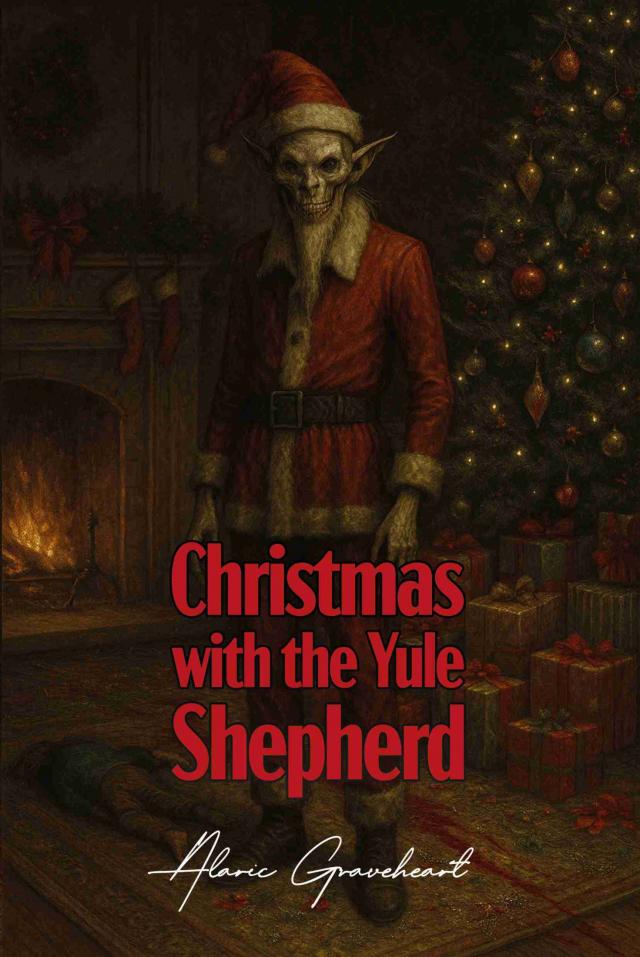
Christmas With The Yule Shepherd
Alaric Graveheart
Frightbound Publishing Ltd.
Copyright © 2025 by Alaric Graveheart
All rights reserved.
No part of this publication may be reproduced, distributed, or transmitted in any form or by any means, including photocopying, recording, or other electronic or mechanical methods, without the prior written permission of the publisher, except as permitted by German copyright law. For permission requests, visit:
www.alaric-graveheart.com
The story, all names, characters, and incidents portrayed in this production are fictitious. No identification with actual persons (living or deceased), places, buildings, and products is intended or should be inferred.
Paperback ISBN: 978-1-7394275-4-2
E-Book ISBN: 978-1-7394275-5-9
Book Cover & Illustrations by Sascha Berninger
1st edition 2025
Contents
Epigraph
Prologue Part I: The First Shepherd
Prologue Part II: Rising
1. New Beginnings
2. The Community
3. The First Death
4. Investigation Begins
5. Mrs. Henshaw's Truth
6. Shocked
7. Impossible Evidence
8. The Second Victim
9. The Crime Scene
10. The Workshop Vision
11. Photographs and Proof
12. Distance Is Irrelevant
13. Desperate Measures
14. A Life Ended, A Spirit Sought
15. The Ultimatum
16. Desperate Alliance
17. Excavating the Foundation
18. The Yule Shepherd Manifests
19. Entering Hell
20. The Great Escape
21. Aftermath
22. Dawn
23. Evening Escalation
24. Midnight Sacrifice
25. Christmas Morning Chaos
26. Silent Suffering
27. First Contact
28. The Descent
Epilogue Part I: One Year Later
Epilogue Part II: Christmas Eve Midnight - The Return
Prologue Part I: The First Shepherd
The Christmas Eve Shift
December 24th, 1889
Hollowbrook Workhouse, Yorkshire
11:00 PM
The thing about hell, Thomas Wardley would think years later–or what passed for years in the place he'd gone–was that it didn't announce itself with trumpets or lakes of fire. Hell was just another Tuesday. Another shift. Another night when your fingers were too numb to feel the splinters anymore, and that was actually a mercy.
Except this wasn't Tuesday. This was Christmas Eve, which made it worse somehow.
The workshop floor of Hollowbrook Workhouse stretched forty feet in every direction, a vast cavern of shadows and sawdust where forty children labored by the guttering light of sixteen tallow candles. The candles weren't for their benefit–Mr. Shepherd didn't believe in coddling–but because you couldn't make toys in total darkness, and toys were what wealthy families in London expected to find beneath their trees come Christmas morning. Perfectly painted wooden soldiers. Rocking horses with real horsehair manes. Porcelain dolls with hand–sewn silk dresses.
Beautiful things, made by small hands that would never touch anything beautiful again.
Thomas was twelve, which made him practically ancient here. He'd been in the workhouse since he was six, when his mother died of consumption and his father drank himself into the Thames. Six years of sixteen–hour shifts. Six years of watery gruel and sleeping on boards. Six years of Erasmus Shepherd's cane.
The workshop was cold enough that Thomas could see his breath, even though he sat only ten feet from the single coal stove that was supposed to heat the entire space. The stove was a joke–a cruel one, like everything else in Hollowbrook. It generated just enough warmth to remind you what you were missing, but not enough to stop your joints from aching or keep the younger children from shivering so hard they could barely hold their tools.
Thomas worked on his 187th toy soldier of the night. His station was wheel–turning, which meant he operated the small lathe that smoothed the wooden pieces before assembly. It required steady hands and constant attention. Two hours ago, he'd dropped a wheel. It had rolled across the floor–such a small thing, barely worth noticing–and Mr. Shepherd had noticed everything.
The cane had come down twice across Thomas's knuckles, sharp cracks that had split the skin. Blood had welled up, dark and thick. Mr. Shepherd had not permitted him to wrap the wounds, and now Thomas worked with red–stained fingers, his blood mixing with the sawdust that coated everything.
He didn't cry anymore. None of them did. Tears were a luxury you left behind after your first month in Hollowbrook.
Around him, the other children worked with the mechanical precision of those who'd forgotten they were children at all. Mary Cutler, age nine, painted tiny faces on wooden soldiers, her tongue poking out in concentration. The faces all looked the same after a while–rosy cheeks, simple smiles–but each one had to pass Mr. Shepherd's inspection or Mary would go without supper. Again.
Peter Hobbs, ten years old and small for his age, assembled the soldiers' wooden muskets, his fingers swift despite their size. He'd been apprenticing under Mr. Shepherd since he was five. Five years of this. Thomas couldn't imagine five more.
Couldn't imagine tomorrow, really.
But it was young Anne Merriweather who would make tomorrow impossible for all of them.
Anne was seven, thin as a rail, with hollow eyes that were too large for her pinched face. She had been working on the same doll for three days–a special commission, Mr. Shepherd had said, for a merchant's daughter in London. The doll was exquisite: eighteen inches tall, porcelain face painted with delicate features, real human hair (Thomas didn't ask where it came from; you learned not to ask questions), and a dress of midnight blue silk with tiny seed pearls sewn along the bodice.
Anne had done the sewing. Her tiny fingers were perfect for such work, Mr. Shepherd said. She'd pricked herself so many times that several of the pearls had small bloodstains, but you couldn't see them unless you looked close, and no one would look close. Rich children didn't think about the cost of things. Not the real cost.
Thomas watched Anne from the corner of his eye. She'd been staring at the doll for the past fifteen minutes, her needle paused mid–stitch. It was a look he recognized–the same look he sometimes caught on his own face in the reflection of the workshop windows. The look of someone teetering on an edge, wondering what would happen if they just... let go.
"Keep working, you lazy creatures." Mr. Shepherd's voice cut through the workshop like a blade.
Thomas's hands jerked back to his lathe, heart hammering. He hadn't even heard Shepherd approach. The man moved like smoke, appearing whenever you weren't looking, always watching, always there.
Erasmus Shepherd stood at the far end of the workshop, a tall silhouette against the feeble light. He was forty–seven years old and looked older–gaunt to the point of skeletal, with sunken cheeks and eyes that sat too deep in their sockets. He wore the same black suit every day, threadbare at the elbows but meticulously maintained. His cane was polished dark wood, three feet long, and he carried it everywhere. Not because he needed it to walk, but because it made a very satisfying sound when it struck flesh.
Thomas knew that sound well. They all did.
"One hundred and eighty–seven toys." Shepherd's voice was thin and reedy, like wind through a cracked window. "We need two hundred. Two hundred toys before you sleep, before you eat, before you do anything but what you were placed on this earth to do, which is to WORK."
He strode down the center aisle between the workbenches, his cane tapping against the floorboards in a steady rhythm. Tap. Tap. Tap. Thomas felt his shoulders hunch instinctively, making himself small, invisible.
"You are orphans," Shepherd continued, his favorite sermon. "Unwanted. Worth less than the rats that nest in the walls. Society has no use for you. I have given you purpose. I have given you meaning through labor. And how do you repay me? By working slowly. By making mistakes. By proving, again and again, that you are exactly as worthless as I suspected."
He stopped behind Anne.
Thomas's hands froze on the lathe.
"Miss Merriweather." Shepherd's voice went soft, which was worse than when he shouted. "Are you working?"
Anne's needle moved frantically. "Y–yes, Mr. Shepherd."
"Are you?" The cane tapped once against the floor. "Because it appears to me that you are admiring your work. Is that accurate?"
"No, sir. I was–I was just checking the stitching, sir, to make sure–"
"To make sure what? That it meets your standards?" Shepherd leaned down, and Thomas could see the shadow of his face in the candlelight, all sharp angles and hollow spaces. "Do you believe you have standards, Miss Merriweather?"
"N–no, sir."
"No. You don't. Because you are nothing. You create beauty for those who deserve it, but you yourself are not beautiful. You are not special. You are a tool, Miss Merriweather. A hammer or a saw. And tools do not stop to admire their work."
Anne nodded frantically, her needle flying now, but Thomas could see her hands shaking. Tears tracked down her face, dripping onto the doll's blue dress. She was going to ruin it. The fabric would water–stain, and then Shepherd would–
Anne gasped, jerking her hand back.
Time seemed to stop.
The doll teetered on the edge of the workbench. Anne lunged for it. Her hands closed on air. The doll fell, tumbling in what felt like slow motion, the candlelight catching on its porcelain face, its perfect painted features, its silk dress–
It hit the floor with a sharp crack.
The porcelain face split down the middle, a jagged line from forehead to chin. One painted eye skewed off at an angle, giving the doll a lunatic stare. The silk dress crumpled beneath it, already collecting sawdust.
The workshop went silent. Even the children who'd been working stopped, needles and hammers frozen in mid–motion. Everyone was looking at Anne.
Everyone except Mr. Shepherd.
He was looking at the doll.
For a long moment, he said nothing. Then, very slowly, he bent down and picked up the broken thing. He held it up to the light, turning it this way and that, examining the damage with the care of a surgeon studying a tumor.
"Three days of work," he said quietly. "Three days of resources. Silk. Porcelain. Horsehair. All wasted. Because you were careless."
"I didn't mean–" Anne's voice was barely a whisper.
"You didn't mean." Shepherd's head tilted, almost curious. "You didn't mean to destroy valuable property. You didn't mean to waste my time, my materials, my generosity in allowing you to work on such a fine piece. You didn't mean any of it. Is that your defense?"
"I'm sorry, Mr. Shepherd, I'm so sorry, please, I'll fix it, I'll–"
"You'll fix it." Shepherd smiled. It was not a kind smile. "Yes. Yes, you will. Everyone, put down your tools and gather round. I believe a lesson is in order."
Thomas's stomach turned to ice.
The children rose slowly from their benches, moving with the shuffling gait of the elderly, their bodies broken by hours of sitting hunched over. They formed a loose circle around Anne, who remained frozen at her workstation, her eyes wide with terror.
"Miss Merriweather has made a mistake," Shepherd announced. He set the broken doll on the center workbench, positioning it so everyone could see the cracked face. "She was careless. Careless with valuable materials. Careless with the time I have invested in her training. Carelessness must be corrected, or it spreads like disease. You understand this, don't you, children?"
Forty voices murmured agreement. What else could they do?
"Good. Then you will watch, and you will learn what carelessness costs."
Shepherd grabbed Anne by her hair–she screamed–and dragged her to the center of the circle. He forced her hand down flat on the workbench, palm up, her small fingers splayed against the rough wood.
"Mr. Shepherd, please–" Anne was sobbing now, struggling weakly, but Shepherd's grip was iron.
From his belt, he drew a wooden mallet. Not his cane–the mallet was worse. Heavier. Used for driving wooden pegs into the toys' joints. Thomas had seen what it did to wood. He'd seen it split hardwood with a single blow.
"Children must learn discipline," Shepherd said, raising the mallet. "They must learn that actions have consequences. They must learn that they are nothing–NOTHING–except what their work makes them."
The mallet came down.
CRACK.
Anne's scream tore through the workshop, a sound that was barely human, a sound that Thomas would hear in his nightmares for–well. For as long as he had nightmares. Which wouldn't be very long at all.
Her index finger bent at an angle that fingers weren't meant to bend. The bone had snapped cleanly, Thomas could see the white gleam of it through the split skin, could see the blood pooling on the workbench, dark and wet.
"That's one finger for carelessness," Shepherd said calmly. The mallet rose again. "And another for destroying property."
CRACK.
The middle finger. Same result. Anne's screams reached a pitch that made Thomas's ears ring. She was trying to pull her hand away, but Shepherd held it down with inhuman strength.
"And a third for wasting my time."
CRACK.
The ring finger. Anne stopped screaming. She simply stared at her ruined hand, at the three fingers bent wrong, at the blood that dripped steadily onto the floor, forming a small puddle beneath the workbench.
Then she slumped forward, unconscious.
Shepherd took a ladle from the water bucket and threw it in her face. Anne jerked awake with a gasp, coughing and sputtering.
"No sleeping," Shepherd said. "You will finish your shift. You will complete your quota. Your hand will work or you will not eat. Do you understand?"
Anne nodded, her face gray with shock and pain.
"Good." Shepherd released her, and she crumpled to the floor. "The rest of you, back to work. We have thirteen toys remaining. No one sleeps until the quota is met."
The children returned to their benches. What else could they do?
Anne crawled back to her station, cradling her ruined hand. Somehow–and Thomas never understood how–she picked up her needle with her good hand. She began to work on a new doll, this one only half–finished, her broken fingers dangling uselessly. Blood dripped onto the fabric. She worked anyway.
They all worked anyway.
Thomas turned back to his lathe. His own broken fingers throbbed in sympathy. He positioned another wheel, began to turn the crank.
Around him, the workshop settled back into its rhythm. The scrape of saws. The tap of hammers. The quiet whimpers of children who'd learned that crying loudly only made things worse.
And above it all, Mr. Shepherd's voice, reciting his philosophy like a catechism: "Christmas is about giving. The wealthy give money. You give labor. This is the natural order. You are orphans, unwanted, worth nothing. Only work gives you value. These toys bring joy to deserving children. You will never deserve such joy. Accept your place."
Thomas accepted his place.
He accepted it right up until 11:47 PM, when his hand–the one with the broken fingers–knocked his candle onto the pile of sawdust beside his lathe.
It might have been an accident.
Years later, when he had time to think about it, time that stretched into eternity in the darkness beneath Hollowbrook, Thomas would remember that moment with perfect clarity. Would remember seeing the candle teeter. Would remember having half a second to grab it, to save it, to stop what was about to happen.
Would remember letting it fall instead.
Because death, even death by fire, was better than one more day in Erasmus Shepherd's workshop.
The sawdust smoldered first, a dull orange glow that Thomas stared at with something like wonder. Then it caught, small flames licking upward, hungry and bright.
"Fire," someone whispered.
The word rippled through the workshop. Fire. Fire. FIRE.
The flames reached the workbench–old wood, dry as bone, coated in sawdust and wood shavings that were essentially kindling. The bench caught with a soft whumpf, and suddenly the flames weren't small anymore.


