

Perilous planets, p.1
Perilous Planets, page 1


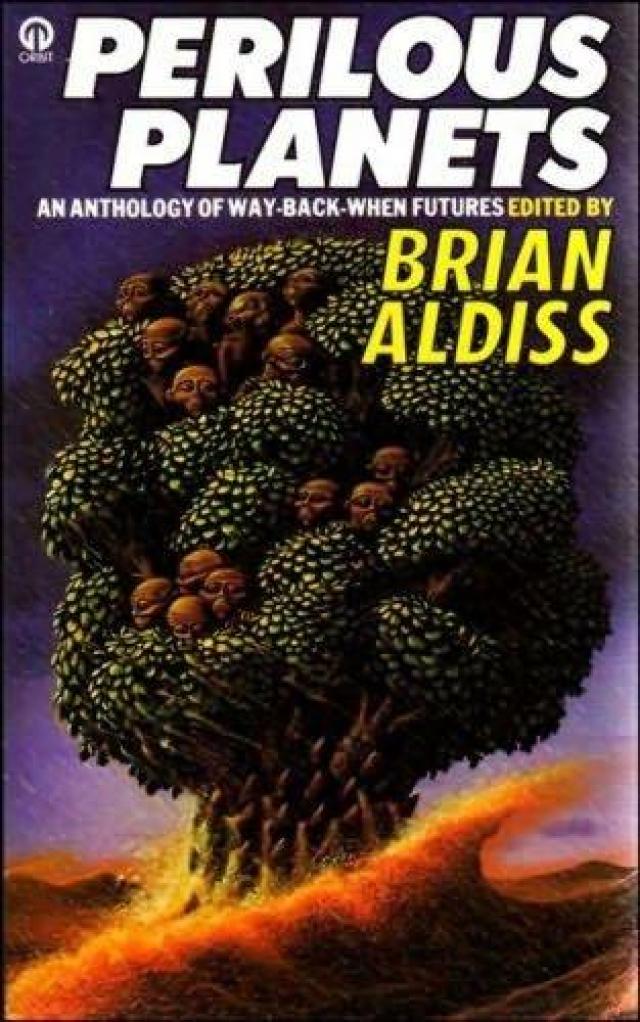
Perilous Planets
Brian W. Aldiss
Brian W. Aldiss is Britain’s leading science fiction writer. He has won many of the prizes in the field, including the Hugo, the Nebula, and the BSFA Award. The Australians voted him ‘World’s Best Contemporary Writer of SF’, and his novels and stories have been translated into many languages. His science fiction novels include Non-Stop (1958), Hothouse (1962), and recently more controversial novels such as The Dark Light Years (1964), Report on Probability A (1967), and Barefoot in the Head (1969). He has also proved himself a master of the short story, in such collections as The Moment of Eclipse (1970). His recently published history of science fiction Billion Year Spree has been widely acknowledged as a major contribution to the genre.
Also available in Orbit edited by Brian W. Aldiss:
SPACE OPERA
SPACE ODYSSEYS
EVIL EARTHS
GALACTIC EMPIRES Vols. I and 2
Perilous Planets an anthology of way-back-when futures edited by Brian W. Aldiss
Futura Publications Limited An Orbit Book
An Orbit Book
First published in Great Britain by George Weidenfeld & Nicolson Ltd This edition 1980
Introduction and compilation copyright © Southmoor Serendipity 1978
This book is sold subject to the condition that it shall not, by way of trade or otherwise, be lent, re-sold, hired out or otherwise circulated without the publisher’s prior consent in any form of binding or cover other than that in which it is published and without a similar condition including this condition being imposed on the subsequent purchaser
ISBN o 7088 80711
Reproduced, printed and bound in Great Britain by Hazell Watson & Viney Ltd Aylesbury, Bucks
Futura Publications Limited no Warner Road Camberwell, London SE5
ACKNOWLEDGEMENTS
‘HOW ARE THEY ALL ON DENEB IV?’ by C. C. Shackleton Copyright © 1965 SF Horizons Ltd. Reprinted by permission of the author
MOUTH OF HELL by David I. Masson Copyright © 1968 David Masson. Reprinted by permission of Faber and Faber Ltd. from THE CALTRAPS OF TIME by David I. Masson
BRIGHTSIDE CROSSING by Alan E. Nourse Copyright © 1951 Alan E. Nourse. First published in GALAXY 1951. Reprinted by permission of Brandt & Brandt
THE SACK by William Morrison Copyright © 1950 by Street & Smith Publications Inc. Reprinted by permission of the Conde Nast Publications Inc. First published in the September 1950 issue of Astounding Science Fiction
THE MONSTER by A. E. van Vogt Copyright © 1948 by Street & Smith Publications Inc. (now Conde Nast Publications Inc.). Reprinted by arrangement with Forrest J. Ackerman and the E. J. Carnell Literary Agency. First published in Astounding Science Fiction 1948
THE MONSTERS by Robert Sheckley Copyright © Robert Sheckley 1953. Reprinted by permission of
A. D. Peters & Co. Ltd.
GRENVILLE’S PLANET by Michael Shaara Copyright © 1952 Michael Shaara. Reprinted by permission of the author
BEACHHEAD by Clifford Simak Copyright © 1951 ZiffDavis Publishing Co. Reprinted by permission of Robert Mills Limited. First published in Fantastic Adventures July 1951
THE ARK OF JAMES CARLYLE by Cherry Wilder Copyright © 1974 by Cherry Wilder. Reprinted by permission of the author and her agent, Virginia Kidd. Published in New Writings in SF24 edited by Kenneth Bulmer. First published by Sidgwick & Jackson in 1974. Corgi edition published in 1975
ON THE RIVER by Robert F. Young Copyright © 1964 by ZiffDavis Publishing Co. Reprinted by permission of the author
GODDESS IN GRANITE by Robert F. Young Copyright © 1957 by Fantasy House Inc. Reprinted by permission of the author. Published in THE WORLDS OF ROBERT F. YOUNG (Gollancz Feb. 1974). Reprinted from The Magazine of Fantasy and Science Fiction, September 1957
THE SEEKERS by E. C. Tubb Copyright © 1965 by John Carnell for New Writings in SF6. Reprinted by permission of the author and the E. J. Carnell Literary Agency
WHEN THE PEOPLE FELL by Cordwainer Smith Copyright © 1937 by Street & Smith Publications, renewed 1965 by Paul Linebarger. Reprinted by permission of the author’s estate and the Scott Meredith Literary Agency Inc., 845 Third Avenue, New York,NYioo22
SCHWARTZ BETWEEN THE GALAXIES by Robert Silverberg Copyright © 1974 by Random House Inc. Reprinted by permission of the author and his agents, Scott Meredith Literary Agency Inc., 845 Third Avenue, New York, NY10022
THE TITAN by P. Schuyler Miller Copyright © 1952 by P. Schuyler Miller. Reprinted by permission of Mary E. Drake, sister and heir
FOUR IN ONE by Damon Knight Copyright © 1953 by Galaxy Publishing Co. Reprinted by permission of the author
THE AGE OF INVENTION by Norman Spinrad Copyright © 1966 by Mercury Press Inc. Reprinted from the Magazine of Fantasy and Science Fiction by permission of the author and his agent, Michael Bakewell & Associates Ltd.
THE SNOWMEN by Frederik Pohl Copyright © 1959 by Galaxy Publishing Corporation. Reprinted by permission of the author and the E. J. Carnell Literary Agency
Contents
Introduction
‘How Are They All on Deneb IV?’ By C. C. Shackleton
SECTION 1
UNINHABITED PLANETS
‘. . . Because they’re there’
Mouth of Hell by David I. Masson
Brightside Crossing by Alan E. Nourse
The Sack by William Morrison
SECTION 2
INHABITED PLANETS
Whatever Answers the Door?
The Monster by A. E. van Vogt
The Monsters by Robert Sheckley
Grenville’s Planet by Michael Shaara
Beachhead by Clifford D. Simak
SECTION 3
A DASH OF SYMBOLS
No Names to the Rivers
The Ark of James Carlyle by Cherry Wilder
On the River by Robert F. Young
Goddess in Granite by Robert F. Young
The Seekers by E. C. Tubb
SECTION 4
MARS AND VENUS
Love and War
When the People Fell by Cordwainer Smith
The Titan by P. Schuyler Miller
SECTION 5
BECOMING MORE ALIEN
A Universal Home Truth
Four in One by Damon Knight
The Age of Invention by Norman Spinrad
The Snowmen by Frederik Pohl
Schwartz Between the Galaxies by Robert Silverberg
Afterword
Introduction
Long before I began compiling this book, I could see what it had to contain. Its title and its contents leaped at me while I was working on the first anthology in this series, Space Opera*, three years ago.
For the majority of readers new to science fiction, a landing on another planet - a planet, because unknown, even more perilous than Earth - must be their peak experience of the genre. If they don’t get the true sf charge out of touchdown on Procyon v, they will never get any charge at all. The cutting edge of science fiction lies along the interface between the known and the unknown.
So what I wanted for my anthology was that seminal story in which our brave astronauts, or space-travellers as they used to be called, make the first-ever voyage through space, see the stars like jewels flung into the sack of night, and touch down on a totally unknown planet. There they jump out to test the atmosphere, find it even better than Earth’s, and take a stroll amid the glorious scenery. Whereupon something awful appears and - according to which seminal story you read -attempts to eat them, warps their minds with obscene telepathic messages, or captures them and takes them into subterranean tunnels.
It was a fantastic story, one you remember for the rest of your life. My trouble was, I had forgotten which story it was. For months, I leafed my way through my library, looking for the seminal story. I found plenty of stories like it, but never that actual story.
Eventually the truth dawned. That seminal story had no actual existence. It was a creation of my memory, compounded from elements common to many similar first-landing stories. It was, you might say, a folk memory of landing on a strange planet.
Space Opera was followed by Space Odysseys, Evil Earths, and Galactic Empires (in two volumes), all from the publishers of this companion volume.
Looking backwards into the mists of receding time, or the receding mists of time, I can see how the legend has gradually become briefer and more sophisticated over the ages since I first began reading, and the sayers of the saga themselves gradually less Neanderthal. Right on the edge of the abyss where memory begins, I am able to recall myself lying in my cot, dummy in mouth, reading an absolutely enchanting Great Progenitor of the story in Wonder Stories.
This is how that Great Progenitor went.
Two professors with German names are arguing about the nature of life. One of them believes that life would be possible even with a silicon-based metabolism, as opposed to the carbon-based metabolism prevalent on Earth; the other does not so believe. Both put their points of view. Sometimes they grow angry and strike their brows, or scribble equations on a handy blackboard. Every few chapters, in comes the housekeeper and throws more coal on the fire.
So heated grows the argument, that the two professors with German names decide to settle the matter by travelling to Mars, which they suspect is a silicon world. Going out into the backyard, they begin to assemble a rocketship, still occasionally striking their brows. Some parts they get from the local hardware store, where the owner is amused by their preposterous idea; he often looks over the garden fence to joke with them. But progress is made, little by little, chapter by chapter.
The rocket is completed. The two professors with German names persuade their housekeeper to come along with them as cook; she consents to come as long as she can bring her dog, Fritz. They climb aboard, shovel in the coal, heat up the boiler, and the rocket goes shooting up into space - to the considerable discomfiture of the hardware store owner.
Space is very interesting and is described in some detail. They can see all the planets in the solar system, etc. They are aiming for Mars but Fritz knocks the compass over and they land by accident on Jupiter instead. To their surprise, they find Jupiter is rather like Earth, except cloudier. Also the trees are bigger.
The two professors with German names step outside and sniff the air. It is even better than Earth’s. They take a stroll.
Whereupon something appears. It is a crowd of Jovians and - bless my soul! - they prove to have a silicon-based metabolism. So one of the professors wins his argument. They shake hands and marry the housekeeper, whose carbon-based metabolism has always had a certain appeal.
Doubtless some of my more cynical readers will find this story a little naive, comical even. Let me assure you that my first impressions were entirely more favourable. At that tender age, I had never heard anyone discussing such a fascinating subject as the nature of life; if taxed I might have claimed offhand that life had no nature. Nor had the subject of a silicon-based metabolism ever crossed my mind. I believe I am correct in saying that it was this metaphysical aspect of science fiction which interested me as much as the actual spaceflight and landing on Jupiter.
As the ages passed and I left nappies behind, I found that the story of that first landing was developing. The earlier chapters became abridged, even perfunctory. The spaceships were still built privately in back yards, but the details of manufacture, and the argument, were curtailed. The landing, and what happened then, became the thing. After more ages the stories simply skipped the prolegomena and opened with the ship blasting out of space and the captain jumping out of his ship, sniffing the air and finding it even better than Earth’s, and claiming it in the name of - well, it used to be the British Empire, but that changed too.
Nowadays, the formula has tightened still further. Perhaps you will recall a recent story which begins smartly, ‘After landing on Regulus v, the men of the Yarmolinsky Expedition made camp .. .’ (I prefer not to give the name of the story; with any luck, you will find it in the next anthology in this series.)
There was a time, during the sixties, when it looked as if the first-landing story was dead, killed by its own cliches. At that period, Harry Harrison and I had started the first of our many collaborations, a little magazine of sf criticism entitled SF Horizons. An Oxford friend of ours, C. C. Shackleton, wrote some witty send-ups of various aspects of science fiction. One subject he impaled was precisely this matter of first-landings; as one can infer from his remarks he felt the subject had It suffered severely from over-use. I am happy to include his piece, ‘How Are They All on Deneb IV?’ as a kind of postscript to this Introduction, since it defines the area more wittily than I could ever aspire to do.
So this anthology does not contain that first-landing story you remember. It was just a folk-memory. All parts of the legend are, of course, embedded in H. G. Well’s novel, The First Men on the Moon. One never forgets the moment when Cavor and Beford see the sun rise, watch the plants grow, and sniff the air, to find it even better than Earth’s.
What this anthology does contain are stories which, while being excellent in their own right, range along the whole spectrum of interest aroused by that feat which still remains imaginary: standing upon another planet. (The Moon is a satellite, not a planet.) That particular kind of thrill has been conjured in literature since time immemorial; during time memorial, sf is the name of the literature that does it now.
Actual unrestricted travel in space, if it ever comes, may alter the nature of science fiction, as reality wipes out folk memories. There must be other beings on other planets who dream similar tales. I’m convinced - I know it is controversial to say this - that when we get to Jupiter we shall find it inhabited by creatures with a silicon-based metabolism. For sure, their writers will be writing science fiction, too. Who knows, maybe it’s even better than Earth’s...
We have here seventeen stories from nine different magazines; their vintages cover a span of three decades. Some are deservedly famous, some undeservedly neglected. As always, in the hope of preserving a whiff of period flavour, I have left the original blurbs intact, or forged them where the originals were not available. Can you tell the fakes? Two hundred and fifteen correct answers to the last anthology so far. An additional puzzle this time: which piece is by me, operating under a pen name?
Brian W. Aldiss Heath House Southmoor October 1976
‘HOW ARE THEY ALL ON DENEB IV?’
by C. C. Shackleton
All right, I know, times are changing. It’s the great theme of our age. Ever since evolution and all that, the decades have gone hog wild for change; you’d think there was a law about it.
Maybe there is a law about it.
Don’t think I’m complaining: I am. Since I was a kid, everything has changed, from the taste of bread to the nature of Africa and China. But at least I thought sf would stay the same.
Instead, what has happened? It’s all different. They don’t write like Heinlein any more - even Heinlein doesn’t. In the old days, you knew exactly where you stood in a story. Take the aliens; back in the Golden Age, when the writers had a bit of a sense of wonder and there were blondes on the covers, you knew the aliens would always be there, endlessly mown down, endlessly picturesque, swarming over endless alien worlds. But nowadays - well, let’s take actual cases, he said, reaching eagerly for the May 1940 copy of Gruelling Science Stories. The Luftwaffe was plastering London at the time, but thank heavens the American sf writers hadn’t got wind of that, and Zago Blinder was still turning out his customary peaceful limpid prose. His May 1940 stint was entitled, with what I’ve always thought showed considerable skill in alliteration, ‘The Devils of Deneb iv’.
You know how this sort of thing goes right from the start. The pleasure lies in its predictability. Scarcely has the whine (whisper, snarl, thunder) of the landing jets died than the hatch opens and three Earthmen jump (crawl, climb, fall) out and stand looking round Deneb iv. They find the air is breathable and quickly hoist the flag (Old Glory, U.N. banner, Stars and Stripes).
Up to now, we readers have been carried along breathlessly (restlessly, hesitantly, mindlessly) on the flood of the author’s prose, full of admiration for the way in which he has so economically created a situation so distinct from our own humdrum world. More, the old-timers among us are full of gratitude for his dropping the first three (four, six, twelve) chapters describing the construction of the spaceship in someone’s back yard and its long eventful journey to Deneb which were once considered compulsory in this sort of exercise.


