

Kapo, p.1
Kapo, page 1


ALEKSANDAR TIŠMA (1924–2003) was born in the Vojvodina, a former province of the Austro-Hungarian Empire that had been incorporated into the new Kingdom of Yugoslavia after the First World War. His father, a Serb, came from a peasant background; his mother was middle-class and Jewish. The family lived comfortably, and Tišma received a good education. In 1941, Hungary annexed Vojvodina; the next year—Tišma’s last in high school—the regime carried out a series of murderous pogroms, killing some three thousand inhabitants, primarily Serbs and Jews, though the Tišmas were spared. After fighting for the Yugoslav partisans, Tišma studied philosophy at Belgrade University and went into journalism, and in 1949 joined the editorial staff of a publishing house, where he remained until his retirement in 1980. He published his first story, “Ibika’s House,” in 1951; it was followed by the novels Guilt and In Search of the Dark Girl and a collection of stories, Violence. In the 1970s and ’80s, he gained inter national recognition with the publication of his Novi Sad trilogy: The Book of Blam (1971), about a survivor of the Hungarian occupation of Novi Sad; The Use of Man (1976), which follows a group of friends through the Second World War and after; and Kapo (1987), the story of a Jew raised as a Catholic who becomes a guard in a German concentration camp. Tišma moved to France after the outbreak of war and collapse of Yugoslavia in the early 1990s, but in 1995 he returned to Novi Sad, where he spent his last years.
RICHARD WILLIAMS’s translations from the Serbo-Croatian include the Siniša Kovačević play Novo je doba (Times Have Changed).
DAVID RIEFF is the author of ten books, including The Exile: Cuba in the Heart of Miami; Slaughterhouse: Bosnia and the Failure of the West; A Bed for the Night: Humanitarianism in Crisis; Swimming in a Sea of Death: A Son’s Memoir; and, most recently, In Praise of Forgetting: Historical Memory and Its Ironies.
OTHER BOOKS BY ALEKSANDAR TIŠMA
PUBLISHED BY NEW YORK REVIEW BOOKS
The Book of Blam
Translated by Michael Henry Heim
Introduction by Charles Simic
The Use of Man
Translated by Bernard Johnson
Introduction by Claire Messud
KAPO
ALEKSANDAR TIŠMA
Translated from the Serbo-Croatian by
RICHARD WILLIAMS
Afterword by
DAVID RIEFF
NEW YORK REVIEW BOOKS
New York
THIS IS A NEW YORK REVIEW BOOK
PUBLISHED BY THE NEW YORK REVIEW OF BOOKS
435 Hudson Street, New York, NY 10014
www.nyrb.com
Copyright © 1987 by Nolit, Belgrade
Translation copyright © 1993 by Harcourt, Brace & Company
Afterword copyright © 2021 by David Rieff
All rights reserved.
Reprinted by special arrangement with Houghton Mifflin Harcourt Publishing Company.
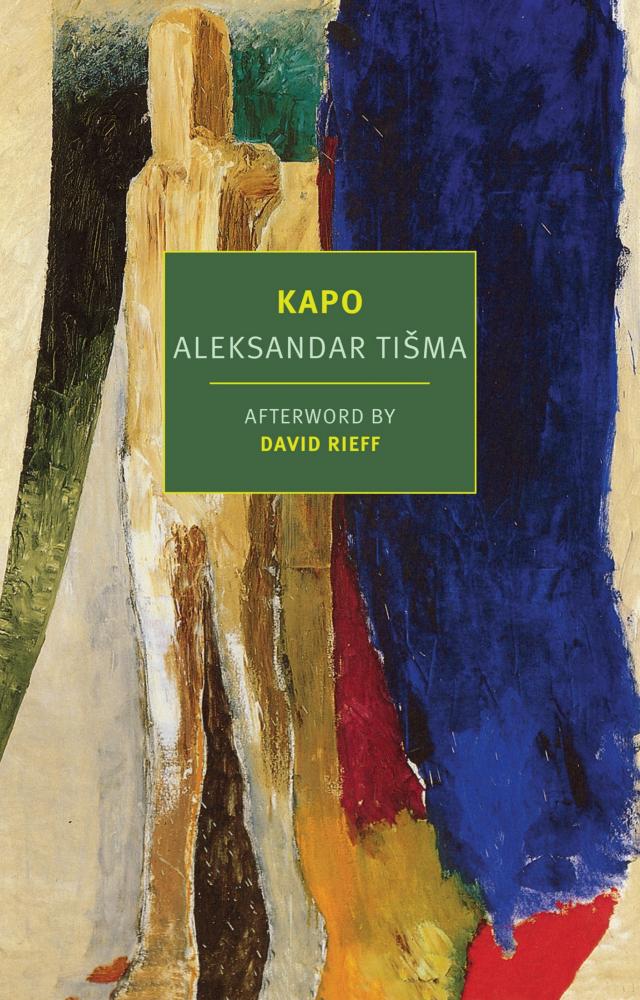
Cover image: Nathan Oliveira, Untitled/Standing Figure #6, 1990; courtesy of the artist’s estate
Cover design: Katy Homans
The translation of this book was supported
by the Ministry of Culture and Media of
the Republic of Serbia.
Library of Congress Cataloging-in-Publication Data
Names: Tišma, Aleksandar, 1924–2003, author. | Rieff, David, writer of afterword. | Williams, Richard, translator.
Title: Kapo / by Aleksandar Tišma ; translated by Richard Williams, afterword by David Rieff.
Other titles: Kapo. English
Description: New York : New York Review Books, [2021] | Series: New York Review Books classics | Copyright © 1987 by Aleksandar Tišma, translation copyright © 1993 by Richard Williams.
Identifiers: LCCN 2019039526 (print) | LCCN 2019039527 (ebook) | ISBN 9781681374390 (paperback) | ISBN 9781681374406 (ebook)
Subjects: LCSH: World War, 1939–1945—Jews—Fiction. | World War, 1939–1945—Yugoslavia—Fiction. | Fear—Fiction.
Classification: LCC PG1419.3.I8 K3613 2020 (print) | LCC PG1419.3.I8 (ebook) | DDC 891.8/2354—dc23
LC record available at https://lccn.loc.gov/2019039526
LC ebook record available at https://lccn.loc.gov/2019039527
ISBN 978-1-68137-440-6
v1.0
For a complete list of titles, visit www.nyrb.com
CONTENTS
Cover
Biographical Notes
Other books by Aleksandar Tišma published by NYRB Classics
Title Page
Copyright and More Information
KAPO
Afterword
HE HAD FOUND HELENA LIFKA. HE HAD RECOGNIZED HER, was sure it was she—unless a whole chain of illusions had conspired to deceive him.
Her emergence from the doorway by the metal plate with the number 16, the number he had been given with the name of the street, the name he had seen at the street corner. Then her appearance, that slight stoop he knew so well, timidity in the hunched shoulders and bowed head, and her legs, those stout, strong columns, the fleshy calves, the knees bent softly inward. The body was changed, a ruin—after all, decades had passed—but not so changed that it didn’t bring back memories.
But these thoughts did not form until he was no longer looking at her, not having dared to step into the house after her. While he had her there before him, his mind, everything in him rebelled against recognition, crying out, “It isn’t, it can’t be!” Perhaps because he could not accept that she had become an old woman, or because he was afraid of what recognition would force him to do: follow her into the house, introduce himself, subject himself to her horror, hatred, even revenge. Revenge least of all, really; he no longer feared her. On the contrary, he wanted to lay himself open before her, to receive her forgiveness.
No, it would be hatred, terror, she would shrink from him as if he were a loathsome thing, a toad or a snake, a creature buried in the unconscious and in dreams, that would, if it surfaced, make her recoil and scream.
He himself had had a similar feeling when he saw her framed in the high, narrow doorway, descending the two steps to the sidewalk. Holding onto the wall as she took the first step, then removing her hand but keeping it raised at chest level, a hand enclosed in a gray cotton glove; raised not to support herself—there was no need of that once she had reached the second step, because the wall was past her shoulder now—but out of habit, as if ready to clutch some kind of support, a proper iron railing, which these stairs did not have. Or perhaps it wasn’t out of habit, but in preparation for the future, when such a railing would be indispensable.
He sensed fear in the way she moved; not only in the hand, which remained raised, but in those awkward legs that stepped down without assurance, as if hobbled, bound with cords above the touching knees. Her coat, also gray but lighter than the gloves, bunched above the thighs. A simple coat, cut like a man’s, with two rows of buttons and a narrow, snug collar, and it seemed to him that the folds in it were labored and stiff, too, as if they covered ropes.
Against his will, his eyes were drawn to that hinge of the body which is the most important in walking, that center also of femaleness—or, in the male, of maleness—and he thought that if it wasn’t ropes (it couldn’t be ropes), then it was her underpants, the thick, bulky underpants of an old woman, that were binding her tightly there, piled one atop the other as protection against the cold, though it was only October, because she didn’t care how they looked, she wasn’t going to show herself to anyone in her underpants. She wasn’t, because, beneath them, wrapped in them, there was only old flesh: an old slack belly, graying hairs sparse from rubbing, old flabby pudenda that hung between jellylike thighs which rubbed as she walked, producing moist sores.
Looking at her loins, he felt his own to be old and flabby, so that his hunt for her, his spying from a doorway across the way, seemed indecent, as if the purpose were for these two loins, old as they were, again to come together.
The thought of such a coupling horrified him, made him want to thrust Helena Lifka away, far away, just as horror, an inner shriek of rejection, had been his first impulse when he found her trail again in the truck to Banja Luka, in the newspaper which lay folded under the bench in front of him, discarded, belonging to no one, because the bench was for the moment vacant, empty of passengers.
Yet he had not picked up the paper at first, as if he knew that he shouldn’t, that something in it was waiting to attack and bite. Or perhaps he hesitated because the paper wasn’t his and he would be violating the law of ownership, but when finally, moved by boredom, he took it from the dirty floor and unfolded it, he read—even before realizing that it was useless to him, printed in a language he didn’t understand—the word Szabadka. That was the first word his eyes fell on. He felt revulsion and pain, because it immediately summoned the name Helena Lifka, and Jüdin, which had been written on the same line as that name, along with the number 1925, in the register of new arrivals at Auschwitz.
A foreign newspaper was a natural place for this remembered word, Helena Lifka’s birthplace, which had led him to conclude, with relief, when he first saw it in the camp, that the woman came from a country other than his own, probably Hungary, so at least as far as nationality was concerned she was unrelated to him. But now, in the truck, he wondered how a foreign paper found its way to the road between Pobrdje and Banja Luka, where foreigners hardly ever strayed.
It was as if the paper had been planted there, to remind, to threaten. But who would threaten? As the truck bounced along, raising dust, he glanced at the other passengers—two peasant women on the bench behind him, engrossed in a conversation that was raised to a shout because of the noise, and a number of government employees scattered dejectedly in the corners—searching for a possible culprit.
He concluded that it could have been someone else, a third party who on the seat in front of him had dropped the paper under the bench, as bait, and then left. Except he remembered now that when he boarded the truck at Pobrdje, where he had been surveying fields, the paper was already under the bench, and the bench, the entire center of the vehicle, had been empty—which was why he sat there.
He folded the newspaper as he found it, then dropped it back under the seat in front of him as inconspicuously as possible, pushing it farther forward with the tip of his shoe: This isn’t mine. But in his thoughts he was unable to ignore it. He asked himself if he had read Szabadka correctly. Perhaps it was another word, one similar to the word he remembered, the same letters but in a different combination. Should he bend over again and pick up the paper, to make sure? He no longer had the courage to do so.
The truck jolted along, making stops. The two women got off, and a new passenger got on, a musician with a tamburitza. The dust from the road poured in under the canvas and settled on the floor and benches and in the lungs, but he kept looking, out of the corner of his eye, at the paper that lay under the seat in front of him, occasionally shifting left, right: there was a danger it might stray into the corner where a bent-over man sat with a hat on his head and a briefcase under his arm, and that he might pick it up and take it with him, to use as wrapping paper if nothing else.
Then he would never find out if he had actually read Helena Lifka’s birthplace, nor would he ever know in what kind of paper it had been printed, because in his excitement he had failed to note the name of the paper. So even if he found the courage to make inquiries about Szabadka, in some library in Banja Luka or even in Sarajevo, he would have nothing to go on.
When they arrived at the bus station in Banja Luka and everyone got up, he got up too, but at the opening in the canvas, he stepped back from the pressing crowd, picked up the paper, and shoved it under his coat. His heart pounded: Had this act exposed him? He cast a furtive glance at his fellow passengers as he elbowed his way toward the opening and waited for someone—the man with the briefcase certainly looked like an informer—to thrust a hand into his coat, pull out the paper, and strike him across his face and glasses with it, shouting, “Here’s one!”
But nothing of the sort happened. The man with the briefcase got off without looking back, and after him the musician, tamburitza clutched to his chest. Lamian was last, but then it occurred to him that the trap might be set by two: the man with the briefcase would report that Lamian had picked up the paper, and someone else—in uniform perhaps, since it would no longer be necessary to conceal anything—would wait for him right at the opening in the canvas, stand him up straight as he buckled from the jump to the ground, and pull the evidence of guilt from under his coat.
He wanted to put it down again, and looked around for a place, but the driver, who was standing next to the truck, signaled with his hand for him to hurry, so he jumped, clutching his coat just as the tamburitza player had clutched his tamburitza a moment before. Into the dust with a thud, into the small-town bustle outside the station; he straightened his legs, and discovered with relief that the driver’s face was no longer turned to him but the ties on the canvas, which he was hastily rethreading through their grommets.
And the uniform? Lamian didn’t see a single one, nor did he see anybody observing him, nearby or from a distance. The square, covered with stalls, counters, and belated shoppers clustered around them, looked as it always did, as if no one was expecting him or lying in wait for him. As if the foreign paper had indeed found its way by chance into the truck that served as a bus to link the remote border villages with Banja Luka. And as if he, Lamian, had by chance sat where some foreigner, perhaps traveling through to the sea, had discarded the paper, had dropped it on the dusty floor.
He went directly home and, locking the door, lowering the blinds, and turning on the lamp, took the paper from beneath his coat and placed it on the table. He unfolded it. Yes, in one of the headlines, the third, halfway down the page, where the bulge of the fold was, Szabadka, in large type on a line with some other words. He tried, with no success, to guess their meaning. Turning the page, he scanned the next sheet spread out before him, looking for the same word, or any word he could understand.
On the third page, he found it again, but not in a headline. It was under a headline, at the beginning of a short news item or report, which began, after the word, with a date written in reverse order: 1947, junius 19. So it was indeed the name of a place, as he had thought, though in the back of his mind, doubt remained, the possibility of a coincidence, for example, what signified a place in the camp register could mean, even though spelled the same, something different in another context: an object, a person’s name.
He continued to search for the same word, in the headlines, then lowering his glance to the beginning of each article. He found it seven more times, five of which were on the eighth and last page, where the shortest news items were. From this he concluded that the paper was published in the place that bore that word as its name, or near that place.
He turned back to the front page and started sounding out the huge letters at the top, slanted as if written by hand, and they even had little tails at the end, like those left by the stroke of a pen. The words told him nothing. But directly beneath them he found again, in ordinary type, Szabadka, 1947 junius 20, and then, after a mark which could have only been an equals sign, Subotica, 20. jun 1947. He stared at the words and numbers, at each letter and each number separately, put them together, separated them again, until his eyes blurred.
To clear his eyes, he looked up at the wall, which was cut in half with a shadow cast by the lampshade, and it was as if in that border between light and shadow, he read what now dawned on him: that Szabadka was Subotica in Hungarian, and therefore the paper he had found on the floor of the truck, even though in Hungarian, was printed in Yugoslavia, in the city of Subotica, whose Hungarian name he hadn’t known. He had thought that Helena Lifka was a foreigner, at least in her citizenship, a person from beyond a border that he had considered his, though borders had been erased by the war. But in reality she had come if not at that time then certainly now, from within the same borders as he, and possibly lived within those borders, assuming, that is, she still lived.
THE DISCOVERY HAD BEEN SECONDARY, INCIDENTAL, JUST as his relief had been—a relief in reality unfounded—when he read Szabadka in the register of new arrivals.
He had gone to the records office on that autumn morning in 1944 not to establish what country the girl was from but to learn if she was really a Jew, as Lina, the Slovak Blockelteste, had claimed, a claim that had left him astonished and desperate.
With a forced smile, he had got rid of Lina, stuffing into her hands the package of silk underwear he had ready for her. Quivering with impatience, he waited for Riegler to appear so he could ask him for a pass to the office, on the excuse that his count of the Arbeitskommando did not tally. He started toward his destination, stumbled down the rain-soaked path, eyes fixed on the muddy ground in front of his feet, as if it might open up and swallow him, and so almost collided with Scharführer Lang, who gave him such a powerful shove in the ribs that he nearly fell. Then he had to snatch off his cap and report, and suffer a pair of slaps for his inattention, which would have cost him his life if he hadn’t had a pass.
The collision seemed such a bad omen, he thought of abandoning his errand. But he knew that if his doubts were not resolved, they would give him no peace, so he continued toward the office, making an effort to walk with more composure.
He went inside, took off his cap, and blurrily established that there were no Germans in the room. Looking for a familiar face among the prisoners bent over their desks, he saw Jelinek, for whom he had wangled a wool vest and some mange medicine from the Kanada supply depot. He went up to him, clicking his heels and reporting loudly, for all to hear, that he had been sent by Kommandoführer Riegler for information about prisoner No. 13698. At the same time, he slipped a cigarette from the split left sleeve of his tunic and laid it among the papers on the desk, so that only Jelinek saw, and Jelinek dropped what he was doing and turned to the tall ledgers on the shelves behind his desk.


