

Humanity 2 0, p.1
Humanity 2.0, page 1


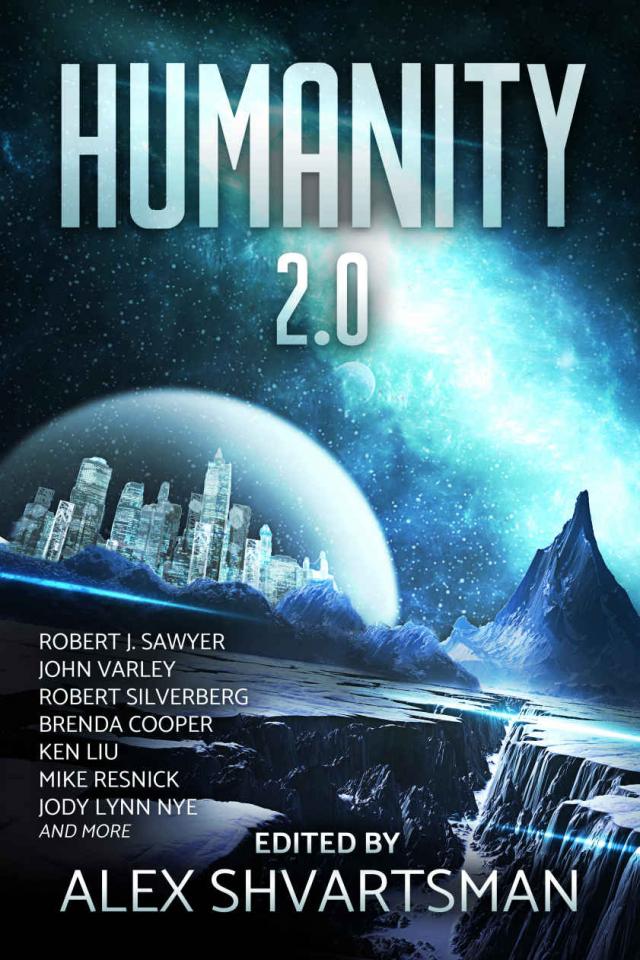
Table of Contents
HUMANITY 2.0
Copyright
FOREWORD
Alex Shvartsman
THE WAVES
Ken Liu
JUSTICE AND SHADOW
Angus McIntyre
NEXUS
Nancy Fulda
A LACK OF CONGENIAL SOLUTIONS
Kenneth Schneyer
GREEN GIRL BLUES
Martin L. Shoemaker
MINDJACK
Jody Lynn Nye
PICNIC ON NEARSIDE
John Varley
AN ENDLESS SERIES OF DOORS
David Walton
ANGRY ROSE’S LAMENT
Cat Rambo
THE RIGHT PLACE TO START A FAMILY
Caroline M. Yoachim
THE IRON STAR
Robert Silverberg
e^h
Alvaro Zinos-Amaro
THE HAND ON THE CRADLE
Brenda Cooper
THE HOMECOMING
Mike Resnick
STAR LIGHT, STAR BRIGHT
Robert J. Sawyer
ABOUT THE AUTHORS
ABOUT THE EDITOR
HUMANITY 2.0
edited by
Alex Shvartsman
Copyright
Humanity 2.0 edited by Alex Shvartsman. Copyright © 2016 by Alex Shvartsman. All rights reserved. This book may not be copied or reproduced, in whole or in part, by any means, electronic, mechanical or otherwise without written permission from the publisher except by a reviewer who may quote brief passages in a review.
"The Waves", copyright © 2012 Ken Liu, first published in Asimov's Science Fiction, December 2012
"Picnic on Nearside", copyright © 1974 John Varley, first published in F&SF, August 1974
"Angry Rose's Lament", copyright © 2008 Cat Rambo, first published in Abyss & Apex, 2008
"The Iron Star", copyright © 1988 Agberg Ltd, first published in Amazing Stories, January 1988
"The Homecoming", copyright © 2011 Mike Resnick, first published in Asimov's Science Fiction, April 2011
"Star Light, Star Bright", copyright © 2000 Robert J. Sawyer, first published in Far Frontiers, September 2000
All other stories copyright © 2016 by their authors
Cover illustration and design by Holly Heisey, http://hollyheiseydesign.com
This is a work of fiction. Any resemblance to any actual persons, events or localities is purely coincidental and beyond the intent of the author and publisher.Tarikian, TARK Classic Fiction, Arc Manor, Arc Manor Classic Reprints, Phoenix Pick, Phoenix Science Fiction Classics, Phoenix Rider, The Stellar Guild Series, Manor Thrift and logos associated with those imprints are trademarks or registered trademarks of Arc Manor, LLC, Rockville, Maryland. All other trademarks and trademarked names are properties of their respective owners.
ISBN DIGITAL: 978-1-61242-310-4
ISBN PAPER: 978-1-61242-309-8
www.PhoenixPick.com
Great Science Fiction & Fantasy
Free Ebook Every Month
Published by Phoenix Pick
an imprint of Arc Manor
P. O. Box 10339
Rockville, MD 20849-0339
www.ArcManor.com
FOREWORD
–––––––––––––––––––Alex Shvartsman
“The stars are not for Man.” —Sir Arthur C. Clarke, Childhood’s End
“That is, not for biological humans 1.0.” —Guilio Prisco
In his article for KurzweilAI, Guilio Prisco writes: “Ultimately, I think space will not be colonized by squishy, frail and short-lived flesh-and-blood humans…. It will be up to our postbiological mind children, implemented as pure software based on human uploads and AI subsystems, to explore other stars and colonize the universe.” Mr. Prisco is not a science fiction writer. He’s a scientist, futurist and transhumanist who was, at one point, a senior manager in the European Space Agency. He’s dead-serious about humanity exploring the stars sooner rather than later, and he’s not alone.
In 2012, former astronaut Dr. Mae Jamison founded the 100 Year Starship project. Their stated mission is to make human interstellar travel capabilities a reality within a century. It may be a lofty goal, but they’re funded by the likes of NASA and DARPA. Some of the world’s smartest people are investing time, effort, and money into the possibility of interstellar travel in our—or perhaps our children’s—lifetime, and no technology that may get our descendants outthere is off the table. “Eventually, they will travel between the stars as radiation and light beams,” concludes Prisco.
When asked about the famous Clarke quote, Prisco is quick to point out that it was merely a narrative device used in Childhood’s End. Like most science fiction writers, Clarke was a vocal proponent of space travel. He wrote several pop-science books on the subject. And, of course, a great many stories.
Science and science fiction are ever in conversation. Writers look to the latest breakthroughs and emerging technologies to inspire their fiction, while scientists and engineers often turn to SF tales both to challenge themselves and to better understand how scientific innovation might affect society. Conscious of this symbiotic relationship, organizers regularly invite science fiction writers to speak at the 100 Year Starship Symposium. As of 2015, they instituted the Canopus Award for Interstellar Writing to encourage and recognize science fiction that examines interstellar travel. The inaugural winner in the short-form fiction category was “The Waves” by Ken Liu, the story which opens this anthology. (Full disclosure: my own “The Race for Arcadia” was one of the runners-up.)
“The Waves” and other stories collected in this book examine how interstellar flight might change humanity itself. Will we choose to upload our minds into a singularity? Enhance ourselves with alien DNA? Or will our bodies remain the same, but our culture and societal norms adapt to accommodate for effects of time dilation, or become subsumed by advanced alien cultures?
What will it mean to be human in such a future?
Ken Liu’s story is a millennia-spanning saga that examines many different metamorphoses humanity might undergo, while holding a staunchly positive view of our future selves. Kenneth Schneyer’s tale counters with a far more pessimistic outlook of human nature and its influence on the other species in the universe.
Our authors imagine different modes of interstellar travel: from cryo-ships in stories by Jody Lynn Nye and Caroline M. Yoachim, to the enormous generation vessels of Angus McIntyre and Alvaro Zinos-Amaro, to the instant-transfer portals of Nancy Fulda and David Walton. Whether uploaded, genetically re-engineered, or merged with an alien consciousness, the characters in these stories consistently retain at least some of their humanity—for better or for worse.
I selected two stories to serve as counter-points to the rest. In John Varley’s “Picnic on Nearside” it is the aliens who come to us, and take over Earth; the remnants of humanity must adapt to life on the Moon, outer planets and the asteroid belt. When faced with a difficult decision, the people in Robert Silverberg’s “The Iron Star” make arguably the most human—but not humane—choices.
Finally, Mike Resnick brings a man forever changed by his journey to the stars back to Earth in the Hugo-nominated “The Homecoming,” and Robert J. Sawyer’s characters rediscover the stars in “Star Light, Star Bright.”
Although their visions may differ wildly, these writers—as well as scientists and engineers from around the world—vividly imagine a future where our species will reach beyond Earth. And while space may not be hospitable to the flesh-and-blood Homo sapiens of today, to dream of reaching the stars is among the most human things we can do.
THE WAVES
–––––––––––––––––––Ken Liu
LONG AGO, just after heaven was separated from earth, Nü Wa wandered along the bank of the Yellow River, savoring the feel of the rich loess against the bottom of her feet.
All around her, flowers bloomed in all the colors of the rainbow, as pretty as the eastern edge of the sky, where Nü Wa had to patch a leak made by petty warring gods with a paste made of melted gemstones. Deer and buffalo dashed across the plains, and golden carp and silvery crocodiles frolicked in the water.
But she was all alone. There was no one to converse with her, no one to share all this beauty.
She sat down next to the water, and, scooping up a handful of mud, began to sculpt. Before long, she had created a miniature version of herself: a round head, a long torso, arms and legs and tiny hands and fingers that she carefully carved out with a sharp bamboo skewer.
She cupped the tiny, muddy figure in her hands, brought it up to her mouth, and breathed the breath of life into it. The figure gasped, wriggled in Nü Wa’s hands, and began to babble.
Nü Wa laughed. Now she would be alone no longer. She sat the little figure down on the bank of the Yellow River, scooped up another handful of mud, and began to sculpt again.
Man was thus created from earth, and to earth he would return, always.
“What happened next?” a sleepy voice asked.
“I’ll tell you tomorrow night,” Maggie Chao said. “It’s time to sleep now.”
She tucked in Bobby, five, and Lydia, six, turned off the bedroom light, and closed the door behind her.
She stood still for a moment, listening, as if she could hear the flow of photons streaming past the smooth, spinning hull of the ship.
The great solar sail strained silently in the vacuum of space as the Sea Foam spiraled away from
There’s something you should see, João, Maggie’s husband and the First Officer, whispered in her mind. They were able to speak to each other through a tiny optical-neural interface chip implanted in each of their brains. The chips stimulated genetically-modified neurons in the language-processing regions of the cortex with pulses of light, activating them in the same way that actual speech would have.
Maggie sometimes thought of the implant as a kind of miniature solar sail, where photons strained to generate thought.
João thought of the technology in much less romantic terms. Even a decade after the operation, he still didn’t like the way they could be in each other’s heads. He understood the advantages of the communication system, which allowed them to stay constantly in touch, but it felt clumsy and alienating, as though they were slowly turning into cyborgs; machines. He never used it unless it was urgent.
I’ll be there, Maggie said, and quickly made her way up to the research deck, closer to the center of the ship. Here, the gravity simulated by the spinning hull was lighter, and the colonists joked that the location of the labs helped people think better because more oxygenated blood flowed to the brain.
Maggie Chao had been chosen for the mission because she was an expert on self-contained ecosystems and also because she was young and fertile. With the ship traveling at a low fraction of the speed of light, it would take close to four hundred years (by the ship’s frame of reference) to reach 61 Virginis, even taking into account the modest time-dilation effects. That required planning for children and grandchildren so that, one day, the colonists’ descendants might carry the memory of the three hundred original explorers onto the surface of an alien world.
She met João in the lab. He handed her a display pad without saying anything. He always gave her time to come to her own conclusions about something new without his editorial comment. That was one of the first things she liked about him when they started dating, years ago.
“Extraordinary,” she said as she glanced at the abstract. “First time Earth has tried to contact us in a decade.”
Many on Earth had thought the Sea Foam a folly, a propaganda effort from a government unable to solve real problems. How could sending a centuries-long mission to the stars be justified when there were still people dying of hunger and diseases on Earth? After launch, communication with Earth had been kept to a minimum and then cut. The new administration did not want to keep paying for those expensive ground-based antennas. Perhaps they preferred to forget about this ship of fools.
But now, they had reached out across the emptiness of space to say something.
As she read the rest of the message, her expression gradually shifted from excitement to disbelief.
“They believe the gift of immortality should be shared by all of humanity,” João said. “Even the farthest wanderers.”
The transmission described a new medical procedure. A small, modified virus—a molecular nano-computer, for those who liked to think in those terms—replicated itself in somatic cells and roamed up and down the double helices of DNA strands, repairing damage, suppressing certain segments and overexpressing others, and the net effect was to halt cellular senescence and stop aging.
Humans would no longer have to die.
Maggie looked into João’s eyes. “Can we replicate the procedure here?” We will live to walk on another world, to breathe unrecycled air.
“Yes,” he said. “It will take some time, but I’m sure we can.” Then he hesitated. “But the children…”
Bobby and Lydia were not the result of chance but the interplay of a set of careful algorithms involving population planning, embryo selection, genetic health, life expectancy, and rates of resource renewal and consumption.
Every gram of matter aboard the Sea Foam was accounted for. There was enough to support a stable population, but little room for error. The children’s births had to be timed so that they would have enough time to learn what they needed to learn from their parents, and then take their place as their elders died a peaceful death, cared for by the machines.
“…would be the last children to be born until we land,” Maggie finished João’s thought. The Sea Foam had been designed for a precise population mix of adults and children. Supplies, energy, and thousands of other parameters were all tied to that mix. There was some margin of safety, but the ship could not support a population composed entirely of vigorous, immortal adults at the height of their caloric needs.
“We could either die and let our children grow,” João said, “or we could live forever and keep them always as children.”
Maggie imagined it: the virus could be used to stop the process of growth and maturation in the very young. The children would stay children for centuries, childless themselves.
Something finally clicked in Maggie’s mind.
“That’s why Earth is suddenly interested in us again,” she said. “Earth is just a very big ship. If no one is going to die, they’ll run out of room eventually, too. Now there is no other problem on Earth more pressing. They’ll have to follow us and move into space.”
You wonder why there are so many stories about how people came to be? It’s because all true stories have many tellings.
Tonight, let me tell you another one.
There was a time when the world was ruled by the Titans, who lived on Mount Othrys. The greatest and bravest of the Titans was Cronus, who once led them in a rebellion against Uranus, his father and a tyrant. After Cronus killed Uranus, he became the king of the gods.
But as time went on, Cronus himself became a tyrant. Perhaps out of fear that what he had done to his own father would happen to him, Cronus swallowed all his children as soon as they were born.
Rhea, the wife of Cronus, gave birth to a new son, Zeus. To save the boy, she wrapped a stone in a blanket like a baby and fooled Cronus into swallowing that. The real baby Zeus she sent away to Crete, where he grew up drinking goat milk.
Don’t make that face. I hear goat milk is quite tasty.
When Zeus was finally ready to face his father, Rhea fed Cronus a bitter wine that caused him to vomit up the children he had swallowed; Zeus’s brothers and sisters. For ten years, Zeus led the Olympians—for that was the name by which Zeus and his siblings would come to be known—in a bloody war against his father and the Titans. In the end, the new gods won against the old, and Cronus and the Titans were cast into lightless Tartarus.
The Olympians went on to have children of their own, for that was the way of the world. Zeus himself had many children, some mortal, some not. One of his favorites was Athena, the goddess who was born from his head, from his thoughts alone. There are many stories about them as well, which I will tell you another time.
But some of the Titans who did not fight by the side of Cronus were spared. One of these, Prometheus, molded a race of beings out of clay, and it is said that he then leaned down to whisper to them the words of wisdom that gave them life.
We don’t know what he taught the new creatures, us. But this was a god who had lived to see sons rise up against fathers, each new generation replacing the old, remaking the world afresh each time. We can guess what he might have said.
Rebel. Change is the only constant.
“Death is the easy choice,” Maggie said.
“It is the right choice,” João said.
Maggie wanted to keep the argument in their heads, but João refused. He wanted to speak with lips, tongue, bursts of air, the old way.
Every gram of unnecessary mass had been shaved off the Sea Foam’s construction. The walls were thin and the rooms closely packed. Maggie and João’s voices echoed through the decks and halls.
All over the ship, other families, who were having the same argument in their heads, stopped to listen.


