

Power and glory, p.1
Power and Glory, page 1


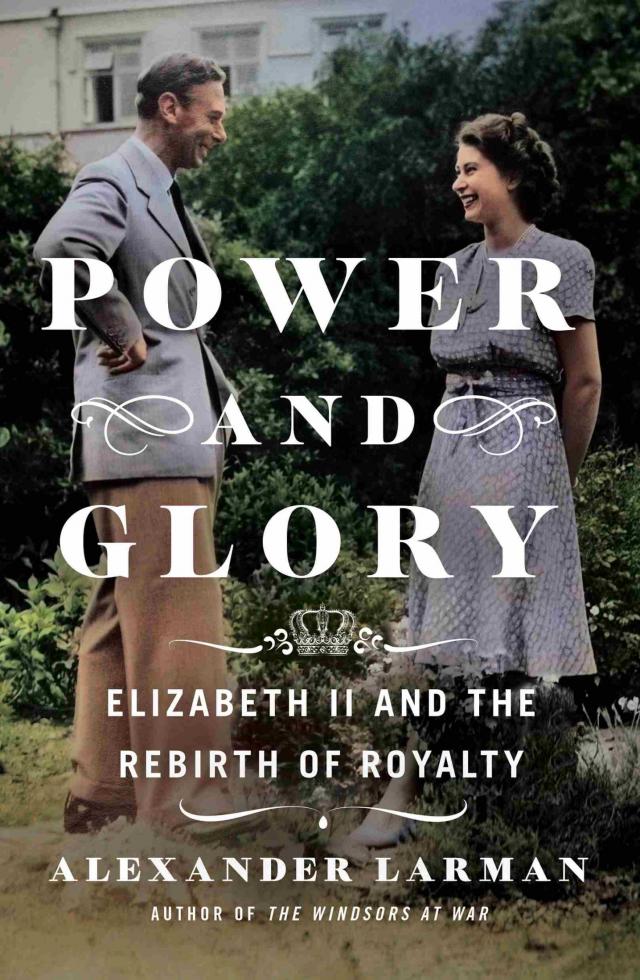
Begin Reading
Table of Contents
About the Author
Photos
Copyright Page
Thank you for buying this
St. Martin’s Publishing Group ebook.
To receive special offers, bonus content,
and info on new releases and other great reads,
sign up for our newsletters.
Or visit us online at
us.macmillan.com/newslettersignup
For email updates on the author, click here.
The author and publisher have provided this e-book to you for your personal use only. You may not make this e-book publicly available in any way. Copyright infringement is against the law. If you believe the copy of this e-book you are reading infringes on the author’s copyright, please notify the publisher at: us.macmillanusa.com/piracy.
For my daughter Rose, the greatest queen any father could wish to have
Kings are pretty cheap these days.
Ernest Bevin, 10 September 1946
Above all things our royalty is to be reverenced, and if you begin to poke about it you cannot reverence it … Its mystery is its life. We must not let in daylight upon magic.
Walter Bagehot, The English Constitution
Behold, my desire is, that the Almighty would answer me, and that mine adversary had written a book.
Job, 31:35
Dramatis Personae
Royalty and their circle
George VI, King of the United Kingdom, the Dominions of the Commonwealth, and Emperor of India
Queen Elizabeth, his wife
Princess Elizabeth, their elder daughter; queen 1952-2022
Princess Margaret, their younger daughter
Prince Philip, Duke of Edinburgh, husband to Princess Elizabeth
Prince Charles, son to Philip and Elizabeth
Princess Anne, daughter to Philip and Elizabeth
Edward, Duke of Windsor, former king, now international playboy; known as ‘David’ to his family and familiars
Wallis Windsor, his wife
Queen Mary, the royal mother
Prince Henry, Duke of Gloucester, her third son
Mary, Princess Royal, Countess of Harewood, her daughter
Lord Mountbatten, Edward’s cousin and Philip’s uncle
Lord Brabourne, his son-in-law
Patricia Mountbatten, Philip’s cousin
Bessie Merryman, Wallis’s aunt
May Elphinstone, Queen Elizabeth’s sister
David Bowes-Lyon, Queen Elizabeth’s brother, ‘a vicious little fellow’
Sir Alan ‘Tommy’ Lascelles, private secretary to George VI 1945-52; private secretary to Elizabeth II 1952-53
Sir Edward Ford, assistant private secretary to George VI 1946-52
Martin Charteris, private secretary to Princess Elizabeth 1950-52; assistant private secretary to Elizabeth II 1952-53
Marion ‘Crawfie’ Crawford, former governess to the princesses
Major George Buthlay, her husband
Peter Townsend, equerry to George VI
Dermot Morrah, journalist and royal speechwriter
Owen Morshead, royal librarian and archivist
John Gibson, footman to Prince Charles
Lady Anne Glenconner, lady-in-waiting
[Albert] George ‘A. G.’ Allen, solicitor to the Duke of Windsor
Sir Walter Monckton, lawyer and counsellor to George VI and the Duke of Windsor
Kenneth de Courcy, confidant to the Duke and Duchess of Windsor
Godfrey Thomas, former royal courtier
Charles Murphy, ghostwriter for the Duke of Windsor
F. J. Dadd, secretary to the Duke of Windsor
Mike Parker, equerry to Prince Philip
Lord Beaverbrook, newspaper magnate and friend to the Duke of Windsor
Viscount Ednam, Earl of Dudley, and Laura, Countess of Dudley, friends of the Duke of Windsor
Joan Martin, Wallis’s maid
Anne Seagrim, secretary to the Duke of Windsor
Politicians
Clement Attlee, prime minister 1945-51; Leader of the Opposition 1951-55
Herbert Morrison, Deputy Leader of the Labour Party 1945-56
Hugh Dalton, Chancellor of the Exchequer 1945-47
Ernest Bevin, Foreign Secretary 1945-51
James Chuter-Ede, Home Secretary 1945-51
Arthur Creech Jones, Secretary of State to the Colonies 1946-50
Harold Laski, Labour politician
Tom Driberg, Labour politician
William Jowitt, Lord Chancellor
Winston Churchill, Leader of the Opposition 1945-51; prime minister 1951-55
Anthony Eden, de facto deputy prime minister 1951-55
Robert ‘Bob’ Boothby, Conservative politician
Henry ‘Chips’ Channon, Conservative politician and diarist
Harold Nicolson, Conservative politician and diarist
Leo Amery, Conservative politician
Rab Butler, Conservative politician
Jock Colville, private secretary to Princess Elizabeth 1947-49; private secretary to Churchill 1951-55
Lord Halifax, British ambassador to the United States 1940-46
Archibald Clark Kerr, 1st Baron Inverchapel, British ambassador to the United States 1946-48
Duff Cooper, British ambassador to France 1944-48
Ramsay MacDonald, former prime minister
Alexander Cadogan, Permanent Under-Secretary for Foreign Affairs 1938-46
John Martin, private secretary to Churchill 1941-45
Sir Pierson Dixon, private secretary to Bevin 1945-48
Edward Holman, assistant ambassador to France
Sir Edward Baring, high commissioner to South Africa
Sir William Murphy, ambassador to the Bahamas
John Wheeler-Bennett, British representative in Germany
Clement Davies, leader of the Liberal Party 1945-56
Harry S. Truman, American president 1945-53
James F. Byrnes, US Secretary of State 1945-47
George Marshall, US Secretary of State 1947-49
Admiral William Leahy, Truman’s chief of staff
Robert Coe, US diplomat to the United Kingdom
Jan Smuts, president of South Africa 1939-48
Norman Robertson, Canadian high commissioner
Joseph Stalin, leader of the Soviet Union 1924-53
Society – high
Clementine Churchill, wife to Winston
Diana Cooper, wife to Duff
Susan Mary Alsop, socialite
Osla Benning, Canadian debutante
Cecil Beaton, society photographer and diarist
John Reith, director general of the BBC 1927-38
Herman and Katherine Rogers, friends of Wallis
Osbert Sitwell, writer and wit
Noël Coward, playwright and actor
Peter Coats, companion to Chips Channon
Kathleen Kennedy, daughter of American ambassador Jack Kennedy
Cecil Roberts, friend to the Duke and Duchess of Windsor
Henry Luce, publisher and founder of Life magazine
Dan Longwell, editor of Life magazine
John Gordon, Sunday Express editor
Norman Hartnell, royal couturier
Cyril Garbett, Archbishop of York
Commander Sir Morton Stuart, Manipulative Surgeon to the King
Sir Thomas Dunhill, Serjeant Surgeon to the King
Professor James Learmonth, Regius Professor in Clinical Surgery
Clement Price Thomas, a leading chest surgeon
Lord Moran, physician to Churchill
Lady Astor, friend to Queen Elizabeth
D’Arcy Osborne, diplomat and friend to Queen Elizabeth
James ‘Jimmy’ Donahue Jr, socialite, playboy and friend to the Duke and Duchess of Windsor
Ella Maxwell, American gossip columnist and hostess
Earl of Athlone, friend to the Duke of Windsor
Rowland Baring, 2nd Earl of Cromer, friend to the Duke of Windsor
Oscar Nemon, sculptor to the great and good
Edmund Hillary, mountaineer
Michael Ramsey, Bishop of Durham
Society – low
John Capstick, chief inspector at Scotland Yard
Leslie Holmes, convicted thief
John Dean, butler to Lord Mountbatten
James Cameron, Daily Express journalist
Marietta Fitzgerald, American journalist
Bruce and Beatrice Blackmar Gould, co-editors of Ladies’ Home Journal
Dorothy Black, ghostwriter for Crawfie
Vera M. Brunt, outraged by Crawfie
Colm Brogan, Daily Express journalist
Kenneth H. Smith, president of the Book Publishers’ Representatives Association
R. M. MacColl, Daily Express journalist
Introduction
When I sat down to write The Crown in Crisis in late 2018, it was without any intention of the book turning into the first instalment in a trilogy. Indeed, in all its drama and richness, the abdication saga seemed like a perfectly self-contained story. Yet by the time I had finished, I was desperate to continue the narrative, which concluded with the exiled former Edward VIII heading into Europe under cover of night. It was a particular thrill while writing its sequel, The Windsors at War, to be able to draw upon a vast amount of rare and unseen material, which gave insight into everything from the fractious relationship between King George VI and his disobedient broth
Yet when I finished Windsors, I was caught in a dilemma. It seemed clear that the logical next step was to finish the story of the era that I had begun, and that I needed to write a third and final book that would begin with VE Day and follow the story up until the coronation of Elizabeth II. But my fear was that it would be anticlimactic compared to the other two. Those books had been steeped in grand, operatic themes of betrayal, power and a family being torn apart by war and treachery. If this one could offer nothing more dramatic than a royal wedding, the slow death of a king, and a coronation, was it really worth the effort?
It will be for readers to judge for themselves as to whether I have succeeded, but Power and Glory proved every bit as thrilling and revelatory to research and write as the earlier books, exploding any belief that I had that this period was somehow less eventful. The focus this time lies with three separate protagonists: the young Princess Elizabeth, whose marriage and family life is coloured by the increasing knowledge that she will be taking on an awesome weight of responsibility; George VI, whose fragile health was dealt a terminal blow by the strain that the war placed upon him and his country; and, naturally, the Duke of Windsor, seeking to pursue his own agenda and damn the consequences.
I have attempted to be fair towards the duke, as in my other books, but the man does not make it easy for even the most generous of biographers to portray him in a warm and sympathetic light. In 2022, I stayed at a hotel in Paris that he and Wallis used to frequent, and, unable to sleep, wondered what the chances were of a spectral visit from an outraged Edward, chastising me for his presentation in these books. Had I been taken to task by his apparition, I hope that I should have had the presence of mind – shortly before telephoning the concierge and asking for bell, book and candle – to reply that nothing I have said about him in the trilogy is based on anything other than meticulously documented fact: usually, and most damningly, his own entitled words. Unlike fine wine, he does not improve with age.
If the duke supplies much of Power and Glory’s high drama (and, at times, comic relief), it is his brother’s story that constitutes its tragic arc. George VI was the monarch who never wanted the responsibility of the role, and it is testament to his belief in duty that he committed himself to its onerous burdens, even as it became increasingly clear that the strain was having a terminal effect upon his health. I have attempted to present the monarch as a rounded character, neither sanctifying him nor belittling him, but I hope that my portrayal of him as someone whose greatest strengths were domestic rather than regal is one that firmly anchors the book as a deeply human story.
If the book has a heroine, however, it can only be the future Elizabeth II. She made only fleeting appearances in The Crown in Crisis and The Windsors at War, but I am finally able to give her the full measure that she deserves, bringing her to life in both private and public spheres. If my first book was a ticking-clock suspense thriller set against the backdrop of something thought constitutionally unprecedented, and the second a wartime saga that explored a dysfunctional, squabbling family tested to its limits, so this one too has a simple story at its heart: it is an account of a close and loving father-and-daughter relationship, albeit one where the father is dying and the daughter is facing upheaval and change on an unimaginable scale.
Both of my earlier books were intended, to a large extent, as black comedies of manners. Power and Glory is different. While writing about the Duke of Windsor’s misdemeanours never ceased to amuse – or shock – me, I was struck by how often I would attempt to finish chapters of this book and be unable to type because I was weeping so copiously. Even now, certain lines – ‘I felt that I had lost something very precious’; ‘my whole life whether it be long or short shall be devoted to your service’ – still have a Pavlovian effect upon me.
I was writing Power and Glory when I learnt of the queen’s death on 8 September 2022, and like everyone else in Britain, I felt as if one of the aspects of my life that had been forever constant was removed from me. Yet amid the millions of words written about her in the subsequent days, by sources sympathetic, hostile or otherwise, there was one central point universally acknowledged: in both her remarkable longevity and her lifelong dedication to service, she was a monarch sans pareil. It is therefore appropriate that Power and Glory should depict the end of one era, and of one Britain, and the birth of a new one. This book may be a tragedy, and a requiem for a lost nation, but it is also a paean of praise to the woman who redefined the country in her image.
It may, or may not, come as a surprise to my readers to learn that I am not a monarchist. Unlike some of my historian peers, I have always attempted to look at the royal family with clinical detachment, rather than from the perspective of a fully paid-up admirer of what strikes me as a deeply flawed and anachronistic institution. Certainly, the ludicrous indulgence offered to the Duke of Windsor – a man who should have gone to prison during World War II for treason, and ideally remained there – shows the worst aspects of ‘the Firm’ and the noblesse oblige offered to its members, regardless of their activities. Yet the virtues they exemplified at their best were real, too: courage, generosity, compassion and a dedication to serving their country rather than themselves. When I finished writing this book, I had to restrain an urge to leap onto a table and shout, ‘God Save the Queen!’ If I am a republican, I am a very, very flawed one indeed. But if this conclusion to the trilogy engenders a similar urge in a single reader, I will proudly consider my duties as a historian and biographer fulfilled.
Alexander Larman
Oxford, June 2023
Prologue
‘My Whole Life Shall Be Devoted to Your Service’
Sir Alan ‘Tommy’ Lascelles, private secretary to George VI, was a man who prided himself on his unflappability. After all, during his decades of royal service, he had done everything from act as a reluctant counsellor to the Prince of Wales – later Edward VIII cum Duke of Windsor – to being the king’s confidant, right-hand man and general major-domo. If Tommy didn’t know about something taking place in the royal household, the chances were that it was either irrelevant or mere conjecture. Yet in April 1947, something of international import had occurred that had disturbed his composure. A speech had been written that would be crucial to the future of the monarchy and was due to be broadcast in a matter of a few days. And not only had it been vetoed by the king as not being good enough, it was currently lost.
As Lascelles careered up and down the White Train, an air-conditioned train that housed both the royal family and a gaggle of courtiers, journalists and staff on their state trip to South Africa, desperately searching for the missing draft, he was able to think about the successes and failures of the royal tour; the first that had taken place since 1939, when the king and queen had visited Canada and the United States in a successful attempt to drum up support for the world war that everyone believed was imminent.
Then, the affection with which the royal couple had been greeted was only matched by the outpouring of national pride that awaited them when they returned home. Yet now, despite the similarly warm welcome that the pair and their daughters, Elizabeth and Margaret, had received in this outpost of the Commonwealth, the trip had not recaptured past glories. The king, especially, was worn down, querulous and increasingly resembling a relic of a bygone era. It was vital that the speech that would be broadcast at the end of the tour should restore international faith in the monarchy. The speech, Lascelles reflected, that had not only been dismissed by the king as inadequate, but was now nowhere to be seen.
It also did not help that Princess Elizabeth, who would be delivering the speech, was herself something of an unknown quantity. She was, of course, familiar to her future subjects thanks to such high-profile events as her appearance alongside her parents on the Buckingham Palace balcony on VE Day, smiling and rejoicing in her country’s deliverance and triumph; while rumours of her nascent relationship with a young Greek-born naval officer, Philip Mountbatten, had been dominating newspaper headlines for weeks, if not months, before she departed on the South African trip earlier in 1947. Yet, wholly intentionally, Lascelles and her family had kept her away from public view while she was still young. It was only now, as she turned twenty-one, that the appropriate moment had come to introduce her on the world stage. And the means of doing so had to be perfect.


