Endpapers, p.1
Endpapers, page 1


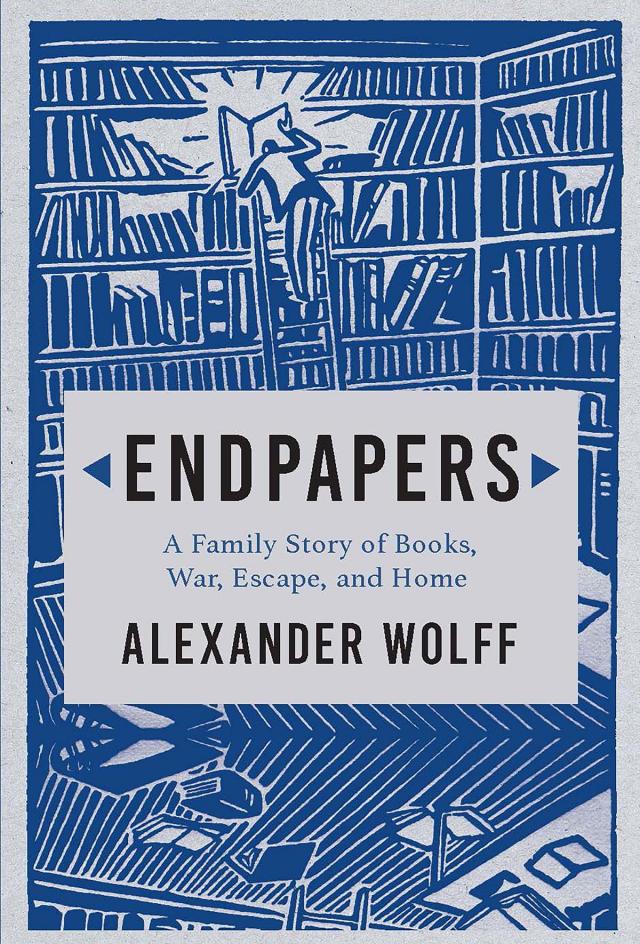
ENDPAPERS
Also by Alexander Wolff
The Audacity of Hoop: Basketball and the Age of Obama
Big Game, Small World: A Basketball Adventure
Raw Recruits (with Armen Keteyian)
ENDPAPERS
A Family Story of Books, War, Escape, and Home
ALEXANDER WOLFF
Atlantic Monthly Press
New York
Copyright © 2021 by Alexander Wolff
Excerpt from Austerlitz by W. G. Sebald, translated by Anthea Bell, translation copyright © 2001 by Anthea Bell (Hamish Hamilton 2001, Penguin Books 2002). Used by permission of Random House, an imprint of Penguin Random House LLC. All rights reserved. Same excerpt, copyright © The Estate of W. G. Sebald, used by permission of The Wylie Agency (UK) Limited.
Excerpts from “Kurt Wolff Tagebücher, October 23, 1914, to June 28, 1915,” used by permission of Deutsches Literaturarchiv-Marbach.
A portion of this book appeared in different form in Sports Illustrated and on SI.com.
Jacket design by Becca Fox Design
Jacket illustration: Frans Masereel, Holzschnitt aus Le Soleil, 1919
© 2020 Artists Rights Society (ARS), New York / VG Bild-Kunst, Bonn
All rights reserved. No part of this book may be reproduced in any form or by any electronic or mechanical means, including information storage and retrieval systems, without permission in writing from the publisher, except by a reviewer, who may quote brief passages in a review. Scanning, uploading, and electronic distribution of this book or the facilitation of such without the permission of the publisher is prohibited. Please purchase only authorized electronic editions, and do not participate in or encourage electronic piracyof copyrighted materials. Your support of the author’s rights is appreciated. Any member of educational institutions wishing to photocopy part or all of the work for classroom use, or anthology, should send inquiries to Grove Atlantic, 154 West 14th Street, New York, NY 10011, or permissions@groveatlantic.com.
Published simultaneously in Canada
Printed in Canada
This book was designed by Norman E. Tuttle of Alpha Design & Composition.
This was set in 11.75-pt. Stempel Garamond LT by Alpha Design & Composition of Pittsfield, NH.
First Grove Atlantic hardcover edition: March 2021
Library of Congress Cataloging-in-Publication data is available for this title.
ISBN 978-0-8021-5825-3
eISBN 978-0-8021-5827-7
Atlantic Monthly Press
an imprint of Grove Atlantic
154 West 14th Street
New York, NY 10011
Distributed by Publishers Group West
groveatlantic.com
For Frank and Clara,
American, German—
citizens
Every time we reached the page which described the snow falling through the branches of the trees, soon to shroud the entire forest floor, I would look up at her and ask: But if it’s all white, how do the squirrels know where they’ve buried their hoard? . . . How indeed do the squirrels know, what do we know ourselves, how do we remember, and what is it we find in the end?
—W. G. Sebald, Austerlitz
CONTENTS
Prologue
Introduction
One: Bildung and Books
Two: Done with the War
Three: Technical Boy and the Deposed Sovereign
Four: Mediterranean Refuge
Five: Surrender on Demand
Six: Into a Dark Room
Seven: A Debt for Rescue
Eight: An End with Horror
Nine: Blood and Shame
Ten: Chain Migration
Eleven: Late Evening
Twelve: Second Exile
Thirteen: Schweinenest
Fourteen: Turtle Bay
Fifteen: Mr. Bitte Nicht Ansprechen
Sixteen: Shallow Draft
Seventeen: Play on the Bones of the Dead
Eighteen: The End, Come by Itself
Epilogue
Acknowledgments and Sources
Bibliography
Image Credit
Notes
Index
Prologue
A jab of his elbow, and my father: “It’s like the Gestapo!”
For me, a teenager during the seventies in suburban Rochester, New York, access to what my father called “the Glotzofon” was strictly limited: a sitcom on weekend evenings, a game on Saturday or Sunday, nothing on school nights, until the great exception, that stretch during 1973 when, weekdays in prime time, public television rebroadcast hearings of the Senate Select Committee on Watergate.
Until that point I had suffered my father’s interests. At sixteen, I hardly wanted a place on his turf of chamber music and kit radios and things to be found under the hood of a car. Nor would he edge toward mine, where British art rock and the fortunes of the Knicks ruled. But Washington blood sport engrossed us both. We followed our team and scouted out theirs, memorizing rosters of names with Rs and Ds attached. And we agreed that some cosmic casting director had had a hand in Senator Sam Ervin’s jowls and John Dean’s wife and a witness named Anthony Ulasewicz, who was Runyonesque relief to American viewers but to my father the kind of cop with a conscience that the Germany of his youth had failed to sufficiently produce.
I would come to understand what drew my father to the TV each evening. Born into the Weimar Republic, not quite twelve when Adolf Hitler came to power, he was now a citizen of another country and savored this second chance to stand up for democracy. Homework could wait. On school nights I found a place on the couch next to him, to share the first thing over which we really connected.
Until one day our weeknight miniseries spilled into the weekend, with what came to be known as the Saturday Night Massacre. First one Justice Department official, then a second, was dismissed for failing to carry out President Nixon’s demand to fire the Watergate special prosecutor. Nixon’s assault on the rule of law helped lead the House to pass the articles of impeachment that led to his resignation.
For my father this all came more than thirty years too late. But he kindled to the thrill of it—the thrill of watching public servants of this country to which he now belonged refuse on principle to follow orders.
Introduction
In the Footsteps of Kurt and Niko
This is a story that spans the lives of my grandfather and father, two German-born men turned American citizens. It recounts the fortunes of each—the first an exile, the second an emigrant—based on a year I spent in Berlin, taking the measure of blood and history in the midst of rising rightist populism on both sides of the Atlantic.
My grandfather was a book publisher who commanded the German literary landscape before World War I. Kurt Wolff had been born to a mother of Jewish descent, but it was his eye for das Neue, the new, that would put him at odds with the times, as Adolf Hitler and his repressive and hateful politics grew more and more popular. A balky peace, hyperinflation, and social turmoil conspired to undermine the Kurt Wolff Verlag, until he was forced to shut down his publishing house in 1930. Three years later Kurt fled Nazi Germany, eventually landing in New York, where in 1941 he founded Pantheon Books. He left behind my father, Nikolaus Wolff, who served in the Wehrmacht—the armed forces of the Third Reich—and wound up in an American POW camp before emigrating to the United States in 1948.
Cover of 1927 Almanac of Art and Poetry, published by Kurt Wolff Verlag, Munich. Woodcut by Frans Masereel from the graphic novel Le Soleil, published by KWV in 1920 as Die Sonne
Street scene in Lübeck, August 1936. Photograph by Nikolaus Wolff, age fifteen
From my birth in 1957 until my father’s death fifty years later, the prevailing winds of assimilation kept his eyes trained ahead. I contented myself with a seat in that boat, facing those calm waters. The fresh-start conformism of postwar America did nothing to encourage him to glance backward, and if he didn’t look back, I was hardly moved to do so. I joined him in making our way through the world with purpose and hard work. Germans call this therapy by industriousness “taking the Arbeitskur.”
But a decade after my father’s death, having just turned sixty, I found myself being pulled back through the years. I wanted a better sense of the European chapters in the lives of my forefathers and the bloody period in which they unfolded. I was moved more than anything by a nagging sense of oversight—a feeling that I had failed somehow in not investigating my family’s past. Germans of my generation grilled their elders about National Socialism, asking parents and grandparents, aunts and uncles, what they had known and what they had done. In Germany the convulsions of the sixties and early seventies came with dope and rock and civil unrest, to be sure, but also with the belief that the Wirtschaftswunder, the West German economic boom, had been enabled by a corporate and political establishment studded with ex-Nazis. A younger generation charged its elders with suspending accountability and remembrance and indulging in an Arbeitskur writ large. A broadly held willingness to take up and work through questions of guilt, shame, and responsibility, known as Vergangenheitsaufarbeitung, or “working off the past,” has since become a marker of modern Germany.
A German cousin—my father’s godson and his namesake, exactly my age and a fellow journalist—asked me pointedly why we decided to up and move to Berlin. You, I replied, took up the whole “working off the past” thing long ago. As an American, I never did. Cousin Niko understood right away. He had spent his youth brandishing his countercultural sympathies, taking part in the “purification ritual for the sins of the fathers.” But surely I could be excused for being late to that work. Our family—the Wolffs of Wilmington, Delaware; Princeton, New Jersey; and Rochester, New York—was hardly German anymore. What historical stocktaking I’d done dealt with American evils, slavery and Jim Crow, sins that implicated my mother’s ancestors. Though my father arrived in the United States as a twenty-seven-year-old speaking only basic English, his new country’s integrative ways ensured that he was quickly regarded as no less American than the Connecticut-raised WASP he would marry.
So it was, after thirty-six years on the staff of Sports Illustrated, that I took a buyout and wired the severance payment to a German bank. My wife, Vanessa, gave notice at the agency where she worked as a visiting nurse. We found a couple to move into our old farmhouse in Vermont and look after our dog and cat, and enrolled our teenage children, Frank and Clara, in an international school on the outskirts of Berlin. We signed a year’s lease on an apartment in Kreuzberg, where our neighbors would hail from more than 190 countries and gentrification hadn’t entirely sanded down a gritty, Levantine edge. Berlin is infested with co-working spaces, so it was easy to find a desk only a few doors away, in the AHA Factory, whose very name seemed to promise that tenants would push out some kind of revelation every few minutes.
When our plane touched down at Tegel Airport on an August afternoon in 2017, I knew only the vague contours of the European lives of the two men to precede me. Kurt Wolff left Germany for good on the night of February 28, 1933, fleeing Berlin as the ashes of the Reichstag fire still smoldered. Over the next six and a half years, before war broke out, he shuttled between Switzerland, France, and Italy with a soon-to-expire German passport he was struggling to renew. My grandparents’ divorce, finalized in 1931, had left my father and his older sister, Maria, then eleven and fourteen, in Munich with their mother, whose family owned the Merck pharmaceutical empire, and her second husband, Gentiles both.
The Nazis likely objected less to Kurt’s mother’s Jewish ancestry than to his authors, many of them Jewish, like Franz Kafka, or Expressionist, pacifist, or “degenerate” besides. Works by Karl Kraus, Walter Mehring, Heinrich Mann, Joseph Roth, Carl Sternheim, Georg Trakl, and Franz Werfel all became fuel for book burnings. After the Germans invaded and occupied France, Kurt and his second wife, Helen, with support from the American journalist Varian Fry and his Emergency Rescue Committee, fled Nice with their son, my half uncle Christian, and in March 1941 sailed from Lisbon to New York. By early the following year Kurt and Helen were running Pantheon Books out of their Manhattan apartment.
Kurt would go on to leave the larger public mark, and in some literary circles his name still sparks curiosity. But the great questions that fall to me now come refracted through my father, who did not live a public life. How could Niko Wolff have served in the Wehrmacht despite his Jewish heritage? When his father fled Germany, why didn’t my father join him, rather than be left to live through the Nazis’ rise and rule? What burdens of guilt or shame did Niko carry into the New World and through the rest of his life? To what interventions, exemptions, or privileges did he owe his survival—and do I owe my existence? Of what should I be ashamed?
Unlike Kurt’s, my father’s story comes with none of the ennobling accents of the Gesinnungsemigrant, the German who went into exile out of conviction. I arrived in Berlin knowing little more than what Niko had told me: that he had been forced to join the Hitler Youth chapter at his Bavarian boarding school; that he had served with the paramilitary Reichsarbeitsdienst, the Reich Labor Service, as a nineteen-year-old; and that he had driven a supply truck in support of a Luftwaffe squadron during the invasion of the Soviet Union. I asked if he had ever killed anyone, and he told me: never knowingly. He spent the three years after the war in Munich literally picking up rubble, a duty required to earn a place as a chemistry student at the Institute of Technology. Kurt helped Niko land the student visa that brought him to the United States for graduate work. Other than for occasional family visits, my father didn’t go back.
Kurt was sixty when he became a hyphenated American, and he took that interstitial bit of punctuation, connective and disruptive, as a license to reinvent himself. He did so not once but twice. Within a few years of literally stepping off the boat, he was publishing best sellers in a language he hadn’t mastered; two decades later, back in Europe after having been more or less chased into exile again, he found himself resurrected by the same species of ruthless American executive that had just turned him out. He enjoyed several unexpected years of professional satisfaction as a redeemed German-American before his death.
Kurt flaunted his enthusiasms, and he worked relentlessly, and for the most part cheerfully, to dragoon others into seeing things as he did. And while he sometimes struggled to gracefully take no for an answer, that obstinacy was made tolerable by the enthusiasm with which he worked to get colleagues, guests, readers, or companions to acquiesce to some recommendation of his, usually for a book but often for a work of art or music, or a dish or a vintage. During the first two-thirds of a century marked by destruction and dread, Kurt was forever in search of people with the good taste to recognize his good taste. It couldn’t have been easy being the son of such a man, particularly if your interests and experiences ran in other directions. My father was picking his way through ruins while his father was safely in Manhattan, prospecting for another universalist essay or sumptuous folio with which to favor the public.
From handed-down stories and a few secondary sources, this is more or less what I knew before leaving for Berlin. Indeed, hovering over the entirety of this account is astonishment at how much I would discover about my family and the corollary to that—how little my father had told me. Fortunately, my grandfather’s papers are archived in Germany and the United States and many have been published. Dear Dr. Kafka: Mr. Franz Werfel has told me so much about your new novella—is it called The Bug?—that I would like to acquaint myself with it. Would you send it to me? From his appointment books, diaries, and notes, I know that Kurt, an amateur cellist, played trios with the Swiss Expressionist painter Paul Klee, a violinist, on a September day in 1919, and that the bill for taking T. S. Eliot to lunch at the Grand Ticino in Greenwich Village during the fifties came to seventy-five cents. Late in his life Niko put together a guide to several decades of his father’s diaries, a spreadsheet of Who, When, Where, and Weiteres (miscellaneous) that attests to both Kurt’s compulsive sociability and why I called my father the Human Flowchart.
Kurt himself vowed never to write anything “along the lines of ‘my life and loves.’” To produce a memoir is a fool’s errand, he liked to say: “What one can write is not interesting, and what is interesting one cannot write.” Beyond an outline of my grandfather’s life, I’ve nonetheless tried to grant the wish of the critic D. J. R. Bruckner, who in a 1992 review of a collection of Kurt’s essays and letters called him “a difficult man, it is clear enough from his own words—for all his passion for good writing, his warmth, gentleness and loyalty. Even a reader at a distance can be made uneasy by his clarity, unyielding logic and lofty rules of conduct. But it is all so inspiring. . . . What is so fine is Wolff himself. To be talked to in confidence by such a human being lifts the spirit.” May that invocation help justify how much unmediated Kurt Wolff fills the pages that follow.
I brought reams of family letters to Berlin and began to read them knowing that thousands more sit in repositories elsewhere. To get lost in more than a half century of correspondence is to hear a recitation of the epistolary rules my ancestors lived by. It isn’t enough to hold on to what the postman delivers; you also make sure to save a copy of whatever you send. What’s the point of keeping some sentiment or aperçu to yourself, stashed away in a private journal or diary (or so I hear my grandfather declaiming from across the years), when it can be confided to another person? If the essence of publishing is to share the written word, writing a letter is publication in the most limited edition possible.