

The arbella stuart consp.., p.1
The Arbella Stuart Conspiracy, page 1
part #3 of The Marquess House Series


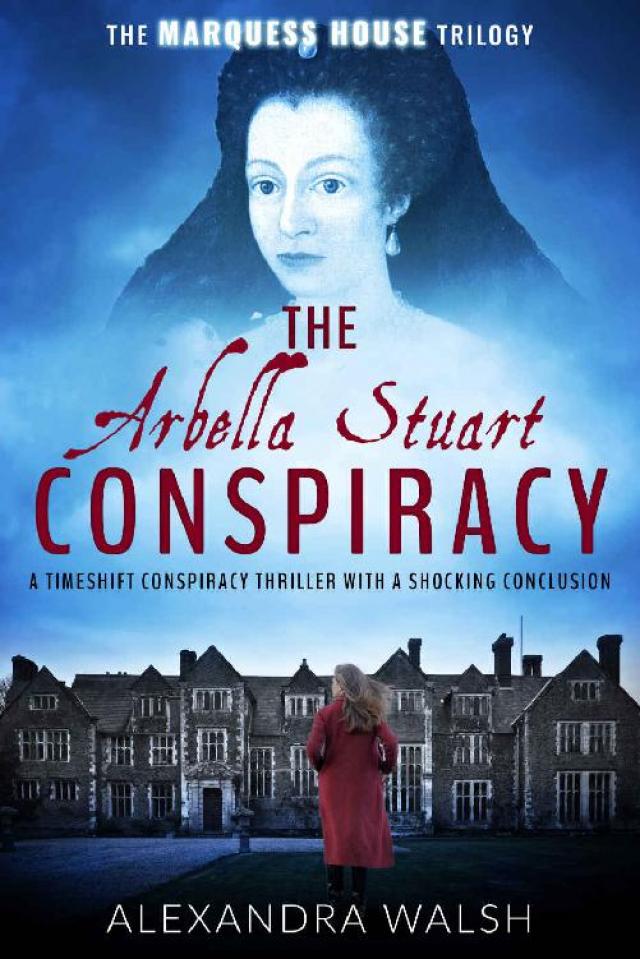
THE ARBELLA STUART CONSPIRACY
The Marquess House Trilogy
Book Three
Alexandra Walsh
To Kathryn, my almost-twin sister
Love you
Table of Contents
PROLOGUE: THE BETHLEM ROYAL HOSPITAL, LONDON, SEPTEMBER 1660
PART ONE: MARQUESS HOUSE, 2019
CHAPTER ONE
CHAPTER TWO
CHAPTER THREE
CHAPTER FOUR
CHAPTER FIVE
PART TWO: ENGLAND, 1603
CHAPTER ONE
CHAPTER TWO
CHAPTER THREE
CHAPTER FOUR
CHAPTER FIVE
PART THREE: MARQUESS HOUSE, 2019
CHAPTER ONE
CHAPTER TWO
CHAPTER THREE
CHAPTER FOUR
PART FOUR: ENGLAND, 1603
CHAPTER ONE
CHAPTER TWO
CHAPTER THREE
CHAPTER FOUR
PART FIVE: MARQUESS HOUSE, 2019
CHAPTER ONE
CHAPTER TWO
CHAPTER THREE
PART SIX: ENGLAND, 1603
CHAPTER ONE
CHAPTER TWO
CHAPTER THREE
CHAPTER FOUR
PART SEVEN: MARQUESS HOUSE, 2019
CHAPTER ONE
CHAPTER TWO
CHAPTER THREE
PART EIGHT: ENGLAND, 1604
CHAPTER ONE
CHAPTER TWO
CHAPTER THREE
CHAPTER FOUR
CHAPTER FIVE
CHAPTER SIX
PART NINE: MARQUESS HOUSE, 2019
CHAPTER ONE
CHAPTER TWO
CHAPTER THREE
CHAPTER FOUR
EPILOGUE
A NOTE TO THE READER
PROLOGUE: THE BETHLEM ROYAL HOSPITAL, LONDON, SEPTEMBER 1660
“What have you done to her?”
A shaft of light had illuminated the miserable space as the door was flung open. The single occupant of the cell huddled further against the corner, burrowing deeper into the mean bed of damp, stinking straw, trying to hide in the inadequate camouflage. The greying mess was the only relief in the stone room where the grimy water dripped ceaselessly down the walls, making them slick and icy to the touch. Rats skittered away from the sudden invasion of light and noise, disappearing through gaps in the stones, swallowed into the welcoming darkness.
“And you claim this is one of your better cells?” came the man’s voice; cold, derisive, ringing with distaste. “We will discuss this place once my business here has been concluded,” he promised. “These people are not animals; they deserve better than the rancid treatment you claim will cure them.”
The long shadows of several men flickered in the doorway and the voice of the Warden spoke, his tone nervous. “Is it wise to approach the prisoner — my apologies — the patient?” he asked. “What if you are attacked?”
A mirthless laugh bounced off the stone walls. “It is unlikely any of your so-called patients would have the energy or the strength to attack me, not on the vile grey sludge you feed them,” he retorted. “Now, leave us, we have business to complete.”
A cold shudder of fear ran down the spine of the woman in the straw. From the moment she had heard his voice, she was unsure whether to feel relief or fear. Had he come to help, or do her harm? Lifting a filthy hand with broken nails and festering sores, she afforded herself a wry smile, aware she presented a vastly different picture from the last time they had been together, dancing in the flickering candlelight of the majestic ballroom.
She heard a gentle thud, a different noise from the usual clangs, and there was no grinding of the key in the lock. A moment later, he was crouching in front of her, his breath warm on her cheek, smelling, as it always did, of cloves and cinnamon. His cologne was sharp, cutting through the stench of her own wasted, ailing body, and his touch, when it came, was gentle.
“My dear,” he whispered, “are you able to open your eyes? We must take you home.”
“Home? I have no home,” she croaked, her voice parched and rusty through lack of use. “You took it.”
“You will come to my home, as my guest, and when you are well, I will return you to yours.”
Even in her sorry state, she knew this man never did anything without an ulterior motive and she wondered what he would require in payment for saving her from this living hell. “Homes come at a high price,” she whispered.
“Everything has a cost,” he agreed, “but I will ask nothing of you until you are well, and if you are never recovered enough, then it will be my honour to ensure you are cared for and live in comfort for the rest of your life.”
“And how long will that be if I refuse your command?” she asked.
“Your life will, I hope, be long and happy.”
“I am old,” she replied. “My years are few and this place has shortened them further.”
He held her gaze for a moment, before clapping his hands. The door opened, this time to admit three women. The woman in the straw cowered; her instinct was to hide after the months of cruelty that had been inflicted upon her by both the male and female gaolers. Yet when her eyes ran over these women in their well-made dresses of starched cotton, she realised they were strangers.
“Fill this,” ordered the man, pointing to the bronze, free-standing bathtub that had materialised in the cell while she had kept her eyes shut. He walked across the room and made himself comfortable on the padded chair that had also been carried into the cell. “A screen will be brought in to spare your modesty,” he continued, “then these especially selected ladies, who will now form part of your staff, will wash and dress you. After this, we will return home, where you will see my physician.”
Finally understanding that her ordeal in Bethlem Royal Hospital was over, the woman rose. Many entered this place, known as Bedlam, the notorious and terrifying home for the mentally afflicted, but few left alive. “What do you want of me?” she said, her voice sounding more like her own.
“Nothing,” he responded, his tone slippery with insincerity.
“You’ve never been able to lie to me,” she replied. “My body may be frail, but my mind is as sharp as ever. There is a task you need me to perform. I would rather be prepared.”
“Prepared for what? Refusal?”
“No,” she said, and was pleased to see relief in his eyes. “You are removing me from this vile situation and for that I am grateful, but I need to know why.”
“You are to do something which no one else in my realm is capable of.”
This was not the reply she had expected and, despite herself, she was intrigued. “And what is that?”
“Write.”
Her laughter was bitter. “There are many writers in your realm,” she said. “Why do you need me?”
“Because I trust you,” he said, and for once his words were sincere.
“And you do not trust your many players, playwrights and poets?”
“Not as I trust you.”
“What if I refuse?” she asked.
The man threw back his head and laughed. “You won’t refuse. You will, of course, be able to decide who will work with you.”
“Work with me? Is this task so huge I’ll need assistance?”
“I suggest you choose three trustworthy helpers, who will be sworn to secrecy —”
“Before they are murdered when the task is complete,” she interrupted. “Don’t play me for a fool.”
The women returned, carrying steaming pitchers, jug after jug until the linen-lined bath was brimming with fragrant water. Screens were erected and one of the women, a slim blonde with clear green eyes, stripped the tattered dress from the woman’s body, handing it to a maid to dispose of, before helping her into the water.
A sigh of happiness escaped the woman’s lips as she sank into the water, the filth on her skin beginning to dissolve.
For the next half hour, as she was scrubbed clean, deloused, and dried in crisp linen sheets, she contemplated the strange offer. An outright refusal would earn her a place in a gaol cell again, of this she was in no doubt, and the thought terrified her. She had been lucky to survive this incarceration; another would kill her. This man was ruthless; he might persuade the court he espoused liberal beliefs but when he wanted something, there were no lows to which he would not stoop.
As she was helped from the cooling bath and laced into a simple dark green dress, a plan began to form in her mind. It was not ideal, she knew, but it was better than the alternative of remaining here. Matching shoes were slipped on her stocking feet and her damp hair was wound into a neat style under a simple cap.
“You’re ready, madam,” said the woman with green eyes.
“Thank you,” she replied. “What is your name?”
“It’s Anna, my lady.”
“You will travel with me, Anna,” she said and, taking the woman’s hand, led her around the screen.
“You are returned to us, my dear,” he said, but his smile did not warm his eyes.
“I accept.”
“You do?”
If this man thought he could play games with her, then she would let him believe so, but she knew secrets he did not. A wicked smile flashed across her face as she pondered all the ways she would be able to make him pay. “Because you will pay,” she muttered in her mind like a curse, “and you will pay for years and years to come.”
She placed her hand on his and allowed him to lead her from the stinking cell.
PART ONE: MARQUESS HOUSE, 2019
CHAPTER ONE
“Watch out!” shouted Dr Perdita Rivers. A sickening shriek filled the air as the wall above her began to crumble; bricks sheered away from the ceiling, cascading past her in a rush of dust and dirt. Perdita dived out of the way, waiting for the fall to be over. As the tumult ebbed, an uneasy silence emerged and Perdita shook the debris from her long dark hair before calling out, “Is everyone all right?”
Piper Davidson, her twin sister, emerged from the cloud of dust and debris, followed by two more dusty figures.
“Way to go, Perds!” exclaimed Kit Mackensie, the taller of the two. “It’s answered your question: is there more basement behind the false wall? Yes, there is!”
“I didn’t expect it to collapse when I pushed it though…” Perdita laughed.
“It isn’t a supporting wall, is it?” interrupted Piper, a hint of concern in her voice.
“No, it can’t be, it doesn’t line up with any of the others,” interjected Callum Black, the fourth grime-covered shape. “It was probably added later when whatever is in there was no longer being used.”
While they were speaking, the dislodged debris of centuries had subsided, and a wide space was opening up before them.
“It’s a grotto,” said Perdita, a grin unfurling across her face and making her unusual grey-green eyes sparkle with excitement. “The Tudors first popularised them,” she explained as she edged forwards, her torch sweeping the floor, watching for obstacles left behind by the collapse. “Then there was a resurgence of interest in them during the Victorian times.”
Kit shook pieces of plaster from his dark, curly hair and followed Perdita into the yawning space. “Perds, I’ve spent a huge part of my life at Marquess House and I had no idea this was here. How did you discover it?”
“I’ve been studying the plans that were drawn up when Granny Lettice was renovating the house. There were drawings for a grotto and even an ancient photograph of her standing in the entrance, so I knew it had been built. It was mentioned in letters between Lettice and her husband William as well. William was a go-getting Victorian business magnate with his eye on creating a modern future and had been all for flattening what he saw as these old-fashioned Tudor buildings and creating a modern estate in its place, taking in new and fashionable designs.”
Piper stared at her sister, wide-eyed, her horror reflecting Perdita’s own panic when she had first discovered how the beautiful heart of their home had come close to being destroyed forever.
“From all I’ve discovered so far about Lettice Hawkland,” Perdita continued, “she loved leading fashionable trends, and the Tudors were the height of fashion in the Victorian era. If she had been in possession of a genuine Tudor manor, I bet she was delighted that she could restore the ancient core of the house as it would have been the envy of her fashionable friends. As a compromise, her husband, William Lakeby, our great-great-great grandfather, built the cutting-edge, modern wing where, once it was complete, they lived in aspidistra-adorned luxury.
“William tried to persuade Lettice away from what he saw as her romantic side. Lettice, however, was no fainting Victorian damsel but a woman who knew her own mind, so she stood firm and William crumbled. He even agreed to build her this grotto.”
“How do you know all this Perds?” asked Piper.
“It’s all in the archives,” Perdita replied, “and I’ve been going through them, compiling a history of Marquess House.”
“So why do you think it was boarded up?” asked Piper, climbing over a pile of rubble, her torch illuminating the shell-encrusted walls.
“No idea,” replied Perdita. “Perhaps they stopped using it or it went of fashion. Careful, Pipes, there’s a slope.”
“It’s a pool,” Piper exclaimed.
“Cal, come with me and let’s see if there’s an exit or whether it’s been blocked up,” called Kit, edging his way through the gloom.
Perdita and Piper remained together, and Perdita gently took Piper’s hand.
“Are you OK, Perds?” Piper asked.
Her sister nodded. “I’m finding it difficult to believe that it’s a year tomorrow since Granny Mary died and our lives changed completely,” she replied.
Once again, she thanked every deity she could think of for her sister. It had always been the two of them against the world, especially after their mother, Louisa, had died when they were children.
The previous year, Perdita had been working on an archaeological dig in Pembrokeshire when her then fiancé, Warren Dexter, had arrived with the news that her estranged grandmother, the historian and philanthropist, Mary Fitzroy, had died. The following day she had received a letter from Alistair Mackensie, who had been Mary’s solicitor, inviting her to her grandmother’s stately home, Marquess House in St Ishmaels, only a few miles from the dig site.
During the interview, Alistair had explained that she and Piper were the main beneficiaries of Mary’s will and, apart from a few personal bequests, they had inherited everything — her manor house, an extensive research centre and a vast fortune. They were now worth in excess of £300 million between them.
It had taken the twins a while to come to terms with their inheritance. They could not understand why their grandmother had shunned them in life — abandoning them after their mother’s death when they were seven years old — yet had embraced them in death. Determined to unravel this mystery and, with Piper in America accompanying her husband, Jeremy Davidson, Perdita had resigned from her university job and moved into Marquess House.
Once ensconced, she had searched her grandmother’s published and unpublished books for clues and, to her astonishment, had discovered a trail of information left by Mary for her to find. It seemed the key to Mary’s behaviour lay in her unfinished manuscript The Catherine Howard Anomaly, which she had been working on at the time her only child, Louisa, the twins’ mother, had died.
With the help of Alistair’s son, Kit, Perdita had uncovered more than she had imagined. Not only had she discovered the truth about her mother’s death and the real reason Mary had stepped away from them, she also revealed an incredible but provable alternate version of Tudor history concerning Henry VIII and his fifth bride, the teenager Catherine Howard. Struggling to understand why such an incredible historical revelation had been covered up, Perdita was told the real danger she now faced was from a shadowy section of the British Secret Service called MI1 Elite.
This organisation was tasked with retaining the accepted version of history. It worked by clandestinely removing and destroying any historical evidence that emerged which might offer an alternative or more truthful view of events than the one recorded in the history textbooks and accepted as correct. What made matters worse was that Perdita’s former fiancé, Warren, had been part of this highly secretive and dangerous section of the British government. It transpired he had been married throughout their relationship and had seduced her in order to discover what she knew about her grandmother’s work. While Perdita had dealt with her own emotional upheaval, Piper’s marriage to Jeremy had collapsed when he had an affair with a co-worker called Kirstin.
The twins were told they were protected by an ancient document called The Milford Haven Treaty that created a sovereign state within Marquess House, making them immune from arrest by the Secret Service while they were living there. However, in order to get around this, the new and ruthless head of MI1, Inigo Westbury, had reintroduced The White List, an assassination register of academics who tried to reveal more than the government was willing to allow. Although Alistair had been able to have the arrest warrants for treason quashed, it nevertheless meant Perdita, Piper and Kit had been in incredible danger and had been forced to flee for their lives to the Mackensie’s stronghold in Andorra: Castle Jerusalem.
With their lives still at risk, Perdita and Piper had been stunned to discover more secrets concerning their new lives. The most surprising were the aristocratic titles they were now entitled to use — Perdita, as the eldest twin by ten minutes, held the unusual and ancient title once bestowed upon a wife of Henry VIII, the Marquess of Pembroke, a male title for a woman, while Piper, as her heir, was Viscountess Cleddau.


