

The marriages of pere ol.., p.1
THE MARRIAGES OF PÈRE OLIFUS, page 1


THE MARRIAGES OF PÈRE OLIFUS
Translated by Alfred Allinson
This short novel was first published in 1849 and was written in collaboration with Paul Bocage as a loosely based sequel to Mille-et-un fantômes, a series of short stories by various writers. The tale is unusual for the Dumas canon, although there are typical conventions found elsewhere in the young writer’s work. The novel tells the story of Père Olifus, a Dutchman and a traveller, who marries several times and suffers many misadventures with his wives.
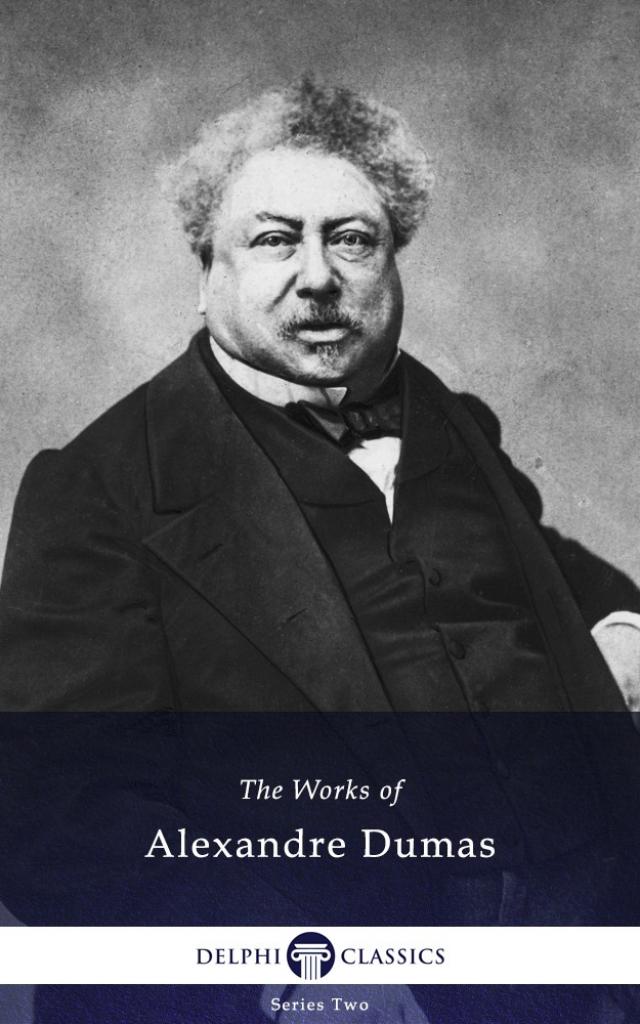
Dumas as a young man
CONTENTS
CHAPTER I.
CHAPTER II.
CHAPTER III.
CHAPTER IV.
CHAPTER V.
CHAPTER VI.
CHAPTER VII.
CHAPTER VIII.
CHAPTER IX.
CHAPTER X.
CHAPTER XI.
CHAPTER XII.
CHAPTER XIII.
CHAPTER XIV.
CHAPTER XV.
CHAPTER XVI.
CHAPTER XVII.
CHAPTER XVIII.
CHAPTER XIX.
CHAPTER XX.
CHAPTER I.
THE RAVEN FANCIER.
ONE morning in the month of March, 1848, on passing from my bedroom to my study, I found lying on my desk as usual a pile of newspapers, and atop of this pile of newspapers a pile of letters.
Among the letters was one missive with a great red seal which attracted my particular attention. It was unstamped and addressed merely to “Monsieur Alexandre Dumas, Paris,” — circumstances which pointed to its having been delivered by hand.
The writing had a character of its own, something midway between the English and the German styles. Whoever had traced the words was evidently a person used to command and possessed of a certain determination of mind, the whole modified by outbursts of feeling and eccentricities of thought that at times made him altogether a different man from what he usually appeared.
I am very fond, when I receive a letter in an unknown hand and the said letter appears to come from somebody of importance, I am very fond of conjecturing beforehand, from the two or three lines of address traced by the individual in question, his rank, personal habits and general character.
After duly making my reflexions, I opened the letter and read as follows:
“The Hague, Feb. 22, 1848.
“Sir, — I do not know whether Eugène Vivier, the distinguished artist who came to pay us a visit in the course of last winter, and whose acquaintance I had the happiness to make, has told you I am one of your most constant readers. I may indeed claim to belong to their number, great as it is. To mention that I have read Mademoiselle de Belle-Isle, Amaury, Les Trois Mousquetaires, Vingt Ans Apres, Bragelonne and Monte Cristo, would be paying you too unmeaning a compliment.
“I have long been wishing to offer you a souvenir and at the same time make you acquainted with one of our greatest national artists, Monsieur Backhuisen.
“Allow me therefore, sir, to send you herewith four drawings of this artist’s, representing the most striking scenes of your Romance of The Three Musketeers.
“I bid you farewell and beg you to believe, sir, your very good friend “WILLIAM, PRINCE OF ORANGE.”
I must confess this letter, dated 22nd February, 1848, that is to say the day on which the Parisian revolution broke out, and received on the next day but one after that in which the mob had wanted to kill me on the ground that I was a friend of Princes, caused me a sensible thrill of gratification.
The fact is, to the poet the foreigner represents posterity, standing as he does outside our petty literary animosities, our trivial artistic jealousies! The foreigner, like the future, judges the author by his works, and the wreath that comes across the frontier is woven of the same flowers as those we cast upon a tomb.
Nevertheless curiosity was even stronger than gratitude. The first thing I did was to open the package that lay in one corner of my desk, and there I found according to promise four charming drawings, — one representing D’Artagnan and his yellow horse arriving at Meung, another the ball at which Milady cuts the diamond studs from Buckingham’s doublet, another the bastion of Saint-Gervais and the fourth the death of Milady.
This done, I wrote to the Prince to thank him. I had long known my correspondent to be a true artist. I was aware that he was a composer of distinction, and two brother Princes, men not likely to be mistaken in their judgment either of men or things, had often told me about him, the Duc d’Orléans to wit and Prince Jérome Napoléon.
The former, as is very generally known, had a charming talent as an engraver. I possess proofs of his that are models of what an etching or a mezzotint should be.
As for the latter I have some verses of his, the existence of which he has probably forgotten, of a republican cast which once cost him a heavy imposition at the Gymnasium of Stuttgart, and which were given to me at Florence in 1839 or 1840 by the fascinating Princesse Mathilde.
In especial I had heard speak of the Princess of Orange as being one of those highly gifted women who, when they are not called Elizabeth or Christina, are known as Madame de Sévigné or Madame de Staël.
The final result was that, when the Prince of Orange was called to succeed his father on the throne of Holland, the idea almost inevitably suggested itself to my mind to make the journey to Amsterdam to be present at the coronation of the new King and offer my accumulated thanks in person to the ex-Prince of Orange.
I started accordingly on the 9th May, 1849. Next day the morning papers announced the fact that I was on my way to Amsterdam to write an account of the coronation festivities. They had said the same when on October 3rd, 1846, I left Paris for Madrid. I beg pardon of the journals that are so good as to chronicle my doings; but when I accept the invitations of Princes, I go as a guest and not as a reporter.
This small matter explained, I come back to the house of my departure. Besides the pleasure of locomotion and the satisfaction of the craving to breathe from time to time a different air, a delightful surprise awaited me. Just as I was passing from the waiting room on to the platform of the railway station, I felt someone twitch the skirts of my coat.
“Where are you off to like that?” asked the individual who had taken this means of attracting my attention.
I uttered a cry of wonder:
“And you?” I asked in return.
“I am going to Holland.”
“Why, so am I.”
“To see the Coronation?”
“Precisely.”
“So am I. Have you been invited formally. Eh?”
““No; but I know the King to bi an artistic Prince, and as the breed is grown scarce since the death of the Duke of Orleans, I am anxious to see him crowned.”
My travelling companion was Biard. You must know Biard by name, if you do not know him personally. Biard, as you are aware, is the gifted painter of the clever Revue de la Garde Nationale dans un Village, Le Baptêmie du Bonhomme Tropique, Les Honneurs Partagés, the designer of the poetical canvas showing two Laplanders, at the foot of an iceberg cracking and tottering to its fall, shooting past each in his canoe and embracing as they go by, the delineator of those delightful portraits of women full of charm and brilliancy which were to be seen at the exhibitions of the last two years. More than this, — it is one of my bad habits to think of the man first, the artist second, in these cases, — he is the charming talker, the indefatigable narrator, the world-wide traveller, the kind-hearted friend, the ungrudging fellow-artist, who is so ready to forget his own claims whenever he speaks of other men’s, — in a word such a travelling companion as I hope my readers may have to go round the world with, and as I was enchanted to have found to share my Dutch excursion.
It was a year or two since we had met. What a strange life we lead, to be sure; we are delighted to meet, enchanted to see each other, we spend hours, days, a week in enjoyment of the chance pleasure of each other’s society, we come back in the same railway carriage, and drive home in the same cab, we shake hands declaring with the utmost seriousness, “Well, well, how silly it is never to see each other; let us manage better in future,” — and we never meet again! Each returns to his own life, throws himself into his own work again, builds his own pile, ant-hill or giant’s castle, the true magnitude of which only posterity can adjudicate, and its duration time decide.
A jovial night of good talk it was that night on the road to Brussels seated between Biard and my son. There were five or six other passengers in the Diligence; I wonder if they could make anything of our conversation. I have my doubts. After fifty leagues of road and five or six hours’ travelling, I wonder whether they thought us men of intellect or simple idiots; I cannot tell. Our minds work in so strange a fashion; our wits jump so suddenly from the high levels of philosophy to the vilest pun! our temperament is so special, so individual, so eccentric! it is so much the appanage of a peculiar caste that a long initiation, as it were, is needed to comprehend its manifestation in words!
Still one may have too much of a good thing, even of laughing, and about two o’clock in the morning the talk ran dry; about three we fell asleep; about five they woke us up to examine our baggage; about eight we finally arrived at Brussels.
At that capital perfect quiet reigned, and if one had not heard so much abuse spoken, in French of France, one might have forgotten that such a country existed. We were back again in the full enjoyment of monarchical institutions.
& nbsp; A curious country this Belgium, a land that keeps its King because that King is always perfectly ready to go. True he is a man of infinite tact is King Leopold I. At each Revolution that breaks out in France, at each revolt that threatens at Brussels, he runs out on his balcony hat in hand, and signifies his desire to speak. When he has procured silence:
“My children,” says the Monarch,’ “you are aware they made me King against my wish. I did not want a throne, before they gave me one, and since I have had one, I have often longed to be rid of it; so if you are like me and have had enough of Royalty, give me an hour, — I don’t ask for more, — and in an hour I will be out of the Kingdom. I have encouraged the building of railways for this express purpose. Only be good, and don’t break things; that would not be the slightest use, you know.”
To this little harangue the populace replies:
“Oh! we don’t want you to go away. We felt the need of making a little noise, that was all. We have kicked up our little row, and now we feel quite happy again. Long live the King!”
After which King and people part better pleased with each other than ever.
All the way as we came along, Biard had been dinning in my ears, “Never mind, when we get to Brussels, I am going to take you to see something you have never seen before.” And in my self-conceit, every time he said so, I had shrugged my shoulders.
I had been at Brussels perhaps ten times already, and on one of these occasions I had seen the Park, the Botanical Garden, the Palace of the Prince of Orange, the Church of Sainte-Gudule, the Boulevard de Waterloo, the shops of Méline and Cans, the Palace of the Prince de Ligne. What could there be left for me to see?
Accordingly, the moment we arrived, “Come along,” said I to Biard, “let’s see what I have never seen before.”
“Come along,” he replied laconically, — and we set off together, Biard, my son Alexandre and myself.
Our guide led us straight to a handsome looking house, not far from the Cathedral, stopped before a carriage door and rang the bell without the smallest sign of hesitation.
The door was opened by a manservant, whose strange appearance struck me at the first glance. The tips of his fingers were red with blood, while the man’s waistcoat and trousers were literally covered with feathers or rather down coming from the plumage of all sorts of birds. Moreover, he had a singular trick of turning his head about, a semi-circular movement like that of some species of climbing birds.
“Friend,” Biard addressed him, “will you be so kind as to inform your master that a party of foreigners visiting Brussels are desirous of seeing his curiosities?”
“Sir,” returned the man, “my master is not at home, but in his absence I have his orders to do the honours of the collection.”
Damned unfortunate!” muttered Biard. Then turning to me, “It will not be so interesting,” he said, “but no matter, let us persevere.”
The servant was waiting our pleasure; we nodded to him, and he stepped off to show us the way.
“Notice the way he walks,” Biard whispered to me;” that is a curiosity in itself.”
Indeed our worthy cicerone had the gait not of a man but of a bird, and the particular bird he seemed to have taken as his model was the magpie.
First we traversed a square courtyard inhabited by a cat and two or three storks. The cat looked at us defiantly; the storks on the contrary, standing motionless on their long red legs, seemed full of confidence in our peaceful intentions.
All the way across the courtyard I observed nothing specially out of the common in our leader’s way of walking, beyond the afore-mentioned twisting about of the head, and a certain stately gravity in his fashion of putting one leg in front of the other. He moved along, as I have said, in the solemn way magpies do, when they do walk solemnly.
Presently we came to the garden, — a small botanical garden, square like the courtyard, but larger. It was filled with a host of flowers, duly labelled and planted out in a number of beds divided by walks, so that each one of the said beds could easily receive due and proper attention.
No sooner were we in the garden than our guide’s whole demeanour altered. His solemn march became a series of hops. From three or four paces away he would catch sight of an insect, — a caterpillar, or a beetle; instantly, with a jerk of the loins impossible to describe, he would take two or three little jumps forward, both feet held together, then a jump to one side; alighting on one foot he would stoop suddenly on the same side, catch the creature, without ever missing, between thumb and finger, toss it on to the path and stamp down on it the foot he held suspended in the air with all the weight of his body. Thus there was not a second lost between discovery, capture and execution of the offender. Justice satisfied, he would jump back with a little sideways hop into the same path that we were following.
Every time he saw an insect of any sort or kind, the same operation was repeated, — but with such rapidity and address that we could pursue our way unhindered towards a detached building which seemed to be item No. 1 of the exhibition we had come to see.
The door stood wide open, showing the interior, which was square and fitted with a continuous series of pigeon-holes. At the first glance I concluded these receptacles were full of different sorts of seeds. I supposed I was about to examine the collection of some expert horticulturist, and expected to see interesting varieties of haricot beans, lentils and vetches. But on coming closer and looking carefully, I saw that what I had taken for botanical specimens were nothing more nor less than birds’ eyes, — eagles’ eyes, vultures’ eyes, parrots’ eyes, falcons’ eyes, ravens’
eyes, magpies’ eyes, starlings’ eyes, blackbirds’ eyes, finches’ eyes, sparrows’ eyes, tomtits’ eyes, eyes of every kind and species of feathered creature.
It looked for all the world like a stock of assorted ammunition, from balls of twelve to the pound down to the finest small shot. Thanks to a chemical preparation, no doubt the invention of the I owner of the collection, the eyes had all preserved their colour, consistency, and one might almost say their expression. Only, removed as they were from their orbits and deprived of the eyelids, they had assumed one and all a ferocious, menacing aspect. Above each division a ‘label indicated to what bird belonged the particular eyes in it.
Oh! Coppelius! Doctor Coppelius! thou fantastic creation of Hoffmann’s brain, thou who were always asking for oyes, fine oyes, hadst thou but come to Brussels, in what profusion wouldst thou have found the objects thou wast ever in persevering search of for thy daughter Olympia!
“Now, gentlemen,” said our guide when he thought we had had time enough to examine this first section of the show, would you like to go on to the raven gallery?”
Never was name better deserved. Picture a long corridor, ten feet broad and twelve high, lighted by windows giving on a garden, the walls entirely covered by ravens nailed on their backs with wings outspread and legs and neck extended. The whole length of the room they formed a series of fantastic circles and extravagantly contorted arabesques.
Some were dropping to pieces, falling into dust, others were in every stage of putrefaction; others again were new and fresh, and some still writhing and screaming in their death agony. There might be eight or ten thousand of them altogether.
I turned to Biard, full of grateful thanks; it was quite true, I had never seen anything like it before.
“And it is your master,” I asked the servant, “who devotes his time to tracing all these cabalistic shapes on the wall?”
“Oh! yes, sir, nobody but my master ever touches his ravens. He would be furious if anyone dared to interfere!”
“But then he has agents all over Belgium to supply him with birds?”
No, sir, he catches them himself.”
“How does he catch them himself? and where?”
“Up there, on the roof,” — and so saying, he pointed to a roof, in which I could certainly make out a piece of mechanism, the ingenious details of which the distance made it impossible to distinguish.
I am a great fowler myself, though I do not carry my passion for ornithology to the same insane and extravagant lengths as our worthy Brussels amateur. I have limed and netted hundreds of birds as a boy; so these details began to rouse my curiosity.


__english_preview.jpg)


