

Stuck with you, p.1
Stuck with You, page 1


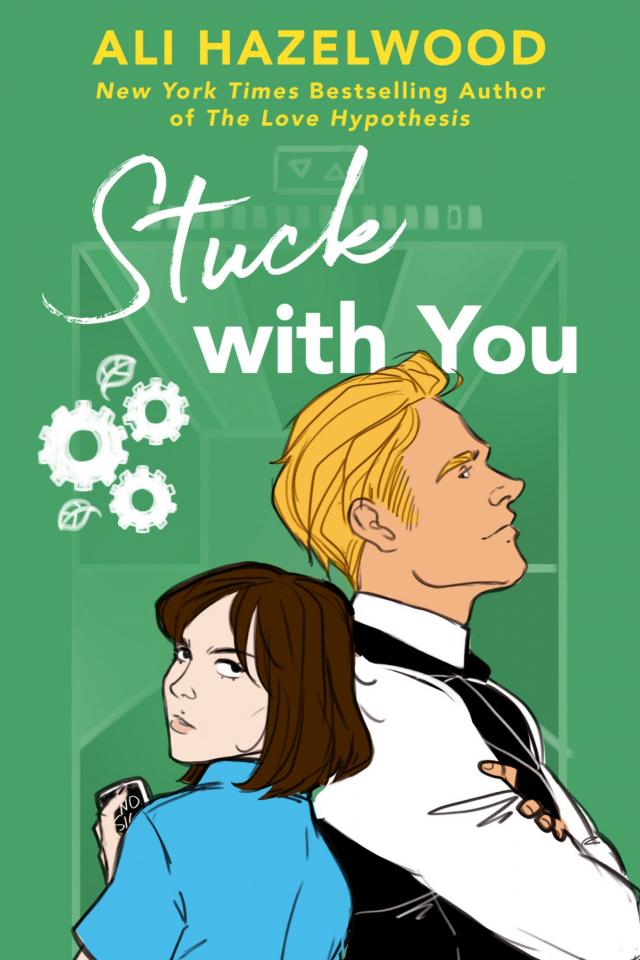
PRAISE FOR
The Love Hypothesis
“Contemporary romance’s unicorn: the elusive marriage of deeply brainy and delightfully escapist. . . . The Love Hypothesis has wild commercial appeal, but the quieter secret is that there is a specific audience, made up of all the Olives in the world, who have deeply, ardently waited for this exact book.”
—New York Times bestselling author Christina Lauren
“Funny, sexy, and smart. Ali Hazelwood did a terrific job with The Love Hypothesis.”
—New York Times bestselling author Mariana Zapata
“This tackles one of my favorite tropes—Grumpy meets Sunshine—in a fun and utterly endearing way. . . . I loved the nods toward fandom and romance novels, and I couldn’t put it down. Highly recommended!”
—New York Times bestselling author Jessica Clare
“A beautifully written romantic comedy with a heroine you will instantly fall in love with, The Love Hypothesis is destined to earn a place on your keeper shelf.”
—Elizabeth Everett, author of A Lady’s Formula for Love
“Smart, witty dialogue and a diverse cast of likable secondary characters. . . . A realistic, amusing novel that readers won’t be able to put down.”
—Library Journal (starred review)
“With whip-smart and endearing characters, snappy prose, and a quirky take on a favorite trope, Hazelwood convincingly navigates the fraught shoals of academia. . . . This smart, sexy contemporary should delight a wide swath of romance lovers.”
—Publishers Weekly
Titles by Ali Hazelwood
The Love Hypothesis
LOATHE TO LOVE YOU
Under One Roof
Stuck with You
Below Zero
Stuck with You
Ali Hazelwood
JOVE
NEW YORK
A JOVE BOOK
Published by Berkley
An imprint of Penguin Random House LLC
penguinrandomhouse.com
Copyright © 2022 by Ali Hazelwood
Excerpt from Love on the Brain copyright © 2021 by Ali Hazelwood
Penguin Random House supports copyright. Copyright fuels creativity, encourages diverse voices, promotes free speech, and creates a vibrant culture. Thank you for buying an authorized edition of this book and for complying with copyright laws by not reproducing, scanning, or distributing any part of it in any form without permission. You are supporting writers and allowing Penguin Random House to continue to publish books for every reader.
A JOVE BOOK, BERKLEY, and the BERKLEY & B colophon are registered trademarks of Penguin Random House LLC.
Ebook ISBN: 9780593437827
Jove audio edition: March 2022
Jove ebook edition: June 2022
Cover illustration by lilithsaur
Adapted for ebook by Cora Wigen
This is a work of fiction. Names, characters, places, and incidents either are the product of the author’s imagination or are used fictitiously, and any resemblance to actual persons, living or dead, business establishments, events, or locales is entirely coincidental.
pid_prh_6.0_140138093_c0_r0
Contents
Cover
Praise for The Love Hypothesis
Titles by Ali Hazelwood
Title Page
Copyright
Dedication
Chapter 1
Chapter 2
Chapter 3
Chapter 4
Chapter 5
Chapter 6
Chapter 7
Chapter 8
Chapter 9
Chapter 10
Chapter 11
Chapter 12
Epilogue
Excerpt from Love on the Brain
About the Author
For Marie, my fave Elizabeth Swann
Chapter 1
Present
My world comes to an end at 10:43 on a Friday night, when the elevator lurches to a stop between the eighth and seventh floor of the building that houses the engineering firm where I work. The ceiling lights flicker. Then go off completely. Then, after a stretch that lasts about five seconds but feels like several decades, come back with the slightly yellower tinge of the emergency bulb.
Crap.
Fun fact: This is actually the second time my world came to an end tonight. The first was less than a minute ago. When the elevator I’m riding stopped on the thirteenth floor, and Erik Nowak, the last person I ever wanted to see, appeared in all his blond, massive, Viking-like glory. He studied me for what felt like too long, took a step inside, and then studied me some more while I avidly inspected the tips of my shoes.
Re-crap.
It’s a slightly complicated situation. I work in New York City, and my company, GreenFrame, rents a small office on the eighteenth floor of a Manhattan building. Very small. It has to be very small, because we’re a baby firm, still establishing ourselves in a pretty cutthroat market, and we don’t always make a ton of money. I guess that’s what happens when you value things like sustainability, environmental protection, economic viability and efficiency, renewability rather than depletion, minimization of exposure to potential hazards such as toxic materials, and . . . well, I won’t bore you with the Wikipedia entry on green engineering. Suffice it to say, my boss, Gianna (who coincidentally is the only other engineer working full-time at the firm), founded GreenFrame with the aim of creating great structures that actually make sense within their environment, and is delightfully, crunchily hard-core about it. Unfortunately, that doesn’t always pay very well. Or well.
Or at all.
So, yeah. Like I said, a slightly complicated situation, especially when compared with more traditional engineering companies that don’t focus as much on conservation and pollution control. Like ProBld. The giant firm where Erik Nowak works. The one that takes up the whole thirteenth floor. And the twelfth. Maybe the eleventh, too? I lost track.
So when the elevator began to slow down around the fourteenth floor, I felt a surge of apprehension, which I naively discarded as mere paranoia. You have nothing to worry about, Sadie, I told myself. ProBld has tons of offices. They’re always expanding. Orchestrating “mergers” and eating up smaller firms. Like the Blob. They are truly the corrosive alien amoeboidal entity of the business, which translates to hundreds of people working for them, which in turn means that any one out of those hundreds of people could be calling the elevator. Any one. There’s no way it’s Erik Nowak.
Yeah. No.
It was Erik Nowak, all right. With his massive, colossal presence. Erik Nowak, who spent the entirety of our five-floor ride staring at me with those ruthless, icy blue eyes of his. Erik Nowak, who’s currently looking up at the emergency light with a slight frown.
“The power’s out,” he says, an obvious statement, with that stupidly deep voice of his. It hasn’t changed one whit since the last time we talked. Nor since that string of messages he left on my phone before I blocked his number. The ones that I never bothered answering but also couldn’t quite bring myself to delete. The ones I could not stop myself from listening to, over and over.
And over.
It’s still a stupid voice. Stupid and insidious, rich and precise and clipped and low, with acoustic properties all its own. “I moved here from Denmark when I was fourteen,” he told me at dinner when I asked him about his accent, slight, hard to detect, but definitely there. “My younger brothers got rid of it, but I never managed.” His face was as stern as usual, but I could see his mouth soften, a slight uptick on the corner that felt like a smile. “As you can imagine, there was lots of teasing growing up.”
After the night we spent together, after all that happened between us, I felt as if I couldn’t get the way he pronounced words out of my head. For days I constantly squirmed, turning around because I thought I’d heard him somewhere in my proximity. Thought that maybe he was nearby, even though I was jogging at the park, alone in the office, in line at the grocery store. It just stuck to me, coated the shell of my ears and the inside of my—
“Sadie?” Erik’s infamous voice cuts through my thoughts. It has that tone, the one of someone who’s repeating himself, and maybe not just for the first time. “Does it?”
“Does . . . what?” I glance up, finding him next to the control panel. In the stark shadows of the emergency light he’s still so . . . God. Looking at his handsome face is a mistake. He is a mistake. “I’m sorry, I . . . What did you say?”
“Does your phone work?” he asks again, patient. Kind.
Why is he so kind? He was never supposed to be kind. After what happened between us, I decided to torture myself by asking around about him, and the word kind never came up. Not once. One of New York’s top engineers, people would often say. Known for being as good at his job as he is surly. No-nonsense, aloof, standoffish. Though he was never any of these things with me. Until he was, of course.
“Um.” I fish my phone out of the back pocket of my black tailored pants and press the home button. “No service. But this is a Faraday cage,” I think out loud, “and the elevator shaft is steel. No RF signal is going to be able to make a loop and . . .” I notice the way Erik is staring at me and abruptly shut up. Right. He’s an engineer, too. He already knows all of this. I clear my throat. “No signal, no.”
“—a building-wide power outage?”
“Maybe even the whole block.”
Shit.
Shit, shit, shit. Shit.
Erik seems to be reading my mind, because he studies me for a moment and says reassuringly, “It might be for the best. Someone is bound to check the elevators if they know that the power’s gone.” He pauses before adding, “Although it might take a while.” Painfully honest. As usual.
“How long?”
He shrugs. “A few hours?”
A few what? A few hours? In an elevator that is smaller than my already-minuscule bathroom? With Erik Nowak, the broodiest of Scandinavian mountains? Erik Nowak, the man who I . . .
No. No way.
“There must be something we can do,” I say, trying to sound collected. I swear I’m not panicking. No more than a lot.
“Nothing that I can think of.”
“But . . . what do we do now, then?” I ask, hating how whiny my voice is.
Erik lets his messenger bag drop to the floor with a thump. He leans against the wall opposite mine, which should theoretically give me some room to breathe, even though for some physics-defying reason he still feels too close. I watch him slide his phone in the front pocket of his jeans and cross his arms on his chest. His eyes are cold, unreadable, but there is a faint gleam in them that has a shiver running down my spine.
“Now,” he says, gaze locked with mine, “we wait.”
It’s 10:45 on a Friday night. And for the third time in less than ten minutes, my world crashes to an end.
Chapter 2
Three weeks ago
There are worse things in the world.
There are, without a single doubt, giant heaps of worse things in the world. Wet socks. PMS. The Star Wars prequels. Oatmeal raisin cookies that masquerade as chocolate chip, slow Wi-Fi, climate change and income inequality, dandruff, traffic, the finale of Game of Thrones, tarantulas, food-scented soap, people who hate soccer, daylight saving time (when it moves one hour ahead, not behind), toxic masculinity, the unjustly short life span of guinea pigs—all of these, just to name a small handful, are truly terrible, dreadful, horrific things. Because such is the way of the universe: it’s full of bad, sad, upsetting, unfair, enraging circumstances, and I should know better than to pout like a ten-year-old who’s half an inch too short for the roller coaster when Faye tells me from behind the counter of her small coffee shop:
“Sorry, honey, we’re all out of croissants.”
To be clear: I don’t even want a croissant. Which I know sounds weird (everybody should always want a croissant; it’s a law of physics, like the Fermi paradox or Einstein’s field equation), but the truth is, I would gladly do without this specific croissant—if this were a regular Tuesday morning.
Unfortunately, today is pitch day. Which means that I’m meeting with potential future GreenFrame clients. I talk to them, tell them the hundreds of little things I can do to help them manage large-scale sustainable building projects, and hope they’ll decide to hire us. It’s what I’ve been doing for about eight months, ever since I finished my Ph.D.: I try to bring in new clients; I try to keep the ones we already have; I try to ease Gianna’s workload, since she just had her first baby—who, incidentally, is three babies. Apparently, triplets do happen. And they’re adorable, but they also wake one another up in the middle of the night in a never-ending spiral of sleeplessness and exhaustion. Who would have thought? But back to the clients: GreenFrame has been venturing dangerously close to not-quite-in-the-black territory, and today’s pitch meeting is critical to keep the red at bay.
Enter the croissants. And that other little problem I happen to have: I am a little superstitious. Just a tad. Just a little stitious. I have developed a complex system of rituals and apotropaic gestures that need to be performed to ensure that my pitch meetings will go as planned. I have more years of science education than anyone ever needed, and should probably know better than to believe that the color of my socks is in any way predictive of my professional success. But do I?
Nope.
Back in college, it was exactly three braids in my hair for every single soccer game (plus two coats of L’Oréal mascara if we were playing away) and I had to listen to “Dancing Queen” and “My Immortal” before each and every final—strictly in that order. Thank God I managed to graduate on time, because the emotional whiplash was starting to grind at me.
Not that this issue of mine is something I like to admit widely. Mostly just to Mara and Hannah, my supposed best friends. We met during the first year of our Ph.D.’s and have been lumbering together through the tribulations of STEM academia ever since. For the most part, having them in my life has been my one true joy, but there have been less-than-outstanding aspects of it. For instance, the fact that during the four years we lived together they oscillated between staging anti-superstition interventions and pranking me by inviting stray black cats into our apartment on every Friday the 13th. (We even ended up adopting one for a few months, JimBob, till we noticed that the kitty in the Missing flyers all over the neighborhood suspiciously resembled him; JimBob was, in fact, Mrs. Fluffpuff, and we returned her quietly, in the middle of the night. She’s been dearly missed ever since.) Anyway, yes: I have horrible, amazing, superstition-unsupportive BFFs. But we don’t live together anymore. We don’t even live in the same city: Mara is in D.C. at the EPA, and Hannah has been working for NASA and commuting between Texas and Norway. I can throw salt over my shoulder and frantically look around for wood to knock on to my heart’s content.
Why, why am I like this? I have no clue. Let’s just blame my aggressively Italian mother.
But back to this Tuesday morning: the crux of my problem, you see, is that back in the winter, before my most successful client pitch to date, I got a bit peckish. So I popped into Faye’s hole-in-the-wall coffee shop, and instead of just asking for the usual—punishingly black coffee: no sugar, no cream, just the bitter oblivion of darkness—I tacked a croissant on to my order. It was just as good as the coffee (i.e., simultaneously stale and undercooked; taste hovering between starch and salmonella) and, to my eternal dismay, was promptly followed by me bagging the most lucrative contract GreenFrame had seen in its young history.
Gianna was over the moon. And so was I, until my half-Italian brain started forming a million little connections between the croissant from hell and my big professional win. You know where this is going: yes, I now desperately feel that I must eat one of Faye’s croissants before every single pitch meeting, otherwise the unthinkable will happen. And no, I have no idea how to react to her kind but definitive, “Sorry, honey, we’re all out of croissants.”
Did I say that there are worse things in the world? I lied. This is a disaster. My career is over. Are those sirens in the distance?
“I see.” I bite into my lower lip, order it to un-pout itself, and force myself to smile. After all, it’s not Faye’s fault if my mom drilled into my baby neurons that walking under the stairs is a surefire way to a lifetime of despair. I go to therapy for that. Or I will. At some point. “Are you, um, making more?”
She looks at the display case. “I’ve got muffins left. Blueberry. Lemon glaze.”
Oh. That actually sounds good. But. “No croissants, though?”
“And I can make you a bagel. Cinnamon? Blueberry? Plain?”
“Is that a no on the croissants?”
Faye cocks her head with a pleased expression. “You really like my croissants, don’t you?”
Do I? “They’re so, um.” I clutch the strap of my fake-leather messenger bag. “Unique.”
“Well, unfortunately I just gave the last one to Erik over there.” Faye points to her left, toward the very end of the counter, but I barely glance at Erik-over-there—tall man, broad shoulders, wears suit, boring—too busy cursing my own timing. I should not have spent twenty minutes tickling the majestic beauty of Ozzy’s little guinea pig tush. I am now rightfully paying for my mistakes, and Faye is giving me an assessing stare. “I’ll toast you a bagel. You’re too skinny to skip breakfast. Eat more and you might grow a little taller, too.”


