

Year of the tiger, p.1
Year of the Tiger, page 1


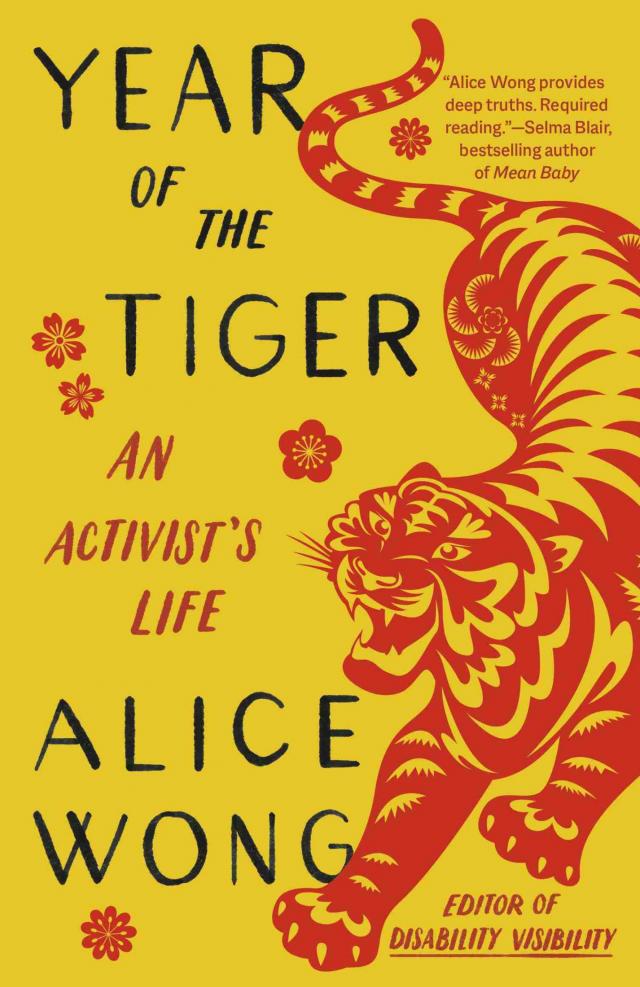
ALICE WONG
Year of the Tiger
Alice Wong is a disabled activist, media maker, and research consultant based in San Francisco, California. She is the founder and director of the Disability Visibility Project—an online community dedicated to creating, sharing, and amplifying disability media and culture—and the editor of the anthology Disability Visibility: First-Person Stories from the Twenty-First Century and Disability Visibility: 17 First-Person Stories for Today (Adapted for Young Adults). Alice is also the host and coproducer of the Disability Visibility podcast and copartner in a number of collaborations such as #CripTheVote and Access Is Love. From 2013 to 2015, Alice served as a member of the National Council on Disability, an appointment by President Barack Obama. She is currently working on her next anthology, Disability Intimacy, forthcoming from Vintage Books.
@SFdirewolf
disabilityvisibilityproject.com
EDITED BY ALICE WONG
Disability Visibility: First-Person Stories from the Twenty-First Century
Disability Visibility: 17 First-Person Stories for Today (Adapted for Young Adults)
A square frame containing Alice Wong’s Chinese name, 王美華, written in seal script, an ancient style of writing Chinese characters. Artwork by Felicia Liang.
A VINTAGE BOOKS ORIGINAL 2022
Copyright © 2022 by Alice Wong
All rights reserved. Published in the United States by Vintage Books, a division of Penguin Random House LLC, New York, and distributed in Canada by Penguin Random House Canada Limited, Toronto.
Vintage and colophon are registered trademarks of Penguin Random House LLC.
The permissions acknowledgments constitute an extension of this copyright page.
Cataloging-in-Publication Data is available at the Library of Congress.
Vintage Books Trade Paperback ISBN 9780593315392
Ebook ISBN 9780593315408
vintagebooks.com
ep_prh_6.0_140870842_c0_r0
FOR THE DISABLED ORACLES OUT OF TIME;
I JOIN YOU IN THE CHORUS OF OUR WISDOM.
Contents
Introduction
ORIGINS A Mutant from Planet Cripton: An Origin
Lessons from a Chinese School Dropout
Troublemakers
First-Person Political: Musings from an Angry Asian American Disabled Girl
Rest in Peace, Meowmee
The Americans with Disabilities Act
Letter to Time Magazine
Untitled High School Poem
Did You Enjoy High School?
ACTIVISM My Medicaid, My Life
The Politics of Change by Lizartistry
Snack Manifesto
The Olmstead Decision and Me
Hashtag Activism and #CripTheVote by Lizartistry
#CripTheVote: Then and Now
Inclusive Politics and the Disability Community by Lizartistry
Bay Area Day of Mourning
Just Say NOPE
Activist Wisdom
ACCESS One of Those Aha Moments
Why Disabled People Drop Out
My Day as a Robot
Net Neutrality, Accessibility, and the Disability Community
The Last Straw
Ode to a Spit Cup
Getting to the Marrow
Food Heaven by Felicia Liang
Let’s Recognize Why #AccessIsLove
Pureed Spinach & Mushroom Soup
CULTURE The 1 Percent Disabled Club
Cat Life (artwork by Sam Schäfer)
How I Spend My Caturdays (and Nights) at Home
Disabled Faces
Westward Ho
Year of the Tiger Crossword
Lunar New Year Memories
Proust-ish Questionnaire
STORYTELLING Storytelling as Activism
Diversifying Radio with Disabled Voices
Choreography of Care
Tiger Tips on Interviewing
Podcasting as Storytelling
Letter to Asian American Disabled Women and Girls
About Time
PANDEMIC I’m Disabled and Need a Ventilator to Live. Am I Expendable During This Pandemic?
Freedom for Some Is Not Freedom for All
Cooking in Quarantine: Shelter-in-Place Jook
It’s My Body and I’ll Live If I Want To
A High-Risk Timeline of Alice Wong, Proto-Oracle
In Praise of Peaches
No to Normal
FUTURE My Disabled Ancestors
Ancestors and Legacies
The Parasite by Hatiye Garip
As I Lay Breathing
The Future of Care?
Dream Dispatch: Society of Disabled Oracles
The Rainbow by Hatiye Garip
How to Create a More Inclusive Future Post-COVID
The Last Disabled Oracle
The Seedling by Hatiye Garip
My Grown-Ass Disabled Person Make-A-Wish List
Thank You, Mrs. Shrock
Future Notice
Illustrations
Acknowledgments
Answers to Year of the Tiger Crossword
Permissions Acknowledgments
Introduction
The book you are reading is from the future, as am I. I have traveled a long way to be with you and have much to share. Spending several decades on Earth has been quite a thing for this disabled Asian American woman in a hostile and unforgiving climate. Clawing, hissing, and fighting through a pandemic, against inequities in vaccine access and eugenic policies and attitudes that consider certain groups disposable, have given me the need to pause and reflect on all that I’ve been through. I have fought these battles for the bare minimum of existing in the same space with you all.
I realized in 2020 that the time to tell my story was now or never. That’s what being a high-risk ventilator user who was deprioritized by the State of California for lifesaving vaccines will do to you. Sheltering in place with your seventy-plus-year-old parents, who are also high risk, for over a year amid anti-Asian violence and hate will do that to you, too. Instead of having a mediocre white man’s midlife crisis and buying a combustible self-driving Tesla or investing in cryptocurrency for “true freedom,” I decided to write a memoir at this age—the age I was never supposed to reach, during a time I was never supposed to occupy. I will never have children, but my work, stories, and relationships are my legacy, and this book you are reading is the latest contribution to the Canon of Alice.
Did I dream of becoming an activist? No, but it’s probably what I’m most known for. Ableism conscripted me into activism. Other people have the luxury to opt in and out of activism like earning extra credit for a project, but not me. What I have learned about creating change and staying true to myself from childhood up to now is yours for the taking. Getting your needs met, being part of a community, stirring up shit, and sharing information: these are examples of my activism, and there are many ways to be an activist whether you use the word to describe yourself or not. How and where I do it is as important as why and whom I do it with. Being agitated and dissatisfied is an activist mood. Activism is undervalued, unsustainable, and unrelenting. Hypercapitalism, white supremacy, and ableism create the structural conditions that undermine activism and other attempts at changing the status quo. Finding the joy, pleasure, and generative possibilities of organizing is part of my long-term unlearning of what activism is supposed to look like. Unlearning and building anew is activism as well.
Living under multiple existential threats, I’ve seen how marginalized communities care for one another and find solidarity across movements, because at the end of the day no one will remember and save us except us. I say this as a longtime resident of San Francisco who cannot remember the last time there was a torrential thunderstorm but who’s had to deal with rolling power outages and days of smoke-filled air from wildfires several years in a row. And in the face of what feels like impending doom, mutual-aid collectives emerge and organizations such as Mask Oakland distribute free N95 masks in anticipation of and response to environmental and public health crises. We can and will do better if we follow the principles of disability justice as outlined by Patty Berne, the cofounder and artistic and executive director of Sins Invalid who believes interdependence is a strength as we meet one another’s needs, all bodies are whole and perfect as they are, our freedom is tied to the freedom of others, and people whose lives are most enmeshed in systems are the experts who should lead.
Year of the Tiger is divided into seven sections: “Origins,” “Activism,” “Access,” “Culture,” “Storytelling,” “Pandemic,” and “Future.” It is a collection of original essays, previously published works, conversations, graphics, photos, commissioned art by disabled or Asian American artists, and more. I hope you will find this book fun and something you will color in, mark up, highlight, scribble on, fold into dog-eared pages, and give to others. I liken it to a mash-up of scrapbook, museum exhibit, magazine, creative writing assignment, and diary, just without the gl
There are many kinds of writing in Year of the Tiger, but essays are my jam. Whether I publish an op-ed for Teen Vogue or a blog post on my website, I am taking the time and doing the labor to express what I care deeply about. The economy of an essay forces a writer to be a ruthless, streamlined shark with their ideas. Restraint and precision are part of an essay’s elegance along with its structure. An essay doesn’t have to be in response to or a critique of something else; it can reveal, subvert, wonder, provoke, analyze, celebrate, and poke fun.
Aside from social media, essay writing is my activist tool of choice, my peak creative and intellectual practice, where I layer, condense, finesse, and coax a thought into a Thing. A story from a personal, overlooked perspective can reach more people than a rally and change more minds than a policy paper. For some publications, I have to summon all that I am into eight hundred words or less, which is some damn fine magic. In Dr. Tressie McMillan Cottom’s newsletter essaying, she wrote, “Beneath all the prose and the argument, an essay is a public. The best essays build a public through process and form, driven from creative impulse to address a social problem….The best scholarship and the most invigorated publics have this in common: They channel massive amounts of creativity. Into relationships. Into methods. Into networks. Into discourse.” It is my intention for every chapter to be in conversation with the others and to ripple out through a mycelial network that builds, shares, and connects My Things to New Wondrous Things, tendrils of making, reaching high and low, in the shade and under the sun.
In writing the proposal for this memoir, I collected some of my past works and was stunned by the volume and the variety. Reviewing cringe-inducing pieces from my high school and college days, I realized every single piece has led me to where I am supposed to be right now. It is a privilege to trace these seeds that grew into sequoias and to highlight the communities that supported me. I planned to have maximum fun in the writing, editing, and assembling process because book stress can always use a chill friend. I tried to let go of my anxieties about memoirs and purposefully did not read an extensive number of them or research comparable ones because I knew it would just mess with my head. This probably goes against most professional advice, but I want to be transparent with you about my process and approach.
Curating myself in words, images, and objects, I was unsure if I had anything new I urgently wanted to write, and why yes, yes I did! But I also took this opportunity to throw some shade and to lean into my pettiness. I do this not purely for vindictive reasons but as examples of real experiences (with Joan Collins–level receipts) from my everyday life. My redacted texts, rage, and callouts are my truths as much as my activism and storytelling. And for anyone who does not enjoy profanity, consider yourself warned.
Memoir, as a book category, is beset with a number of unique expectations by both the author and the reader. You will not find any pithy themes from this memoir, but that’s what blurbs are for! I resist and challenge the idea that a memoir needs to be neatly digestible with sentimental generalizations about the meaning of life. Since this is my first time writing about myself at length, you should know the following:
This is not a book that aims to please or center whiteness and nondisabledness.
This is not a singular success story about overcoming odds, about perseverance or resilience; this is not a “diverse” or “intersectional” book.
This is not a meditation on identity and pride—that is, whether I am too Chinese or disabled enough—nor a caught-between-two-worlds or my-immigrant-parents-don’t-understand-me story. I am actually not Chinese enough and am very, very disabled, and I am hella okay with that. Haven’t we all seen enough of these types of memoirs, anyway?
This is not a “harrowing” yet “triumphant” account of discrimination, ableism, humiliation, and pain. I’ve got a bunch of these stories, and you’re going to get only a sliver. I will not excavate my innermost secrets and traumas for your consumption. A memoir can provide only a glimpse of a person, and I am presenting one that is framed by me for nefarious purposes that you may discover one day if you dare.
One of my concerns when writing Year of the Tiger was about the publishing industry’s propensity to publish memoirs by disabled people as opposed to other types of books they might prefer to write. I don’t have any numbers, but it seems there are more disabled people with memoirs than with graphic novels or cookbooks, with books of photography or poetry, or in genres such as speculative fiction, romance, children’s literature, and every single other category. Why is that? Is it because readers expect disabled people to have an interest only in explaining disability rather than focusing on their other talents and passions? Is it because disability is more easily understood as an individual phenomenon without broader social and cultural contexts? Is it because it’s more palatable and “humanizing” to learn about one person and the presumed challenges and adversities in their life? Is it because the reader expects a catharsis and warm, empathetic after-school-special fuzzies by the last page? Is it because they sell? This is not about the authors but about the publishing industry’s estimation of what makes a book attractive and salable—and, in doing so, the power a handful of corporations exerts to decide which disabled people’s stories are worth telling. Like other disabled writers and editors, I am entangled in this web, too.
I’ve read abstracts for a lot of disability memoirs that made my eyes roll all the way to the back of my head. And while I get that audiences vary and there should be a wide range of memoirs, I would venture to say that a majority of them are inspirational, exceptional, heroic, angelic, tale-of-adversity, or courageous narratives. I present to you instead an impressionistic narrative comprising irregular dots that fade, drift, and link rather than a soaring, symmetrical arc. Still, it unsettles me to be in this category and makes me mindful of how my book will be perceived, reviewed, and marketed to the public. How will the public receive my publics? I await this answer with cautious optimism.
Are memoirs by disabled people the zoo exhibit of the publishing world, allowing the reader (assumed to be a default white, nondisabled, cisgender, heteronormative person) to peer into a life they find equal parts fascinating yet unimaginable? A twenty-first-century spectacle? A reader who wants to feel proud and deserving of diversity points for being a “good” ally after completing it? Whatever reason led you to pick up Year of the Tiger, I welcome you to question everything when you are done.
Memoirs are valuable because remembering allows us to access our imagination and power. I have willed myself into existence time and time again, and the power of memory is linked with the ability to manifest one’s future. Tiger Power (and caffeine) fuels my travel through portals—it takes a lot of big cat energy to leap into unknown situations, roar against injustice, claw open new spaces, make stealthy moves, and swipe at all who annoy me across the multiverse. For now, I am here at this moment with you and will hold on for as long as I can.
A lot of things remain that I want for me, and there are even more things I want for us. Manifestation requires desire, ambition, sensitivity, and creativity. Each book or story by a disabled person holds a piece of a spell…eventually when enough pieces come together and fit, there will be a collective harmonic conjuring. Ripples of energy propelled by momentum, our truths undeniable and irresistible, our messages reverberating far and wide with hidden frequencies just for us. By conjuring our power and manifesting infinite dreams together, the world will finally see us as we are.
Cats rule the world.
—JIM DAVIS, CREATOR OF GARFIELD
Tell me, everybody’s pickin’ up on that feline beat,
’Cause everything else is obsolete.
—AL RINKER AND FLOYD HUDDLESTON, “EV’RYBODY WANTS TO BE A CAT”


