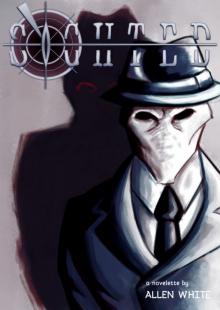
Murderworld, p.6
Murderworld, page 6


The Icepick was one of the Armilons, the eight rarest, most valuable weapons in the Game. Each possessed a special, unique attack ability. When sold, many fetched hundreds of thousands of dollars, and a few—like the Icepick—were worth millions. When offered as stakes in single combat, fortunes and reputations were made and lost in an eyeblink. The sword bestowed a generous hit bonus when severing limbs or when used for a beheading. Eraser X used its power to full advantage, removing an opponent’s arms or legs until only a torso remained for him to decapitate: he erased them one piece at a time.
The crowd hushed, their applause stopping in unison as they waited to receive his words.
“Clanmates,” he began, his voice soft and deep. “Do not merely wield the blade. Do not merely know the blade. To be victorious, you must become the blade.” He paused to let the audience absorb the impact of his words.
“The enemy will try to use their weapon as a wall in order to create distance. This is because they think of their weapon as separate from themselves. But taking a life is an act of intimacy: the weapon does not separate you from your opponent, but joins you to them. This knowledge is how they can be defeated.
“The battle is won before the sword is drawn. As the Hagakure says, ‘Matters of great concern should be treated lightly.’ You create the strongest impression on your enemy by doing nothing. Be at peace, and quiet your inner voice. Embrace stillness. When the enemy sees your unconcern, when he senses the utter depth of your focus, his doubts will overcome his resolve. Inside, he will die before the fight begins.
“This is wisdom.”
twelve
The kitchen was small and confining. The dining table, though one side of it was pushed against a wall, took up most of the room’s available space. Sitting between her parents on the longer axis of the table, Soo-yun pouted. Her mother, Eun-mi, was adamant that she sit and eat dinner with the family before she returned to her room, since once Soo-yun shut her door she’d remain unseen for the rest of the day.
Eun-mi sighed at her husband, Jin-sang, who preferred to stay out of the ongoing mother-daughter feud. He chewed with deliberation on a piece of fried tofu, careful to avoid eye contact with his wife. A balding, plain man with simple tastes, he avoided all conflict and was mild and agreeable to a fault.
Soo-yun poked at her food with a chopstick in each hand, which she used to stab holes into her own soft tofu cakes. She’d be thirteen in a few months, and already had the kind of willfulness that her mother had hoped she wouldn’t see for a few more years. Eun-mi felt as if she had little sway over her daughter’s use of time, yet as Soo-yun did well in school, Eun-mi had little reason to complain about the hours the girl spent alone in her bedroom.
Eighteen months back, as a reward for her excellent grades, they’d bought her a few games for her console, the same device on which she also did her schoolwork. Since then it was as if they’d lost their child. Soo-yun seemed to care about little else. When she’d first gotten her first game, Pink Rabbit’s Lucky Prosperity Shopping Quest, she’d been obsessed with it for a time. It had seemed like harmless fun. But there were also plenty of other games available for free, their revenue streams based on player purchases of special items and vanity character modifications. If Soo-yun had joined such a game, her mother would never know it, as the files on Soo-yun’s console were protected with a biometric lock. It wasn’t like Eun-mi to snoop, and since Soo-yun was such a good student, she’d tried to respect the girl’s privacy. Yet her daughter seemed to prefer the game world to human contact, which for months had left Eun-mi both worried and annoyed.
Korea, like many nations, had in effect doubled the number of teachers available to its swollen population by splitting class time into real and simulated hours. For three days a week, Soo-yun took the bus to a real school, while alternating days were spent at school in-Loka, with only Sunday free. But no matter the day, Soo-yun would spend endless hours inside some unknown environment long after her homework was done, emerging only for dinner or to brush her teeth before bed. It was a little disturbing.
Eun-mi made an appointment with the school psychologist, who told her that it was nothing to worry about. For kids, she noted, the Loka was so expansive and new that real life seemed dull in comparison. Besides, so much of the world’s business was now conducted inside the artificial realm that it was excellent job training for children to become as comfortable as possible operating within it.
Other than following several dramas, Eun-mi had not taken time to explore what the Loka had to offer. But since talking to the psychologist she had begun to visit the Loka almost every night, and she soon fell under the seductive spell offered by its near-infinite artificial worlds. Though she still hated Soo-yun’s lack of social interaction, at least she now was able to better understand it; yet because of an ingrained set of parental expectations she still couldn’t quite leave Soo-yun alone. Now, at dinner, those expectations were again tested by Soo-yun’s reluctance to eat at the table.
“Fine,” said Eun-mi, exasperated. “Take your food with you and go. I expect you to eat all of it.”
Soo-yun brightened, “Yes, Mama!” She lifted her bowl and began to rush out of the room.
“Wait!” insisted Eun-mi. “Did you practice your trombone today?”
“Ninety minutes.”
“Fine.” She waved her hand to dismiss Soo-yun, and her daughter sped away.
Jin-sang glanced at his wife out of the corner of his eye.
“What?” she demanded. “You’re no help!” He again looked down at his food, and continued chewing in silence.
In her closet-sized room, Soo-yun plopped down into her chair, and with one foot pushed her black plastic trombone case under a bed that took up most of the room’s space; she knew was lucky to have her own space, as many children in her neighborhood did not. She shoved a hunk of tofu into her mouth with chopsticks as she pulled the interface over her head with the other hand. Impatient, she tapped the power stud, and felt a familiar, disorienting surge as the machine threw her into the Loka.
She winked into a vast space the shape and scale of the interior of a zeppelin. On all sides was clutter suffused by purple light. Various mismatched furniture dotted the room in styles from futuristic minimalism to historically baroque. A scattering of weapons—knives, guns, clubs, spears, bows, and more—had been dumped into piles in the corners, rested on shelves, or poked out of cabinets and chests. In the center of the ceiling dangled a wrought iron gothic chandelier, spider-like and tugboat-sized, slathered with a dripping frosting of white candles that burned forever with violet flames.
The room’s concave walls were blanketed with moving clips of pop singers, animated characters, and Game killstars. Around and across the images were wisps of arcane graffiti, which, if deciphered, boasted names like “Skelly” and “Nife” and “CorpseCount.” In one corner was a scrawled list titled “100k kill klub,” and beneath, numbered from one to five, were only a few names. The first was “Mari Night,” next to which, in smaller text, read, “Suck it, chamji!”
And there were hedgehogs. Hundreds of the plump, spiny creatures nosed through weaponry, or waddled across the floor, walls, and ceiling, ignoring gravity. Dozens snoozed on any available furniture, or frolicked on the chandelier.
“Hellooo,” called out Soo-yun, now inhabiting the body of Mari Night. Her voice echoed throughout the space. From the other end of the room came a response, as a hissing rocket-propelled grenade spiraled towards her. She dodged it without effort, and it exploded against a far wall, flipping a Louis XVI-style divan into the air on a billowing puff of fire, and scattering several indestructible hedgehogs into the air.
Mari laughed. “BangBang?”
“Maybe,” growled a distant voice.
“Crunch get sour, use live rounds inna clubhouse.”
“Crunch shibal.”
Soo-yun had long ago gotten used to Gamers mixing gutter Korean with English, since Korean gaming culture had long been one of the dominant influences on M-world’s scene. Swearing had been internationalized, so that formerly localized cursing had been corrupted by the Anglicization that permeated world communication, and gradually many of these words had been absorbed into Global English as its own linguistic subset: Gamer creole.
The trick to using slang was that players needed to teach their personal translators not to decipher such words so that they came out the way they spoke them; for even more control, some tweaked their translators with undermarket wrenches, unauthorized software hacks. Being Korean, she preferred not to use such language—it still sounded awful to her, and since she’d get punished if she used such words ex-Loka, they never came to her lips with ease. Instead she’d learned to swear in English.
Mari surged forward, blurred as she bounced from an easy chair onto the wall, where she ran along its surface, first sideways, then even higher, until she sped in a complete corkscrew loop across the ceiling and down the other wall to the ground at the far side of the room.
She alit near a small hill constructed from furniture and assorted junk. Objects had peculiar properties within the Game; they could be destroyed by weapons or by direct smashing force, but in non-combat situations, their structures had no upper weight limit. So they could be stacked and piled and manipulated without damage. People built whole fortresses out of things like tables, flowerpots, cereal boxes, or teddy bears.
Resting atop the hill was a massive human hand the size of a small car, bright blue in color and severed at the wrist. It appeared to be carved of wood. The hand was open, palm up, and somewhat cupped. Lounging in the palm was a man, his legs dangling over the huge fingers, the still-smoking tube of the launcher in his lap. He had shoulder-length, dark blue-green hair. When he smiled, he flashed a mouthful of copper-jacketed bullets instead of teeth. His eyes were thick black crosshairs over green dots. He wore a long coat assembled in checkerboard fashion, with squares of brass-and-lead ammunition alternating with squares of dark brown leather. Hidden inside the coat were custom shoulder holsters that held three pistols to a side, mounted for quick draw. The coat’s long skirt concealed other surprises, such as a rapid-fire machine-shotgun that pumped out a stream of destruction, as well as a Vulpine Decimator, a Gatling-style flechette rifle that could strip flesh from a body in seconds.
“Bang, man, where is everybody?”
“Out to play. Meatswarm in Lebensmüde.”
“Chobo hunt?”
“Nah. Rank-trashin’ meowjellies.”
“Maybe I drop in,” said Mari.
“Fuck that.”
“Better than talkin’ to you.”
“Fuck y—”
She winked out.
Lebensmüde was a combat zone, which meant that formal one-on-one challenges weren’t required. Any player could kill any other at any time. It was a faster way to get into duels, but it also lacked the protection of challenge protocols—so combat here didn’t lock out interlopers from joining anybody else’s battle.
The dojang was designed to look like an abandoned, post-apocalyptic, underground German shopping mall. It had kilometers of dilapidated shops: overgrown biergartens, collapsing theaters, rusting stands for currywurst or pommes frites, and more. Merch was scattered everywhere.
Mari stood in front of a candy store where a river of Gummi Bears had long ago exploded out of the storefront and vomited a jelly rainbow into the promenade. As she shook her boots to dislodge a few sticky passengers, she felt the bass rumble of a distant explosion. She hurried toward the sound. Much of the mall’s fluorescent lighting had been destroyed, and the few remaining lights flickered and sputtered. The gloom was perfect cover, and Mari slipped from shadow to shadow, her suit blending with the darkness.
There came another explosion, much closer, followed by sounds of breaking glass and cracking concrete.
The passageway opened into a tall atrium, a wide, 20-story cylinder-shaped hole that revealed a cutaway view of every level. At its center was a huge globe, a decorative sphere half the height of the atrium, made of mirrored silver. Atop the ball stood what looked to be a man, but with the head of a dog that might have been a mastiff’s: a canid. The dog-man held a long blade in his right hand that looked to be a nodachi, a traditional Japanese battle-sword that was as long as he was tall. In his left, he grasped a metal baton known as a Roman candle: an expensive, high-level armament. The candle was both a striking and a shooting weapon, and just then, its wielder fired a pulsing sphere of blue energy from one end that shot across to a tenth-floor balcony where stood a skinny girl in a magenta cape. The fireball exploded inches from the girl’s face, repelled by her energy shield, but the blast knocked her back on her ass. That looks like Pinx, thought Mari.
A scream from above caught Mari’s attention, and a shape dropped from near the domed ceiling onto the dog-man’s shoulders. Mari recognized the war-cry of her friend Sorrow, and watched with professional interest as he wrapped his legs around the canid’s neck while attempting to bash the creature’s brains out with a silver mallet that looked like a meat tenderizer—which it was. He called it “Maxwell.” Sorrow had a weird sense of humor.
As Mari neared, she watched the dog-man try to slice Sorrow with his sword, but he couldn’t see his assailant, a fact exacerbated when Sorrow used a free hand to cover the dog-man’s eyes. Sorrow dodged the sword, continued to smash his opponent’s head with perfect rhythm, and Mari was close enough to see a mist of blood spattering Sorrow’s face. Though her readout showed the dog-man’s Élan Vital dropping, he still had plenty to go. With over 67,000 kills he was skilled, but the number was no comparison to her own total.
Dog-man, sick of being skull-bashed, pitched head-first from the top of the sphere. If he thought that jumping would get Sorrow to let go he was wrong, and both of them landed with an audible thud as they hit the ground head-and-shoulders first. Sorrow took the brunt of the damage, all the while still pounding away. Dog-man, on his back, shoved the candle into a hip-holster and dropped the sword. He grabbed Sorrow’s legs, which were still around his neck, with both hands. He pried the legs apart, arched his back for leverage, then sat up—fast—to throw Sorrow forward. Sorrow was pitched into a display of mannequins dressed in lederhosen and alpine hats; it seemed that cartoon stereotype Germans once shopped here.
Dog-man stood, seized his sword, moved toward Sorrow for the kill. Sorrow was sluggish, suffering stun effects, and Mari’s tac showed he had some broken ribs. She wasn’t too concerned—she’d seen him kill a guy after both of his legs had been ripped away.
Dog-man whipped up his nodachi for a finishing strike, a feral grin parting his jowls. He strained to bring his sword down, but found it locked in place. From behind, a meaty, armored fist had wrapped around the blade. Dog-man pivoted, still holding the hilt, and came face-to-chest with a towering lump of muscle and metal, a nine-foot tall biomechanical monster known as Crunch. He was an “extreme,” meaning his stats were pushed into a small set of attributes; strength, stamina, and mass. He could cause more damage with his body than most did with the nastiest weapons.
Dog-man looked surprised, a rare expression in a realm where people lived the impossible every day. Crunch grimaced down at his smaller foe, showed a mouthful of teeth like paving stones. Carbon fibers bunched in his chest and bicep as Crunch rotated his fist, which snapped the nodachi as if it were a hummingbird’s femur. Dog-man yanked out the Roman candle, jammed it into Crunch’s formidable, muscled gut, and fired. The candle’s charge exploded, its blue energy a rippling shockwave that swelled between the two combatants. Crunch didn’t move, but Dog-man was blown backwards, tumbling over Sorrow’s head and into a concrete support pillar ten meters away, smashing into it with such force that his body gouged an impact cavity. The candle skittered away across the linoleum floor.
Dog-man flopped to the ground, EV draining away, and tried to sit up as he clawed at his belt for another weapon. Sorrow staggered over to him, blood leaking from mouth and nose, the hammer still in his hand.
“Shoggy piggy-wiggins,” said the dog, wheezing, his voice gruff and gravelly. The translator couldn’t keep up with his arcane, nonsensical slang, so left it untouched. “Buncha dickyblocks. Fuck eeselves wit’ y’own bloopy blades. I hope ee die—gooby skubber-lubbbets!”
“Can’t fuckin’ stand furries, wittle puppy-wup.” Sorrow raised his hammer. “Yiff this.” He brought the hammer down on Dog-man’s brow as hard as he could. Maxwell rang like a bell on the mastiff’s skull, denting it, and brain squirted out of the wound as the canid’s remaining EV vanished.
Sorrow wiped his hammer on Dog-man’s vest. His dandelion of white-blond hair was even wilder than usual, and he smiled with sunny bravado up at Crunch, teeth and chin stained with gore. Pinx flipped down from the balcony, landing beside them.
“Shit work, guys,” called out Mari as she approached.
They all turned to face her. Sorrow spun Maxwell, rolled the hammer through his fingers, amused. “Planning’s for peoples without ‘magination. Combat’s the art of im-pro-vizz-ation.”
“Yeah,” said Pinx, her soft voice muffled behind pink-and-purple hair that hung in her face, covering one eye.
“Is ‘improvisation’ your word for having no fucking clue?” Mari gave Sorrow a playful punch on the arm, hard enough that it knocked off some EV.
Crunch’s voice came out as a lion’s low growl. “Spoinked him hard.”
“Psych points, means he,” said Sorrow.
“Yeah,” said Pinx.