

All that rises, p.1
All That Rises, page 1


Praise for All That Rises
“I first met Alma García at the Bread Loaf Writers’ Conference. I knew her work would be important, and now All That Rises proves it. Alma brings it and gives it all. Enhorabuena, novelista. An auspicious debut.”
—Luis Alberto Urrea, author of Good Night, Irene
“Expansive and well grounded, All That Rises shines as a novel willing to trace its fingers into the highest and darkest branches of the family tree. García gives us an astounding panoply of characters—funny, wounded, smart, and proud—all of them striving to understand how families can nurture the strength of their roots only through hard-won honesty. An immersive and compassionate first novel.”
—Manuel Muñoz, author of The Consequences
“Beautiful, outrageous, and beguiling.”
—Helena María Viramontes, author of Their Dogs Came with Them
“All That Rises introduces us to a refreshing new voice in Latinx literature. With empathy and grace, Alma García has mapped the borderlands in a bold new way. The result is a novel of stark originality populated by characters whose lives readers won’t easily forget.”
—Alex Espinoza, author of Still Water Saints
“A remarkable work of fiction. Alma García has skillfully woven an engaging story of a modern American family redolent with the themes of the border, the Rio Grande remaining an Archimedian point in every character’s life and choices from living in El Paso. García truly understands how the imprint of a life lived in two cultures at once can never leave you. A wonderful accomplishment.”
—Domingo Martinez, author of The Boy Kings of Texas
“With All That Rises, Alma García makes a significant contribution to the rich and beautiful literature that comes out of the border. Not only do we care deeply about her people, but the landscape itself becomes a well-developed, complex character in this compelling, vivid, and often funny novel about family, economic class, and the borders we share, both literal and metaphorical.”
—Daniel Chacón, author of Kafka in a Skirt
All That Rises
Camino del Sol
A Latinx Literary Series
Rigoberto González, Series Editor
Editorial Board
Francisco Cantú
Sandra Cisneros
Eduardo C. Corral
Jennine Capó Crucet
Angie Cruz
Natalie Díaz
Aracelis Girmay
Ada Limón
Jaime Manrique
Justin Torres
Luis Alberto Urrea
Helena María Viramontes
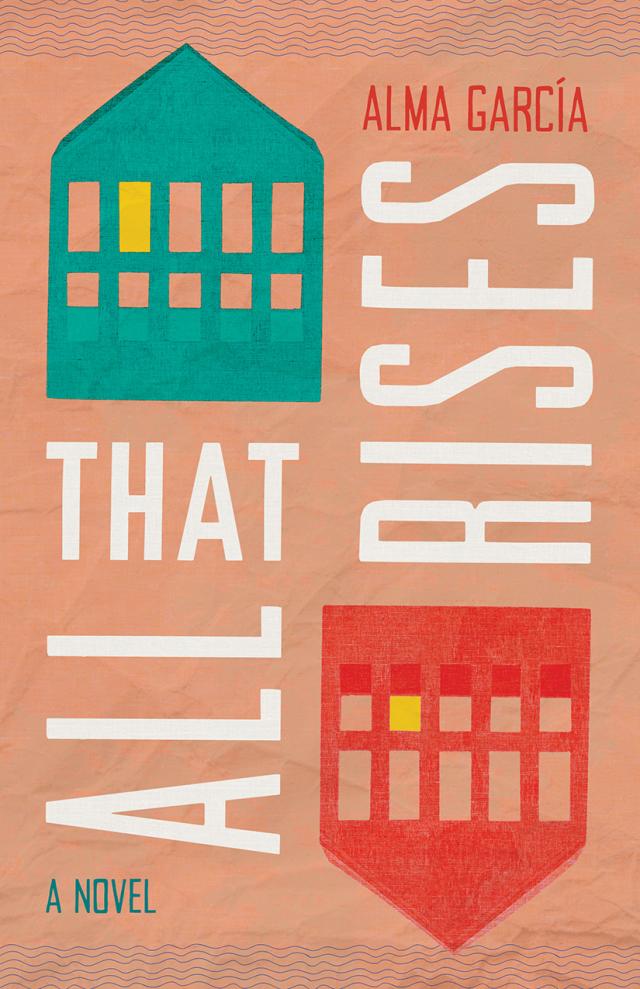
All That Rises
A Novel
Alma García
The University of Arizona Press
www.uapress.arizona.edu
We respectfully acknowledge the University of Arizona is on the land and territories of Indigenous peoples. Today, Arizona is home to twenty-two federally recognized tribes, with Tucson being home to the O’odham and the Yaqui. Committed to diversity and inclusion, the University strives to build sustainable relationships with sovereign Native Nations and Indigenous communities through education offerings, partnerships, and community service.
© 2023 by Alma García
All rights reserved. Published 2023
ISBN-13: 978-0-8165-4915-3 (paperback)
ISBN-13: 978-0-8165-4916-0 (ebook)
Cover design by Leigh McDonald
Designed and typeset by Leigh McDonald in Calluna 10/14, Iva WF and Tallow Sans (display)
Publication of this book is made possible in part by the proceeds of a permanent endowment created with the assistance of a Challenge Grant from the National Endowment for the Humanities, a federal agency.
Library of Congress Cataloging-in-Publication Data are available at the Library of Congress.
Printed in the United States of America
♾ This paper meets the requirements of ANSI/NISO Z39.48-1992 (Permanence of Paper).
For my father and for my mother
Contents
Foreword
Antes / Before
Al Tiempo, Tiempo Le Pido / From Time, I Ask Time
1. Shallow Waters
2. The Brown Invasion
3. Keys to the Kingdom
4. In the Beginning
5. Oh, the Places They’ll Go
6. All the Time in the World
7. Dry as Hell
Al Tiempo, Tiempo Le Doy / To Time, I Give Time
8. Ask Again Later
9. Deep Water
10. Gold
11. In Love and War
12. Lone Star
13. The Seaside Mano
14. The Caverns
15. Out Walking
16. All That Falls
17. All That Rises
El Tiempo Es un Buen Amigo / Time Is a Good Friend
18. El Otro Lado
19. Trespass
20. Regresando
21. Spooks
22. Fiesta
23. Heart of Hearts
24. Day Breaks
El Tiempo Nos Desengañará / Time Will Enlighten Us
25. Here and Now
Acknowledgments
About the Author
Foreword
El Paso, Texas, is one of the most compelling settings in Chicano literature. From John Rechy’s queer novel City of Night (1963) to Estela Portillo Trambley’s novella Rain of Scorpions (1975) to Alma García’s stunning debut novel set in recent times, the border city continues to hold its place as a premier landscape of the literary imagination. Credit its groundbreaking writers who refresh our eyes by paving unexplored pathways into the heart of El Paso’s vibrant life. Such is the case with All That Rises, a multivalent narrative that journeys through the range of experiences of the Mexican labor force and Texan professionals—both Chicano and white—shattering demarcations that we have long believed separate people by class, ethnicity, language, and nationality.
García’s novel, populated by a notably large cast of characters whose stories pulse with secrets and deceptions, unearths the uncomfortable truths of familial and community relationships, the precariousness of imposed hierarchies and economic dependencies, and the brittleness of borders. Though readers will encounter protagonists who work as sweatshop managers and border patrol guards—arguably two of the most embattled occupations in the borderlands—García’s nuanced characterizations will trouble both prejudice and assumption, eschewing reactionary politics by privileging a communal portrait over individual headshots. It’s the greater, more complex history that counts. Yet even that pronouncement is unsettled by García’s intricate and clever storytelling.
The word history cascades down the pages of this novel, situated not as a fixed concept or definition, but one that is subject to question. “History,” one characters quips. “What good is it anyway?” And then elaborates, “Well, that’s the thing about history, ain’t it? All you got is somebody’s memory. No one can prove anything ever happened.” All That Rises showcases the collision between knowledge and belief—what took place and how it is remembered. And, most consequentially, how a view of the self (and others) changes with the discovery of new insights or information.
If all of this sounds weighty, rest assured that the narrative you are about to enter is buttressed by humor and scenes that wallop with emotional punches and surprises. The dust only begins to settle after one revelation when another one starts to come to light, which makes for quite an unpredictable reading experience.
The late Chicano author and El Paso native Arturo Islas once pointed out that “the 2,000-mile-long Mexican–United States border has a cultural identity that is unique.” That condition, he observed, is what fueled the energy in his novel The Rain God (1984). García, too, draws inspiration from this magical and conflicted place, and without question has written a great novel destined to become another classic set in la gran frontera.
—Rigoberto González
All That Rises
What’s past is prologue.
—Shakespeare, The Tempest
El amor es ciego, pero los vecinos no.
Love is blind, but the neighbors aren’t.
—Mexican proverb
Antes / Before
* * *
Every light in the house is off. The neighboring houses too. Below lies the sloping curve of the street, the carpet of city lights, the highway bending through the desert and streaked with sparse trails of red and white. Farther still, a river, the divide between here and over there.
Her shoulder cramps. In her duffel bag, the necessities, stuffed in without folding: sundresses, sleeveless blouses, swimsuit, underwear of a certain quality—in particular, a silk slip, its hem stained with coffee. No time for washing. Or maybe she would fly it like a flag. Her hand slides to the bag’s outer pocket. The envelope crinkles at her touch.
She holds whatever breath she’s still able to breathe as she skims down the driveway. There is who she once was and who she is now, but nothing holds them apart anymore. She is permeable, thinner than air, except for the great weight certain people have left on her heart. She thinks of those sleeping behind her, the shapes they each make in their beds, the arc of their breath. Her hand shakes. Key instead of the beeper, so she won’t make a sound.
Her slippery thumb sets off the car alarm.
She hisses “Shh, shh, shh, shh!” to the horn that announces her, over and over, as she hot-potatoes the fob.
The alarm chokes off. Her heart pounds, eyes spinning wild tow
She waits until the crickets resume their rasping in the hedges. The lights do not come on.
Hmmmph.
She aims the key fob like a gun. Allows the door to slam shut behind her. As she pivots out of the driveway, she forces a squeal from the tires.
Yet she idles in the street, listening to her own slowing breath. Her hands grow heavy and warm on the steering wheel as the darkness opens around her. It can’t keep her out. Her eyes almost close.
“Wake up,” she whispers. “You’ve been dreaming.”
And she’s off.
* * *
Al Tiempo, Tiempo Le Pido / From Time, I Ask Time
2005
Chapter 1
Shallow Waters
Huck DuPre finds the note taped to the toilet.
What if, Huck? What if there was someone else? What if I was on my way to meet him right now? While you’re chewing on that, here are some ideas for explaining my absence: I’ve lost my mind. I’m going on a world tour. I’ve gone off to find myself. I’m trying to rediscover my youth. I’ve joined a convent. The Peace Corps. A cult. I’m a secret alcoholic or prescription drug addict. Tell the girls at the country club I dropped dead. Tell the kids I’ll be back in a couple of weeks. Probably. It depends on how things go. We could all just use a damned break from each other, don’t you think?
Rose Marie’s Lexus is not in the garage. And no one has made any coffee. Outside, the kid he pays to manage the lawn applies pruning shears to the rosebushes.
“I see someone’s up early.”
Jordan, his nine-year-old, screws her fists into the waistband of her pajamas, a cowlick tenting her hair. Huck slots the coffeepot back to its burner. Jordan yanks open the refrigerator. Out come the eggs, a package of bacon, bread loaf, oranges.
“How do you want your eggs?” she demands.
“Make some hash browns,” Quinn calls out from the den. He’s seventeen. Both TV and stereo jabber behind him. In the window-framed distance that is unannexed Ciudad Juárez, a van plows a dirt cloud up a hill.
The tap spurts.
“Jesus!” Skyler, Quinn’s twin, holds her hair as she spits in the sink. “This coffee sucks!”
“Dad made it.” Jordan turns an egg end over end in her hand.
Huck sets down his mug with a slosh. Outside, the kid who takes care of the lawn—Miguel, his name is Miguel—lifts his baseball cap from his head to fan himself as he casts a brazen glance into the dining room.
The river gleams brown, far below.
“No eggs,” Huck announces. “We’re going to Western Playland.”
On the lawn, Miguel, head bowed now and bronze forearms taut, adds gas to the lawn mower with the intensity of a man who knows exactly what should be done.
It had been only the night before last that Rose Marie, leg-lifting in her bathrobe, had asked what Huck thought about the idea of her taking a separate vacation.
“So? How would it make you feel?” Her kneecap cracked as she brought her knee to her chest.
He lifted a copy of the quarterly report from the bedside table. Always, he had found it advantageous to read something or watch television when a careful answer to a question was called for. Whenever things were behind schedule at the maquiladora, or the manufacturer discovered a design flaw, or the workers installed the letters on a batch of keyboards upside down, or a foreman quit, or any of the problems associated with operating a Mexican factory with American money reared their treacherous heads, it was best to create an impenetrable bubble inside which he could assess his situation, dismiss what could’ve been or should be, and move on. In that moment, though, the answer had been simple enough.
“If it would make you happy,” he’d said to her, “then go ahead.”
“But how does it make you feel?”
He studied the profit/loss column. “I’d have to think about that.”
“What do you mean you have to think about it?”
“It means I haven’t thought about it. So it doesn’t really make me feel anything in particular.”
“But what’s your gut reaction? What does it make you feel right now?”
What he’d felt was the heaviness of his eyelids. It had always been Rose Marie’s habit, as a first-class, grade A insomniac, to wait until just before bed to drop the conversation bombs, but the truth of the matter was that arguments after a certain hour of the day made him sleepy.
Even now, as he hoofs up from the parking lot to the gates of Western Playland, he’s still damned tired. The air tastes of burnt sugar and hot dogs and crude oil from the refinery upwind. Everything under the midmorning light sears the eye—the Ferris wheel, the half shells of the Tilt-a-Whirl, the roller coaster with its familiar metallic silhouette of a grinning, sombreroed, pistol-wielding Mexican.
He tugs down the brim of his Stetson and trails the kids to the carnival games, where Skyler is already rupturing a balloon with a dart.
“Yes!” he shouts, projecting cheer.
Quinn sidles up on Skyler’s next pass, probing his hoop-studded ear, and knocks his elbow into hers.
“Asshole,” she hisses.
“What?” Quinn knee-nudges Jordan, who sits in a meditating posture on the lip of a cement planter. Failing to get a response, he leaves a footprint on the back of her T-shirt. “Did you hear that? She just called me an asshole.”
“Quit,” Jordan says with her eyes shut.
Quinn bumps Skyler’s arm again. She shoves him back.
“Kids.” Huck bites into a grin. “For Chrissakes.”
Jordan sighs. “Dad. Why are we here?”
“Hello? Why does anybody come to an amusement park?”
The kids roll their eyes as one, as though they were communicating by radio signal. Then they walk off.
Rose Marie once said to him during one of their fights, “Kids need to question things. Trouble is you don’t want them to think for themselves. Do you just want them to be obedient little drones? Is that what you want?”
He answered in jest, in refusal of guilt, in defense, with a wounding he wouldn’t admit to, “Hell yes.”
Who was she in league with now?
He considers Joe Chandler at the Rodríguezes’ barbecue, the way his eyes trailed her to the buffet table. Richard Martínez at the country-club bar, holding court after his divorce like a big-game hunter freshly returned from safari. These were the known quantities. In the distant, weekday world of her charity work, he had only ever imagined Rose Marie in the company of other women with clipboards and a brisk way of walking. Not a man who might be good looking, who jogged, who ate sushi on trips to California and bought the right kind of birthday gifts and could talk about art, and—
Who the hell cares! If, in fact, there’s someone else, the son of a bitch wouldn’t be impervious to scrutiny. Or punishment.
The kids slouch in line for the roller coaster. Huck pushes toward them through a moist clot of bodies, strollers, tethered balloons that lurch out to rap him on the head. A load of passengers crests the ride’s first summit above him. Would he be able to bear watching the secret videotapes? How much lip-lock could he handle, how much chest pressing chest? What would he do when the unbuttoning and flinging of clothing began? The passengers shriek as they hurtle to earth.
He turns heel on a hot wave of nausea. “Let’s go,” he says, nudging them out of line. “I don’t want to go on El Bandita.”
“Dad,” Skyler says. “it’s Bandido.”
“That’s what I said.”
He scans the perimeter as he shepherds them forward. The whiplash temptation of the bumper cars is off limits when the familial mood is precarious. A ride through the Golden Nugget would get them out of the heat—he had always enjoyed the piano-playing skeleton in Old West garb—but it would come at the cost of ten minutes of strobe lighting and a face-to-face meeting with the honking front end of a semi.
Was it possible to sue your own wife?





