The wehrwolf a short sto.., p.1
The Wehrwolf: A Short Story, page 1


ALSO BY ALMA KATSU
The Fervor
Red Widow
The Deep
The Hunger
The Taker Trilogy
The Taker
The Reckoning
The Descent
This is a work of fiction. Names, characters, organizations, places, events, and incidents are either products of the author’s imagination or are used fictitiously.
Text copyright © 2022 by Alma Katsu
All rights reserved.
No part of this book may be reproduced, or stored in a retrieval system, or transmitted in any form or by any means, electronic, mechanical, photocopying, recording, or otherwise, without express written permission of the publisher.
Published by Amazon Original Stories, Seattle
www.apub.com
Amazon, the Amazon logo, and Amazon Original Stories are trademarks of Amazon.com, Inc., or its affiliates.
eISBN: 9781662507656
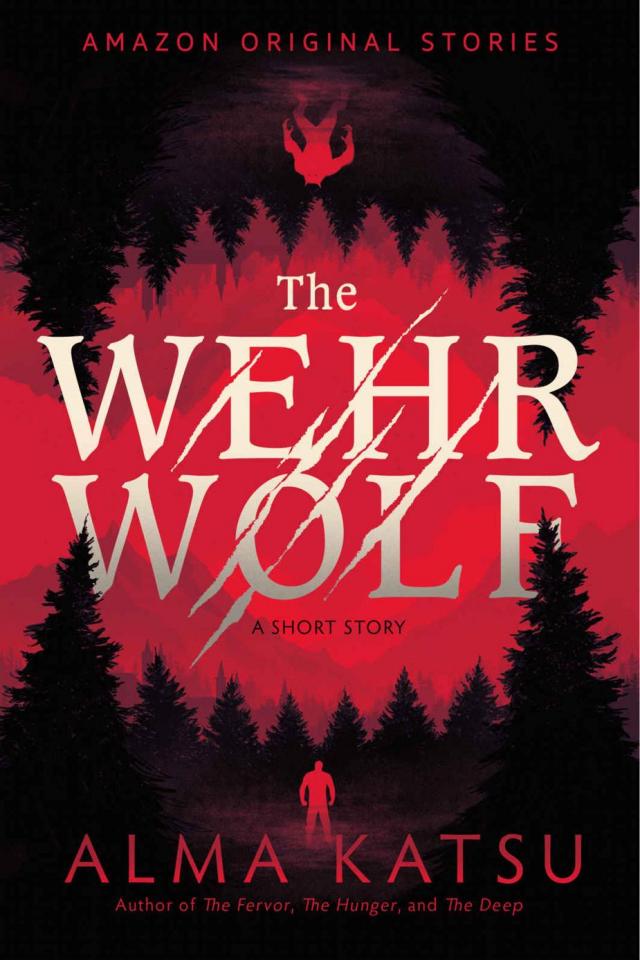
Cover illustration by Phantom City Creative
Cover design by M. S. Corley
Germany, 1945
It started with a splash of crimson blood on snow.
Uwe Fuchs went out, as he did every morning, to feed the last remaining animals on his farm. Half-asleep, he trudged to the barn and lifted the bolt that secured the door, but inside, the livestock were unusually agitated. They crowded at the backs of their stalls and looked at him with worried eyes. After he herded them to their pens and left them with a little hay, he decided to look for signs that a wild animal had approached the barn last night. There had been stories in the village of a predator active in the woods, most likely boar or bear or wolf.
Last night’s light snow covered any possible tracks. Still, Uwe was determined. He was the only man on the farm, after all, and he felt responsible. It was his duty.
He found the blood about fifty feet from the barn. It trailed into the woods.
He hesitated. Should he follow it? What if he ran into whatever was out there? All he had on him was the walking stick he used to prod the animals into their pens.
Behind him, the cow bellowed to be milked. Behind him, too, was his snug, warm cottage, where Katya would be getting his breakfast ready, porridge and hot milk. She would be rousting Liesl from bed. They would be waiting for him at the farmhouse table so they could eat together.
Still . . . he was the woodsman, the protector. It was his job.
As it turned out, he didn’t have to go far. The blood led him to a ditch, and in the ditch was a lifeless form.
Because of the volume of blood on the trail, he’d expected to find a deer. It would have to be one of the last in the forest, since so many villagers had turned to game to keep their families fed.
But it wasn’t. It was a man.
Uwe peered into the ditch. He dithered for a minute over whether he should scramble down to check on the man, who was short and thin, dark with olive skin. But he was clearly dead, his innards spilled out and glistening, red and wet, in the morning sun.
A dead man not fifty yards from his house.
What else was he to think except that the war truly had come home to roost?
“I don’t want you or Liesl going into the woods today,” he said to Katya at the breakfast table.
He had waited until Liesl went to feed the chickens in the courtyard to tell Katya what he’d found. “I’m going to inform Johann.” Johann Konig, the miller, acted as the unofficial mayor of the small village. He would know what to do. Uwe added, “It was a Romani.” That in itself was odd: there hadn’t been any Romani in Scharweg for years. He didn’t need to point out the oddness; everyone knew that the Romani had disappeared around the same time as the Jews, rounded up and taken to the same place, the place they never talked about. Uwe had been sorry to see the Romani go because he hired them to help on the farm during the harvest. All the farmers did. They had pestered Johann into petitioning the authorities to allow the gypsies to stay, but it made no difference: the government had rounded them up anyway.
“Maybe he had been in hiding,” Katya said over her cup of steaming milk. “One of our neighbors could’ve been keeping him safe.”
“It had to have been an animal. Because of the . . . damage.” He didn’t share any details with Katya about the condition of the body. He would protect her from the ugliness in the world, as much as he could.
Odd that they had heard no noise last night. No scream, no cry for help.
“Are there even animals here capable of doing something like that? The forest has been hunted clean. Any animal capable of that kind of killing would’ve moved on.”
“There are still bear. Or wolves. It could’ve been a pack of wolves.” Uwe stood to leave. “Don’t open the door while I am away.”
Katya stood at the door with her arms folded as she watched her husband leave.
Uwe’s response had not surprised her. A man had been murdered and his body left a stone’s throw from their house, and Uwe had gone, calm as you please, to report it to the authorities. As though someone had merely left the pasture gate open or stolen a shovel from the garden.
She loved her husband, but hard times were coming and she worried that Uwe—dear, sweet Uwe—was not ready for them.
Uwe returned with a couple of men from the village. He showed them where to find the body and left them to haul it up and take it away while he spent the rest of the day trying to forget how it had started.
That evening, the Fuchses had a visitor. Uwe told Katya and Liesl to stay in the loft until he left.
Katya gave him a grave look. “You don’t owe him the time of day. Don’t we have enough to worry about?” she’d asked reproachfully.
He kissed her on the forehead. “You know I cannot just turn him away. It would only lead to more trouble.”
Uwe had known Hans Sauer since they were young, but Uwe and Hans had never been friends. Hans was the kind of boy who was feared, not liked. He had revealed his predilection for bullying early, trapping chipmunks and squirrels, which he then killed at his leisure behind his parents’ barn. As a grown man, he harassed people at the tavern when he got drunk and picked fights after church service. Most everyone in Scharweg gave Hans a wide berth. Uwe had never invited Hans into his home, not once.
But these were not normal times.
Uwe glanced longingly at the fireplace and the two chairs he and Katya usually occupied after dinner, Katya knitting or spinning wool, Uwe falling asleep after a hard day’s work on the farm. There would be no napping tonight.
“There are stories from Düsseldorf regularly.” Hans kept his voice low so Katya would not overhear. “The Allied troops will be here any day now.”
Of course, the stories would be bad. Nearly everyone in the village accepted now that Germany was going to lose the war, even though the authorities tried to hide it. The radio spewed mostly made-up news, claiming victory and success, and then in the next minute ordered children and the elderly to report for duty in the Volkssturm—the People’s Army.
“You know what’s happening as well as I. They’re killing men and the elderly and children. Raping our wives and daughters.” This was why Uwe had made Katya and Liesl hide upstairs; he didn’t want to frighten them any further, especially not after what he’d found in the woods. “They’re slaughtering livestock, burning property to the ground, stealing valuables. The Allies are no better than animals.”
Uwe had heard these rumors, too, mainly from Nazi broadcasts, but he hadn’t given them much credence. He had chafed at the party’s hyperbole but finally became disgusted when the Reich started drafting little boys. A nation that put children in harm’s way while its leaders cowered in bunkers had already lost; it just wouldn’t admit it.
Hans leaned toward Uwe until their faces were inches apart. Hans’s eyes were hard like flint. “That’s why you need to join us. It’s your job to keep your wife and little one safe.”
Uwe had heard the men in the village were forming a guerrilla resistance group to fight off the Allied troops. Uwe, being practical, was of two minds on the subject. On one hand, he questioned why they should bother. Anyone could see that a small group of farmers would not be able to hold off the Allies indefinitely. Better to use this time to do what he could for his family. He would be of no use to them if he were killed or taken off to a prisoner of war camp.
On the other hand, the instinct to fight was visceral. His duty as a German and a man had been drummed into his head since birth. Now it was broadcast constantly on the radio, morning, noon, and night.
Also, he had less to fear from the approaching Allied troops than some of the men in the village had. Nearly all the men under the age of fifty had left for the military, the SS, even to serve as guards at the dreaded camps. The Allies had begun seizing the camps and exposing them to the world, and now there could be no more pretense. The world was learning of Nazi atrocities—something that everyone in Germany had long suspected, having watched as their neighbors were taken away. Deserters were sneaking back to their homes under cover of darkness, shedding their uniforms along the way and destroying every bit of evidence they had that connected them to the war. Photographs of themselves wearing those uniforms, souvenirs from battle. In some cases, other more damning things. All sacrificed to the fire.
Good riddance. Uwe had no sympathy for these men. Thank heavens he had not been called up to fight in the war. He had been given a rare hardship pass because his mother, a widow since the Great War, had been dependent on him. Some men in Uwe’s position had volunteered anyway, but not Uwe. He loved his country, but he did not agree with the party in power. There were many like him, Germans who loved their country and their heritage but hated and feared the Nazis and wished, silently, for their reign to end. Uwe had been a teenager when the party came into power, but even he could see they would steer the country into trouble. Still, he told himself that there was nothing he could do about it: politics were for city people, not country rustics like him. His father had answered the call to arms, and look what that got him. Killed by an enemy bullet at the Somme.
“I don’t know, Hans. I have my family to think about . . .”
Hans had a way of scowling that made Uwe nervous. It could be his muttonchop sideburns: they made him look vaguely animalistic. “Joining the resistance is how you protect your family. It is the only way. Do you think you can keep the Allied pigs at bay when they come knocking on your door?” Hans eyed Uwe’s scrawny arms and reedy chest. The Fuchs men had always been on the small side, true, but it would be a mistake to underestimate him, Uwe felt. He could be as deadly as the next man. He knew how to wield an axe and fire a rifle.
Still. Hans had put his finger on Uwe’s secret fear. Katya and Liesl were his world, and they depended on him.
“I’ll think about it,” he finally agreed. It was the only way to get Hans to leave.
After he’d bolted the door behind Hans, Uwe called up to his wife. “He’s gone.”
“Why listen to Hans? You know what kind of man he is,” Katya said as she climbed down the ladder.
“We can’t afford to antagonize our neighbors at a time like this. Have you forgotten what was in the woods, just meters from our house? We’re more vulnerable than ever.” Uwe rubbed his face. He was so tired. “He’s only trying to protect us.”
Uwe left his wife to her knitting and her fretting and went to Liesl with a candle and his daughter’s favorite book of fairy tales. It was a battered old copy of the Grimm brothers’ tales, Kinder- und Hausmärchen. It had belonged to his father and was passed down to Uwe. There were few books on the farm, so Uwe had treasured it. He really didn’t need the book as he knew the stories by heart, but his daughter loved to look at the illustrations.
“Which one shall we read tonight?” Uwe asked as his daughter snuggled under the covers. Light from the candle flickered over her face, and Uwe thought once more that she was the most beautiful child in the village. She had her mother’s fine blonde hair and sky-blue eyes and skin as fair as fresh cream. She was a true Aryan like the children in stories. Uwe didn’t feel that he agreed with the Nazis’ theories of Aryan superiority, but the stories appealed to his nationalistic pride.
Even more significant: Liesl was a child of the Reinhardswald, a near-sacred place for all true Germans. The forest that surrounded them was all she’d ever known and—God willing—all she would ever need.
“Little Red Riding Hood,” she said, her eyes smiling.
Uwe could’ve predicted this: it was her favorite. The book fell open to the first page, an illustration of a pretty young girl about Liesl’s age in a flowing cloak with a basket over her arm. She was in a forest cottage, a grandmother’s cottage, every inch crammed with pots and bottles and baskets. Warm and cozy and safe.
And behind her, dressed in an old woman’s nightgown with a nightcap on its head, was a huge black wolf. The wolf stood on its hind legs like a man, so big that it was nearly bursting out of the grandmother’s nightgown. Its mouth was open, revealing sharp, hungry teeth. The illustration was just comical enough to keep from frightening children, but there was no mistaking the message, the implied threat.
The wolf is no animal, but a type of man.
And this man is dangerous.
When Liesl had finally drifted off to sleep, Uwe climbed down from the loft. He paused, not yet returning the book to its customary place. He ran his palm over the cover, the linen threadbare from generations of use. The Nazi party had ordered that every household must have a copy of Kinder- und Hausmärchen; that was how important these stories were to the German sense of self. The Fuchses had had a copy since Uwe’s great-grandparents’ time, and theirs was the unexpurgated edition, filled with terrible violence: children roasted alive and eaten, Snow White’s own mother ordering the woodsman to kill her and bring back her lungs and liver, servants beaten savagely, even murdered. He supposed it hadn’t bothered his parents or his grandparents because they were farmers and used to an often-brutal way of life. He’d seen a friend’s later edition and was surprised how much it had been softened—for city people, he supposed, who never had to strangle the goose they would have for that evening’s supper.
There had been an old woman in the village, now long dead, who had told Uwe that her great-grandparents had met the Grimm brothers. They had traveled into the countryside to collect stories from common folk who still knew the old tales, the stories that had never been written down and had only survived through retelling from parent to child. According to the old woman, the Grimms were soft spoken and patient, sitting for hours with the farmers and their wives to collect their stories. “They were particularly interested in our village because of where we are,” she’d said proudly. Many of the scariest stories in the collection—“Little Red Riding Hood” and “Hansel and Gretel” and “Snow White”—had their origins in the Reinhardswald. All were about children being abandoned in the forest and left to the predation of wild beasts and unscrupulous men. Uwe had heard this disputed years later at the tavern by a traveler who’d claimed they’d actually been based on old French tales. He’d been dumped in the nearest pigsty for his heresy.
The one story from the Reinhardswald that no one disputed was the tale of the Werwolf. The only matter open to argument was whether the Reinhardswald had been home to the first tale set in Germany, because there were many stories of werewolves throughout the country.
Uwe slid the book onto the shelf, his hand lingering on the spine for an extra moment. It seemed funny to him that Liesl adored the wolf. He supposed it had to do with the illustration, which romanticized the animal to a degree. It bothered him that his daughter misunderstood the message of the fairy tale. She didn’t see that she should be wary of the wolf. And wasn’t the woodsman the real hero of the story? The woodsman who came to her rescue and cut the wolf in two? Yet somehow along the way, Liesl had fallen in love with the wolf—and she wasn’t alone. Wolves were cunning; wolves were strong. Many Germans spoke lovingly of the wolf, even though it was the wolf that carried off their sheep and chickens and sometimes even killed the family dog when it tried to protect them.
How could so many of his countrymen not see the wolf for what it was?
The next evening, Uwe went to Johann’s house to listen to the weekly news broadcast.
There may have been a mayor of Scharweg at some point in its long history, but the official position and title had fallen away over time. There had been no election or vote to elevate Johann to his position of authority; he was merely the man whose judgment most people trusted. Also, because of his business, he was one of the wealthier men in the area and could afford a good radio, one that could pick up the broadcasts from the capital. Nearly everyone in town had gotten into the habit of going to his home on Sunday evenings to listen to the news.
That night, Uwe trudged there alone. Katya wasn’t going; she tended to argue with neighbors who clung to the propaganda coming out of Berlin, and this upset Uwe. He promised to give her a full accounting of the news on his return.
He arrived a little late, so he had to squeeze into a place along the wall. Johann smiled at him weakly from across the room; Uwe suspected Johann didn’t enjoy having his house full of his neighbors every week, but it had become a ritual that he was now helpless to stop. Several men smoked pipes, making the air nearly unbreathable. Even after Uwe had peeled off his scarf and jacket, he was still overheated from the warmth of so many bodies and was nauseous from the spicy pipe smoke. He wished someone would open a window.
“Und jetzt die Neuigkeiten von der Westfront,” the radio announcer began. Now the news from the western front. Everyone in the room held their breath, hoping to hear that the People’s Army had been able to turn back the approaching Allied forces. Last week the enemy had pushed the Wehrmacht over the Rhine, and after that, the news became suspiciously sketchy. Uwe assumed the authorities did not want to reveal the extent of their collapse.