Incriminating evidence, p.1
Incriminating Evidence, page 1


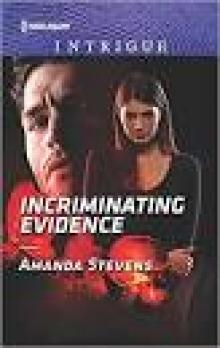
Sometimes secrets are better left in the past
Renowned anthropologist Catherine March fears she’s the biological daughter of a convicted serial killer. Tormented for years by nightmares and vague memories, she’d make a deal with the devil to investigate her mysterious adoption. Nick LaSalle eagerly takes the case, determined to prove someone is willing to kill to keep Catherine’s past buried. But when the evidence hits too close to Nick’s home, he has a choice to make—uncover the truth or protect his reputation and family name…
“You’re trembling,” he said.
“I think I’m still in shock.”
He slipped his fingers through her hair, lifting her face so that he could stare into her eyes. “Maybe I should stay.”
Yes, please stay. The sun will be setting soon and I don’t want to be alone in the dark.
“I’m fine. I don’t want you to think that I’m some frightened little bunny who can’t take care of herself.” She paused on a sharpened breath. “I really wish you wouldn’t look at me that way.”
“What way?”
“You know what I mean. You should go before we make a very big mistake.”
He leaned in ever so slightly. “Would it be a mistake, though?”
INCRIMINATING EVIDENCE
Amanda Stevens
Amanda Stevens is an award-winning author of over fifty novels, including the modern gothic series The Graveyard Queen. Her books have been described as eerie and atmospheric, “a new take on the classic ghost story.” Born and raised in the rural South, she now resides in Houston, Texas, where she enjoys binge-watching, bike riding and the occasional margarita.
Books by Amanda Stevens
Harlequin Intrigue
Twilight’s Children
Criminal Behavior
Incriminating Evidence
Pine Lake
Whispering Springs
Bishop’s Rock (ebook novella)
MIRA Books
The Graveyard Queen
The Restorer
The Kingdom
The Prophet
The Visitor
The Sinner
The Awakening
Visit the Author Profile page at Harlequin.com.
Join Harlequin My Rewards today and earn a FREE ebook!
Click here to Join Harlequin My Rewards
http://www.harlequin.com/myrewards.html?mt=loyalty&cmpid=EBOOBPBPA201602010002
CAST OF CHARACTERS
Catherine March—A strange deathbed confession and a stash of hidden newspaper clippings lead Catherine to believe she could be the biological daughter of a serial killer.
Nick LaSalle—A PI hired to uncover the secret of Catherine’s adoption. His loyalties are divided when the evidence hits a little too close to home.
Emmett LaSalle—Nick’s uncle seems almost desperate to keep him away from Catherine March.
Jackie Morris—She’s worked for LaSalle Investigations for so long that she knows where all the bodies are buried.
Louise Jennings—Catherine’s aunt hasn’t been telling the truth.
Nolan Reynolds—The moody lab assistant has a fascination for serial killers.
Jane Doe Thirteen—The skeletal remains of a murder victim hold the key to Catherine’s past.
Contents
Chapter One
Chapter Two
Chapter Three
Chapter Four
Chapter Five
Chapter Six
Chapter Seven
Chapter Eight
Chapter Nine
Chapter Ten
Chapter Eleven
Chapter Twelve
Chapter Thirteen
Chapter Fourteen
Chapter Fifteen
Chapter Sixteen
Excerpt from Desperate Measures by Carla Cassidy
Chapter One
The hammer of rain on her umbrella obscured the sound of any footfalls behind her. Still, Catherine March cast an uneasy glance over her shoulder. Nothing seemed amiss. No darting shadows. No lurking silhouettes. But she knew she was being followed. The certainty tingled down her backbone as she hurried along the rain-slick sidewalk.
She gripped her umbrella and willed away the icy sensation. She was letting the gloomy day get to her. Grief clouded her common sense. Why would she be under surveillance? She lived a quiet and unassuming lifestyle. Most of her time was spent in a university lab or classroom. She consulted with various law enforcement agencies in and around Charleston, South Carolina, but a sleuthing, gun-toting forensic anthropologist was a figment of Hollywood’s imagination. Catherine didn’t investigate crimes or chase down criminals. Her job was to examine, analyze and inform. The cases on which she consulted were mostly cold, the skeletal remains of the victims picked clean by time, weather and predation.
Take her current assignment. She’d been tasked with creating biological profiles for fourteen separate sets of human remains recovered from an abandoned house on the outskirts of Charleston’s famed historical district. The former owner of the residence, a paraplegic named Delmar Gainey, had spent the last five years of his life in a nursing home and the previous two decades confined to a wheelchair. Before the accident that claimed his mobility, however, he’d murdered those fourteen women and sequestered their bodies in the walls of his home and in his backyard.
The remains of his victims might have stayed hidden forever if not for an ambitious house flipper, who had acquired the property at auction following Gainey’s death. The first gruesome discovery brought the police. The coroner had brought in Catherine.
Butterfly fractures in the long bones told the story of the women’s brutal captivity while striae patterns on the sternums and rib cages painted a vivid image of their deaths. The victims had been stabbed repeatedly with a serrated blade. All except one. Jane Doe Thirteen.
She was the anomaly. An outlier. An inconsistency that needled at Catherine even now as she thought about the single bullet hole in the back of the skull. In all likelihood, the entry wound had been made by a full metal jacket fired at close range from a 9 mm semiautomatic. An execution.
No bone trauma like the other victims. No nicks or fractures. Not even an exit wound.
Jane Doe Thirteen had definitely captured Catherine’s imagination, but for now she had more pressing business.
Clutching the plastic bag to her chest, she plunged on through the puddles.
What were the chances? she wondered as she cast another glance over her shoulder. What were the odds that not one but two old serial-killer cases with seemingly no relation to the other had entered her quiet, ordinary world to wreak havoc on her peace of mind? Delmar Gainey had died in his bed at the Cloverdale Rest Home, no doubt savoring his monstrous deeds to the bitter end. Orson Lee Finch—the so-called Twilight Killer—was still very much alive but destined to spend the rest of his days in the Kirkland Correctional Institution, housed in a specialized unit for the state’s most violent inmates.
Catherine had been little more than a baby when Gainey and Finch had stalked the streets of her city, each possessing a very different set of stressors, signatures and criteria. Then the remains had been found on Delmar Gainey’s property and, soon after, headlines had exploded with startling new developments in the Orson Lee Finch case.
Catherine had experienced little more than professional curiosity until her mother’s death unearthed a more personal revelation. Since early childhood, Catherine had known she was adopted. Her mother, Laura, had spoken openly about the circumstances of Catherine’s birth. You’ll have questions as you grow older. At some point, you may even feel your loyalties are divided. That’s only natural. But I want you to know that you can always come to me, Cath. There should be no secrets between us.
No secrets? Then why hadn’t Catherine known about the loose floorboard in her mother’s closet or the box of newspaper clippings stashed inside the secret compartment? Why hadn’t she been told about the photograph?
Why had Laura March, so pale and weak on her deathbed, pulled her daughter close and whispered a distressing message in her ear?
It’s all a lie.
A car horn sounded in the distance, drawing Catherine’s attention back to the present. She stood shivering on the curb as she waited for the light to change. It was a hot summer day, but the rain and her dark thoughts chilled her.
She took another quick check of her surroundings. She was alone on the street. No one else was about. No one that she could see. The rain had chased everyone inside. She was tempted to scurry across the intersection against the light, but she could almost hear her mother chastising her from the grave. Careful, Cath. Always look before you leap.
Grief settled heavily on her shoulders and tightened her chest. She couldn’t remember ever feeling more alone than she did at the moment, huddled beneath her umbrella and missing Laura March more than she would have ever dreamed possible.
Wiping a hand across her damp cheeks, she drew a sharp breath. The feeling was there again. That frigid whisper up her backbone. She turned, almost expecting to find her mother’s ghost floating toward her through the gloom. Instead, she saw a man watching her from a recessed doorway.
Their gazes collided before he glanced away, but in that fleeting moment of contact, Cather
Her heart raced as she considered her options. Run away or confront him. Before she had time to think, she found herself walking toward him.
“Excuse me!” she called out. “Do I know you?”
Even as she continued to advance, she admonished herself for provoking a stranger on a deserted street, but she couldn’t seem to help herself. Grief did strange things to people. Maybe her emotions had been pent up for too long. Maybe her anguish had been suppressed to the point of explosion.
“Sir? Are you following me?”
He showed no visible reaction to the question, refused to acknowledge her presence with so much as a glance. He took another drag and then carefully flicked the cigarette butt into a puddle before he turned and walked away.
Catherine didn’t follow him. She watched until he was out of sight before she went back to wait for the light, positioning herself so that she could keep an eye on the sidewalk behind her. She tried to tell herself again that she was imagining things. The man had been minding his own business. If anything, she’d likely scared him away. What had she been thinking, harassing a total stranger?
No one was following her. Get over yourself. The only other person who knew of her discovery was her mother’s sister, and she couldn’t fathom a scenario where Louise Jennings would have her watched. Catherine still had a hard time believing her mother had kept secrets from her all these years, but the proof was in the plastic bag she hugged to her chest. The confirmation had been in her mother’s whispered confession.
It’s all a lie.
* * *
THE HEADLINE IN the local paper had called her the bone doctor, a champion of the forgotten dead. Strange that Catherine March would be in the market for a private detective when Nick LaSalle had been reading about her in the paper. The article had highlighted her profession as a forensic anthropologist in general and, more specifically, her efforts to help identify human remains that had recently been recovered from an abandoned house.
Nick knew the woman slightly from his brief time as a homicide detective. He remembered her as dedicated and meticulous in her work. Quiet and thoughtful in her demeanor. He had forgotten how attractive she was. That part had taken him by surprise when she walked into his office.
He let his gaze drift over her features as he wondered why he’d never gotten around to calling her once he’d closed the case. The spark had been undeniable. He felt it now as he took in the long, dark hair, still glistening with raindrops, and the wide brown eyes that observed him with a hint of suspicion.
She wore a fitted gray top with slim black pants and sneakers soaked from the downpour. The only hint of color in the whole of her presentation was an emerald ring that glowed in the too-bright lighting of his office. He’d turned up the glare in order to chase away the dreariness of a rainy day, but a cozier ambience invited candor. He started to get up and adjust the dimmer, but he didn’t want to interrupt her train of thought. Or his, for that matter.
“When did your mother pass away?” he asked as he pretended to jot notes on a yellow legal pad.
“Just over a week ago.”
“I’m very sorry for your loss,” he said, noting the shadow that flitted across her expression and the telltale sheen in her eyes, which she quickly blinked away.
“Thank you.”
“You’re here because you found some old newspaper clippings among your mother’s possessions?”
“I’m here because I found them hidden beneath the floorboards of my mother’s closet. I hadn’t been by her house since she died. I wanted to gather up a few of her things to take home with me and to try and figure out what to do with the rest. Mostly, I wanted to feel close to her.” She cleared her throat and drew a deep breath as she smoothed her hands down the tops of her thighs. She was nervous. That much was obvious. Uneasy, too. Her eyes kept darting to the doorway and to the corridor beyond as if she expected to find someone listening in on their conversation.
They had the second floor to themselves and the receptionist wouldn’t be able to hear from her post in the lobby, but Nick got up and closed the door anyway. Then he surreptitiously dimmed the lights a notch. Catherine didn’t seem to notice. She picked up the plastic bag at her feet and extracted a shoebox.
“You brought the clippings?” Nick walked back over to his desk and sat down.
She nodded. “I noted a loose floorboard when I went into my mother’s closet. I pried it up and found this box inside.”
“When we spoke on the phone, you said the articles are about a serial killer.”
“Not just any serial killer.” Her gaze lifted. “Orson Lee Finch. The most infamous monster in this city’s history.”
“But not the most prolific,” Nick felt compelled to point out. “Delmar Gainey now holds that distinction.”
“Yes, I know. I’m working on the remains that were recovered from his property.”
“I’ve been keeping up with the case. I saw the article about you in the paper. How’s it going?” he asked with genuine curiosity.
She tucked back damp tendrils and seemed to relax. “We’re lucky in that most of the skeletons were found intact, with only a few missing bones. We also have all the skulls. I don’t have to tell you how helpful that is. It allows us to check dental records and, if necessary, reconstruct facial features.” She paused thoughtfully as if something had suddenly occurred to her.
He leaned in. “What is it?”
She said in surprise, “I’m sorry?”
“You look as if something just came to you.”
“I was thinking about one of the victims. There’s a rather puzzling inconsistency.”
She had a way of making everything sound dreamy and mysterious. A conversation about human remains and serial killers should have evoked gruesome imagery, but instead her melodic voice mingling with the sound of raindrops against the windows mesmerized Nick. If he wasn’t careful, he might find himself drowning in the unfathomable darkness of her eyes. “What kind of inconsistency?”
She seemed to catch herself then, shaking her head slightly as she clutched the box with both hands. “That’s a discussion for the police. It has nothing to do with why I’m here.”
Nick leaned back in his chair feeling oddly thwarted. “Back to Orson Lee Finch, then. The Twilight Killer.” He took a moment to pretend to read his notes. He felt a little rattled and he didn’t know why. For all his shortcomings—and he had more than a few—a lack of confidence in his cognitive abilities had never been one of them. Yet he couldn’t seem to get a read on Catherine March. Beneath that ethereal demeanor, something dark and unsettling simmered. “When you called this morning, you mentioned a photograph.”
She glanced down at the box. “It ran in the local paper at the time of Finch’s arrest. The image is grainy, but it appears to be Finch. He’s holding the hand of a little girl who looks to be about two. According to the accompanying article, the photo was sent to the paper anonymously and is the only known shot of that child. It was speculated at the time that she was Finch’s daughter, but no one could ever locate her. Finch would never confirm or deny the rumor. Detective LaSalle... I mean... Sorry...” She faltered uncomfortably, realizing she’d addressed him by his former title. He wondered if she knew the circumstances of his departure from the police department. If so, he could only assume she’d reconciled the rumors to her satisfaction or she wouldn’t be here.
“Call me Nick,” he said.
She looked relieved. “There’s no easy way to say this. I’ve reason to believe that I’m the child in that photograph. If true, then there is a very good chance that Orson Lee Finch is my biological father.”