

What we sacrifice for ma.., p.1
What We Sacrifice for Magic, page 1


PRAISE FOR
What We Sacrifice for Magic
“For fans of magic, of sisters, and of the unexpected, What We Sacrifice for Magic is the book you want. It is charmed, charming, and a poignant and compelling coming-of-age story.”
—Amy Bloom, bestselling author of In Love
“Beneath the gossamer veil of Andrea DeWerd’s enchanting debut is a steely examination of power and its consequences on the magic-wielding Watry-Ridder family. Tenderly written, with spot-on period details, What We Sacrifice for Magic is a beautiful book about the courage it takes to change, if not the stars of our lives, the constellations we make of them.”
—Sally Franson, author of A Lady’s Guide to Selling Out and Big in Sweden
“What We Sacrifice for Magic is a high-stakes coming-of-age story with a heroine you’ll root for and a deep dive into one girl’s dilemma over just what it means to wield her own power. Elisabeth Watry-Ridder has always known she was different, but can she truly embrace all that makes her unique—and defy her family’s expectations—in order to define her own future? This is an exuberant debut; Andrea Jo DeWerd writes with obvious love for her own craft, and readers will look forward to more from her.”
—Allison Pataki, New York Times bestselling author of Finding Margaret Fuller
“Even magic is no easy answer for a young woman coming of age in the sixties under the weight of family and social expectations. Poignant and steeped in summer magic, young Lisbett will capture your heart.”
—Helen Simonson, New York Times bestselling author of Major Pettigrew’s Last Stand and The Hazelbourne Ladies Motorcycle and Flying Club
“Andrea DeWerd’s debut is a beautifully written saga of women whose magic has held them together—and broken them apart—across the ages. There’s something for everyone here: love, family, sisterhood, magic, adventure, and most of all, Elisabeth, a protagonist to root for as she finds her way into who she’s meant to become. I came away from this novel with my heart full!”
—Donna Freitas, author of The Nine Lives of Rose Napolitano
“What We Sacrifice for Magic beautifully captures the tension between the legacies we inherit and the courses we chart for ourselves. DeWerd sacrifices nothing artistically for magic, convincingly weaving in the warp and weft of the Vietnam War–haunted sixties. This book is as much about sibling rivalries and loyalties, the chrysalis that pulses between adolescence and adulthood, bearing up under the expectations of parents, the foreclosed possibilities of small-town life, and the weight of a potentially tragic destiny as it is about any incandescent magic. The most impressive spell here is the one DeWerd casts through her scrupulous storytelling. DeWerd nails the ambivalence in growing up with talents perfectly suited to a family business while yearning to know the wider world. The drama of generations clashing is brought to life in the most fiery ways imaginable, and the reader gapes on with a shiver of helpless excitement, like the transfixed onlookers in DeWerd’s intensely gripping story, wondering with ferocious interest what is going to happen next and delighting in the book’s conclusion that we are stronger together than alone. DeWerd’s plot summons our attention, and enchantment thrums in every direction.”
—Matthew Thomas, New York Times bestselling author of We Are Not Ourselves
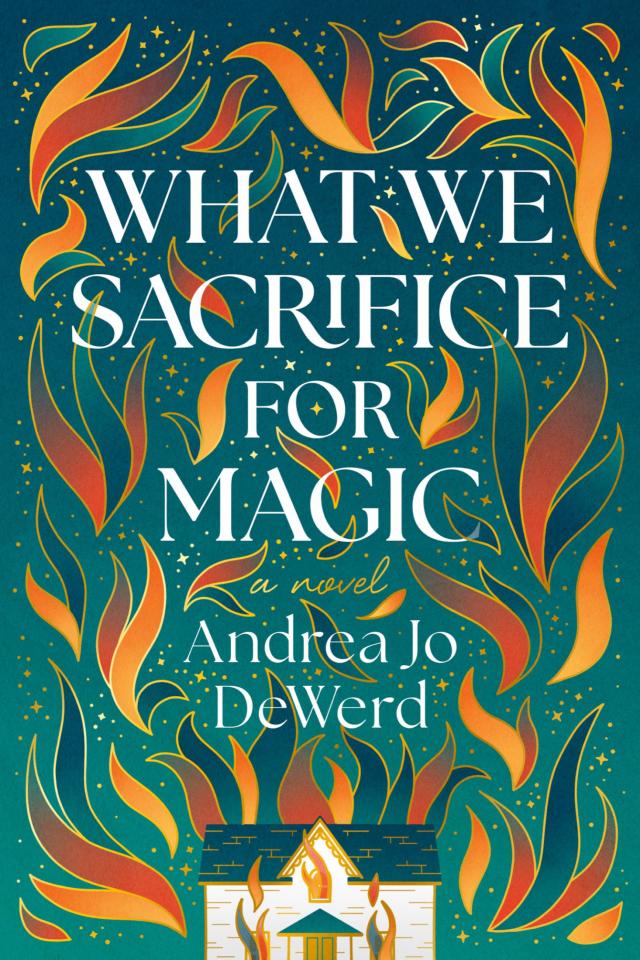
What We Sacrifice for Magic
A Novel
Andrea Jo DeWerd
For my Grampy,
who gave me the most beautiful place in the world
One
I first defied my family the summer after I turned eighteen. By eighteen, I knew I didn’t need to be pretty. As the older Watry-Ridder girl, my power was in my name. Unlike the other girls in town, I didn’t need to catch a man with passing beauty trends or by mastering chicken a la king. But that didn’t stop me from wearing my hair the color of rain-logged corn silk long and wild past my waist, a small defiance of the pins and plaits of my mother and grandmother. Even a promise from John Weseloh—a farmer’s son, one of the good ones—didn’t stop me from tossing my hair that summer in a practiced casual way to see who might be looking.
That hair toss was the very thing that caught John’s eye, or so he said, at the Solstice bonfire after our sophomore year. Two years later at a different party in the same park with the same people, I watched John break away from a knot of yelling boys, some stripped to undershirts in the surprisingly warm air of the early western Minnesota summer. It felt like a normal night, thankfully, after the highs of finishing school and our high school graduation followed by the sudden shock of Robert Kennedy’s assassination in the same week, yet another tragedy deeply felt in our very Catholic town.
There were a few somber conversations around the park, but overall, it felt like any other glorious start to summer as Annie, my best girlfriend since kindergarten, and I sipped warm beers perched on a picnic table. We liked to stay on the edge of the fray, where we could survey the high jinks and mating rituals of the midwestern teen without having to participate. A Doors song floated up to us from someone’s tinny old radio as dusk descended into night and the early-summer lake flies were drawn out toward headlights and lanterns borrowed from our fathers.
Other boys sometimes looked our way, but they emphatically looked away when John made his way toward me. They knew better than to pick a fight. That particular jaunt had run its course many times over. I sighed, bored and a little disappointed. Annie and I secretly loved watching John calmly stare down the other boys who so much as glanced my way—anything to ward off the monotony of small-town life and the looming threat of adult responsibilities.
We didn’t get together until we were sixteen, but John and I had known each other our entire lives, as it goes in a small town. He followed me in class or in line for assembly, John Weseloh behind Elisabeth Watry-Ridder by sheer alphabetical luck. John’s family had a respectable farm outside of town, growing green beans and corn and shipping them off to God knows where. John worked on the farm all summer and fall, but winter was his, when he was a guard on the high school basketball team.
Where John shone, though, was in the town snowmobile races. He tinkered all winter in the workshop at the back of his family’s livestock barn with his homemade snow machine for the races on the frozen lake in January, showing off his latest developments on Sunday afternoons to his basketball teammates. When we were thirteen, John Weseloh had become somewhat of a local celebrity when he came in a close second in his first race on an abandoned sled he had commandeered from his older brothers.
Even after growing up in such close proximity, I was still tickled each time John ditched his meathead teammates and their shoptalk to entertain me.
Annie poked me in the ribs as John threaded his way toward us.
“Tonight must be the night,” she said with a knowing nod in his direction and a flutter of her jet-black shellacked lashes.
“Maybe.” I rolled my eyes, refusing to take the bait.
Annie rolled her eyes back at me. “Don’t you think it’s time you let John get lucky? He’s waited for you long enough.”
Annie’d had sex twice already, and for a small-town girl with nothing better to do, that made her an expert. I loved Annie like a sister—sometimes more than my own sister, Mary—but drugstore lipstick and lemon juice highlights didn’t mean she knew better than me. Still, sometimes she made me feel like I’d better catch up.
“Besides,” Annie continued, “how are you gonna do better than John Weseloh anyway?”
I nodded noncommittally as John approached, but Annie’s words held the sting of truth.
“Hey,” John said, suddenly in front of me, mere centimeters from where my bare thighs—tight and muscular, I noted with pride—beneath white cotton eyelet shorts dangled over the end of the picnic table. John rested the flat of his palm against my thigh like the way you’d soothe a flighty goat kid, not the way you’d caress the thigh of a lover.
“Hey,” I said.
Annie’s gaze shifted pointedly from me to John. She cleared her throat and said, “I’ll leave you two lovebirds to it.”
She turned and sprang off the picnic table confidently, her full prairie skirt swirling around her in a pastel blur. I loved that about Annie Holbrooke: whatever stupid thing I did, she would be right there to outdo me, especially when it drew the attention of boys in the vicinity.
I was feeling brave after watching Annie strut off toward a pack of boys, and slid off the edge of the picnic table into John’s orbit. I took him by surprise, something I did all too often, and he jerked back, throwing me off-balance. Despite his booze-dulled reaction time, he managed to keep me upright, gaining purchase with one arm around my waist.
John’s eyes widened, another surprise, when I said, “Let’s go park.”
Parking with John seemed like exactly what I wasn’t supposed to be doing, the elder, responsible Watry-Ridder girl—which made it all the more appealing.
“Really?” he half slurred, and let me lead him to his older brother’s El Camino. He stopped to open the passenger door for me, handing me into the cab clumsily.
John was exactly the kind of boy I should marry, my grandmother Magda said all too often. We had walked in our commencement just days before; I had finished in the top twenty of the class of 1968, John somewhere toward the middle, slipping by with Cs and athletic prowess. I’d worked as little as possible to earn the As and Bs—and the respect of my teachers, classmates, and community—expected of me as the granddaughter and heiress of Mag
da Watry.
“See how hard your father works,” Magda would say. “He’s always out and around town for us.”
She meant that Dad wasn’t at home to be in the way of the family business. Someone who’d be a supportive partner—a quiet partner—to sit beside me in the front pew of church every Sunday, keep his hands busy and his opinions to himself while the women ran the business, and give me a daughter to teach: that was the perfect match for me in Magda’s mind. Someone like my father. A good man. A quiet one.
* * *
I was raised by my grandmother, surrounded by women. Neighbors and classmates were always crowding around the kitchen table in our white farmhouse on the edge of town. Magda presided over us all, and I had worked beside her since I insolently called my grandmother by her first name as a toddler—everyone else called her that, why shouldn’t I!—and it stuck. I was beside her for all of it. Mary, my younger sister by two years, was underfoot too. My mother was there and not there at the same time. She was a shell of a woman, even in my earliest memories.
My father would occasionally poke his head into the kitchen for a can of pop or a Thüringer sandwich or to forage for fresh silver-dollar rolls from Magda’s cousin Mildred. But the minute a neighbor opened the kitchen’s side door, never knocking first, my father skedaddled to his shed or into town and made himself scarce.
The kitchen was my grandmother’s domain.
* * *
John strangled the steering wheel, focusing hard to avoid swerving from nerves or the six-pack of Schell’s he’d handily consumed at the park. As the houses thinned on the road west of town, he eased the truck onto a dirt road that cut through one of the innumerable cornfields around Friedrich. Impulse took over, and I did something that generally went against everything my grandmother had ever taught me.
* * *
They called us many words over the centuries—seers, energy healers, alchemists, shamans, magicians, heretics. Magda preferred to call us practitioners, or when muttering in her inherited mix of Alemannic German and English, Doggderin. She hated that one word that persisted, chasing us through the generations—witch. That word made us outsiders, instead of the pillars of the community we had become over the years.
My family had lived and worked in the farm country around Friedrich for over a century, since my relatives from the Black Forest made their way across the ocean, through the Port of New Orleans, and up the Mississippi River to the jeweled sky and lake-dotted prairie lands of Minnesota territory before the North Star State was a state. The men of the family had various jobs over the generations—hardscrabble farmers, cavalrymen, merchants, and later, lawyers and millers.
My father, Jacob, grew up in Friedrich to become a sort of mover and shaker about town in his own right. He ran a handful of flour mills and grain elevators with his brothers and his father, a first-generation Dutch immigrant, and somehow found time to sit on the town’s chamber of commerce. As I grew older, I learned it was actually Magda’s influence that put him there, and I wondered how that made my father feel.
There, in the southern-facing kitchen of the Watry house, was where the real family business happened: spells, charms, and energy healing—whatever the people of Friedrich might need to protect their homes and families from the everyday dangers of bad fortune or weather, or petty hexing wars among neighbors.
* * *
I took John’s hand in the dim light of the cab, closing my eyes as I silently cast out to connect to the powerful energy field my grandmother had taught me to call the ice floe. As I burst through the barrier between the spirit world and ours, a frozen river of light opened before me in my mind’s eye, a pure energy river separating life and death and encompassing all of the past, present, and future at once. It was the source of my power, the source of the ancient magic Magda had passed down to me, and visible only to those with our capabilities.
An explosion of light, energy, life force exploded forth from my and John’s clasped hands, visible only to me through eyes capable of seeing the other side. I followed our entwined lights forward, not to see the future exactly, but for some hint of how things would turn out with John. Truthfully, I wanted anything to tell me how far I should go with him, since my gut didn’t seem to have the answer.
My own emerald-green energy burned brightly and jogged ahead; John’s soft lavender energy, as unique to him as a fingerprint, floated behind. I felt myself leaning forward at the edge of my mind’s eye and glimpsed a shadow of a fork, our energies splitting away from each other. But the river of invisible energy bucked wildly and threw me back into the present moment, a reminder of the dangers of soothsaying Magda warned against.
I plunged back into the darkness of the El Camino, gasping as if emerging from an actual frozen river. John nodded slowly, lips pursed, turning toward the window, and pulled his hand away from me.
“I wish you wouldn’t read me without asking,” he said, gazing out into the pitch-black cornfield.
“I didn’t mean to—” I started, then sighed. “Sorry. I let my guard down for a second, and you know how it pulls me in sometimes,” I said, not entirely a lie. After all, John had heard me say for two years how thin the veil was between the worlds, how the spirit world tugged at me every time I closed my eyes at night.
It was a grave offense but worth it, I figured. I cracked a small smile and looked at him through the hair that fell across my face, knowing I looked every bit as nervous and shy as he did every time we were alone together, every time he thought he might get some. I slid across the bench, and he softened. He pulled me onto his lap, and I kissed him deeply, all the while anxious that my unwelcome reading would be the final straw that broke John’s patience for me and my family’s strange ways. But then he hooked his thumbs in my waistband, surprisingly suave for the big-handed farm boy, and I was relieved to feel his annoyance fall away as male biology took over.
John explored my mouth and neck, working his way down toward my breasts beneath the open V of my blouse. He tentatively rested one hand on my breast but didn’t dare venture further. I let my hair fall forward to graze his face and tried to tune out all the voices that told me I shouldn’t be doing what I was doing. I desperately wanted to be outside myself, to enjoy what was happening, but the steering wheel digging into my back, and John’s obvious maleness pressing against his fly and my thighs, brought me crashing back into myself.
As John’s attention slid lower, I guided his mouth back up to my lips, a firm hand on either side of his face. His cheeks were flushed warm with sweat and excitement.
“We shouldn’t,” I whispered.
John groaned and buried his face into the exposed skin of my shoulder. I worried that he would be disappointed, that he’d think I was a tease. I felt pressure—from my family, and Magda in particular—to keep him happy, to keep him interested. I knew John was as good as they came in Friedrich, but the further we went, the more serious our relationship became, it felt less like falling in love and more like a foregone conclusion.
“You sure?” he asked, his lips brushing against my bare clavicle.
Still, a primal longing rose deep in my belly, an emptiness I didn’t recognize, straining toward release, but the unfamiliar and my inexperience took me out of the moment. Is this normal? Is this what everyone feels? Am I doing it right?
“I can’t,” I said louder, untangling myself from his limbs and the steering wheel.
John shrugged but couldn’t suppress a sigh. He recovered quickly, flashing me his easy smile across the sudden distance between us.
“It’s okay,” John said. “We have all the time in the world now.”
I flinched involuntarily when he said it.
We were quiet on the drive home. John smiled to himself, dumbly satisfied—he had gotten to second base, after all—as I prayed my father, or worse, Magda, wouldn’t be waiting up for me.
Two
Magda barely gave me the weekend to savor the first few days of summer, enjoying the end of mundane worries and schoolwork. I rode my bike to the public beach and swam for hours, or read magazines with Annie. At night, John picked me up, and we went to the movies in St. Agnes, or got Cokes at Sharp’s Soda Shop on Main Street, or drove around the cornfields listening to the radio and making out. I was too spooked to go any further. That truck, shared with an older brother who was in Vietnam, was John’s freedom, and for a few days that summer, it was mine too.


