

The galactic rejects, p.10
The Galactic Rejects, page 10
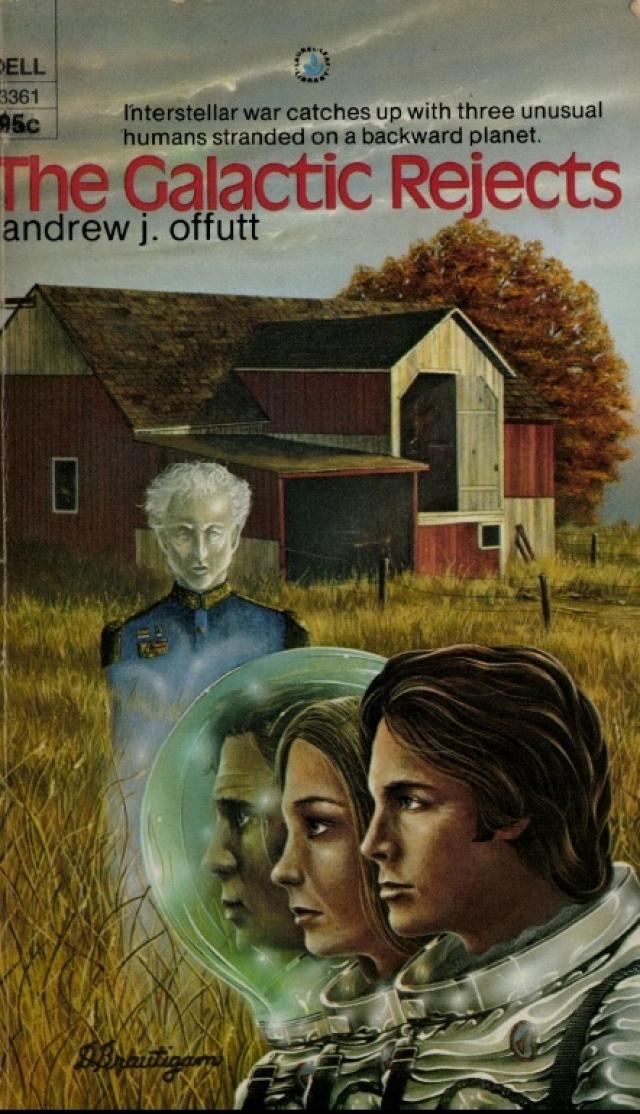


“You,” she said, looking slowly from one intense face to the next, “you’re—testing me!”
She chewed her lip thoughtfully, her eyes leaping from one red-brown Borean face to the next. The one girl wore her hair in traditional short bob; the other’s was long, past her shoulders. One saw quite a bit of that, now, among the young: they were imitating the famous female member of the Corberrin troupe.
“Those boys need help,” the short-haired girl said, she who’d spoken first. She was again bent forward over the table, her arms and hand on it as though poised, her eyes like black coals about to flash into bright flame.
Cory nodded slowly. “Yes,” she said very quietly. “How, though? What’s being done?”
“Evreh,” her escort said, but she shook her head. “Corisande is all right. She’s young. Aren’t you all right, cousin Corisande?”
He’s warning her, Cory thought. I—I might be in danger! If they get the idea I’m NOT all right, that is. They’re doing something—they’re . .. my gosh! There's an underground, a resistance group!
She straightened up and drew a deep breath, let it out as she looked around the candle-lit room full of young Boreans dancing and engaging in whatever conversations they considered worthwhile. And here, at this table, sat five members of some sort of group—a protest group, perhaps, or . . . perhaps more. Serious, intense, dedicated-looking, and not scared.
“Let’s get out of here,” Cory said.
Brool frowned. “Why?”
“I’ll stay with Evreh tonight so that you can all be sure you can trust me. In the morning we’ll go to the bank. Evreh will act as if she isn’t with me. I’ll cash a check. My money’s in Sprencore, not here. I have an idea you five will find something to do with the cash, won’t you?”
“She knows,” Evreh’s date exclaimed in a whisper.
Cory shook her head. “I know that the Azuli are taking people like you and Brool and Horje, too, into that iron fence of theirs, and that they aren’t coming out. I know that all three of you are the right age, and I know that I’m female and Evreh and I don’t have to like some—creatures taking our males. I think someone must be doing something about it. No one's ever tried to take action without having a desperate need for money. Well, I have money.”
They left the restaurant.
Next day Cory cashed the large check, waiting while a wire was sent to her bank—with apologies, dear cousin Corisande, and I certainly enjoyed your performance last night—and was answered. She walked out of the bank with her Borean beltbag stuffed with money. She stood outside, looking up and down the street as though deciding which way to go, and a noisy Norbeek Mark II pulled over: a taxicab.
While Cory leaned in to talk briefly with the driver, Evreh emerged from the bank and climbed into the taxi. When it drove off, Cory’s belt-purse was empty. She was Involved.
12
The Azuli ground truck hummed along, its superb shock-absorber system taking most of the roughness out of the ride on the reprehensible Borean road. With the Azuli rode one Borean; someone had to help them locate natives of the proper age, and collaborators have ever been plentiful among any race on any planet.
He directed them up the side road between a fenced field of cover crop, which was barely breaking the soil, and thirty or so worgs grazing directly across the road from it. They pulled up in front of the farmhouse. All five of them climbed out, short and very pale humanoids wearing pale green Azuli uniforms and squared caps. Four wore side arms. The fifth, who remained beside the truck’s hood, carried a whistler. The Borean fingerman remained in the cab.
The four Azuli crossed the yard, glancing this way and that in the twilight. Two rounded the house; the others knocked on the front door. A woman answered, and went pale and wide-eyed. She did not scream, nor did her husband resist. Their older son was assisted up into the back of the truck, and two Azuli climbed in after him, then a third. The driver took his place behind the stick. The one with the whistler carried easily in the crook of his arm climbed in on the other side, beside the collaborator.
They backed up and drove away. Behind them on the porch, the farmer stood with his arm around his sobbing wife, gazing after the vehicle’s rolling dust cloud.
Back on the highway, the truck was forced to stop after about a mile. Some young idiots had got their wagon sidewise across the road and were having trouble getting it out. It was loaded with hay. The driver revved his engine and buttoned his siren briefly. The three young Boreans who were working about the wagon glanced up and resumed work. One of them waved a hand helplessly.
The Azuli had a choice. Wait, or help. Those idiots were draft-age. . . . The Boreans looked up as four Azuli came swaggering toward them. They turned back to their wagon and its load of hay—
—which was hurled back as two other young Boreans rose from beneath it. The first launched his pitchfork in a fluid motion. It seemed to waver strangely in flight and then drive into the whistler-man’s throat. He went down without a sound, and already another pitchfork was taking the driver in the throat, and the other two Azuli went down before they had their side arms out of their holsters. Each wore a pitchfork in the throat. There had been hardly a sound, but there had been a little, and one of the Borean teeners was loping forward even as his three-pronged spear took its target with uncanny precision, in the throat.
The boy, on one knee, picked up the whistler. Two of his companions moved swiftly toward the truck, pitchforks poised like javelins. And the fifth Azuli came out of the truck and hurrying around it, drawing his pistol.
Both boys launched their three-tined spears and fell flat. The Azuli pistol sent its charge slashing over their heads as its wielder gurgled. The spear launched an instant before the other drove into his throat. The other, heading rather wide of its mark, suddenly swerved and plunged into his falling body.
“How does this thing work?” the boy with the whistle gun cried in frustration, and the sixth member of the group rose from beneath the hay and hurried to show him.
“Can you do it?”
“I can do it. He was leading them to us. I can do it.”
And he did, using the Azuli weapon on the Azuli collaborator as he climbed out of the Azuli truck.
Within five minutes the wagonload of hay was trundling away across the field. Left behind was the Azuli truck, bearing a runny sign just painted on it, in Borean, and one Borean traitor and five Azuli—without weapons.
“So they’re becoming civilized,” Rinegar said behind his morning paper. “They’re learning to kill.” He shook his head and sighed. “The Sons of Freedom indeed—that’s been used so many times it’s a cliche everywhere else but here. Wait a minute—this is impossible! All five of the Azuli were killed with pitchforks directly through the throats. He raised his eyes to stare across the table at Berneson.
“Where was this?”
“Less than ten miles from here,” Rinegar answered, then his eyes left the other man to look past him. Berneson half turned as Corisande joined them. She sat down with a quiet “good morning,” followed by yawn.
“Why so yawny this morning, Core?” Berneson asked. “You’re not getting to be an old woman, are you?”
“She was ... out last night,” Rinegar said in an abstracted voice, staring at her with one eyebrow raised.
“Oh? A little of the nightlife, eh?” Berneson said, still grinning. “Where were you, Incred—” He broke off, his mouth remaining open. His eyes were wide as he looked from her to Rinegar, glanced at the paper, looked back at her again.
“I’d say she was about—ten miles out of town,” Rinegar said, in that same not-quite-present, not-quite-believing voice.
“On a hayride,” Berneson muttered, but the girl was not looking at either of them.
She said nothing. Rinegar gnawed his lip, staring.
After a while Berneson said, “I’ll bet it was fun!”
13
On the afternoon of the day after losing five of their press-gangers, the Azuli made their first arrest on Bor. The culprit was the assiduous newspaper editor who had run the story. The city seemed to swarm with green uniforms and white faces, and there were Azuli skimmers overhead and Azuli cars on the roads. None attended the performance of Corberrin, however. The aliens were entirely too busy to go and watch a trio of the local entertainers of this primitive planet.
An Azuli groundcar was holed and wrecked as it drove along the road not five miles from town; the Borean teener with the Azuli pistol was slain easily and brought into town. The story had been printed, and apparently the invaders felt they might as well let all know that retribution could be swift and ugly. Cory summed it up: “Bor is shuddering.”
Three days later someone, somewhere, printed up a batch of leaflets and strewed them all over town and out into the country, tucked into mailers from a hardware store holding its annual pre-winter sale. They related a new tale of the underground.
This story was even more incredible, given a little thought. Ten young men had been in the back of a Azuli conscript truck. The Azuli guard, armed with one of their two-handed sonic guns called whistlers, had stood at his post while his four fellows went thirstily across the street to sample some local refreshment. He had not moved from his post at the tail end of the truck. The steel tailgate, only entry into the truck’s steel van, had been locked. The time was ten in the morning.
Naturally he paid little attention to the noises within, to the occasional creaking of the truck with the movement of the ten primitives he and his companions had recruited the evening before.
Eventually his fellows returned, bringing him a couple of bottles, and asking if everything was all right. Not until then, so the story went, did he realize that the vehicle was strangely silent. He mentioned it. His chief unlocked and opened the truck.
It was empty.
“No Sons of Liberty sign this time, I notice,” Rinegar said, putting down the pamphlet. “If this is true.”
It's true,” Cory said. She smiled at Berneson. “Isn’t it, Bernie?”
“I forgot the sign,” he said.
“Bernie,” she said, still smiling at him, “was out last night. I’ll bet it was fun!”
They finished their breakfast in silence. Cory and Bernie exchanged secret smiles and rolled their eyes at each other from time to time, pretending Rinegar wasn’t there. But they said nothing.
Stirring his after-breakfast cup of drim, Rinegar leaned back. He glanced around, then spoke.
“All right. We agreed not to get involved. But you, Cory, aided and abetted a resistance group by minddirecting the pitchforks they threw at the Azuli press-gang. And you, Bernie: you teleported into that truck, and out, and back inside, didn’t you? Ten times. You must be a little tired and sore this morning, carrying those conscripts to wherever you teeported them. Right?”
Berneson yawned and flexed his arms elaborately. “Fortunately they aren’t taking fat ones. It was fun, Jake.” He reached over to slap the pamphlet. “Reading about it’s fun, too.” He leaned back, smiling.
Cory leaned forward intensely. “These people need help,” she said, in a low voice as full of resolve as her face. “This is awful, what they’re doing to Bor! We could do something about it.” She shot Berneson a glance. “And not because it’s ‘fun.’ All right, I’ve been helping. I’ve given them money. Then when I learned what they planned to try the other night, I knew they’d never succeed—not against guns. But if they couldn’t miss with whatever missiles they threw—So I went along. I lay there in the hay, staring, and yes, I directed every one of those pitchforks to the target. If I’d known there was a fifth Azuli in the back of the truck, I’d have sent one around after him, too! And if you’d been with me, Jake, you’d have known he was there. He might have killed one of those boys.”
Rinegar sat silent, waiting for her to wind down. When she did, her nostrils flaring and her eyes very bright, he smiled at her.
“Corberrin has some mail this morning,” he said, laying the document on the table. “That”—tapping it as the others fixed their gazes on the definitely non-Borean paper—“is an invitation. Command performance, I believe, is the proper phrase. We’re to present a private performance for none less than General Takhnu.”
“The chief of the monsters,” Corisande whispered, picking up the folded paper. “Oh, yes! What a wonderful chance!”
“Now wait a minute,” Berneson said, frowning and reaching for the invitation from the planetary “governor” from Azul. “That is about the most dangerous situation I can think of!”
Rinegar nodded. “I’ll tell you what, Bernie,” he said, “I’ll tell you what. You think of a way to tell His Generalship and boss-ship that we are very sorry but we won’t be able to put on a show for his noble self and staff, and we’ll discuss it. Otherwise we’d better discuss other things.”
Cory cocked an eyebrow. “Other things?”
“Yes. Bernie says that’s dangerous: it is. He also said wait a minute, as though there were any question of our declining this invitation: there isn’t. That does not decrease the danger, though. We’re going to have to plan carefully, and be mighty careful, the whole time we’re there.”
“We have a week to prepare,” Cory said.
“Yes, and notice that he must’ve checked our present engagement: he’s invited us for the third day after we finish here.”
“Sparm,” Berneson muttered. “I was looking forward to a week off!”
Somehow Corisande could not help laughing.
A week later they checked into the hotel in Sleespoken, and late that afternoon a handsome and streamlined Azuli groundcar came to convey them to alien headquarters on Bor. Neither Bor nor Azuli knew that it was aliens meeting aliens.
14
The multi-building complex forming General Takhnu’s domain was a slice of Azul on Bor. The three Earthsiders didn’t have to pretend surprise at the gleaming technologia, but they were careful to simulate awe and complete lack of comprehension. Corisande had been walking through autodoors all her life, up until the past year on Bor. Now she gasped and shrank back a little when the big metal door wheeped open at her approach.
Their Azuli escort chuckled.
They walked into a wall-lit hallway and along it to a steel stairway behind a door from the corridor; apparently Bor was not so important and Takhnu not so influential as to have grav-plates here in his complex of two-story buildings. They ascended green-painted steel steps framed within blue-painted walls. Ahead of them went a green-clad and emphatically, white humanoid with white hair beneath his squared Azuli cap. He was short, as they were all short. Behind them came another, still explaining to Rinegar how the door worked.
The building complex formed an almost perfect square. Headquarters and officers’ quarters, this building. Then there were barracks and armory and tool-house and controls and power source and garages and storage and—that other building. Another barracks.
Windowless. A prison, then—housing for the Borean conscripts. Approximately half the space within the square formed a courtyard for those press-ganged boys, that they could have sunlight and exercise while they waited. While they waited to be loaded into the great ship whose gleaming bulk reared skyward just outside the base, near a tall tower like an old-fashioned oil well.
Corisande saw some of the boys through a corridor window as they went upstairs. She said nothing, only biting her lip.
General Takhnu, like many other generals whether Earthsider or Azuli, was a big man who had been powerfully muscled and who was now going soft and jowly. His chest surged, but now his belly surged even farther, resting on his broad belt and circular buckle. He was losing his hair, too, and the fringe that remained was the pure white of summer clouds.
He beamed at them, with a great show of comity.
“Se renowned Corberrins! You are very welcome here, my friends, and I hope our food is to your liking. Corisande, I believe: you are more beautiful than your posters, my dear, and it is hard to believe that one so attractive and young could be so talented! And you are Berneson.”
Berneson nodded, squaring his shoulders and giving the Azuli general a ceremonious nod of the head rather than a bow. The alien did not offer to shake hands or grip forearms, fortunately. Berneson was uncomfortable enough, just being here within the lair of the enemy. One slip—one intuitive Azuli guess— and not only their careers but their freedom and very possibly their lives were forfeit.
“Ah, and Rinegar, the mentalist. Will you tell me, cousin,” Takhnu said, adopting the local form of address, “if it is all brilliant illusion and planning, or do you in truth [“troos”] possess some extraordinary mental ability? Can you really read minds sir?”
There was but one answer Rinegar could give, that of the constant showman. In all the centuries of their existence, when had any of the charlatans calling themselves mentalists ever admitted to using tricks and research and secret assistants?
“Why, of course I read minds, General,” he said. “Is there no such ability among the Azuli?”
There was not, he knew. Not aside from charlatanry. The Azuli had not, so far as anyone knew, developed psi-Powers. There was no explanation for the lack, any more than there was an explanation for the fact that Earthsiders, the race of genus Homo terris, had. Genus almost-Homo azulis just. . . hadn’t.
Takhnu returned a dry little Azuli chuckle, the rustling of fallen leaves in an autumnal breeze. His collar was high and gold-braided and uncomfortable-looking, and there were gilded epaulets on his broad shoulders and at the cuffs of his uniform jacket.
“Sen perhaps you will read my mind and tell me what we are going to have for dinner, Cousin Rinegar?”
Rinegar laughed right back. “Ah, General, one does not flaunt one’s abilities so.”


