

Out of breath, p.1
Out of Breath, page 1


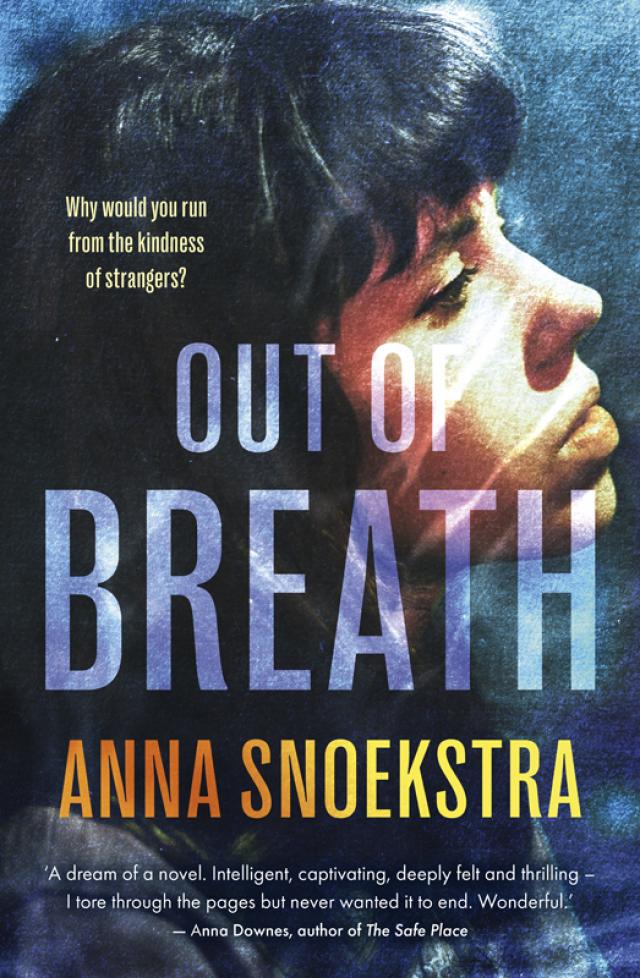
‘Out of Breath is a dream of a novel: intelligent, captivating, deeply felt and thrilling, with a setting to lose yourself in. The exotic cast of characters, the diving, the atmosphere of freedom and the thrum of impending disaster … I genuinely could not put it down. It will appeal to anyone who loves intelligent character-led suspense. I both tore through the pages, desperate to find out what happens, and languished in the story, never wanting it to end. Wonderful.’
—Anna Downes, internationally bestselling author of The Safe Place
‘Out of Breath is an atmospheric, perfectly paced and emotionally gripping novel. Through Jo’s story we are taken to the remote coastal region of Australia, a place bursting with contrasts of darkness and light, earth and water. With great skill, Snoekstra conjures the startling landscapes and inner turmoils of her characters: the deep ocean diving and burning sun act as potent metaphors for those who hope to escape their dark and troubled pasts, only to find that they can only ever rise again to the surface.’
—Katherine Brabon, Vogel Award winning author of The Memory Artist and The Shut Ins
‘I read this book quickly, and felt close to the protagonist, Jo, from the very first page. She is a complex, bruised, lovable character, and I wanted to see where she was going, and what she was running towards. Out of Breath is so readable because it’s so believable, despite the unthinkable twists and turns. Snoekstra has managed to create an atmosphere that stands the hairs and feels as close as skin, without taking us beyond what we understand and know. This book is about human nature, in all its manifestations, and it paints something scary and stark and hopeful.’
—Laura McPhee-Browne, Glenda Adams Award winning author of Cherry Beach
‘Out of Breath is a pacy, layered thriller with a troubled and traumatised woman at its heart. Gorgeous writing. Sinister, smart and totally riveting.’
—Laura Elvery, Fair Australian Prize winning author of Ordinary Matter
‘Snoekstra’s excellent debut stands out in the crowded psychological suspense field with smart, subtle red herrings and plenty of dark and violent secrets.’
—Library Journal (starred review) on Only Daughter
‘In Anna Snoekstra’s dark and edgy debut, a young woman slips easily into the life of a girl missing eleven years, only to discover the grisly truth behind the disappearance … Truly distinctive and tautly told, Only Daughter welcomes a thrilling new voice in crime fiction.’
—Mary Kubica, New York Times bestselling author of The Good Girl
‘Only Daughter is a dark meditation on the secrets we keep about our families and about ourselves. Twisty, slippery, and full of surprises, this web of lies will ensnare you and keep you riveted until you’ve turned the final page.’
—Lisa Unger, New York Times bestselling author of Ink and Bone
‘Unreliable narrator thrillers are practically a subgenre of their own, and there are two unreliable narrators here as well as a wickedly twisted and fast-paced plot that leaves numerous questions unanswered … readers who enjoy a creepy thriller that will keep them guessing will be unable to put this down.’
—Booklist (starred review) on Only Daughter
‘Little Secrets is both twisty and twisted, a portrait of the ugly secrets simmering in a dying town. Snoekstra writes an original tale that is mysterious and dark but also touching and true.’
—Janelle Brown, New York Times bestselling author of Watch Me Disappear
‘A smart and compulsive psychological thriller. I couldn’t put it down!’
—Graeme Simsion, New York Times bestselling author of The Rosie Project, on Little Secrets
‘A story of high school grudges and revenge wrapped up as a crime thriller, Snoekstra’s latest will appeal to fans of The Trap and Gone Girl.’
—Books + Publishing on The Spite Game
‘The Spite Game is a clever, gripping tale of the demons that we carry throughout our lives, and the damage they can cause if we fail to let them go.’
—Better Reading
Photo by Samantha Iliov
ANNA SNOEKSTRA is the author of Only Daughter, Little Secrets and The Spite Game. Her novels have been published in over twenty countries and sixteen languages. She has written for The Guardian, Meanjin, The Griffith Review, Lindsay, LitHub and The Saturday Paper. Her first audio drama, This Isn’t Happening, is out with Audible in late 2022.
Also by Anna Snoekstra
Only Daughter
Little Secrets
Mercy Point
The Spite Game
www.harpercollins.com.au/hq
For the magnificent Phoebe Baker
CONTENTS
Also by Anna Snoekstra
Part One
Chapter 1
Chapter 2
Chapter 3
Chapter 4
Chapter 5
Part Two
Chapter 6
Chapter 7
Chapter 8
Chapter 9
Chapter 10
Chapter 11
Chapter 12
Chapter 13
Chapter 14
Chapter 15
Chapter 16
Part Three
Chapter 17
Chapter 18
Chapter 19
Chapter 20
Chapter 21
Chapter 22
Chapter 23
Chapter 24
Chapter 25
Chapter 26
Chapter 27
Chapter 28
Chapter 29
Chapter 30
Chapter 31
Chapter 32
Chapter 33
Chapter 34
Chapter 35
Chapter 36
Part Four
Chapter 37
Chapter 38
Acknowledgements
PART ONE
CHAPTER 1
SYDNEY, SEPTEMBER 2018
Sydney looks nothing like the places where Jo grew up. The first few years of her life in the village of St Ives shone in pastels: mint green and warm cream and the iced aquamarine of the bay. Then Chesterfield, the colours washed out and muddied. London could be captured in monochrome; even the water of the Thames looked more grey than blue for most of the year.
There’s something about the quality of light in Australia that’s different to anywhere else. Jo can’t place why exactly, but it makes colours more saturated.
The bus pulls in for a stop and Jo is crammed further into the window as more passengers get on. It’s a hot day, the air on board soupy with body heat. Sweat itches her face and her t-shirt sticks to her back. A woman with a baby presses up next to her. Jo grins at the infant, who hides its eyes under the edge of the carrier.
They turn a corner, and this is it, this is the reason Jo loves catching the bus even though it stinks of BO. She watches Sydney Harbour stretch out, postcard perfect. All silvers and blues and stark whites. The baby peeks around the carrier again, smiling this time. She pulls a face at it and it giggles and everything feels so right. She’s finished a long shift at the café and now she’s on her way to her second job and she’s exhausted but still, she is filled up. She’s going to make this life work. This is going to be her place, her home, for keeps.
Jo presses the stop button and weaves her way through elbows and backpacks, steps out onto the street right in front of the pub where she hosts her trivia nights.
*
Jo sits on a stool at the edge of the bar, checking the trivia results from the first round. She goes down the list with her red pen, marking ticks or crosses next to each line and tallying the results.
‘Beer?’ the bartender asks her over the taps.
‘Just a soda water.’
‘Course.’
She likes pubs in Australia much more than the ones back home. In England, the pubs felt closer, darker. They were always too warm with their cranking heaters and open fireplaces. The pubs here have high ceilings, cement floors. They keep the doors open because the air outside is balmy and the sun doesn’t set until eight pm.
The bartender gives her the soda water, a wedge of lime straddling the rim of the glass.
‘Cheers.’ Jo holds the papers under her arm and slides off the stool. She likes to see the different groups who turn up to her trivia nights. She speculates at what binds each team. Sitting by the window is a couple who come every week. They usually score last, since they are only two compared to the teams of six or seven, but it doesn’t seem to bother them. They put their heads together, whisper answers to one another, laugh private laughs. She gives them their sheet and they thank her.
There is another regular group who sits at the long table in the centre of the room. Work colleagues, Jo assumes. Their team name is Jane’s got the number and every time she reads it out they laugh.
‘We’re winning, right?’ one of the guys asks as she approaches. His t-shirt is a dark red, bringing out the pink in his nose, the freckles on his hands. It had taken Jo a while to get used to people’s skin in Australia. Even for the average person, it is more weathered, it tells more of a story. It’s the sun, bringing everything to the surface.
‘You’ll see,’ she says. They are, by a mile. She hands them their sheet and they crowd over it. All except one woman, who doesn’t check to see how they scored. She’s wearing bright lipstick and seems uncomfortable. Her shoulders are stiff. Jo didn’t see her here last week. There is often someone like this in a group, someone who knew none of the answers and felt more and more like an idiot as the gam
Now, she smiles at the woman over the heads of the others. The woman seems surprised and smiles back in a pained sort of way.
Jo passes out the rest of the sheets. Up close, she can see the group near the door are related. The same green eyes, some lined with wrinkles, smile at her as she drops the sheet. The table in the corner all have beards. The group in their early twenties on the far wall have tattoos that are so new they look like they’ve been drawn on their smooth forearms and thighs with felt-tip markers.
She has one sheet left in her hands. It’s for Eric’s team, but their seats are empty. Their dinner plates haven’t been cleared yet, massacres of tomato sauce on porcelain under scrunched-up napkins. She leaves their sheet in the centre of the table. Goes to find them outside.
The dimming evening air is cool enough to wake her up a little. She stopped taking her sleeping pills a few weeks ago and her insomnia is back. It’s not as torturous this time. She used to lay awake with her uncertainty spinning the room. Now, lying next to Eric, she thinks about their future. It grounds her.
His group is sitting at a wooden table in the beer garden, smoking. Ashwan, Alice, Briena and Eric. They fit together too, in a way that isn’t as easy to identify. It’s something in the confidence of their laughs, the way they gesticulate with their cigarettes. The concavity of their shoulders from too long hunching over academic journals.
On their first date, Eric had first told her that his PhD was on the commodity culture of cult television. She’d thought he was joking. He’d been offended when she’d laughed.
‘You need to put rice on it,’ Eric is saying to Ashwan, who shares his office space at the university.
‘Nah, don’t do that, it gets under your keyboard. Then every time you hit a key it crunches. It’s awful.’
‘Didn’t you use quinoa or something that time?’
‘Nah, bulgur wheat. Stupid.’
‘I already dried it anyway, and it’s working.’
Eric puts an arm around Jo as she slots in next to him. ‘How’d you dry it?’
‘Just with a fucking towel.’
They laugh at that. Then Briena takes the sheet from Jo, but doesn’t bother checking how they did. Briena is her only real friend here in Sydney. When Jo realised she wasn’t going to make rent just from her trivia nights, Briena got her a job at the café where she works. Briena dropped out of her Arts PhD in her first year and now she’s putting herself through law school making coffee.
‘Eric, can you please convince Jo not to go to Broome? She has no clue what she’s in for.’
Jo laughs. It’s endearing how close anger and kindness are for Briena.
‘I can’t convince her to do anything she doesn’t want to do.’
That’s not true. And anyway, Jo no longer has any intention of going to Broome. She can’t.
Alice blows out her smoke, smiles. ‘I went on a road trip around there, I don’t know, six years ago. With Lauren when we first started going out.’
‘That’s a way to break the ice,’ Eric says. He holds his cigarette out, away from the group. Its smoke dissolves into the greying sky. There is an elegance to the bend of his wrist.
‘What was it like?’ Jo asks.
‘So beautiful.’
Jo knows that, she’s googled it. Red dirt, huge blue skies. It didn’t look like anywhere she’d been before.
‘Yeah, but it’s isolated, right?’ Briena says. ‘And there’s some absolute creeps out there.’
Alice thinks about it. Fiddles with her bottom lip, running a finger along it like she’s remembering a kiss. ‘So we were driving around in a four-wheel drive, you know, camping along the way. It was always fine, really nice, but this one night we were at a campground and there wasn’t anyone else. It was kind of cool, like we were the only people in the world. The sky was so big, huge, like you wouldn’t believe. But then this guy showed up in his car. People are usually so friendly out there. But he, I don’t know, the energy just changed. He didn’t come say hi or anything. He stayed in his car, parked far away in the shadows of a tree. All night he didn’t come out, just sat in his car. We suddenly felt so aware of ourselves, you know? Two women by ourselves. We hadn’t felt that before then. We left as soon as it got light.’
‘Creepy,’ Briena says.
Alice raises her eyebrows. ‘Was probably nothing.’
‘I’d guess he was hiding out from the cops or something.’ Briena holds Jo’s eye, face serious. ‘That’s why people go out there you know—to disappear.’ She grins at Eric. ‘You guys should get married. A visa wedding would be so much fun. Then she wouldn’t have to go.’
Jo tries to feel Eric’s reaction next to her. Did he stiffen? Did he pull away at all? They are meant to be talking about this later tonight.
‘It could just be a party,’ Briena insists.
‘Are you proposing to my girlfriend for me?’
‘She’s awesome, why wouldn’t you want to?’
‘I’m right here,’ Jo says.
‘Why are you going so far out?’ Ashwan asks.
‘I don’t want to go so far. I don’t want to go at all, you don’t need to convince me.’ She looks pointedly at Briena, then back to Ashwan. ‘It was the only place that agreed to take me.’
A ‘cultural exchange’ they call it, but she knows it’s about cheap labour. Still, eighty-eight days wasn’t that long. Eighty-eight days and she’d come back and her life would return to normal, or at least that was what the plan had been. When she’d first started applying, she’d been excited. A new adventure, a whole new experience. She’d see the other side of Australia. The Australia with farmers and kangaroos, not skyscrapers and arseholes in suits.
But everything is different now.
‘Isn’t there some place you can do it that’s a bit closer? I mean, the Kimberley is, what, two flights away? Eight hours?’ Ashwan asks.
‘The ones that were closer were mostly hostels. If you stay there they find you work, apparently. But I don’t want to stay in a hostel for three months with a bunch of English people.’
‘Jo isn’t very patriotic,’ Eric says, his arm still around her, fingers fiddling with the ends of her hair.
‘I guess I’m not. I was on a bus with a group of them on the weekend. God, they were horrible. All drunk.’ She laughs, remembering the lads with shaved heads and dumb laughs, the pitchy screams of the drunk girls with crap fake tans. She had felt mortified on their behalf. It was like she was back in England.
‘You know what I heard one of them say? This girl, prissiest girl you’d ever seen, she screams, “I was so shocked I could feel me stomach falling out of me arsehole.” I mean, bloody hell. Way to give the English a bad name.’
‘You call people like that chavs, right?’ Eric asks.
Jo stiffens. ‘I hate it when people use that word.’
‘Chavs?’
‘It’s classist.’
Eric pulls his arm away. ‘Nah, I don’t know,’ he says, ‘it’s like saying bogans here.’
‘That’s classist too.’
‘You can have rich bogans.’
‘Yeah, but the fact you have to qualify it with “rich” says it all. Like they’ve got new money, but they are still low class.’
Eric shakes his head. ‘You don’t get it.’
He likes to say that. They’ve been together eight months now and she is getting to know all his habits, the little tells that let her know when he is irritated, upset, nervous. She is about to reply when her stomach buckles. She takes a breath, has a sip of soda water, feels the bubbles shimmer down her throat.
‘Where are you from in England, anyway?’ Alice asks. ‘For some reason I always just think everyone from England is from London.’
‘I was born in St Ives, actually. It’s kind of an English coastal holiday town. Then I went to live with my dad in Chesterfield when I was seven, which is in the East Midlands—’ she laughs, ‘—and definitely not a tourist town.’
She hopes they won’t ask why she went to live with her dad. She is feeling too sick to lie well.
‘But you did live in London,’ Eric interjects before anyone gets the chance. He likes to tell people she’s a painter, rather than the truth, which was that she is a failed painter. An art school dropout. She hasn’t picked up a brush in over a year and she is glad of it.


