

Hilldiggers a novel of p.., p.33
By All That's Green!: A Paranormal Cozy Fantasy Novel, page 33


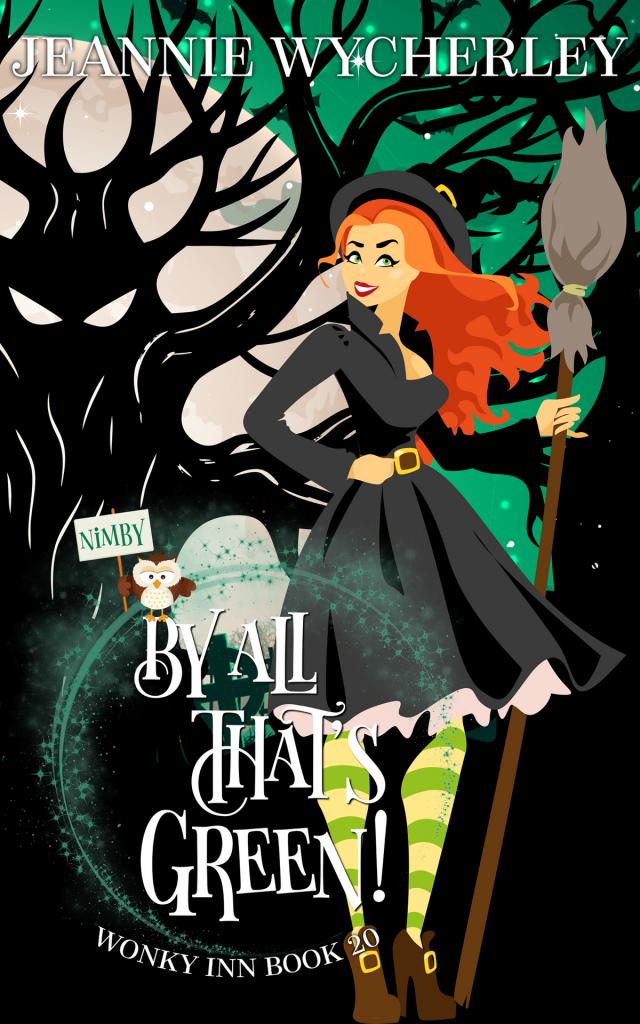
By All That’s Green!:
Wonky Inn Book 20
BY
JEANNIE WYCHERLEY
Copyright © 2025 Jeannie Wycherley
Bark at the Moon Books
All rights reserved.
Publishers note: This is a work of fiction. All characters, names, places and incidents are either products of the author’s imagination or are used fictitiously and for effect. Any resemblance to actual persons, either living or dead, is entirely coincidental.
No part of this book may be reproduced, distributed or transmitted in any form or by any means, including photocopying, recording, or other electronic or mechanical methods, or by any information storage and retrieval system, or AI, without the prior written permission of the publisher, except in the case of very brief quotations embodied in critical reviews and certain other non-commercial uses permitted by copyright law.
Sign up for Jeannie’s newsletter: https://www.subscribepage.com/JeannieWycherleyWonky
By All That’s Green! was edited by Christine L Baker
Cover design by Tammy
Formatting by Tammy
Proofreading by Johnny Bon Bon
Please note: This book is set in England in the United Kingdom. It uses British English spellings and idioms.
Dedication
By All That’s Green!: Wonky Inn Book 20
is gratefully dedicated to you,
dear reader!
Thank you, from the bottom of my heart, for sticking with Alf and the Wonky Inn crew and loving them as much as I do.
You’ll never know how much this series altered the trajectory of my life and finally fulfilled a little girl’s dream <3
Jeannie Wycherley
xxx
Chapter One
“I don’t know why I let you talk me into this,” I said, one hand wrapped around a chipped mug of blackcurrant tea, the other tucked into the pocket of my mossy-green cardigan as I pressed my forehead against the cool glass of the office window. Below me, the Verdancy Festival was blooming into mayhem.
And I mean total mayhem.
“Don’t be such a grouch.” Charity joined me at the window and nudged me in the ribs. “I promised you it would be amazing and it will be! I mean, look! It’s fabulous!”
Standing together, we surveyed the inn’s massive lawn and the jumble of stalls in the process of setting up and arranging their wares. The remnants of morning mist clung stubbornly to the low hedgerows, glittering faintly. Dew and last night’s cobweb lace, silvered in the early light, added to the magickal ambience.
It should have been nice.
The problem with festivals, or indeed any event held at Whittle Inn—I always find—is that chaos tends to hide in the corners, and with my history, you’ll understand I’m not keen on surprises. I sniffed as I watched stallholders bustling and shouting, wagons crunching over the gravel drive, and someone arguing with a bow-tie-wearing goose that was refusing to move.
Yes. You heard that right. That, my friends, is an example of the shape this Verdancy Festival was taking.
When Wizard Shadowmender, the head of my coven and a powerful and influential voice at the Ministry of Witches, had approached me to enquire about holding the annual Verdancy Festival here at Whittle Inn, I’d choked back my mirth and flat out refused, subsequently laughing off his further attempts to persuade me. Abso-bloomin’-lutely not!
End of discussion.
“I have the fear,” I told Charity, but mildly. “Look what happened last time.”
She tittered. “You didn’t have any say in what happened when that rotten convoy camped on your land.”
“I’m not sure I’ve had much say this time,” I grumbled.
Although I hadn’t wanted the event to be held at Whittle Inn, the magnificent Tudor inn that had been in the Daemonne family for centuries, we’d come to a satisfactory compromise and Charity had taken the project on instead.
“Silly!” She nudged me again. “I’ve considered your opinions every step of the way. Besides, what happened before wasn’t a festival. That Lord Whatever-his-name-was—”
“David Berthold,” I reminded her, unable to hide my scorn. “His Illustrious High Eminence, Lord Berthold of Scarabeena.”
“Yeah, him.” She laughed. “He and his cronies were trespassing.”
“Mmm.” She was right but I didn’t feel consoled.
“Festivals should be colourful and full of joy. I promise you this one will be.”
“Are the Devonshire Fellows playing?” I asked.
“Of course.”
“Then it won’t be, and I rest my case.”
I turned away from the window and meandered back to my desk. Spreadsheets to open and bills to pay. You know the score.
But before I could get there, Charity grabbed my arm. “Come on. You look pale—”
“I always look pale. I’m a redhead.”
“We’re going for a wander to see how things are shaping up—”
“And I’m a witch. Witches should be pale.” I narrowed my eyes. “You should be pale. Why are you so tan—”
“Out!” Charity pushed me through the office door and onto the landing.
Wizard Admiral Jellicoe, a frequent guest, happened to be passing. He stood to attention and saluted me. “All present and correct, sah!”
“Ah … jolly good!” I scanned the corridor. If anyone besides the admiral was in the hall, they weren’t making themselves known to me. “As you were.”
“Very good, sah!”
Charity gave me a push and I hurried down the stairs.
The kitchen to my right, and The Hug and The Snug to my left, were bustling as you can imagine. Florence’s generally soft Devonshire twang sounded more strident than usual. “Mary Peter? Where are the cornflowers? You haven’t thrown them out, have you? Domino? That black garlic needs to be finely chopped! No! Not with a food processor! What do we have hands for?”
In the background, I could hear the clanging of heavy pots and the rapid chopping of something on a wooden block. I could only hope that Monsieur Emietter, the ghostly French chef who ran the kitchen with a rod of iron and an explosive temper, hadn’t caught one of Finbarr’s pixies.
Or if he had, let it be Crookshank.
The most annoying of Finbarr’s grotty band of mischievous pixies, Crookshank had recently returned from his travels in Australia, having stowed away in Charity’s rucksack, and now sported a deep suntan—slightly disarming on a pixie, much as it was on a witch—and a cork hat, meaning a hat with corks dangling off the brim, that he refused to take off. He probably slept in it.
Charity, behind me on the stairs, caught hold of my shoulders and turned me in the opposite direction. “Keep going,” she ordered, so I did as she said and marched past The Snug and The Hug, ignoring the chaos unfolding in both rooms.
I mean, don’t ask me why Perdita Pugh had to be here at the festival with all her ghost-hunting equipment. And it must have been all of it because she’d commandeered several tables from the bar and she still had a dozen or so monitors and laptops and other electrical contraptions parked on the floor and the window seat. Apparently Wizard Shadowmender had asked Charity if it would be okay and Charity had said yes. I’d have said no, but that’s because I LIKE A QUIET LIFE!
Next door, The Snug had been utilised as a storage depot. Charity had ordered phenomenal amounts of … stuff—I have no idea what this stuff was; I only paid the bills she presented me with, and believe me, I would be invoicing the Ministry of Witches at my earliest opportunity!—and boxes and crates had been arriving for the past few weeks. Now members of the Wonky Inn Ghostly Clean-up Crew were busily carting boxes in, boxes out, or opening boxes, unpacking boxes and dismantling boxes.
“Make sure you’re recycling those!” Charity ordered as she steered me resolutely into the bar.
The bar, sadly, was no less chaotic. We hadn’t long cleared breakfast, but now ghosts were flitting around cleaning and polishing. Only Silvan, long dark hair freshly washed, perched on a tall stool on the customer side of the bar, appeared calm. But then, he was drinking coffee and working on a crossword puzzle in The Celestine Times, so go figure. “Good to see you getting involved,” I said to him. He glanced up, winked, and immediately returned his attention to his cryptic clues.
Ned, my handyman-come-barman-come-gardener-come-anything-he-could-turn-his-hands-to, swore in exasperation. “I’m going to chop you up into a million pieces!”
I raised my eyebrows. Ned, possibly the serenest and least flusterable man residing at Whittle Inn, rarely raised his voice, let alone cursed or threatened violence. However, as I drew alongside him I realised he was grappling with a trestle table.
“Problem?” I asked.
He flushed and whipped the cap from his head. “Beg pardon, Miss Alf. It’s this old thing.”
“Why do we need a trestle table in the bar anyway?” I puzzled.
Charity grabbed my arm to pull me away. “I thought we could serve cocktails in here. This gives us extra room!”
“I see.” I was about to follow her through to reception when the table collapsed and elegantly turned itself into a chaise longue.
I watched in awe. Ever since the first Verdancy Festival wagon had pitched up on the Whittle Inn lawn, the magick had been off the charts. Previously inert objects had suddenly begun to take on a life of their own. H edges and bushes moved themselves around the garden—much to our gardener’s consternation. Zephaniah, also a ghost, had been killed during the First World War, but his spirit had returned home to Whittle Inn where, pre-war, he’d been employed by my great-grandmother alongside his uncle, Horace Bailey, in the gardens. He wasn’t a fan of all this Verdancy Festival magick either, especially when one of the herbaceous borders had started migrating west, muttering something about better light.
“Argh! You’re a table! Behave like one!” Ned stamped his foot. “It keeps doing this!”
“I happen to think a chaise longue is a better fit for the bar,” Silvan suggested, without taking his eyes off his paper. “The table obviously thinks so too.” He sniggered.
“Where did you find it?” I asked Ned. I wasn’t sure I’d ever seen it before.
“Finbarr—” Ned began.
“Enough said.” I shook my head at Charity and backed away.
“Leave it, Ned,” Charity instructed him. “Why don’t you go and help Zephaniah with the beer tent.”
“There’s a beer tent?” Silvan enquired, momentarily distracted from twelve across.
“Of course!” enthused Charity. “We’ve organised a dozen guest ales from all over the UK, plus eight ciders from the West Country, and”—she waved a finger in the air—“even some local gins!”
“Sounds good,” said Silvan. “I might have to try a few of those out.”
A few? He’d be rolling drunk in no time. I tutted, and Charity pushed me.
Reception, fortunately, appeared calm, mainly because Colonel Archibald Peters—a ghost I’d ‘rescued’ in Transylvania and an old friend of my similarly deceased great-grandmother—was asleep at his post, plus anyone who was checking out had already done so, and it was still a little early for check-ins. Charity tapped the reception desk and Archibald jerked awake. “Would you like a wake-up call?” he blurted before realising it was us. “Oh, apologies, ladies. I was—”
Whirrrrrrrrrr. Zzzzussss.
Balanced on the edge of the desk sat a new contraption made of wood, freshly painted white. It had dispensed a ticket rather like a mini-printer would. “What’s this?” I asked, tugging at the perforations to free the ticket.
“It’s a suggestion box,” Charity told me. “Wizard Shadowmender thought it would be a good idea to collect feedback on how the festival is going. I bought this one online. Zephaniah must have managed to get it to work.”
“Why does a suggestion box need to work? Surely you write something on a card and post it through the hole? It doesn’t have to do anything—” I studied the writing on my ticket. Take a chill pill, it said. I pursed my lips.
Charity read the suggestion over my shoulder. “Ah. It’s still not working.”
“To be fair, it is a suggestion,” I said, balling up the ticket and throwing it at her.
“And a good one at that.” Charity giggled, bent to retrieve my litter and followed me outside.
I stood on the steps and surveyed my beautiful lawns.
Or what remained of them.
The usually pristine stretch of emerald green—Zephaniah’s pride and joy—had been transformed into something between a medieval fayre, a magickal flea market and the aftermath of a pixie riot. Along with a temporary bandstand and staging area dead in the centre, dozens of tents and stalls had sprung up like mushrooms in the night—some literally, judging by the purple-and-cream toadstool stools sprouting beside the herb alchemy booth to my right.
They gave off a strong whiff of fungi …
I wrinkled my nose as Charity came to a halt beside me, shielding her eyes from the morning sun. “Isn’t it glorious?”
I grunted.
“Look at the tree!” Charity gushed, linking my arm in hers and dragging me off to the right.
She meant the tree that had been freshly planted in the centre of what I laughingly called the ‘side’ lawn, and what my father Erik and most of the ghosts who inhabited the inn and grounds referred to as the cricket pitch.
A Heart Tree.
Extremely rare, the saplings were housed at the Magickal Botanical Greenhouse in a secret location in Kew Gardens. In the days before every Verdancy Festival, one young specimen was ceremoniously placed in a prominent position, surrounded by a circle of specially selected magickal stones. Over the course of the next few days it would grow taller and stronger, flourish and spread its branches wide. Many of the festivities would take place around it. On the final evening it would seed, and every attendee would have the opportunity to take their own seedling home, although the seeds were never as magickal as the parent tree.
A pixie zipped overhead, trailing streamers and dropping petals in completely the wrong places. Another one dive-bombed a cake stall with a banner that read Love the Earth or Else and accidentally tangled it around a gnome-shaped topiary, which promptly sneezed and shuffled off in search of privacy.
“Do we have any control over this at all?” I asked, staring askance at the topiary. Since when had my bushes been so … so … alive?
“Control is such an unnecessarily rigid word,” Charity replied, thoroughly enjoying herself.
We wandered over in the direction of the beer tent—a sizable marquee—which was being erected on the path heading towards Speckled Wood. I soon spied Zephaniah locked in a silent tug of war with a tent pole that had apparently decided it was a sunflower. It kept trying to bend towards the light. He, in turn, was attempting to hammer it into the ground with a ghostly mallet and a growing sense of righteous indignation. He only had one arm, after all.
Meanwhile, Ned was already mid-wrestle with an enchanted ale barrel that wouldn’t stop hiccupping. Every time he stood it upright, it belched froth and wobbled indignantly. “I told you,” he shouted at no-one in particular, “I’m not having another conversation with a sentient keg!” Deeply disgruntled, he abandoned the barrel and began wrestling with one of the marquee’s support beams. The ale barrel, now alone, immediately developed separation anxiety and acquired a nervous twitch, rolling itself repeatedly into his ankles.
“Zeph? Hold this still, will you?” he growled, his voice echoing as he disappeared inside the canvas.
“Not my fault it doesn’t like you,” I heard Zeph mutter. He was floating thirty centimetres or so off the ground and using a spectral hoe to redirect the tent pegs. The pegs had sprouted tiny legs and were attempting a mutiny. “It’s the hops,” Zephaniah added, squinting at the barrel. “They’re sullen this year.”
“Not as sullen as I am,” I murmured under my breath.
From somewhere behind a nearby van that had arrived to deliver cider, a fiddle struck up the first few notes of an old Irish favourite, ‘The Peatbog Polka’, and I recognised Luppitt Smeatharpe leading his ghostly minstrel brothers in a warm-up jig. I flinched.
“I’m going to need stronger tea,” I muttered.
A low hoot cut through the breeze, and I turned to see Mr Hoo, my owl familiar, swooping down from the inn’s roof, talons clutching a glinting object. He deposited it proudly at my feet—a tea spoon with an intricate vine design on the handle, which I recognised from Florence’s prize cutlery drawer.
“Hoo-hoo-hoo hoo!” he said with great dignity, then fluffed his feathers and flew up and away, straight into the still-sagging roof of the beer tent.
“Festival tax?” I bent to retrieve the spoon.
Charity snorted. “Is he nicking things again?”
“Of course. I don’t know what’s got into him. He’s building a shrine in my bedroom, a bit like a treasure chest. Fancies himself as royalty, I reckon. Next he’ll be demanding a title.”
“Silvan said Mr Hoo’s started calling himself Chief of Aerial Security,” Charity told me. “Which, I suppose, is fair.”
“It would be if he could avoid crashing into the marquee,” I said, watching him right himself and stroll around, pretending nothing untoward had occurred.
We ambled among the stalls. I couldn’t help but admire the variety and colour. A quiver of excitement ran through me, albeit a grudging one. Who doesn’t love a festival? I’m not a monster.
“Ooh! Ooh! This is my mum’s stall!” Charity told me, grabbing my elbow. I read the banner above. Peggy’s Punk Eco-Merch Tent. “It was my idea,” Charity admitted. “I’d have run it myself but I can’t be in more than one place at once, and seeing as you didn’t want to take charge—”


