

Barren grounds, p.1
Barren Grounds, page 1


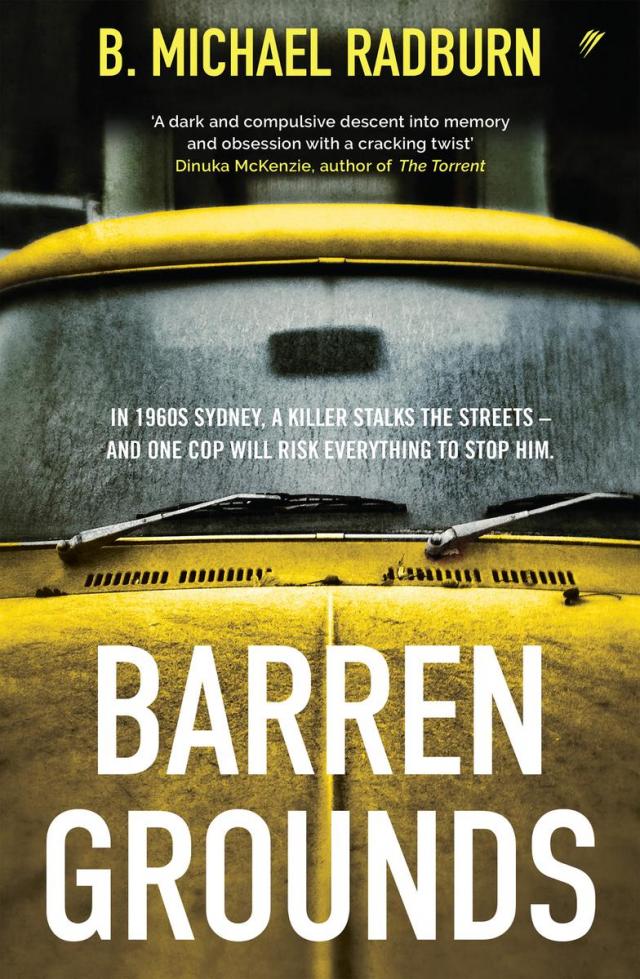
The calling card of the killer known as ‘The Jeweller’ is as elegant as it is gruesome: a pair of ring fingers, separated from their owners, encircled by a band of wire, and delivered directly to Senior Detective Joe Capello. When the Jeweller taunts Joe and his team into meeting him in the diseased grounds of Barren Park, the consequences of that evening will have permanent repercussions for everyone involved. And for Joe, it gets personal.
Two years later, Joe is off the force, but no less obsessed with the Jeweller and his horrific crimes. When a new parcel arrives at his home, Joe is invited back onto the task force and given the opportunity to redeem himself. But vindication relies on Joe finally capturing The Jeweller and now he has to decide if he’s willing to do what it takes – whatever it takes – to finally bring this case to a close.
For Susan
Go gently into that good night, Sis.
You were loved.
‘Every artist covets an audience …
even those who paint in blood.’
The Jeweller
CONTENTS
Title Page
Dedication
Epigraph
Prologue
Part One: Legacy of Ruin
1
2
3
4
5
6
7
8
9
10
11
12
13
14
15
16
17
18
19
20
21
Part Two: The Colours of Love and Pain
22
23
24
25
26
27
28
29
30
31
32
33
34
35
36
37
38
39
40
41
42
43
44
Part Three: This trinity of God, Man and Devil
45
46
47
48
49
50
51
52
53
54
55
56
57
58
59
60
Epilogue
Acknowledgements
Also by B. Michael Radburn
About the Author
Copyright
PROLOGUE
The Field of Bones 1942
Its footfalls grew louder as it drew nearer. Twelve-year-old Joseph Capello recognised the sound as coming from a nightmare – a lie of the subconscious that would dissolve with dawn’s light. And yet, the terror was real enough, as the cloaked figure stalked the shadowed passageways between the camp huts.
Joseph’s coarse blankets pressed him into the mattress, his chest too constricted for him to scream as the murky figure sought him out. It could smell souls like a child smells a freshly baked pie; taste coppery blood like a boy tastes caramel. The footsteps halted outside their hut and Joseph withered into the mattress as a talon scratched at an eddied knot in the wall just inches from his face.
The scratching woke him.
He cast the blankets aside and sprang upright in bed. Joseph focused on the familiar knothole, a tight wad of newspaper plugged firmly against the night and whatever lay beyond.
He didn’t know what time it was, but it was still dark outside the window, his bedroom door open enough to let in some of the kitchen’s light. Joseph concentrated on his breathing as he sank back down, hugging his knees. He strained to hear the scratching again. Just a dream – another lie. He studied the twisted trail of the blankets he had cast across the floor, to the mirror opposite, the auburn-eyed twelve-year-old boy in the mirror staring back at him. His once plump cheeks had wasted away along with his appetite since Mama, Papa and he had been exiled to the camps, with busloads of other Italian immigrants.
Joseph stood warily so as not to make the floorboards creak. He stepped into the rectangle of kitchen light as he heard the front door open slowly, the rabbit snares that hung from the handle chiming his father’s entry. Joseph held his breath, stood stock-still as Papa skulked in, having defied the camp curfew, and Mama’s feelings, for the German bathtub gin in the adjoining compound. Joseph couldn’t let his father see him witness this indiscretion. He waited for Papa to steal into his and Mama’s bedroom before moving so much as an eyelash, then returned to bed, the blankets he’d gathered covering his head as he waited for the shouting to begin.
And it did.
Joseph thrust his head deep into the pillow and pressed his hands to his ears, the memory of bus tyres on dirt roads slowly overpowering the yelling in their little cabin. Eventually, the memories of last summer’s heat haze thawed the winter cold.
Joseph watched his mother write the latest entry in her diary and place the strip of gold cotton in the crease between the pages. Her handwriting was elegant, flowing across the page like a trail to something wonderful. Everything about Mama, a Roman dressmaker, was elegant: style and grace wrapped in a ribbon of melancholy.
She had let Joseph take the window seat. As the wind cooled the sweat on his temples, he was conscious that his father sat alone, across the aisle. Papa looked pitiful, defeated, head resting on his arms against the seat in front, his brown leather jacket with its olive-green cotton waistband across his legs. What they couldn’t pack, they wore, and what they couldn’t wear, they carried, the rest of their belongings stuffed into a steamer trunk on the bus roof. His father was frightened, Joseph could tell, but Papa chose to carry that fear alone. Whereas Mama tried to resist being forced to become something else, Papa simply succumbed to it.
The bus slowed as they passed through large gates. Tall barbwire fences stretched for miles beneath the noonday sun. A guard waved them through, eyes hidden beneath his slouch hat, rifle slung over one shoulder, khaki shirt stained with sweat. A sergeant’s three stripes were on his rolled-up shirtsleeves. The man became still as they passed, his steely, pale blue eyes fixed on Mama, who remained oblivious to his attention. His face had the weathered lines of a man much out of doors, but soon creased into a kind smile before he turned his back on the dust kicked up by the passing bus.
The world was different inside the fence – it felt limited, as if the barbwire was wrapped around Joseph’s chest. West beyond the fence, a single windmill stood idle in a field of sun-bleached cattle bones, its sails motionless in the stagnant air, its bright red windvane like a drop of blood against the blue fabric of the sky.
Joseph and his family would be living here for however long the war lasted.
The outside air had a dryness that reached into his lungs with each breath as he stepped off the bus. He and Mama rested beneath the dappled shade of a stringy-bark tree outside a building with the sign STORE & REGISTRATION. Joseph sat on their steamer trunk, Capello carved above the brass lock, wilting against his mother’s arm and watching his father queue for blankets and their hut allocation. A black-and-white fox terrier with a grey, whiskery face, ears upright and eyes bright, sat panting by its dish in the doorway, oblivious to the passing humanity.
Joseph’s fingers drifted languidly across his family’s name carved into the trunk, his lips silently mouthing each letter. He watched the dog as she rose and wandered over to sniff warily at something blue – thumb sized – on the tree bark. Curious, Joseph followed. He nudged the dog away, and saw that the shape was an insect. He tapped it lightly, but it didn’t move.
‘Be careful,’ Mama called.
‘It’s dead,’ he declared. ‘Just a shell.’ Joseph delicately unhooked the insect’s casing from the tree and held it up to the light, amazed at the iridescent blues, fierce and beautiful. ‘What is it, Mama?’
She lit a cigarette, drew the smoke delicately between her red lips, a ring of colour left on the white tip, as she examined his find.
‘I don’t know,’ she confessed. ‘But it’s quite lovely.’
Joseph found the smell of her Chesterfields comforting. He sat beside his mother and they examined the strange translucent shell, wondering what it was called. After all, everything had a name.
‘Mama?’ Joseph asked in Italian. ‘Does Capello mean the same here as it does back home?’
She looked down at him with sad eyes. ‘English,’ she reminded him in a blunt tone. ‘Australia is your home now. You can dream in Italian, but you must speak in English.’ She paused to consider his question. ‘Of course your name means the same in both countries.’
‘But you’ve never told me the meaning.’
His mother was silent for a moment. ‘You need to know your Latin,’ she said finally. ‘Your name has two meanings. One is the name for a trickster, from the Latin: capullum.’ She tapped his nose playfully. ‘Just like you, my little lamb.’
Joseph did like that idea. ‘And the other meaning?’ he asked.
‘Again from the Latin,’ she said. ‘Capa, as in cloak, or cape.’ She lifted Joseph’s chin, brushed the dust from his lips with her thumb. ‘Have you heard of the Cloakman?’
‘No.’
‘I see.’ She drew on her cigarette, stared across the road as her husband finally stepped inside the store. ‘The Cloakman is a combination of the two. He is the trickster who hides beh ind his black cloak, with his pockets full of mischief. The Cloakman will bring nothing but trouble and is to be avoided.’ Her fingers trembled as she dropped her cigarette on the ground and crushed it beneath her shoe.
‘The Cloakman,’ he whispered as a stifling gust of wind blew a dust devil across the road.
A blast of winter wind buffeted the window in Joseph’s bedroom. He rode the gust back to his hiding place beneath the blankets, realising that his breath and the wind were the only sounds remaining – that the shouting had ceased. He pulled down the covers and saw the first light of dawn emerging through his window. Joseph sat up, and heard something roll from his bed to the floor.
The chill from the frigid air cut deeper when he saw the familiar newspaper plug pushed out from its place in the wall. Joseph stared at the open knothole and listened to the wind’s mournful tune beneath the eaves. He crept closer, bedsprings creaking beneath his knees, hesitating a moment before pressing his eye to the opening – at last brave enough to glimpse the Cloakman, with his pockets full of mischief.
PART ONE
Legacy of Ruin
1962
1
Joe Capello had left his police coat and hat in the car downstairs, preferring to cover his badge and sergeant’s stripes with a black sweater when off duty. The leather bench outside Dr Alice Simone’s office was hard as stone, but was the only seat close to the waiting-room window Joe preferred to sit near. He glanced at his watch and sighed. Dr Simone was twenty minutes late already. Why do they make appointments if they can’t keep them? He glared at the gold-leaf sign on the office door.
Dr A. Simone, MD, Ph.D.
Psychiatrist
Once a week, for three long months now, he had sat here staring at that sign, dreading the hour ahead. He wouldn’t go if he was paying for the sessions. In Joe’s opinion, it was just good departmental money being pissed against the wall. And he certainly wouldn’t go if it wasn’t a condition of his employment since the accident. And if having to see some head doc wasn’t enough, she was a woman. All his life, doctors had been old men in tweed coats, who always looked sicker than Joe ever felt. Dr Simone was the exception, not the rule, and she had a fierce confidence, something Joe felt himself reluctantly admiring.
Behind the reception desk was a mirrored wall, perhaps intended to make the room look bigger. The receptionist was a redhaired girl in her mid-twenties, who today wore a lemon-coloured cotton top, buttoned up to the neck, her posture as straight as a telegraph pole. She gave Joe a glancing smile, and he smiled awkwardly back, catching his reflection in the mirror, hair swept into shape with Brylcreem. He pressed at the crow’s feet in the corners of his eyes. His only remaining youthful feature was the fine scar that cut neatly through his right eyebrow. A scar from Rushworth – so long ago now, he couldn’t remember how he’d earned it. Maybe Dr Simone could unearth that little gem too. Joe touched the hair at his temples, where a light peppering of grey had begun to emerge.
He turned from the flatness of his reflection to stare out over Sydney Harbour. From Dr Simone’s eighth-floor office, he had a clear view of the staggered foundations of the new Opera House. He had seen an artist’s impression of it in the newspaper, its towering sails and cathedral windows mirroring the harbour like something from a science-fiction movie. But then he was staring at his reflection again, ghostly in the glass, and was back to thinking about Rushworth and the bus ride all those years ago. That was the thing about Dr Simone’s sessions. They were always dragging up memories he would rather leave buried. Hell, he could almost taste the camp’s dust again.
A familiar rage started to build. Joe could feel his hands begin to tremble, and clasped them tightly together until it passed. He didn’t need a shrink to name it. Rage was an emotion as natural as any other, its genesis in some moment that would eventually pass. Better to let it do its job and run its course, he decided, than keep it alive in Dr Simone’s scab-picking sessions.
He cast about for a distraction, and found it in Lucille Ball’s smile on the cover of a TIME magazine on the table beside him. ‘Who loves ya, Lucy?’ he whispered to her.
The receptionist’s intercom buzzed. ‘I’ll send him through,’ she said, lifting her finger from the talk button and walking to the door. ‘You can go in now, Mr Capello.’
As Joe entered, Dr Simone – tall and slender, looking half her age – stepped out from behind the desk. The wall behind her was arrayed with gilded-framed credentials, and photographs of the doctor with various mayors, the state premier and the current police commissioner. They were her trophies; a display of her successful career’s pathway, and a reminder to her patients that she had friends in high places. She sat down on one of two deep-blue velour sofas facing each other in the centre of the room. A smoked glass coffee table stood between them, a copy of today’s Herald beside a clean ashtray. She wore a black suit, the jacket open over a bone-coloured top, the solitaire diamond pendant that hung from her neck catching the light. Her tawny hair was in its usual bun, and her hazel eyes shone confidently.
‘Good to see you again, Joe,’ she said with a smile. She gestured to the sofa opposite. ‘Won’t you sit?’
‘Thanks,’ Joe said, taking his seat. He eyed the folder beside her with his name on the cover, which grew thicker with each visit. Maybe she’s gonna write a book about me. ‘That can’t all be about me?’ He tried to sound jovial.
‘Every word.’ Dr Simone looked at the folder for a moment, then handed it to him. ‘Twelve sessions,’ she said. ‘You’re welcome to read it if you’d like.’
‘I’ll wait for the movie.’ Another attempt at humour.
She smiled again and put the folder down. ‘There’s nothing in there that we haven’t already discussed, Joe.’ She gently patted it. ‘Your journey here so far.’
Joe relaxed back into the sofa, which was far more comfortable than the waiting-room bench. ‘And yet, I’m still not sure how I got here, Doc.’
Dr Simone shifted slightly in her seat. ‘I can recommend the number fourteen bus,’ she said.
Joe raised his eyebrows. It was her first attempt at a quip in three months. ‘You’re cracking jokes now, Doctor?’
‘You started it,’ she bantered. ‘And, besides, I thought it might break that tension you’ve been working on in my waiting room.’
‘That obvious, huh?’
‘You wear your heart on your sleeve, Joe.’ She paused, looking at him. ‘If your journey is still uncertain after all this therapy, why don’t we take some time to recap?’ She gently tapped the little finger of her left hand on the sofa armrest. ‘Perhaps start by telling me where you think it all began?’
Joe opened his mouth, ready to reply that it was the first day of the Jeweller case, but then paused, no longer sure. He wished he possessed her certitude, just long enough to get him through this session, then recalled he’d once had self-confidence in spades. Before his demotion. Before the fatal accident.
His gaze fell upon the Herald on the coffee table between them. ‘I think it all began with an article in the paper last year,’ Joe said.
2
SIX MONTHS EARLIER
Joe climbed the steps to Mama’s veranda, where a porch swing swayed in the gentle breeze. He rested a cumbersome box on his hip while he negotiated the tricky front door handle. Nudging the door open with his knee, he stepped inside, the early morning light casting his shadow along the hall rug.
‘Mama, it’s me,’ he called, placing the box on the hallstand. ‘Mama?’ He closed the door, and could just make out Frank Sinatra crooning from the record player in the parlour.
The hum of a sewing machine suddenly smothered Frank’s dulcet tones. ‘Mama. It’s me, Joe,’ he called again, passing his old bedroom. ‘I brought you a present.’
‘Joseph?’ she called back from the sewing room. Her once-soft voice had a coarser edge these days. ‘That you?’
Joe shook his head and smiled. Her hearing was getting worse. It wasn’t the only thing going south. He could smell a hint of cigarette smoke in the air; she’d promised him she’d give them up.


