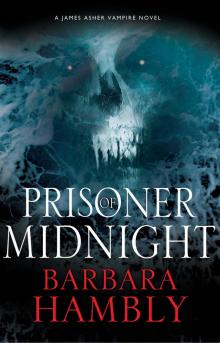
The dog wizard, p.21
The Dog Wizard, page 21


He had walked into one of those small zones such as had formed within the Citadel, pockets where the Void had leaked the aberrant magics of other universes, universes where magic had different rules, different strengths.
The urge to call some greater magic, some wild pyrotechnic of joy, was almost overwhelming—it was like trying not to gasp in air after emerging from minutes underwater. But that, he knew, could be appallingly dangerous, particularly here on the Brehon Line; he only hoped the tiny dot of blue light wasn’t triggering a field of darkness, or the spontaneous transportation of perfectly innocent people, elsewhere on the Line. Keeping the magic down to the smallest possible level, he called another tiny, heatless star to his palm, walked backward until it flickered desperately and disappeared, walked forward again—in a fair imitation of John Cleese’s Minister of Silly Walks—until it reappeared and then, in fifteen of his own erratic strides, sputtered and vanished once more.
Still no untoward side effects or, at least, none in his own vicinity. This pocket must be from a world whose magic operated much the same as it did in this one. Jumping cautiously over the cart rut and climbing the northern road bank in the scrambling track of Gru’s hunters, he waded through the thick curls of buckler fern and bracken for perhaps another thirty feet before the glowworm brightness once again died.
He stood still, thigh-deep in a pool of blackberry brambles, hearing no sound but the whisper of the spruce and the pounding of his own heart.
It would take him an hour and a half to reach the Green King’s Chapel, perhaps that long to return to the Citadel and find an unguarded scrying-stone of sufficient strength to get through whatever spells of guard had been established around Joanna’s prison. Provided, of course, spells of scrying wouldn’t result in fire or flood or lightning—though, if the magic of this field was similar, they should be fairly safe. And provided Daurannon or Bentick didn’t take it into their heads either to stop him or accompany him back.
And on the other hand, Joanna might simply be at the Green King’s Chapel.
“Dammit,” he muttered, “this place might not even be here tomorrow.” He glanced around him, taking note of the dead and leaning trunks of two alders—covered thick with shaggy green moss—that bounded one corner of the zone, and the zone’s relation to three boulders he’d known from years ago, which he’d always privately described as Aunts Tilly, Milly, and Dilly Having Tea. As he moved off once more, northeastward toward the brighter afternoon sun beyond the pines, where the village fields lay, he held out his hand in a last futile effort to summon the star glimmer to his palm. But nothing appeared—only the sliding, illusory coin of wind-fluttered sunshine.
“Ah, well, easy come, easy go.”
He heard the voices of the hunters again as he skirted through the elder thickets, haw, and horsetails that bounded the north fields: “It’s laired near here—we’ve all seen its tracks.”
“Splendid,” Antryg murmured, propping his glasses on his nose and wishing he had at least enough magic to keep the mosquitoes off him. “Wolf or bear, I wonder? Or will I be really lucky and walk into the latest abomination?”
He spent the next half hour cautiously making his way through the thicker vegetation that divided the woods from the soft brown earth shawled now with a velvet of tender green. The mud in the fields would show his tracks if he cut across them; moreover, he recalled how Suraklin had sometimes put his own perceptions into the eyes of birds, as a means of looking for people—usually other mages—whom he could not track with a scrying-crystal.
Joanna at the Green King’s Chapel.
The pentacle on the cards: the sign of earth.
A woman’s voice crying.
Fear-spells.
Whoever has done this to her...
The Green King’s Chapel lay silent and deserted in the dappled brightness of late-morning light. The ancient god of its dedication had been among the most popular of the old deities, and his worship had lasted long—indeed, there were places in the Sykerst where on certain nights the villagers still drove their livestock in procession down the long aisle of the witch-paths by moonlight, dragging the effigy of the Green King’s sacrificed body upon a cart. The chapel itself, though long roofless, was a solid ring of stone, its eight high windows nearly obscured by the secondary wall of ivy that had grown over the original granite. Against the leathery green of last year’s leaves, patches of new growth sparkled parakeet-bright; Antryg could have spread out his hand and not covered one of the larger leaves, and the twining stems were bigger around than his wrist.
There was no sound but a dove’s soft mutter and the liquid reply of a cuckoo deeper in the trees.
Antryg moved in a complete circuit of the chapel, pausing frequently to shut his eyes and listen. No sound of human breath, no smell of human food or human waste... none of the uneasy silences that arise among animals when a human being is near. True, he thought, Joanna’s prison was spelled against scrying, and there were ways of covering from nearer scrutiny as well.
He moved in for a closer look. His crooked fingers brushed the ivy, then worked through to the stonework beneath. The only spells on the building had been laid decades ago. They were fading now, with the scouring winters and duck-breathed summer heats, with the passage of beasts and insects to and fro: the scraping of the world’s life against the counterflow of old magic.
And they had not been fear-spells to begin with.
Like everyming else, the doorway was overgrown with ivy. Squirming his tall, skinny frame through, Antryg found himself in the open ring of the chapel’s uneven floor, of which only a few moss-clotted tombstones remained. Salmonberry and fire-weed were waist-high in places under the pallid sunlight; the granite of the altar had not seen sacrifice for almost three hundred years; the entrance to the crypt gaped to the sky.
“How very odd,” he murmured, and picked his way carefully down the narrow, foot-runneled stairs.
Foxes startled and scrambled in the moist darkness of the crypt; an opossum shrank back among the ivy roots, staring at him with a white, pointed face and lunatic eyes. By the smell of it the Sacred Well still held water. The place would be a whining inferno of mosquitoes in less than a month.
But Joanna had never been here. Nor had anyone else, for years.
Antryg stood for a few moments, resting his hands on the crumbled lip of the well curb, the heavy earth smell of the place weighting his lungs, listening deeply and ever more deeply to the underground stillness around him and to the wild ringing of every alarm bell his mind possessed.
Tom had lied.
Or someone had lied to Tom.
Or someone had set up the illusion of fear-spells, the illusion of a woman’s voice... Or someone had stopped Tom on the road this morning and touched his hand, looked into his eyes and planted there the belief that he’d talked to one of Gru Gwidion’s hunters yesterday who’d given him that story.
It was something Suraklin had done all the time; Antryg had done it, too, and not only in the Dark Mage’s service.
To get him out of the Citadel?
Quite clearly... So that he’d be well away from Aunt Min’s protection and less likely to be found than he had been last night? Or simply so he wouldn’t have a decent account of his doings and whereabouts for four or five hours?
“Dammit,” he said aloud, his voice echoing in the deeps of the well. “I’m getting a little tired of...”
“A little tired of what?” demanded a cold, sweet voice from the crypt stairs behind him. He swung sharply around in a swirl of patched coat skirts; she stood in the bar of sunlight like an obsidian lily, her hands folded before the buckle of her belt. She’d tucked up the long skirts of her robe, revealing seven or eight inches of soft boot leather and the dark blue fringe of the undertunic beneath; her black hair was braided back for easier traveling, and without its usual frame of glossy curls, the exquisite bone structure of her oval face stood out more clearly. The light shining through the new leaves of the ivy was not greener than her eyes.
“Well,” said Antryg, breaking into a smile of relieved delight, “of being followed, for one thing. I’m extremely happy to see you, Rosie. You didn’t really mink I’d run away, did you?”
“So long as the Council’s geas lies upon you, no.” She looked chillingly down upon him as he walked back to the steps. “I know that if you flee, you will perforce return.”
“Well, for food, if nothing else,” he agreed mildly. “Did you follow me for a tête-à-tête—or as they say in Los Angeles, a one-on-one? Or did you just not want to have breakfast in the same room with Daur, after your little altercation this morning?”
She stood looking down at him for a moment, her head silhouetted against the hard robin egg blue of the sky. Then she said, “I followed you to ask that you let the perform these rites of energy you have designed, instead of Aunt Min.”
The steely coldness of her voice was a shield, and in it Antryg heard clearly that she would far rather have cut his throat than ask him for even the slightest favor. Softly, he said, “Ah,” and then was silent for a time.
“I think the spells themselves are ridiculous and won’t work—but they will draw a great deal of power. She isn’t strong, Antryg. She hasn’t been well.” She handed the words to him like bleeding pieces of her own flesh and waited, green eyes watchful as cold stars, for his reply.
“Violets always grew well here, up behind the altar,” Antryg said at last and ascended the stairs past her into the sky-circled arena of the chapel above. “The Duchess of Purlex used to candy them whole and make a syrup from the leaves which relieved kennel cough in her dogs.”
Her ladyship at his heels, he sprang lightly up onto the lumpy dais, where the block of granite, its carvings hammered nearly away by centuries of winter, still stood under the ruins of its ancient canopy. Kneeling, he reached behind the altar, and found, as he had in years past, the shadowy space behind thick with them. “It’s a bit late in the season for really good ones, but they say that if a girl places them beneath a young man’s mattress at the dark of the moon and recites his name three times, he will be drawn to love her as the moon waxes—which gives her a clear two weeks to fix her interest. Presumably after the full she’s on her own. Would you like some?”
He held out the bunch to her, queer little fairy-faces of plum and blue and white in their nest of leaves. She disdained to touch them, or perhaps to take any gift from his hand.
“No? I’ll take them back to Kitty. Sometimes I think no one ever did give her violets in the spring, which is a great shame.” He perched on the edge of the altar and fished in his pocket for a rubber band to tie the stems together. “I take it you came after me because Auntie told you not to be a mother hen?”
“They’re your spells. You could find some reason why they would be better done by the.”
Antryg braced his shoulder against the heavy trunks of the ivy in the chapel doorway, pushing them aside for the Lady with his free arm and one boot. She bent to step through, holding her skirts up. Though she had left the heliotrope stole of her Council rank back at the Citadel, she still moved through the woods like a cold-eyed queen.
“You think she’d believe me?”
His only answer was the bitter resentment in her eyes.
Catching one boot-toe under a pinecone and flipping it through the sunlit air, he said, “Rosamund, she wouldn’t be who she is if she didn’t revel in something new; in seeing if she couldn’t make spells that are ridiculous and chaotic and against all the laws of physics and logic and orthodox magic actually work anyway. You know that.”
“I know that you know that,” she replied quietly. “And that you’ve always known how to charm her.” Her rose-petal mouth hardened into a brittle line. “Or was that your intent?”
“What, to weaken my strongest supporter?”
“To weaken the linchpin of the geas.”
Behind the massive lenses his rain-colored eyes were grave. “I think you’re not giving either of us very much credit.”
“Credit doesn’t matter much to me in the face of... of losing her.” Her voice shivered a little on those words, then turned sharp and silvery again. “And why aren’t you back there helping her, at least?”
A wide grin split his face. “Because under the conditions of the geas all I’d be able to do is get under her feet, and I didn’t want to get thwacked with her cane. I came here looking for Joanna; I’d heard some rather curious news...”
“You still insist that one of the Council kidnapped her?” Rosamund cut in impatiently, lengthening her stride through the whispering lace of the bracken. “That one of the Council is behind the chaos in the Vaults?”
Antryg shrugged. “Well, I’ve tried hard to come up with a reason why Ruth would lie to me about seeing a wizard. She’s generally a very truthful woman, Ruth—except, of course, when she’s standing dripping wet with a towel about her telling someone over the telephone that she’s just leaving the apartment that minute to meet them for lunch.”
“Then why hasn’t that person contacted you? Why hasn’t there been some demand made, some threat, some exchange?” Her eyes narrowed in the fleeting splinters of the filtered sun. “Or have they?” she added softly. “If there is a renegade in the Council—other than yourself, that is—are you working for him already?”
Antryg paused and pushed his spectacles up onto the bridge of his long nose. The gleam of a knife in the moonlight returned to him, the retreating swirl of a long black robe around the closing door of the passage into the Pepper-Grinder’s upper chamber... the crush of death-spells on his lungs. She sent him. He is her cat’s-paw... And then there was the whole curious matter of Tom’s story that morning.
“I’m not, of course,” he said. “But that has begun to puzzle me Even if my being under the geas put a glitch of some kind in their plans, one would think they’d at least use Joanna to discourage my investigations. And I may hear yet. But it seems a very awkward arrangement.”
He moved off again, the Lady stumbling a little with her lesser experience of rough walking but drawing her hand aside from his offer of help.
“Holding anyone captive is, you know,” he added. “Unless one has an accomplice, though of course for wizards it’s easier because one can use spells to keep the captive quiet. I suppose it’s conceivable that if our hypothetical kidnapper is on the Council, he or she is strong enough to transform Joanna into a canary, which would solve a lot of logistical problems. Has Phormion or Bentick recently acquired an unaccounted-for canary? Though of course I doubt it’s possible to transform Joanna into a canary. A cat, on the other hand, would pass almost completely unnoticed.”
Lady Rosamund’s mouth flexed in exasperation. “Can you truly see Bentick violating his vows so comprehensively? Or Nandiharrow? Or Issay, or Phormion...?”
“Someone violated their vows badly enough to try to murder me last night,” he said, and Rosamund’s eyes widened with what appeared to be quite genuine shock.
“Who?”
“I don’t know. I couldn’t see. It happened beneath the Castle, so it could have been either Bentick or Phormion, but considering the number of tunnels which run through there it could just as easily have been our boy Daur. Whoever it was seemed to think...”
Like the stinging crack of a whipstroke, the heavy, flat roar of a musket smote the air, followed at once by the acrid stink of powder. Lady Rosamund cried out and fell, clutching the spreading patch of dark red wetness that splattered suddenly from the torn flesh of her thigh, and from the woods behind them a voice yelled, “There they are!”
Better to sleep among wolves than in a wizard’s house.
—Sykerst proverb
Chapter XIV
ANTRYG CAUGHT THE LADY in his arms as she fell. Though her eyes were shut, there was consciousness, if not strength, in the arm she flung around his neck; he took a running leap down a broken dip of ground, ducked into a thicket of moss-choked alder and blackberry bramble, then immediately slipped toward the shelter of a small outcropping of boulders forty feet away, running half-crouched in the waist-deep jungle of fern.
“You see it?” yelled a man somewhere, and another replied, “Two of them, it looked like...” “That big gray one with the three white paws...” “You see any blood? I swear I hit one...”
“Stopping the bleeding... best I can,” gasped Rosamund’s voice, scarcely a breath in his ear. “Cold... dear God, so cold...”
“Can you hold a cloaking-spell around yourself at the same time?” Antryg shed Aunt Min’s seedy old shawl for her to lie on, slipped out of his patched, tawdry coat to cover her, and hastily ripped a strip from its lining to tourniquet her leg. Ferns and horsetails grew thick about the boulders, offering them minimal cover; with luck the men would beat the thicket and pass by this less obvious place.
The dark head moved against the dull rainbow of tangled color. Her lips already had a grayish cast; in spite of his makeshift dressing, she was losing blood. If she went into shock or lost consciousness, he thought, she was through.
“Hold on,” he breathed and broke cover, darting through the ferns with the golden blades of late-morning sunlight sparkling on his earrings and beads. Another musket roared—They’d had time to reload—and with a snarling, woody twang the steel-and-hornbeam shaft of a crossbow appeared in a tree trunk inches from his shoulder. He remembered that, when they hunted predators, Gru Gwidion and his hunters put datura on their arrows; with no magic at his disposal it wouldn’t take more than a scratch to kill him.
Another arrow flashed in the sunlight. Leaping like a scared deer, Antryg cut through the fern and spruce needles of the soft forest floor, the hunters in full pursuit. They knew the woods as well as he did—better, for their experience was fresh and not something half-forgotten for nine or ten years. In any case he couldn’t think of losing them yet. They were still far too close to Lady Rosamund’s hiding place.