

Tales out of time, p.1
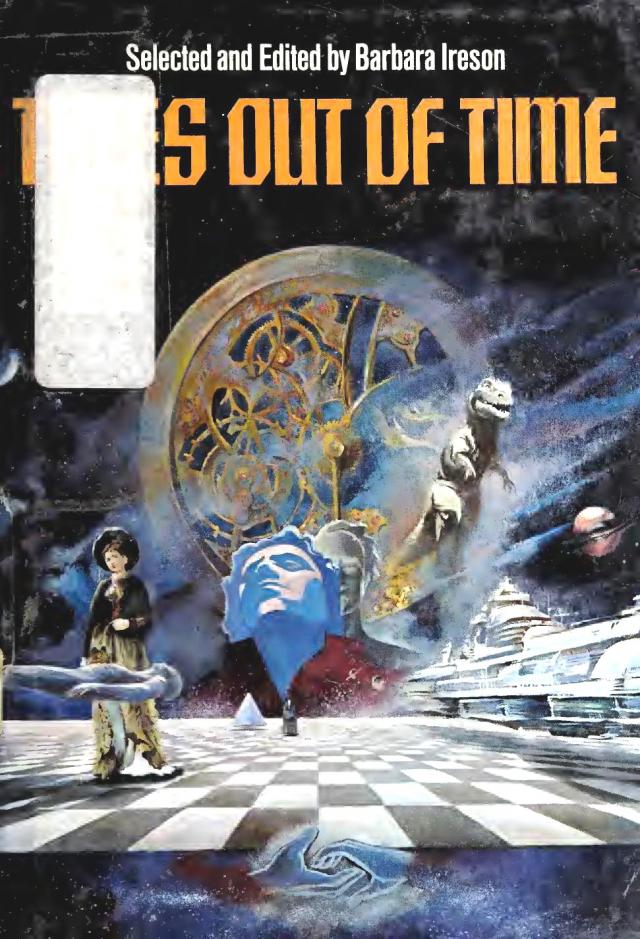
Tales Out of Time, page 1


05-10-2023
What would it be like to go on a safari…and hunt dinosaurs? Or to move so quickly that you could be invisible? Or to correspond with a person who had lived and died a century ago? What if you could capture time in a pane of glass?
TALES OUT OF TIME
Selected and Edited by Barbara Ireson
Travel a time warp back to the days when prehistoric monsters roamed the earth, or reverse direction for a look through light-years of time and space at the world of the future. All things are possible in this imaginative and thought-provoking anthology of science fiction and fantasy stories by such distinguished and popular authors as Ray Bradbury, H.G. Wells, John Rowe Townsend and Walter de la Mare.
Each of the 14 stories herein deals with an unusual aspect of time—time travel, time warps, parallels in time, for example—and investigates new and exciting possibilities. An extremely readable collection which will appeal to both young and old, TALES OUT OF TIME leads readers on an exploration of the fourth dimension and challenges conventional conceptions of space, time and the universe.
TALES OUT OF TIME
TALES OUT OF TIME
Selected and Edited by
BARBARA IRESON
PHILOMEL BOOKS
New York
Copyright © 1979 by Faber and Faber, Ltd., London.
First United States edition 1981 by Philomel Books, New York.
All rights reserved. Except for use in a review,
the reproduction or utilization of this work in
any form or by any electronic, mechanical, or other means,
now known or hereafter invented, including
xerography, photocopying, and recording, and in any
information storage and retrieval system is forbidden
without the written permission of the publisher.
Printed in the United States of America.
Philomel Books are published by The Putnam Publishing Group,
200 Madison Avenue, New York, New York 10016.
Library of Congress Cataloging in Publication Data
Main entry under title:
Tales out of time.
CONTENTS: Wyndham, J. Pawley’s peepholes.—Shaw, B. Light of other days.—Finney, J. Time has no boundaries,—[etc.]
1. Children’s stories, English. 2. Children’s stories, American. [1. Space and time—Fiction.
2. Science fiction. 3. Short stories] I. Ireson, barbara
PZ5.T2#1981 [Fic] 80-25362
ISBN 0-399-20786-4 .
80-25362
Acknowledgments
The editors and publishers herewith render thanks to the following authors, publishers, and agents for permission to reprint copyrighted materials in this book. All possible care has been taken to trace the ownership of every selection included and to make full acknowledgment for its use. If any errors have accidently occurred, they will be corrected in subsequent editions, provided notification is sent to the publisher.
“Pawley’s Peepholes” from THE SEEDS OF TIME © 1956 by the Estate of John Wyndham. Reprinted by permission of the author’s Estate and the agents for the Estate, Scott Meredith Literary Agency, Inc., 845 Third Avenue, New York, New York 10022.
“Light of Other Days” by Bob Shaw © 1966 by The Cond£ Nast Publications, Inc. Reprinted by permission of the author and the author’s agents, Scott Meredith Literary Agency, Inc., 845 Third Avenue, New York, New York 10022.
“Time Has No Boundaries” from I LOVE GALESBURG IN THE SPRINGTIME © 1962 by Jack Finney. Reprinted by permission of the Harold Matson Company, Inc.
“Alice’s Godmother” from COLLECTED STORIES FOR CHILDREN by Walter de la Mare. Reprinted by permission of the Literary Trustees of Walter de la Mare and the Society of Authors as their representative.
“The Shape of Things” © 1948 by Ray Bradbury. Reprinted by permission of the Harold Matson Company, Inc.
“Blemish” reprinted by permission of the author, John Christopher.
“The Love Letter” © 1959 by Jack Finney. Reprinted by permission of the Harold Matson Company, Inc.
“Halloween for Mr. Faulkner” by August Derleth. Reprinted by permission of the author’s Estate and the agents for the Estate, Scott Meredith Literary Agency, Inc., 845 Third Avenue, New York, New York 10022.
“Trying to Connect You” by John Rowe Townsend from THE ELEVENTH GHOST BOOK edited by Aidan Chambers, published by Barrie and Jenkins. Reprinted by permission of the Hutchinson Publishing Group, Ltd.
“A Sound of Thunder” from GOLDEN APPLES OF THE SUN © 1952 by Ray Bradbury. Reprinted by permission of the Harold Matson Company, Inc.
“Deadline” from SHOCK II by Richard Matheson © 1964 by Richard Matheson. Reprinted by permission of the Harold Matson Company, Inc.
Contents:-
Pawley’s Peepholes
Light of Other Days
Time Has No Boundaries
Alices Godmother
The Shape of Things
Time Traveling
Blemish
The Love Letter
Halloween for Mr. Faulkner
Phantas
The New Accelerator
Trying to Connect You
A Sound of Thunder
Deadline
JOHN WYNDHAM
Pawley’s Peepholes
When I called at Sally’s I showed her the paragraph in the Westwich Evening News.
“What do you think of that?” I asked her.
She read it, standing, and with an impatient frown on her pretty face.
“I don’t believe it,” she said, finally.
Sally’s principles of belief and disbelief are a thing I’ve never got quite lined up. How a girl can dismiss a pack of solid evidence as though it were kettle steam, and then go and fall for some advertisement that’s phony from the first word as though it were holy writ, I just don’t…Oh, well, it keeps on happening, anyway.
This paragraph read:
MUSIC WITH A KICK
Patrons of the concert at the Adams Hall last night were astonished to see a pair of legs dangling knee-deep from the ceiling during one of the items. The whole audience saw them, and all reports agree that they were bare legs, with some kind of sandals on the feet. They remained visible for some three or four minutes, during which time they several times moved back and forth across the ceiling. Finally, after making a kicking movement, they disappeared upward, and were seen no more. Examination of the roof shows no traces, and the owners of the Hall are at a loss to account for the phenomenon.
“It’s just one more thing,” I said.
“What does it prove, anyway?” said Sally, apparently forgetful that she was not believing it.
“I don’t know that—yet,” I admitted.
“Well, there you are, then,” she said.
Sometimes I get the feeling that Sally has no real respect for logic.
However, most people were thinking the way Sally was, more or less, because most people like things to stay nice and normal. But it had already begun to look to me as if there were things happening that ought to be added together and make something.
The first man to bump up against it—the first I can find on record, that is—was one Constable Walsh. It may be that others before him saw things, and just put them down as a new kind of pink elephant; but Constable Walsh’s idea of a top-notch celebration was a mug of strong tea with a lot of sugar, so when he came across a head sitting up on the pavement on what there was of its neck, he stopped to look at it pretty hard. The thing that really upset him, according to the report he turned in when he had run half a mile back to the station and stopped gibbering, was that it had looked back at him.
Well, it isn’t good to find a head on a pavement at any time, and 2 a.m. does somehow make it worse, but as for the rest, well, you can get what looks like a reproachful glance from a cod on a slab if your mind happens to be on something else. Constable Walsh did not stop there, however. He reported that the thing opened its mouth “as if it was trying to say something.” If it did, he should not have mentioned it; it just naturally brought the pink elephants to mind. However, he stuck to it, so after they had examined him and taken disappointing sniffs at his breath, they sent him back with another man to show just where he had found the thing. Of course, there wasn’t any head, nor blood, nor signs of cleaning up. And that’s about all there was to the incident—save, doubtless, a few curt remarks on a conduct-sheet to dog Constable Walsh’s future career.
But the Constable hadn’t a big lead. Two evenings later a block of flats was curdled by searing shrieks from a Mrs. Rourke in No. 35, and simultaneously from a Miss Farrell who lived above her. When the neighbors arrived, Mrs. Rourke was hysterical about a pair of legs that had been dangling from her bedroom ceiling, and Miss Farrell the same about an arm and shoulder that had stretched out from under her bed. But there was nothing to be seen on the ceiling, and nothing more than a discreditable amount of dust to be found under Miss Farrell’s bed.
And there were a number of other incidents, too.
It was Jimmy Lindlen who works, if that isn’t too strong a word for it, in the office next to mine who drew my attention to them in the first place. Jimmy collects facts. His definition of a fact is anything that gets printed in a newspaper—poor fellow. He doesn’t mind a lot what subjects his facts cover as long as they look queer. I suspect that he once heard that the truth is never simple, and deduced from that that everything that’s not simple must be true.
I was used to him coming into my room, full of inspiration, and didn’t take much account of it, so when he brought in his first batch of cuttings about Constable Walsh and the rest I didn’t ignite much.
But a few days later he was back with some more. I was a bit surprised by his playing the same kind of phenomena twice running, so I gave it a little more attention than usual.
“You see. Arms, heads, legs, torsos, all over the place. It’s an epidemic. There’s something behind it. Something’s happening!” he said, as near as one can vocalize italics.
When I had read a few of them I had to admit that this time he had got hold of something where the vein of queerness was pretty constant.
A bus driver had seen the upper half of a body set up vertically in the road before him—but a bit too late. When he stopped and climbed out, sweating, to examine the mess, there was nothing there. A woman hanging out of a window, watching the street, saw another head below her doing the same, but this one was projecting out of the solid brickwork. Then there was a pair of arms that had risen out of the floor of a butcher’s shop and seemed to grope for something; after a minute or two they had withdrawn into the solid cement without trace—unless one were to count some detriment to the butcher’s trade. There was the man on a building job who had become aware of a strangely dressed figure standing close to him, but supported by empty air—after which he had to be helped down and sent home. Another figure was noticed between the rails in the path of a freight train, but was found to have vanished without trace when the train had passed.
While I skimmed through these and some others, Jimmy stood waiting, like, a soda siphon. I didn’t have to say more than, “Huh!”
“You see,” he said. “Something is happening.”
“Suppose it is,” I conceded cautiously, “then what is it?”
“The manifestation zone is limited,” Jimmy told me impressively, and produced a town plan. “If you look where I’ve marked the incidents you’ll see that they’re grouped. Somewhere in that circle is ’the focus of disturbance.’” This time he managed to vocalize the inverted commas, and waited for me to register amazement.
“So?” I said. “Disturbance of just what?”
He dodged that one.
“I’ve a pretty good idea now of the cause,” he told me weightily.
That was normal, though it might be a different idea an hour later.
“I’ll buy it,” I offered.
“Teleportation!” he announced. “That’s what it is. Bound to come sooner or later. Now someone’s on to it.”
“H’m,” I said.
“But it must be.” He leaned forward earnestly. “How else’d you account for it?”
“Well, if there could be teleportation, or teleportage, or whatever it is, surely there would have to be a transmitter and some sort of reassembly station,” I pointed out. “You couldn’t expect a person or object to be kind of broadcast and then come together again in any old place.”
“But you don’t know that,” he said. “Besides, that’s part of what I was meaning by ’focus.’ The transmitter is somewhere else, but focused on that area.”
“If it is,” I said, “he seems to have got his levels and positions all to hell. I wonder just what happens to a fellow who gets himself reassembled half in and half out of a brick wall?”
It’s details like that that get Jimmy impatient.
“Obviously it’s early stages. Experimental,” he said.
It still seemed to me uncomfortable for the subject, early stages or not, but I didn’t press it.
That evening was the first time I mentioned it to Sally, and, on the whole, it was a mistake. After making it quite clear that she didn’t believe it, she went on to say that if it was true it was probably just another invention.
“What do you mean, ‘just another invention’? Why, it’d be revolutionary!” I told her.
“The wrong kind of revolution, the way we’d use it.”
“Meaning?” I asked.
Sally was in one of her withering moods. She turned on her disillusioned voice.
“We’ve got two ways of using inventions,” she said. “One is to kill more people more easily: the other is to enable sharp operators to make easy money out of suckers. Maybe there are a few exceptions like X-rays, but not many. Inventions! What we do with the product of genius is first of all ram it down to the lowest common denominator and then multiply it by the vulgarest possible fraction. What a century! What a world! When I think what other centuries are going to say about ours it makes me go hot all over.”
“I shouldn’t worry. You won’t be hearing them,” I said.
The withering eye was on me.
“I should have known. That is a remark well up to the Twentieth-Century standard.”
“You’re a funny girl,” I told her. “I mean, the way you think may be crazy, but you do do it, in your own way. Now most girls’ futures are all cloud-cuckoo beyond next season’s hat or next year’s baby. Outside of that it might be going to snow split atoms for all they care—they’ve got a comforting feeling deep down that nothing’s ever changed much, or ever will.”
“A lot you know about what most girls think,” said Sally.
“That’s what I was meaning. How could I?” I said.
She seemed to have set her mind so firmly against the whole business that I dropped it for the evening.
A couple of days later Jimmy looked into my room again. “He’s laid off,” he said.
“Who’s laid off what?”
“This teleporting fellow. Not a report later than Tuesday. Maybe he knows somebody’s on to him.”
“Meaning you?” I asked.
“Maybe.”
“Well, are you?”
He frowned. “I’ve started. I took the bearings on the map of all the incidents, and the fix came on All Saints’ Church. I had a look all over the place, but I didn’t find anything. Still, I must be close—why else’d he stop?”
I couldn’t tell him that. Nor could anyone else. But that very evening there was a paragraph about an arm and a leg that some woman had watched travel along her kitchen wall. I showed it to Sally.
“I expect it will turn out to be some new kind of advertisement,” she said.
“A kind of secret advertising?” I suggested. Then, seeing the withering look working up again: “How about going to a movie?” I suggested.
It was overcast when we went in; when we came out it was raining hard. Seeing that there was less than a mile to her place, and all the taxis in the town were apparently busy, we decided to walk it. Sally pulled on the hood of her mackintosh, put her arm through mine, and we set out through the rain. For a bit we didn’t talk, then:
“Darling,” I said, “I know that I can be regarded as a frivolous person with low ethical standards, but has it ever occurred to you what a field there is there for reform?”
“Yes,” she said, decisively, but not in the right tone. “What I mean is,” I told her patiently, “if you happened to be looking for a good work to devote your life to, what could be better than a reclamation job on such a character. The scope is tremendous, just—”
“Is this a proposal of some kind?” Sally inquired.
“Some kind! I’d have you know—Good God!” I broke off.
We were in Tyler Street. A short street, rainswept now, and empty, except for ourselves. What stopped me was the sudden appearance of some kind of vehicle, farther along. I couldn’t make it out very clearly on account of the rain, but I had the impression of a small, low-built truck with several figures in light clothes on it driving across Tyler Street quite quickly, and vanishing. That wouldn’t have been so bad if there were any street crossing Tyler Street, but there isn’t; it had just come out of one side and gone into the other.


