

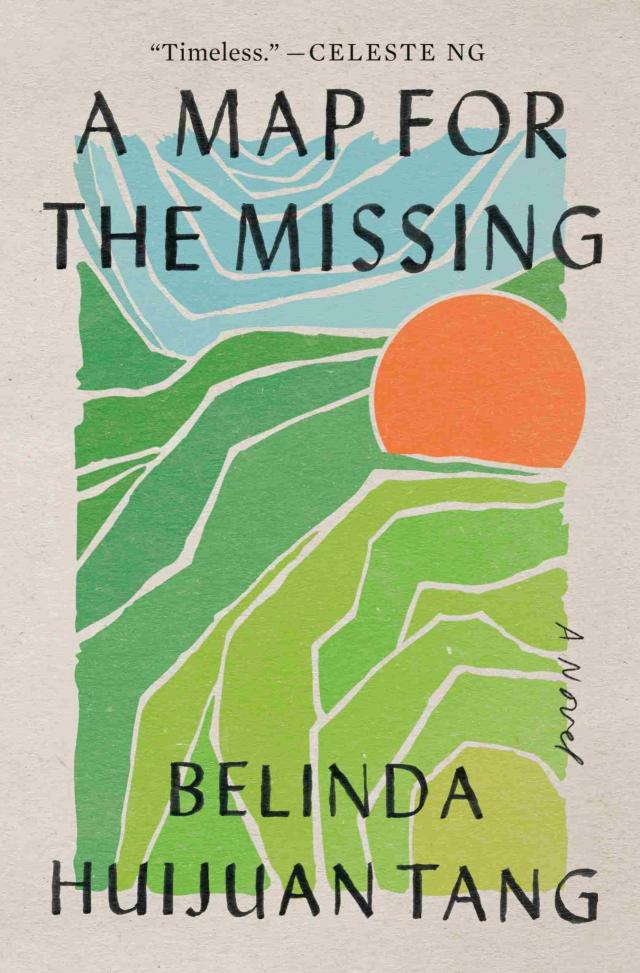
A map for the missing, p.1
A Map for the Missing, page 1


PENGUIN PRESS
An imprint of Penguin Random House LLC
penguinrandomhouse.com
Copyright © 2022 by Belinda Huijuan Tang
Penguin Random House supports copyright. Copyright fuels creativity, encourages diverse voices, promotes free speech, and creates a vibrant culture. Thank you for buying an authorized edition of this book and for complying with copyright laws by not reproducing, scanning, or distributing any part of it in any form without permission. You are supporting writers and allowing Penguin Random House to continue to publish books for every reader.
library of congress cataloging-in-publication data
Names: Tang, Belinda Huijuan, author.
Title: A map for the missing : a novel / Belinda Huijuan Tang.
Description: New York : Penguin Press, 2022.
Identifiers: LCCN 2021041971 (print) | LCCN 2021041972 (ebook) | ISBN 9780593300664 (hardcover) | ISBN 9780593300671 (ebook)
Subjects: LCSH: Chinese—United States—Fiction. | Homecoming—Fiction. | Families—Fiction. | Missing persons—Fiction. | China—History—1976-2002—Fiction. | LCGFT: Novels.
Classification: LCC PS3620.A6844 M37 2022 (print) | LCC PS3620.A6844 (ebook) | DDC 813/.6—dc23/eng/20211206
LC record available at https://lccn.loc.gov/2021041971
LC ebook record available at https://lccn.loc.gov/2021041972
International edition ISBN 9780593492963
Cover design and hand lettering: Grace Han
Cover art: Getty Images
Designed by Amanda Dewey, adapted for ebook by Cora Wigen
This is a work of fiction. Names, characters, places, and incidents either are the product of the author’s imagination or are used fictitiously, and any resemblance to actual persons, living or dead, businesses, companies, events, or locales is entirely coincidental.
pid_prh_6.0_140600470_c0_r0
Contents
Cover
Title Page
Copyright
Dedication
Epigraph
Part 1: 老家 (Ancestral Home)
Chapter One
Chapter Two
Chapter Three
Chapter Four
Chapter Five
Chapter Six
Chapter Seven
Part 2: 上山下乡 (Up to the Mountains, Down to the Countryside)
Chapter Eight
Chapter Nine
Chapter Ten
Chapter Eleven
Chapter Twelve
Chapter Thirteen
Chapter Fourteen
Chapter Fifteen
Chapter Sixteen
Chapter Seventeen
Part 3: 旱季 (Dry Season)
Chapter Eighteen
Chapter Nineteen
Chapter Twenty
Chapter Twenty-one
Chapter Twenty-two
Chapter Twenty-three
Chapter Twenty-four
Chapter Twenty-five
Part 4: 迷途指南 (A Map for the Missing)
Chapter Twenty-six
Chapter Twenty-seven
Chapter Twenty-eight
Chapter Twenty-nine
Chapter Thirty
Chapter Thirty-one
Chapter Thirty-two
Chapter Thirty-three
Part 5: 二十四史 (The Twenty-Four Histories)
Chapter Thirty-four
Chapter Thirty-five
Chapter Thirty-six
Chapter Thirty-seven
Chapter Thirty-eight
Part 6: 回归 (Return)
Chapter Thirty-nine
Chapter Forty
Acknowledgments
About the Author
For my waipo
Who, on his own,
Has ever really known who gave him life? . . .
Since you ask me, yes, they say I am his son.
—Homer, The Odyssey
They don’t want to create a place for themselves in history: they want to create themselves.
—Wang Anyi, The Song of Everlasting Sorrow
Part 1
老家
Ancestral Home
One
JANUARY 1993
你爸不见了
Translated directly, the words mean your father can’t be seen.
His mother’s voice shouts again—
你爸不见了—
your Ba’s gone missing.
He is in his office in the math department of the university, the echo of the phone’s ring jarring against the silence of the hall tense with the purposeful air of research. This has never happened before; because of the expense of international calls, he has always been the one to make the calls that would travel the Pacific.
你在吗? she asks.
The shock of hearing her voice and of what she says has rendered him speechless. At last, he forces a sound out of his mouth.
“Yes, Ma. I’m here.”
The cratered receiver pressed to his ear, he does a calculation. It is late afternoon in Palo Alto, which means that in China it is hardly even morning. In order to call him, she would have had to rise in the stillness of night and walk the fifteen li to town, leaving the frozen dirt roads of their village, going farther and farther until she reached the township’s main avenue, which, even at that hour, would still be dark and quiet, the determination of women preparing their storefronts visible only through shadow. At the forlorn train station, she would have asked one of the half-asleep passengers which direction to board, and then when she reached the city, she’d have to question a stony-faced city dweller to read the signs illegible to her. Not until she reached the telecommunications building almost three hours later would she have been able to finally make the call.
At this realization, his stomach tumbles, down and down. He grasps for the cushioned arm of his desk chair, for its comfort, for its familiarity.
Her words are so frantic that he must take a moment to hold the receiver away from his ear, put it aloft in the empty air. She’d never been shaken of the belief that her voice had to be made very loud in order to travel across a phone line, much less the distance of the Pacific Ocean. The more she yells, the more he begins to fear the entire math department will hear her through his office walls. He stuffs the receiver into the thick sleeve of his sweater to muffle the sound.
Finally, he calms her enough to hear her explain. His father left home two mornings ago, she says, shuffling out of the courtyard with a plastic bag knotted in a bow over his wrist, as if planning on a day trip. He hasn’t returned. She assumed he’d merely gone to a nearby village, perhaps to see a relative or an old army friend, but to believe this, she admits, she had to put aside her doubts about why he’d do such a thing. His father hadn’t taken a trip out of their village in years.
He inhales deeply. He promises his mother he will come home.
* * *
—
He was startled for the second time by the pattering of knuckles against his office door, then the voice calling out, in that tentative tenor he heard so often in America, thick with its awareness of the possibility for intrusion—“Hey?”
Yitian looked up from his hands, twisted until the skin had risen to a red-and-white mottle, and was surprised to find that the light in his office was already softening with the sunset. He hadn’t realized it was so late.
Steven Hsiung stood at the doorway, apprehensive, leather messenger bag dangling from his shoulder. On the corner of Yitian’s desk, the phone was still dangling off its cord.
“I was about to leave, but I just wanted to pop in and ask if everything is all right? I heard your voice earlier, and I wanted to come check.”
“Oh, nothing’s wrong.” It was obvious by their twin accents—Steven’s only becoming audible at the ends of difficult words, Yitian’s ever present—that the two of them could have conversed more comfortably in Chinese, but Yitian had followed the lead Steven set when they first met. Steven was an earlier arrival to their department, having come to America from Taiwan about a decade before Yitian. Speaking to their American colleagues, Steven made appropriate jokes at the appropriate times. When he pronounced Yitian’s name, the syllables were filtered through Steven’s attempt to make them American, and the result was strange, like dough kneaded flat and then remade in an unfamiliar shape. Yitian didn’t even know Steven’s Chinese name.
When Yitian saw Steven’s eyes linger questioningly on the phone receiver, he scrambled to put it back on the cradle.
“My mother called—” It seemed impossible to avoid speaking about the call now, but he wanted to describe it in the simplest, vaguest terms he could find. “I may need to go back home and help with my father.”
Steven looked at him with the same weariness he’d worn the first time they’d met, and then, to Yitian’s surprise, strode to the door, nudged it shut with his foot, and set his bag down. The department’s practice was to keep their offices open—to foster collegiality, the chair had said gently, when he asked Yitian if he would mind not closing his—so that Yitian often had the sensation of being observed.
Steven sighed and leaned against the desk. “It always happens like this at their age—t
“It will be fine. The chair is quite flexible with things like this, and he’ll help find someone to cover your class for a few weeks, if you need to go. You don’t know this yet, but we’re actually quite lucky, in this department.”
Steven began to tell him of his own mother, who’d suddenly been diagnosed with ovarian cancer two years previously and whom he now had to regularly travel back to Taiwan to care for. Yitian listened dully as he spoke about the hospitalizations, the home aid they’d hired, the emergency trips he had to take back to Taipei, the feeling of heaviness that weighed constantly upon him. This was the most Steven had ever spoken to him, aside from once when he and his wife invited Yitian and Mali over for dinner, an awkward affair where Yitian realized that he had little in common with Steven’s elegant family from Taipei who could trace their ancestry all the way back to royalty in the Ming dynasty. Yitian had stayed quiet, only saying that he was from a village in Anhui, then allowing Mali to describe her childhood in a hutong home in Beijing, which he supposed they’d better understand. They’d all spoken English, and Steven’s wife had ordered takeout that she had no qualms serving to them directly from their little paper boxes. He understood that he and Mali weren’t considered important guests. At the door and saying their goodbyes, there had been insistences that they had to do it again, but no one ever followed up.
Neither then nor now had Yitian been able to tell Steven that he hadn’t been back to China since leaving eight years previously, or that he hadn’t returned to his own village in fifteen. He feared the questions that would come after the telling—Steven would surely have expressed confusion about why he hadn’t been home in so long. He would have assumed that Yitian was a son, part of a family back in that place, home, with a set of duties toward his parents. This understanding of obligation as the core of one’s being was their shared culture. How could Yitian explain that he’d failed in his fundamental duties to his father for fifteen years, and hadn’t even spoken to him in all that time? Steven wouldn’t understand.
“It’ll be all right,” Steven said, finishing his story. Yitian realized he’d hardly listened to a word.
“Thank you,” Yitian said.
“Don’t worry, okay?” Steven smiled. His eyes crinkled behind his polished glasses, ones that Yitian had seen actors wear in movies from the sixties. Yitian could see that his older colleague felt proud of the advice he’d given, the support he’d shown to a fellow countryman. The easiest thing to do was nod; how could he express that he himself didn’t even know what kind of help he needed?
* * *
—
After Steven left, Yitian stuffed all his papers into his backpack and headed to his car. Normally he took the scenic 280 home, but today, he eschewed the long way and jostled alongside the traffic on the industrial 101 so that he could get home quickly and ask Mali about what to do next.
He was disappointed when he unlocked the door and found a message she’d left on the answering machine, saying that her boss had asked her to stay late. Mali did data entry for a real estate agent whom she referred to as Mrs. Suzanna, who lately had been training her to take on her own sales. Mrs. Suzanna had been the only one willing to employ her years ago when she had no work visa, and Mali could never refuse her requests.
He flipped open their address book, searching for someone else to whom he could speak. He couldn’t call his mother; she wouldn’t know to be waiting for the phone at the village office. Calling their friends, Junming and Meifang, would require that storytelling and recalling. No, the only person who wouldn’t ask for explanations was Mali. He sat at the dining table, directly facing their front door, and stared at the decorative plastic ivy she’d strung over the entrance. To give the home warmth, she’d said. She always thought of things like that when he couldn’t. When they’d moved into the home, looking at the neutral stucco walls, beige and sand and camel shades whose names he couldn’t keep apart, he’d been pummeled suddenly by overwhelming loneliness, so strong it paralyzed him. He hadn’t known whether she sensed his feeling or had the same one herself, but either way, she’d been the one to say, let’s put in some pictures of our families, let’s buy some leafy plants to decorate. And it had worked; the house began to feel like a home. Her suggestions always worked. He knew he wouldn’t be able to make sense of what his mother had told him until he could speak about it with her.
She found him staring blankly at the doorway and immediately she came to him, dropping the thick stack of paperwork she’d lugged home with her. Only after she’d pulled out the chair across from him, leaned her elbows upon the table, and took his hands into hers did he begin to parse his mother’s story.
“So what will you do?” she asked.
“I said I would go back,” he said.
When he’d told his mother this, it was without conscious choice. Instinct drove him to urgency. She’d been yelling; he was a son and his father was missing.
“Will you?” He looked in her eyes and saw that she hadn’t been expecting his answer.
“You don’t want me to go?”
“It’s not that. I just think it’s not so strange, right? To leave and go on a trip. Old people forget to tell others these things, sometimes. He can’t have gone so far.”
He looked across the table at her face, searching for some hope that he could latch on to and steal for himself. She seemed so certain as she reassured him—but she was always so certain, he realized.
“It would be a big trip for you.” She bit her lip. “And I wonder if by the time you get there, he’ll already be back.”
“Maybe.” Mali’s practicality and optimism didn’t have their usual effect tonight. Over the years he’d told her so little about his father, keeping the terms vague enough that she knew about the estrangement but not its reason. She thought this was a simple matter of an old man traveling in his later years to see friends. But his father hadn’t left the village in years, never breaking the outline of that circumscribed space where things were familiar to him, which protected him from the dangers he’d seen of the world outside.
“I didn’t mean I don’t want you to go,” she said, and he could see that she felt she’d misstepped. She’d gone to see her family in Beijing twice since they’d come to America, each time with excitement and a suitcase packed full of gifts. “If you think it would help—of course you should go.”
While she warmed up leftovers in the microwave, she called the airline to purchase the tickets.
“One way. What’s the earliest available?” She knit her eyebrows together. “Are you sure there isn’t anything sooner? It’s a family emergency.” A pause. “Okay. Book that.” He wouldn’t have been able to summon such precise English at a time like this. One hand checking the food’s temperature, another twisting her finger around the cord of the receiver cradled against her ear. How was she so practiced, so calm? He was overtaken by sudden gratitude.
She hung up the phone and balanced dishes in both hands as she brought them to the table. “Tomorrow afternoon at four, there’s a flight leaving from SFO. Connecting through Seoul. I booked it for you. You’ll be home the next day. All good?”
He nodded. Home. Her words, not his.
* * *
—
Perhaps if Yitian and his father spoke, he would have been able to piece together a story for where his father might have gone, but he didn’t know what shape his father’s life might have taken in the fifteen years since they’d last seen each other.
In bed beside Mali that evening, he couldn’t make himself sleep. They’d purchased an ultraplush mattress for his benefit, as he often had trouble at night, but Mali swore she could fall asleep anywhere.
Tonight the softness discomfited him. In the darkness he lay awake and tried to imagine what his father’s body and face would look like after all the time that had passed. He looked into the shadows of their bedroom and tried to fill in his father’s features, piece by piece. He began with the eyes. He could not imagine them ever giving up their opacity. The eyelids that drooped over them acted like a blanket for the pupils, dark as wet soil after a rainstorm. Even in Yitian’s childhood, those eyes seemed to belong to a man much older. On rare occasions when his father laughed, the heavy lids made it impossible to tell if the smile reached upward.





