

The hot seat, p.1
The Hot Seat, page 1


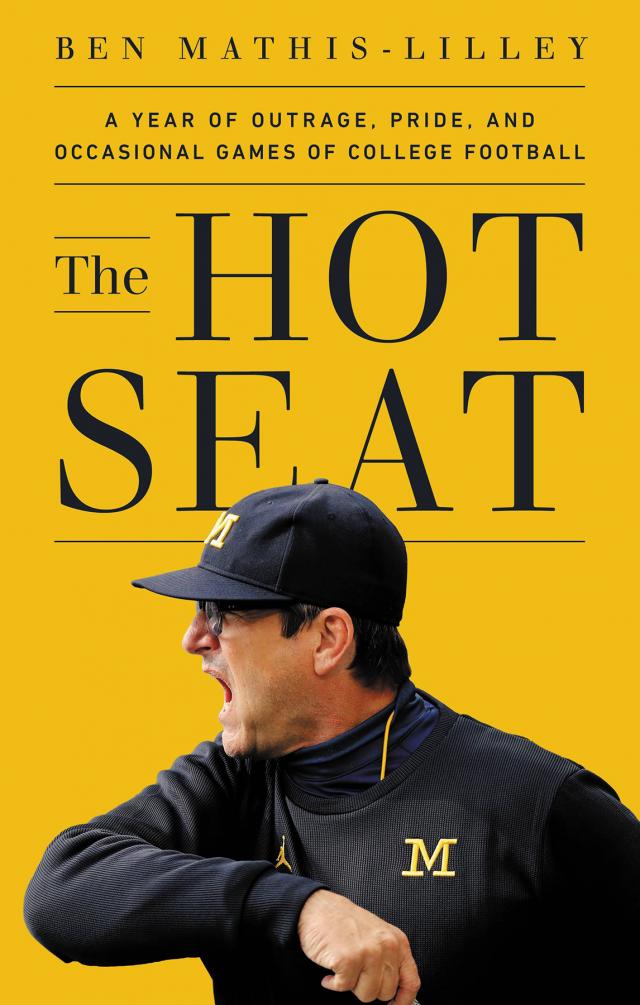
Copyright © 2022 by Ben Mathis-Lilley
Cover design by Faceout Studio, Spencer Fuller
Cover photograph © Carlos Osorio/AP/Shutterstock
Cover copyright © 2022 by Hachette Book Group, Inc.
Hachette Book Group supports the right to free expression and the value of copyright. The purpose of copyright is to encourage writers and artists to produce the creative works that enrich our culture.
The scanning, uploading, and distribution of this book without permission is a theft of the author’s intellectual property. If you would like permission to use material from the book (other than for review purposes), please contact permissions@hbgusa.com. Thank you for your support of the author’s rights.
PublicAffairs
Hachette Book Group
1290 Avenue of the Americas, New York, NY 10104
www.publicaffairsbooks.com
@Public_Affairs
First Edition: August 2022
Published by PublicAffairs, an imprint of Perseus Books, LLC, a subsidiary of Hachette Book Group, Inc. The PublicAffairs name and logo is a trademark of the Hachette Book Group.
The Hachette Speakers Bureau provides a wide range of authors for speaking events. To find out more, go to www.hachettespeakersbureau.com or call (866) 376-6591.
The publisher is not responsible for websites (or their content) that are not owned by the publisher.
Library of Congress Cataloging-in-Publication Data has been applied for.
ISBNs: 9781541700338 (hardcover), 9781541700352 (ebook)
E3-20220627-JV-NF-ORI
CONTENTS
Cover
Title Page
Copyright
Dedication
1. I’ve Never Felt This Bad
2. The Hot Seat
3. Hope-O-Meter
4. Western Michigan
5. Washington
6. Wisconsin and Nebraska
7. LSU vs. Florida
8. Michigan State
9. Florida Atlantic vs. Marshall
10. Penn State
11. Ohio State
Epilogue
References
Acknowledgments
Discover More
About the Author
To the ten year olds playing
“The Victors,” past and future
Explore book giveaways, sneak peeks, deals, and more.
Tap here to learn more.
CHAPTER
1
I’VE NEVER FELT THIS BAD
At about 1:50 p.m. EST on Saturday, November 7, 2020, a lot of people were thinking about the United States presidential election. Just before noon, a number of news outlets had projected that Joe Biden would win the state of Pennsylvania, making him the presumed next president after four tense days of waiting for votes to be counted.
I was supposed to be one of those people. My job is to write about the news for the online news magazine Slate, and the 2020 American presidential election was a pretty big news story. Instead, the record shows that at that time, on that day, I was sending an email, the subject line of which was “Next Coach Thread,” to five other people.
The University of Michigan football team was in the process of losing to the historically mediocre Indiana University football team and falling to a record of 1-2 with a number of additional losses presumed to be imminent. I felt it was important as “an act of formally moving on”—those are my exact, still-embarrassing words—to begin discussing who might become the team’s head coach after its current coach, the zealously unconventional Jim Harbaugh, was dismissed, which I assumed to be an inevitability. The six of us on the email chain are citizens of a country that was at that moment experiencing unprecedented electoral chaos. We have a combined six spouses, six mortgages, and eleven children—in other words, a lot of other things to think about. We exchanged thirty-seven more messages about Michigan’s football coaching situation over the next forty-eight hours. (I did some posts about the election for my real job too.)
The season only got worse, and the group conversations became more heated. Here are some highlights from another 2020 Michigan football discussion that I was part of, this one conducted via Twitter direct messages with an entirely different group of people, none of whom I had ever met, at that point, in real life:
• “This is a catastrophe for the entire Harbaugh Era”
• “Harbaugh’s worst loss”
• “I’ve never been more OK firing Harbaugh”
• “Worst loss of the Harbaugh Era and it’s not that close”
• “[name of player] needs to be sent to space jail”
• “I’m gonna kill my self [sic] in real life” [he was joking; he’s still alive]
• “this team is not good fellas”
• “we suck lmao”
• “This is a paradigm shifting loss”
• “I’ve never felt this bad”
• “I’ve learned the most important lesson in life: it sucks”
• “There is no more fun to be had for me”
• “With every succeeding snap my belief in firing him on the spot grows”
• “Basically anything would be an improvement over this”
• “it particularly sucks to see all these guys who can play put in a position to suck donkey ass”
• “OK gang give me a few hours. I’m gonna fly to Ann Arbor Municipal Airport, and then I’m gonna pick up Jim Harbaugh. And then I’m gonna drive him back to the airport so we can fire him on the tarmac”
• “It really is like they have eight players on the field”
• “This is worse than would’ve been reasonable to expect. And it would’ve been reasonable to expect bad”
• “It seems like we have six guys on the field”
• “guys what the fuck”
• “please quit your job jim”
• “soup soup soup soup soup soup soup soup soup soup soup soup soup soup soup soup soup soup soup soup soup soup soup soup” [The coach that many people wanted Michigan to hire to replace Harbaugh was Iowa State’s Matt Campbell, hence “soup.”]
• “I keep saying this and it’s not rhetorical: What is this team doing in practice”
• “God dude”
• “That was awful”
• “So bad”
• “dflksdjfklsdjf”
• “The moon landing didn’t happen”
I’m not sure what that last one was in reference to. But the word fire comes up 293 times in an archive of messages from that fall. We did not all necessarily feel personal hostility toward Jim Harbaugh. Some did, while some felt sad for him. But we all assumed that he was not going to be the coach of the Michigan football team anymore and that he had earned that fate.
Many, many other people felt the same way. On the MGoBlog fan site, the subject of discussion in the comments section under a recap of the Wolverines’ 49-11 November loss to Wisconsin—its worst home loss in eighty-five years—was not whether Harbaugh should be fired, but who else the university should fire such that “the root cause of the systemic suck is figured out and eliminated.” The word fuck appeared 171 times in comments about the game. (One of the site’s moderators tracks this figure each week.)
Harbaugh was described as on the verge of being canned—or assumed to be a foregone subject of termination—by sportswriters and commentators at the Associated Press, CBS, Fox Sports, and multiple arms of the ESPN content machine. (ESPN had also asserted that his job was in danger in 2019, while Yahoo! Sports and Fox had done so in 2018.) Later in November, Michigan was beaten by a COVID-19–addled Penn State team that at that point was 0-5 and whose signature move was fumbling the ball. On Twitter, ABC color analyst Brian Griese, a professionally objective and even-tempered observer who, like Harbaugh, is a former Big Ten champion Michigan quarterback, posted a graphic highlighting the low points of the coach’s recent record with the caption “enough is enough.” National sportswriters and pundits made jokes and exchanged memes at Michigan’s expense, of the sort that suggested other football teams in the Big Ten conference would be so happy to see Harbaugh retained as coach that they would dance in the manner of characters from popular film and television programs.
Multiple people with connections to the Michigan program to whom I’ve spoken identified the team’s October home loss to Michigan State University Spartans, which preceded the Indiana game, as the most shockingly grim of the 2020 season’s many grim events. MSU, naturally one of Michigan’s biggest rivals, was playing with a roster that had been thinned out during a transition between head coaches and had lost its previous game to Rutgers, which is generally not a good team. MSU nonetheless beat Michigan 27-24 on its own field. (Because of COVID-19, there was no crowd. Harbaugh wore a mask over his headset microphone all season, distending it to the point of both aesthetic and epidemiological unsoundness.) The margin of the final score belied both the game’s horrible air of disaster and the simultaneously panicked and anesthetized manner in which the Michigan coaching staff seemed to have prepared the team to play. MSU basically had one offensive idea, which was throwing the ball as high up in the air as possible and hoping that someone on the right team would catch it, as is done at elementary schools. It worked every time. As one person I spoke to put it, “Jesus Christ.”
Michigan finished the season 2-4, with six games canceled because of COVID-19.
The coach of a college football team can make thousands, hundreds of thousands, and perhaps even millions of peopl e—many of them otherwise stable and superficially reasonable adults—insanely angry. I experience churning gastrointestinal distress on Saturdays during the season until Michigan has a lead of at least seventeen points. In my idle moments, when taking showers and driving my three children around northern New Jersey, I spend more time mentally debating self-posed hypotheses such as, “Did Jim Harbaugh corner himself into a no-man’s land between the Wisconsin/Iowa system development model and the Ohio/Penn State talent acquisition model?” than I do thinking about any other question, including things such as, “Do I have the right career?” and “What are parents’ and children’s obligations to each other?” and “What happens to our souls when our bodies die?” This kind of fixation, conducive to neither peace of mind nor personal productivity, is very common.
Why are so many people like this?
CHAPTER
2
THE HOT SEAT
The question of whether it is absurd and undesirable to care to the point of physical discomfort about sports has nagged at me for some time. I was also deeply bothered for several recent years by the question of why Jim Harbaugh had not been more successful as Michigan’s coach and whether he should be fired.
The roots of these preoccupations extend back to the 1980s and 1990s, when my family lived about one hundred miles north of Ann Arbor. (The town I was raised in, Midland, is a city-sized Dow Chemical plant to which houses and a school district have been attached for convenience.) Sometime around 1990, at the age of eightish, I became a Michigan football fan. My parents weren’t natives of the state and no longer live there, and while they both like sports, I think they find my level of interest in the team a little weird. I didn’t go to college at U of M, but I liked the colors on the uniforms, I liked the big stadium and the marching band, I liked when players ran with or caught the ball for touchdowns, and I liked that Michigan usually won. So that was that. Go Blue!
About a dozen years ago, I read a book about soccer called Football Against the Enemy, which observed that the way the sport was played in different countries—down to what happened on the field, in terms of strategy and style—varied because of historical and cultural factors particular to each place. This struck me as a mind-blowing framework to apply to college football. By its nature, NCAA football is not as well played as NFL football, but there is still something about this version of the sport that many people find compelling to the point of madness. Perhaps this is because college games are contests not just between teams and players but between ways of life.
In US professional sports, athletes who only rarely have a personal connection to their team’s home city perform in generic corporate arenas, team operations overseen by an MBA class that treats wins and losses as data points in a process of asset maximization. But in college football, teams have many of the characteristics of the places where they play. Rosters, even on the most nationally dominant teams, are disproportionately built from local and regional high schools. Programs often maintain trademark styles for generations. The things I and others are drawn to—the colors, the crowds, the chants, the rivalries—are not just matters of marketing (though they are definitely also that) but of personal and communal identity.
There are some instincts and urges that explain the appeal of sports in general to humans, like the attraction to physical spectacle and the compulsion to find out the ending (i.e., final score) of a given story (i.e., game). These become more powerful when they intersect with the equally ancient tendency to think of oneself and one’s social group in reference to epic narratives and heroes. In the United States, no sport plays more obviously to that tendency—projecting the message that the people on the field represent the particular people watching from the stands or on TV—than college football. As Sports Illustrated’s Richard Johnson said to me, “College football makes people in New York City think about what people in Oxford, Mississippi, and Tuscaloosa, Alabama, are interested in.” If you go somewhere new in the United States and want to know what makes it different from other places, the fastest way to do that might be to observe its preeminent college team.
For example, at the time I read Football Against the Enemy, the University of Oregon—based in fast-growing Eugene, its program funded in large part by Nike billionaire Phil Knight—was running elaborate misdirection plays at an unprecedented, no-huddle speed and attaching GPS trackers to players during practice. Louisiana State, playing in Baton Rouge among alligators and swamp vegetation, ran the ball up the middle most of the time, using plays that were many decades old, with straightforward and brutal intentions. The team’s coach sometimes ate grass off of the field during games as a self-invented folk treatment; he said it helped keep him humble. Both teams were excellent. Both approaches worked!
Nowhere are college football identities expressed more conspicuously than through the head coach. Coaches must not only win but also exemplify the sometimes contradictory values and ideals that supporters believe their schools and teams stand for (e.g., unrelenting dominance, but also widely appreciated integrity). Their job security is ultimately determined by fans who have, on the one hand, extremely unreasonable expectations and, on the other hand, only the vaguest idea why teams ultimately succeed or fail.
If a coach isn’t winning decisively every year, it is understood that he is on the hot seat. This means he is being attacked by alumni, former players, big-money donors, TV pundits, and online cranks who believe he should be fired. After every loss, social media sites, message boards, radio airwaves, and podcasts—my God, the podcasts—will be overloaded with opinions about how he is, to take one time-honored binary, either calling too many passes (because “games are won or lost in the trenches”) or not calling enough passes (because “you’ve got to adapt to modern football”). A coach is never more than a few high-stakes victories from having a statue built in his honor while he’s still alive. But he is also never more than one defeat from turning into a widely derided idiot whose face becomes a meme image that young people use to signify failure. (In 2016, Texas Christian really did erect a statue of its then coach, Gary Patterson, on campus. In 2021, Patterson resigned under pressure because of the team’s poor record.) The coach exists in a state of perpetual water-cooler subjecthood.
Coaches, for all their belief in self-reliance and the determinative power of “wanting it more than the other guy,” are at the mercy of trends and conditions over which they have no control. These are numerous and involved, ranging from the decentralized structure of US higher education (which requires colleges to continually pursue more money and prestige or risk ceasing to exist), to the decline of industry in the Midwest (which has drastically changed the distribution of football talent), to media corporations’ decisions about what will maximize their advertising revenue (which leads to reorganizations of college football’s competitive environment on an almost annual basis).
The sport can be a little too revealing about who “we” are. When a friend of mine who did not attend a “football school” mentioned that his general impression of the college game was one of overinvested psycho fans, sleazy boosters, exploitative corporate sponsors, and coaches who alternate between being psychologically abusive and legally overpermissive, the only thing I could say was, well, yeah. It’s a sport that has seemed unsustainably chaotic at every stage of its existence, and now it seems especially so. For many years, colleges have withheld revenue from the players who are generating it on the principle that they are “student-athletes” playing an amateur sport for nonpecuniary reasons, even though that amateur sport is worth billions of dollars and the students recruited to play it are all but excluded from the normal activities of collegiate life, lest they take time or attention away from football.
This pretense, thin and transparent in the best of times, is finally beginning to disappear in practice, most prominently via the adoption of the “name, image, and likeness” (NIL) rights that allow NCAA athletes to accept sports-related income so long as it doesn’t come from schools themselves. More players are sharing their feelings about political questions, and not just those that are related to amateurism and compensation. Some fans like this. Others really don’t!


