Poor richards almanack, p.1
Poor Richard's Almanack, page 1
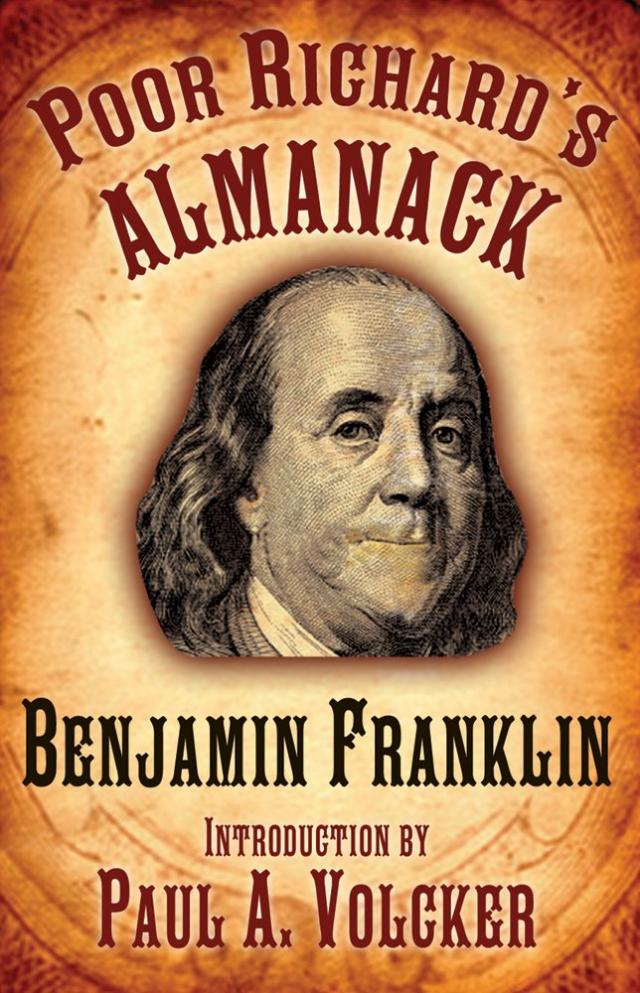


Poor Richard's Almanack
Benjamin Franklin
Copyright © 2007 by Skyhorse Publishing, Inc.
Introduction © 2007 by Paul A. Volcker
All Rights Reserved. No part of this book may
be reproduced in any manner without the express
written consent of the publisher, except in the case
of brief excerpts in critical reviews or articles. All
inquiries should be addressed to Skyhorse Publishing,
555 Eighth Avenue, Suite 903, New York, NY
10018.
www.skyhorsepublishing.com
Library of Congress Control Number: 2007936296
10 9 8 7 6 5 4 3 2
9781602391178
Printed in the United States of America
Table of Contents
Title Page
Copyright Page
INTRODUCTION
ON MONEY AND BUSINESS
ON LOVE, MARRIAGE, FAMILY, AND FRIENDSHIP
ON HEALTH
ON HUMAN NATURE
ON VIRTUE, VICE, GOD, AND FAITH
ON WISDOM AND LEARNING
IN VERSE
INTRODUCTION
How does one write an introduction to something that has become so much a part of our common language? Early to bed, early to rise ... Don’t throw stones if you live ... God helps those ... A penny saved ... No gain without ... And on and on.
I don’t know how many of these proverbs Ben Franklin made up himself back in Philadelphia in the mid-eighteenth century. For all I know, the Greeks and the Romans, maybe even the Egyptians, had their own versions. What I do know is that all these apothegms (now there’s a fresh word for you) in Poor Richard’s Almanack are fun to browse.
Some of them are, in fact, “terse and witty instructive sayings” (The American Heritage Dictionary, entry on “apothegms”). Some are dated: After all, a penny is hardly worth saving these days, even for a miser like me. Conversely, a fair number seem particularly apropos for today’s world. For example: The magistrate should obey the laws. Sudden power is apt to be insolent, sudden liberty saucy. Pray, don’t burn my house to roast your eggs.
To be sure, some seem strained, trite, even pointless. But that’s a matter of taste. And to be expected considering there are nine hundred of them.
What I know for sure is that this book made Ben Franklin both famous and wealthy when its first edition was published more than 250 years ago. It’s fun to read in bits and pieces, just right for the bedside table or the guest room. You may even use it to introduce your kids to one of America’s founders and to remind them that there are lessons about life that never change.
And it’s just as handy and portable as the latest PlayStation!
Paul A. Volcker
January 10, 2007
ON MONEY AND BUSINESS
In Rivers and bad Governments, the lightest things
swim at top.
Light purse, heavy heart.
Keep thy shop, and thy shop will keep thee.
Necessity never made a good bargain.
’Tis a well spent penny that saves a goat.
Drive thy Business, or it will drive thee.
Speak little, do much.
Ask and have, is sometimes dear buying.
The master’s eye will do more work than both his
hands.
He that sows thorns, should never go barefoot.
Ill Customs & bad Advice are seldom forgotten.
He that riseth late, must trot all day, and shall scarce
overtake his business at night.
He that speaks ill of the Mare, will buy her.
A country man between two lawyers, is like a fish
between two cats.
A large train makes a light purse.
After crosses and losses, men grow humbler and wiser.
There are three faithful friends—an old wife, an old
dog, and ready money.
At the working man’s house hunger looks in, but
dares not enter.
A good lawyer, a bad neighbour.
He that would have a short Lent, let him borrow
money to be repaid at Easter.
If Passion drives, let Reason hold the Reins.
You will be careful, if you are wise,
How you touch men’s Religion, or Credit, or Eyes.
Money & Man a mutual Friendship show:
Man makes false Money, Money makes Man so.
Industry pays Debts, Despair encreases them.
There is much money given to be laught at, thought
the purchasers don’t know it; witness A’s fine horse,
and B’s fine house.
The poor man must walk to get meat for his stomach,
the rich man to get a stomach for his meat.
Avarice and happiness never saw each other; how
then should they become acquainted?
The worst wheel of the cart makes the most noise.
The use of money is all the advantage there is in having
money.
For 6£ a year you may have use of 100£, if you are a
man of known prudence and honesty.
He that idly loses 5s. worth of time, loses 5s., and
might as prudently throw 5s. into the river. He that
loses 5s. not only loses that sum, but all the other
advantages that might be made turning it in dealing,
which, by the time a young man becomes old,
amounts to a comfortable bag of money.
A penny saved is two pence clear. A pin a-day is a
groat a-year. Save and have.
Every little makes a mickle.
If you’d be wealthy, think of saving, more than of
getting: The Indies have not made Spain rich, because
her Outgoes equal her Incomes.
He’s gone, and forgot nothing but to say farewell to
his creditors.
Who is rich? He that rejoices in his Portion.
The Devil wipes his Breech with poor Folks’ Pride.
An open foe may prove a curse; but a pretended foe
is worse.
Wealth is not his that has it, but his that enjoys it.
A little well-gotten will do us more good,
Than lordships and scepters by Rapine and Blood.
He that buys by the penny, maintains not only
himself, but other people.
He that hath a Trade, hath an Estate.
Sloth (like Rust) consumes faster than Labour wears:
the used Key is always bright.
Light Gains, heavy Purses.
Changing Countries or Beds, cures neither a bad
Manager, nor a Fever.
As Pride increases, Fortune declines.
Neither trust, nor contend, nor lay wagers, nor lend;
And you’ll have peace to your Lives’ end.
Pay what you owe, and what you’re worth you’ll know.
Little Strokes, Fell great Oaks.
A Person threatening to go to Law, was dissuaded
from it by his Friend, who desired him to consider,
for the Law was chargeable. I don’t care, reply’d the
other, I will not consider, I’ll go to Law. Right, said
his Friend, for if you go to law, I am sure you don’t
consider.
If you’d lose a troublesome Visitor, lend him money.
Industry, Perseverance, & Frugality, make Fortune yield.
The poor have little,—beggars none;
The rich too much—enough not one.
A Wolf eats sheep but now and then;
Ten thousands are devour’d by men.
Avoid dishonest gain: no price can recompence the
pangs of vice.
Content makes poor men rich; Discontent makes rich
Men poor.
Well done, is twice done.
Proclaim not all thou knowest, all thou owest, all
thou hast, nor all thou can’st.
Great beauty, great strength, and great riches are really
and truly of no greater use; a right heart exceeds all.
A light purse is a heavy curse.
Help, Hands; for I have no Lands.
No gains without pains.
A Man without ceremony has a need of great merit
in its place.
The creditors are a superstitious sect, great observers
of set days and times.
Great spenders are bad lenders.
He who multiplies Riches multiplies Cares.
The Eye of a Master, will do more Work than his Hand.
Beware of little Expenses: a small Leak will sink a
great Ship.
Be always ashamed to catch thyself idle.
Poverty wants some things, luxury many things, avarice
all things.
Old Boys have their Playthings as well as young
Ones; the Difference is only in the Price.
Many have been ruined by buying good pennyworths.
When there’s no Law, there’s no Bread.
A rich rogue is like a fat dog, who never does good till
as dead as a log.
He that lieth down with dogs, shall rise up with fleas.
Take counsel in wine, but resolve afterwards in water.
God works wonders now and then; Behold! a lawyer,
an honest man.
He
Great famine when wolves eat wolves.
Beware of meat twice boil’d, and an old foe
reconcil’d.
There is no little enemy.
When Prosperity was well mounted, she let go the
Bridle, and soon came tumbling out of the Saddle.
He that waits upon fortune, is never sure of a dinner.
A fat kitchen, a lean will.
Would you persuade, speak of Interest, not of Reason.
A little House well fill’d, a little Field well till’d, and
little Wife well will’d, are great riches.
Where carcasses are, eagles will gather; where good
Laws are, much people flock thither.
Lawyers, preachers, and tomtit’s eggs, there are more
of them hatched than come to perfection.
All things are cheap to the saving, dear to the wasteful.
Nothing humbler than Ambition, when it is about to
climb.
An innocent plowman is more worthy than a vicious
prince.
He that is rich need not live sparingly, and he that can
live sparingly need not be rich.
Virtue and a Trade, are a Child’s best Portion.
Don’t think to hunt two Hares with one Dog.
All things are easy to Industry, all things difficult to
Sloth.
He that cannot obey, cannot command.
Laws like to cobwebs, catch small flies;
Great ones break through before your eyes.
An egg to-day is better than a hen to-morrow.
Drink water, put the money in your pocket, and leave
the dry-bellyache in the punch-bowl.
The magistrate should obey the laws, the people
should obey the magistrate.
Necessity has no law; I know some attorneys of the
same.
He does not possess wealth, it possesses him.
The thrifty maxim of the wary Dutch,
Is to save all the money they can touch.
By diligence and patience, the Mouse bit in two the
Cable.
’Tis against some Men’s Principle to pay Interest, and
seems against others’ Interest to pay the Principal.
The Good-will of the Govern’d will be starved, if not
fed by the good deeds of the Governors.
Children and Princes will quarrel for trifles.
Success has ruin’d many a Man.
Haste makes Waste.
Early to bed and early to rise, makes a man healthy,
wealthy, and wise.
To be humble to superiors is duty, to equals courtesy,
to inferiors nobleness.
If you know how to spend less than you get, you have
the philosopher’s stone.
Diligence is the mother of good luck.
Wish a miser long life, and you wish him no good.
At a great penny worth, pause a while.
He that is of Opinion Money will do every Thing may
well be suspected of doing every Thing for Money.
He that pays for work before it’s done, has but a
pennyworth for two pence.
A lean Award is better than a fat Judgment.
Patience in Market, is worth Pounds in a year.
When the well’s dry, we know the worth of water.
A good Wife & Health, is a Man’s best Wealth.
Buy what thou hast no need of, and e’er long thou
shalt sell thy necessaries.
Sell not virtue to purchase wealth, nor liberty to purchase
power.
He that sells upon trust, loses many friends, and
always wants money.
Lovers, travellers, and poets, will give money to be
heard.
Forewarn’d, forearm’d.
He that speaks much, is much mistaken.
Creditors have better memories than debtors.
Prosperity discovers Vice, Adversity, Virtue.
Many a Man would have been worse, if his Estate had
been better.
I have never seen the Philosopher’s stone that turns
lead into gold, but I have known the pursuit of it turn
a man’s gold into lead.
Never intreat a Servant to dwell with thee.
He that can have patience can have what he will.
Now I have a sheep and a cow, every body bids me
good-morrow.
God helps them that help themselves.
Three things are men most likely to be cheated in, a
Horse, a Wig, and a Wife.
Poverty, Poetry, and new Titles of honour, make men