Under the rock, p.1
Under the Rock, page 1
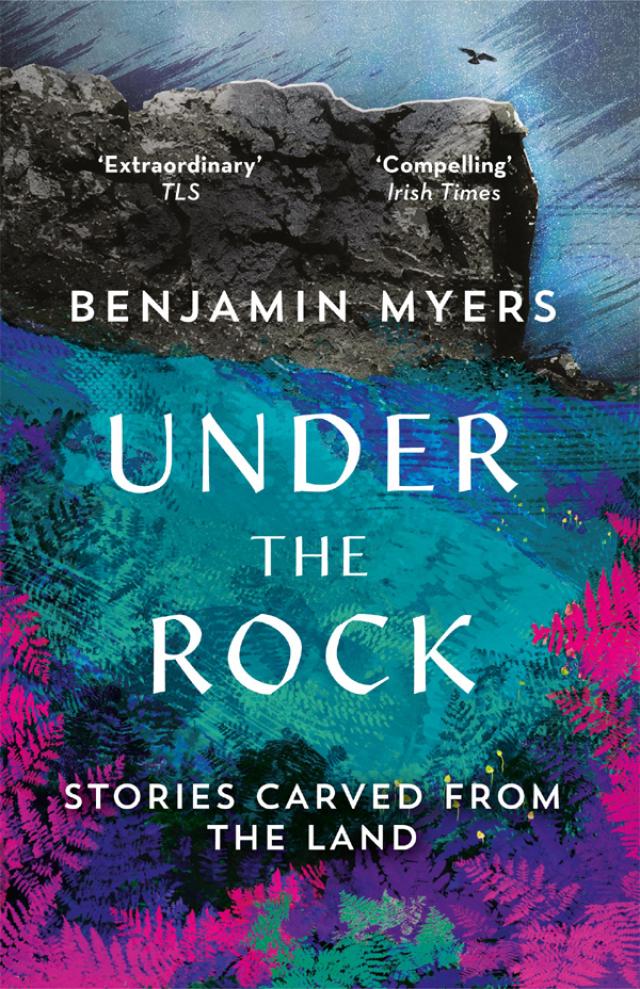


‘Extraordinary, elemental . . . never less than compelling: this is a wild, dark grimoire of a book’ – Times Literary Supplement
‘Thoughtful, engaging and beautifully crafted . . . the writing is lyrical yet muscular and elemental, transporting the reader to this place of rugged beauty and dark secrets’ – The Yorkshire Post
‘Compelling . . . an atmospheric exploration of the landscape and its history’ – Irish Times
‘A daring new work . . . make[s] the unremarkable truly remarkable. It’s a work that is focused on landscape and place and is another step on this special writer cementing himself as more than just a cult favourite’
– NARC
‘Prodigious, awe-incurring . . . few are as impressive as the formidable Benjamin Myers, who has developed a voice as pure and authentic as it is stark, honest and resolutely northern . . . creates an overall sense of dreamy, quiet beauty, born of love for the lie of the land’ – The Big Issue
‘A visionary work of immense power and subtlety which establishes Myers as one of Britain’s most consistently interesting and gifted writers’
– Morning Star
‘Best known for his bleak and brilliant crime fiction, Myers turns his focus to nature writing with absorbing results in this lyrical exploration of Scout Rock in Yorkshire’s Calder Valley’ – i-news, Best Books to Take on Holiday 2018
‘The writing is perfectly poised and seductive, luminous, an earthy immersion into the granular dark of place. The prose has an intense, porous quality, inhabiting the reader right from the stunning start with the voices of rock, earth, wood and water. This is a truly elemental read from which I emerged subtly changed. The writing has a shamanic quality; Benjamin Myers is a writer of exceptional talent and originality . . . it has all the makings of a classic’
– Miriam Darlington, author of Otter Country and Owl Sense
‘Richly layered, densely and elegantly structured, discursive, elegiac and beautiful. Under the Rock is a stunning exploration of place, mind and myth’ – Jenn Ashworth, author of Fell and The Friday Gospels
‘One of the many joys of Under the Rock – this absorbing, compelling, moving book – is its language; it trickles like a rivulet, thunders like a cataract, and sticks to you like mud. It is full of crannies and dips and peaks wherein wonders hide; explore it for a lifetime and you will not exhaust its mysteries. Unafraid of blood-drenched history and the darkest of despair, this is nonetheless a defiantly life-praising book; it accompanied me to bed and bar, train and plane, and each situation was enriched and brightened by its presence . . . It is utterly vital’ – Niall Griffiths, author of Grits, Sheepshagger and Stump
‘I really, really loved Under the Rock . . . it truly stands out and confirms Ben as one of the most original and engaging British authors currently writing about landscape. He describes brilliantly the emotions that nature and place trigger in us, and the endless fascination we have with them. It’s a bone-tingling book about both a beautiful location, and about the nature of our engagement with our environment’ – Richard Benson, author of The Valley and The Farm
‘What distinguishes Under the Rock is Myers’ unshakeable commitment. He writes at all times with rock-solid conviction, fashioning a book which is less a work of simple description than a new contribution to the mythology of Elmet’ – Will Ashon, author of Strange Labyrinth, Clear Water and The Heritage
‘Place-writing at its most supple: both deeply considered, and deeply felt’
– Melissa Harrison, author of Rain: Four Walks in English Weather
‘I have become a Benjamin Myers junkie in the last 12 months . . . Myers’ place-writing is as good as anything being scrawled in Britain today’ – Horatio Clare, author of Down to the Sea in Ships and Orison for a Curlew
‘Terrific . . . It’s a book which doesn’t just discuss or describe landscape, but immerses you within it . . . if this doesn’t put Ben Myers on everyone’s radar then I don’t know what will’ – Daniel Carpenter, Bookmunch
‘[A] beautifully poetic, passionate and elegiac book . . . Myers’ writing left me with a heart-wrenching desire to be there’ – Harry Gallon, Minor Literatures
‘An extraordinary blend of power, poetry and grit . . . Benjamin Myers has made his rock sing’ – Richard Littledale, The Preacher’s Blog
‘Myers’ prose is outstanding’ – Marcel Krueger, Hong Kong Review of Books
Contents
Introduction
PART I: Wood
Field Notes I
PART II: Earth
Field Notes II
PART III: Water
Field Notes III
PART IV: Rock
Field Notes IV
CODA: Beyond
Sources
Acknowledgements
Index
About the author
Introduction
Picture a hill half blasted into history.
Imagine one side of this great hill torn away, hewn and cleaved, quarried and pillaged, dumped in and raked over, hacked and scarred, its face forever disfigured, like that of a Passchendaele survivor.
Now fill this blackened space with seeds and spores. Slowly, now. Let things settle. Let trees reach downwards, their curling roots grasping deep into the underworld. Let weeds wander, and life crawl and colonise and entangle.
Let the seasons set the pace. Months, not minutes. Decades, not days.
See a century that feels like a second. Let life breathe.
In time creatures will come. All the indigenous species of the North Country: the deer and the fox, the badger and the squirrel. Rabbits too, though far fewer than you would imagine.
And birds, of course. Here birds will find a haven in the upper reaches of the looming cliff face, or create crowns of thorns in the tops of trees that in the wet and windy months sway like the masts of ships. Birds of many varieties will pass through the thick woodland’s clotted corridors, some feeding and flitting, others in full-throated joyous song.
Willow warblers and chiffchaffs.
Woodpeckers and wagtails.
Goldcrests and nuthatches.
Blackcaps and red kites.
In the trees there will also appear owls, exploding from branches like white fireworks, their magnesium feathers shimmering beyond the reaches of the old tallow candles, the oil, gas and kerosene lamps that illuminate the ages, before finally, silently, crossing the searching beams of alkaline-powered torches and the dipped headlights of distant growling cars.
This way ghosts were born: in wooded dells, down dark lanes of hedgerow and holloway, across clodded fields, when drunk men took fright at the unblinking brilliant xanthous eyes of an ice-white barn owl in flight, its talons stowed, wings beating a rhythm into the night, and had to create a new mythology to save face. Centuries later the nocturnal call of the owl runs the length of the woods and permeates the dreams of those of us who live close by, prone under duck down, the night world at our window.
Insects thrum and hatch and hover before filling the beaks and bellies of the bird life, and so the circle spins.
NOW IMAGINE MAN coming here.
Imagine man coming with pickaxes and chisels.
Imagine man coming with jackhammers and flak jackets.
Imagine man coming with dynamite and diggers and drills.
The crows take their temporary leave as industry makes its mark. The deer too will tread lightly through the mud and sandstone colluvium and rise to the top slopes, carving a new path up, up and away to the moor beyond.
In time they will return. In time they will all return, the wild creatures of this unknown place. The mammals, the birds, the insects. New burrows and dens and setts will be unearthed, latrines dug out and nests lined. The cycle will start again, and again. But not before the land has been blasted and quarried, dug and drained and filled, tipped into, dumped on and polluted with the death-making products of the accelerated industrial age. Fence it then, they will say. Shut it down and block it off, and create a cursed mythology of toxic soil and bottomless mineshafts and cliff-diving suicides and unexpected landslides in the night. Fence off this scar across the pocked face of the curiously named Mytholmroyd in the Upper Calder Valley, West Yorkshire, a piece of England sliced away.
Imagine this wild place. Summon it from the thousands of colours that swirl and merge in the prickling abyss behind your eyelids. See it now as the sun rises and sets behind this sparkling bluff of stone, and then open your eyes and there it is once again: Scout Rock. Here I sit now within its creeping shadow, a dark presence blackening my bitter coffee darker still. I drink it in.
Sometimes – especially in the depths of another dank, dreek autumn or on a sunless winter day too sallow even to grant us the thinnest of frosts, or perhaps at the dizzy height of summer, when the sun rises victoriously over its ragged crest to win the push-and-pull battle between light and dark – it feels as if The Rock is guiding my every movement. It is dictating my moods, my emotions. Steering hand and mind in every word I write.
It’s there looking over my shoulder now – see it, always? – a folded shroud for the town, a black dog stalking the sleep of all who lie below it, a tombstone erected in memoriam of old sky creatures unseen.
Tomorrow the sun’s rays will reach the lower canopy of this fenced-off green cathedral, and the nettles and balsam and ragwort and hogweed will reclaim their kingdom once again. The deer will dance, the badgers will snitter and the single pair of nesting ravens will kite the warming updrafts, their fullthroated cro
PART I
Wood
Chapter One
Unremarkable places are made remarkable by the minds that map them.
Carved from the south side of the Calder Valley at Mytholmroyd, Scout Rock is a sheer slab of crag overlooking wooded slopes and undulating, weed-tangled plateaus. To most, it is unremarkable, a fleeting backdrop gone in a slow blink from a passing train or car window, or perhaps more akin to a dirty grounded iceberg if seen from a slow-gliding canal boat; an umbral form flitting briefly across the mind’s eye. Subliminal, almost.
To others The Rock might serve as a marker for the widening out of the dale between the more heavily populated conurbation of Halifax to the east and a narrowing at Hebden Bridge to the west. Here great wooded walls harbour hidden ante-valleys, ruined mills and the ghostly remains of hamlets, which appear to squeeze inwards, restricting daylight and shortening the breath for just a few hard miles to the valley town of Todmorden and, beyond it, the hinterlands of Lancashire (as an old saying goes: ‘Yorkshire is all hills and moors; Lancashire is all mills and whores.’)
For some of the more mature generation Scout Rock is a doomed place. Foreboding mythologies took seed in the fertile imagination of childhood and made it a no-go area, where eighteenth-century thieves hid out, where the town tip once was, and later where industrial refuse was dumped without forethought or environmental consideration.
Charles Dickens passed through the area in 1858 and later wrote of it in a lengthy piece entitled ‘The Calder Valley’. Dickens charted the rich history of the area in fascinated detail. Of Scout Rock he wrote: ‘Beyond Mytholmroyd by the precipitous crags of Hathershelf Scouts – a rampart-like range of weather-worn rock, very conspicuous in the neighbourhood, and in places the sides are richly wooded. This place was the head of a feudal district, the forest of Sowerbyshire.’
Too doomed to be a playground for the modern valley’s children, Scout Rock was yet significant enough to imprint itself upon the memory of a master of words who came of age facing this very arboreal stage, Edward James ‘Ted’ Hughes, described on his death by Seamus Heaney as ‘a great arch under which the least of poetry’s children could enter and feel secure’. This man is remembered in blushed recollections and with a reading voice like thunder rolling down off Midgley Moor; his life is commemorated with a Westminster slab, and with him rest the fading memories stored in muscle and bone of the black-stone scarp that haunted his adolescence, the ‘memento mundi over my birth; my spiritual midwife at the time and my godfather ever since’.
Scout Rock is remarkable in the eyes of those who have decided it is so. Anything can be if it is willed into being: a pebble shaped by centuries of tumbling in the oceanic backwash, a single falling feather so light it barely succumbs to gravity, a mysterious gash in the landscape dense with trees, now fenced off and left to rewild itself.
Today The Rock still inspires dark utterances from the tongues of elders, their weather-worn faces creasing in admonishment at my confession that I like to explore this place that is, officially at least, hazardous and out of bounds to all members of the public: stay away from the Rock, lad, they say in voices as deep as ancient wells. Nothing good ever happened up there.
WE LEAVE LONDON early one June morning, Della and I. It is a decade ago and all our combined possessions have been crammed into a removal van that left the night before. What remains is shoved into the back of my car.
The last item we pack is half a tin of treacle, whose lid, almost inevitably, will be prised open during the journey by the dumb-bell that it is pressed up against. We will arrive at a new life dripping sticky syrup and curses.
Before we set off, one of the removal men, whose limbs give the appearance of having been elongated from years of lifting, tells us that his team had recently helped a mother and her four children relocate to ‘that neck of the woods’.
‘It was a house somewhere up on the tops,’ he explains, lifting a filing cabinet beneath one arm. ‘Same valley. Remote. She said it would be a new start for her.’
I nod. He sniffs.
‘She killed herself after two months.’
We hit the morning traffic and an hour later are still edging along Vauxhall Bridge Road into Victoria. Our mood is strained, conversation terse. The stress of a house move is underpinned by the knowledge that once you leave the city it is very difficult to return; one only moves to London when either young or wealthy, and now we were neither.
Twelve years earlier, during the first weeks of Tony Blair’s New Labour government, I had tracked a similar journey in reverse, driving a borrowed car full of clothes, books, records and treacle down from the north-east of England to find myself circling Piccadilly Circus at five o’clock on a Saturday evening, Eros looking down at me as I attempted a U-turn, much to the chagrin of the dozen black cabs caught in my slipstream.
Eventually I edged my way south of the river over the same bridge I crossed now, to move into a dilapidated transpontine squat in a labyrinthine Victorian building inhabited by social workers, punks, teachers, Finnish sonic terrorists, drug dealers, Greek artists, council workers, tennis coaches, Irish dissidents, passing backpackers, male prostitutes, an ex-Alpine goat herder, heroin addicts, academics and petty criminals. Here I lived rent-free for four years.
But now it was the height of a recession, and London was no city in which to be poor. Where once it was a dizzying maze to be navigated one day at a time, a playground for constant reinvention, now it was a place owned by the property developers, the oligarchs. The old one-bedroom flat, with its bath on breeze blocks in the kitchen and infestation of mice, abandoned by the local council for thirty years, had recently sold for £800,000.
What pleasure I still found in London for free was the many hours either exploring the overgrown Victorian splendour of Nunhead Cemetery, one of the ‘magnificent seven’ that circle the city, or tracking the abundance of urban foxes, themselves squatters living beneath the decking in our back garden. I passed hours watching the wild screeching parakeets that soared over Peckham Rye, which were rumoured to have descended from either Henry VIII’s menagerie at Hampton Court, or the Ealing Studios set of 1951 film The African Queen or – my favourite – liberated by Jimi Hendrix during a moment of clarity on Carnaby Street in the late 1960s.
Nevertheless, I was in danger of becoming parochial, so Della, a fellow Northern exile and herdsman’s daughter from a long line of cattle men, and I were doing what many like us had done before: seeking space, silence and the suggestion of financial survival.
We turn off Park Lane and its alien world of wealth, circle Marble Arch, then drive on up the Edgware Road, under the Westway with all its connotations of Ballard and The Clash, past the Turkish cafés, the old Irish pubs of Kilburn High Road and along Shoot-Up Hill to Cricklewood. As the high-pitched thrum of the city’s hive-like centre gives way to the retail parks and unknowable suburban conurbations whose historic names – Burnt Oak, Canons Park – suggest places of musket smoke and great intrigue, we pass through and under the overlapping flyovers like concrete ribbons, and I slither from my old city skin and finally breathe out.
IT IS JUNE, the month that Pablo Neruda describes as trembling like a butterfly, and the Yorkshire valley is in wild bloom. Whispering fields wave hello, and the river banks are lost beneath blankets of barbed nettles and the soured honey scent of balsam.
The varying shades of green are almost overwhelming, and with the car windows open I hear the cadence of birdsong.
The cottage sits down a narrow lane in a hamlet a mile from Mytholmroyd. It has an old stone inglenook fireplace and original warped beams supporting the ceiling. There are three bedrooms and a garden that is a landscaped, fenced-off corner of a semi-wild meadow, and the water is supplied by a spring up the hill. Rent is affordable, even on the sub-minimum wages of a mature student and freelance writer.
There is a stone water trough out front, and an old man sporting a trilby, a red neckerchief and a sheriff’s badge leaning on a five-bar gate, squinting into the sunlight. I will later learn that he is Arthur, a chipper pensioner who likes to dress as a cowboy and take long, looping daily walks from Hebden Bridge, always stopping for a moment of reflection at this favoured view.