

Sharpe 22 sharpes assa.., p.1
Sharpe 22 - Sharpe's Assassin, page 1


This is a work of fiction. Names, characters, places, and incidents are products of the author’s imagination or are used fictitiously and are not to be construed as real. Any resemblance to actual events, locales, organizations, or persons, living or dead, is entirely coincidental.
SHARPE’S ASSASSIN. Copyright © 2021 by Bernard Cornwell. All rights reserved under International and Pan-American Copyright Conventions. By payment of the required fees, you have been granted the nonexclusive, nontransferable right to access and read the text of this e-book on-screen. No part of this text may be reproduced, transmitted, downloaded, decompiled, reverse-engineered, or stored in or introduced into any information storage and retrieval system, in any form or by any means, whether electronic or mechanical, now known or hereafter invented, without the express written permission of HarperCollins e-books.
Originally published in Great Britain in 2021 by HarperCollins Publishers.
FIRST U.S. EDITION
Cover design by Claire Ward
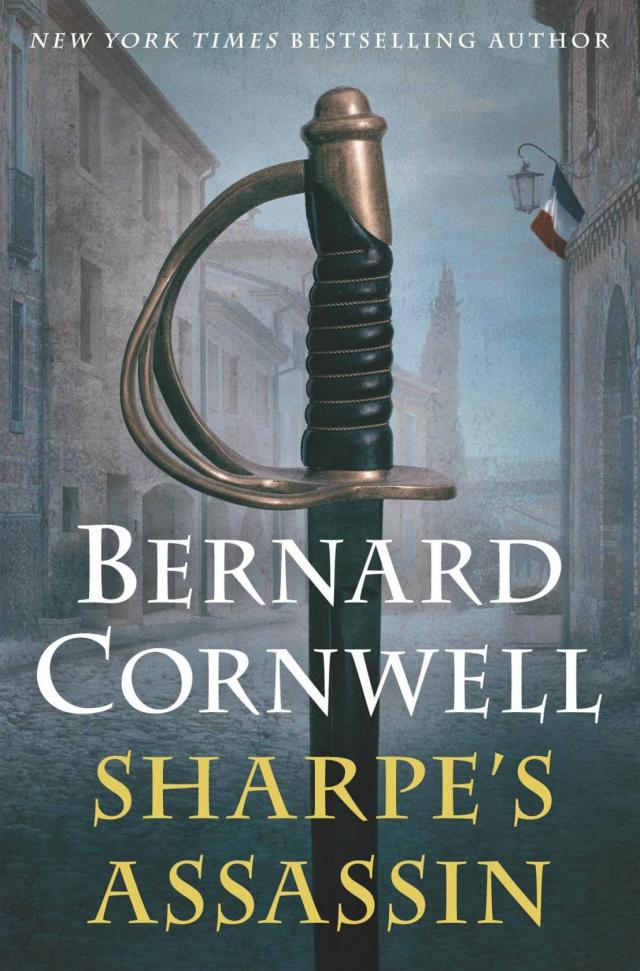
Cover photographs © Drunaa/Trevillion Images (street), © Johnny Ring (sword); © Shutterstock.com
Digital Edition DECEMBER 2021 ISBN: 978-0-06-256328-6
Version 10222021
Print ISBN: 978-0-06-256326-2
Sharpe’s Assassin
is for
WHISKEY
My wonderful dog
who kept me company
as I wrote eleven books and
who died just as this one was finished
Part One
The Fortress
Chapter 1
There were three men on the ridgetop. Two were alive.
One of the two, a tall, lean man, his face darkened by sun, was wielding a pickaxe, slamming the blade down into the stubborn earth. The top twelve inches of digging had been easy, but the hard rain of two days before had not loosened the thick clay soil beneath and the pick was striking hard, but not deep. “This’ll take all bloody day,” he grumbled.
“Let me do it,” the second man said. He was even taller, a burly hard-muscled man who spoke in an Irish accent. “You take the shovel.”
“I want to do it,” the first man said surlily and slammed the pick down again. He was stripped to the waist, wearing only a crude straw hat, calf-length boots, and French cavalry overalls. His shirt and his green rifleman’s jacket were hung on a nearby tree, together with his heavy cavalry sword, a tattered red officer’s sash, and a rifle.
“I told you to dig the hole in the valley,” the bigger man said. “Ground’s softer down there.”
“It has to be up here, Pat. Dan always liked the high ground.”
“I’ll miss Dan,” Patrick Harper said wistfully.
“Bloody Frogs.” The pickaxe hammered down again. “Give me that shovel.”
“I’ll shovel it,” Harper said, “make room.” He jumped into the shallow grave and scraped out some loose soil and stones.
The officer walked to the tree and took down his rifle. “I’ll bury this with him,” he said.
“Why not his own rifle?”
“Because his is better than mine. Dan won’t mind.”
“He looked after his rifle, that’s for sure.”
Dan Hagman’s corpse lay on the grass. He had been killed by a French voltigeur in the battle that had been fought on the ridge just one day before. Most of the battalion’s dead were being buried in a shallow grave on the lower ground close to the château of Hougoumont that still smoked from the fire that had destroyed the main house. Another fiercer and larger fire burned closer to the château, and the stink of it wafted up the ridge.
The officer crouched beside Hagman’s corpse and gently touched the dead man’s face. “You were a good man, Dan,” he said.
“He was that.”
The officer, whose name was Richard Sharpe, flicked a piece of dirt from Dan Hagman’s green jacket that had been cleaned and mended by one of the battalion wives. Sharpe had washed Hagman’s face, though no amount of washing could erase the rash of powder burns scored into Hagman’s right cheek, each burn thrown up by the explosion of powder in his rifle’s pan. “We should say a prayer,” he said.
“If we ever make his grave deep enough,” Harper grumbled.
“You can say it. You’re a Catholic?”
“Christ, I haven’t seen a church in ten years,” Harper said. “I doubt God listens to me.”
“He doesn’t even know I exist. I wonder if Dan prayed?”
“He sang a nice hymn, so he did,” Harper said. He took the pickaxe and drove it deep in the ground. “We’ll soon have this done,” he said, loosening the hard-packed soil with a heave.
“I don’t want the foxes digging him up.”
“We’ll put rocks on top of him.”
Sharpe had made a wooden cross from the shattered backboards of an artillery wagon. He had used a red-hot bayonet to burn Dan Hagman’s name into the crosspiece, then added “Rifleman.” He arched his back, trying to work the pain from his muscles, and stared across the shallow valley where the battle had been fought. There were corpses everywhere, men and horses, while the crops were flattened and scorched by artillery fire. “God, that stinks,” Sharpe said, nodding down the slope to where the fiercer fire was being fed with timber cut from the wood beyond Hougoumont. Men were also carrying French corpses to the fire and throwing them onto the flames. The British dead were being buried, but the enemy would burn their way into eternity. Sharpe dropped the wooden cross and picked up the spade.
“Officer coming,” Harper said in warning.
Sharpe turned to see a cavalry officer coming toward them. “Not one of ours,” he said dismissively, turning away to scrape at the soil Harper had loosened. The approaching officer had sky blue trousers and a dark blue tunic crossed with a golden sash. To Sharpe’s eyes the uniform looked unnaturally clean. The men who had fought on this ridge were filthy, their uniforms stained with mud, darkened by blood, and scorched by powder burns, but the young cavalry officer appeared elegant and polished.
“The bugger’s talking to Sergeant Huckfield,” Harper said, eyeing the horseman, who had stopped beside a group of redcoats who were cleaning muskets gathered from the battlefield. One of the redcoats gestured toward Sharpe, who swore under his breath, making Pat Harper laugh. “Trouble will find you,” he said.
The elegantly uniformed officer turned his horse and spurred toward Sharpe and Harper. He saw what they were doing and grimaced. “I’m told you men know where I can find Lieutenant-Colonel Sharpe,” he said. He had a crisp voice that, like his well-groomed horse and expensive uniform, spoke of money.
“You’ve found him, your honor,” Harper said, exaggerating his Irish accent.
“You?” The officer stared at Harper with disbelief.
“I’m Colonel Sharpe,” Sharpe said.
If the cavalry officer had found the thought of Harper as a colonel unbelievable he seemed to find Sharpe even more preposterous. That could have been because Sharpe had his back turned and that back was crossed with the scars of a flogging. Sharpe tipped back his straw hat as he faced the newcomer. “And you are?”
“Captain Burrell, sir. I’m on the Duke’s staff.”
“Lord Burrell?” The scorn in Sharpe’s voice was unmistakable.
“A younger son, so no, sir.”
“What can I do for you, Burrell?”
“The Duke wants to see you, sir.”
“He’s still in Waterloo?”
“In Brussels, sir. We rode there this morning.”
“I’ll have to finish here first,” Sharpe said, and drove the spade into the earth. “And I need to shave.” He had not shaved in four days and the stubble was dark on his cheeks.
“The Duke says it’s important,” Burrell said nervously. “He insisted on the utmost haste, sir.”
Sharpe straightened. “You see that dead man, Captain?”
“Of course, sir.”
“He was a damn fine soldier and a good friend. That man marched with me from Portugal to France, then came here, where some bastard voltigeur killed him. I owe him a grave, and I pay my debts. If you’re in such a hurry then you can climb off that bloody horse and help us.”
“I’ll wait, sir,” Burrell said uncertainly.
It took another hour to deepen the grave sufficiently, but then Dan Hagman was laid in the earth and Sharpe put his own rifle at the side of the corpse and hooked one of the dead man’s fingers through the trigger guard. He touched Hagman’s powder-scarred cheek. “If you go to the wrong place, Dan, take a shot at the devil. Tell him it’s from me.”
He climbed out of the pit and helped Harper shovel earth and stones onto the corpse. “You want to say a prayer, Pat?”
“Not me, sir. We want someone who has God’s ear. I might as well fart as pray.”
Sharpe grunted. “Find someone who can give him a prayer, Pat, but not Huckfield or any other bloody Methodist.” He looked up at Burrell, who had been walking his horse up and down the ridgetop as if impatient to leave. “So what does the Duke want?”
“Best for him to tell you himself, sir. And he did urge the utmost haste.” Burrell hesitated. “You don’t like Methodists, sir?”
“I hate the bastards,” Sharpe said, “all they do is preach at me. I already know I’m a sinner, and don’t need them telling me. No, I just want a good prayer said for a good man.” He shoveled more earth to make a mound over the grave, rammed in the crude wooden cross, and was just finishing as Pat Harper returne d leading a pale and skinny youth. “Who the hell are you?” Sharpe asked him.
“Private Bee, sir,” the youngster said nervously. He looked scarcely a day over seventeen, was as thin as a ramrod, and had long black hair. His red coat was bright, unstained by mud or powder burns.
“We got a draft of new troops this morning,” Harper explained, “thirty-six men. Young Bee was one of them.”
“So you missed the battle?” Sharpe asked the lad.
“We did, sir.”
“Then you were lucky,” Sharpe said, “and you know a prayer, Bee?”
“I do, sir.”
“Then say it, lad. This was a good man who fought hard and I want him to go to heaven.”
“Yes, sir.” Bee sounded excruciatingly nervous as he stepped to the grave’s edge and clasped his hands. “Dormi fili, dormi,” he started uncertainly, then found his voice, “mater cantat unigenito. Dormi, puer, dormi. Pater nato clamat parvulo.” He stopped.
“Amen,” Burrell said solemnly.
“Amen,” Sharpe said. “That sounded good, Bee.”
“There’s more, sir?”
“I’m sure that’s enough. It sounded like a proper prayer.”
“My mother taught it to me,” Bee said. He looked so frail that Sharpe was surprised the boy could even heft his musket.
“You did well, lad,” Harper said, then took a bottle from his pack and poured half the contents onto the grave. “A wee drop of brandy to see you to heaven, Dan.”
“God damn it,” Sharpe said angrily, cuffing at the tears in his eyes, “but he was a good man.”
“The best,” Harper agreed.
“Fetch my horse, Pat,” Sharpe said, and saw Private Bee look confused.
“Your horse, sir?” the boy asked.
“Is your name Pat too?”
“It’s Patrick, sir.”
“Pat Bee,” Sharpe said, amused, “Sergeant Pat Harper can fetch the horse.” Harper had already left and Sharpe looked up at Burrell. “I’ll be with you in a minute, Captain.” He pulled on his shirt and then the ragged rifleman’s green jacket, stained with blood and burned powder. He tied the ragged red sash at his waist, strapped on his sword belt, then slung Hagman’s rifle on his shoulder. He exchanged the straw hat for a battered shako that had a ragged split where a French musket ball had hit. He cupped his hands. “Captain Price!”
Harry Price ran from the field behind the ridge where the battalion was camped. “Sir?”
“You’re in charge. I’m going to Brussels and Lord only knows when I’ll be back. Set picquets tonight.”
“You think the French will be back, sir?”
“The buggers are still running away, Harry, but it’s regulations. Picquets.” He looked at Bee. “What company are you in, Bee?”
“Haven’t been told, sir.”
“Take him, Harry, he looks like a light infantryman.”
“About as light as they come, sir,” Price said, looking at Bee’s frail body.
Sharpe gave Bee two shillings for what had sounded like a good prayer, then hoisted himself into his saddle. The horse had been captured from a French dragoon and had a green saddlecloth embroidered with a wreathed N. “Look after Nosey,” Sharpe told Harper.
“Nosey will be eating fresh horse meat tonight, sir,” Harper said. “And Charlie Weller can look after him. I’m coming with you.”
“There’s no need, Pat.”
“I’m coming,” Harper said obstinately. He ran to find his own horse, then joined Sharpe, who was trotting west to catch up with the elegant cavalryman.
“Nosey?” Burrell asked, amused.
“My dog.”
“The Duke might not like that name, sir.”
“The Duke doesn’t have to know. Besides, he’s spent a lifetime giving me orders, so calling my dog Nosey is payback. So tell me what the Duke wants?”
“He insists on telling you himself, sir.”
The three horses walked along the road, which ran the length of the ridge. They passed a group of captured French cannon, their muzzles dark, and Sharpe looked to his right to see where the Imperial Guard had attacked up the slope. The bodies were still thick there, most of them stripped naked by the peasants who had crept onto the battlefield after dark to pillage the corpses. “Were you here?” he asked the captain.
“I was, sir. I watched you lead your battalion down the slope. It was well done.”
Sharpe grunted. His memory of the battle was confused, mostly images of thick smoke through which the blue-uniformed French had loomed menacingly, but he did remember the battle’s end when he had swung the battalion out of line and wheeled it onto the flank of the Imperial Guard before unleashing a murderous volley of musketry. “It was bloody desperate, Captain.”
“And the Duke named you commanding officer,” Burrell said admiringly.
“Maybe he’s about to take that away,” Sharpe said grimly.
“I don’t think so, Colonel,” Burrell said, though he sounded anything but certain, “it didn’t sound that way. What happened to Colonel Ford?”
“He lost his wits,” Sharpe said. “Poor man.”
“Poor man, indeed.” Burrell steered his horse around the corpses of a dozen French horses that were bloodily heaped where a blast of canister had ripped the heart from the French cavalry assaults.
“What’s this place called?” Sharpe asked.
“Well, the farm here is called Mont-Saint-Jean, but the Duke is naming the battle after the closest town, Waterloo.”
“The battle of Waterloo,” Sharpe said, thinking how odd that name sounded. “Let’s hope it’s the last battle we ever fight.”
“Amen to that, sir,” Burrell responded, “but who knows what will happen before we get to Paris.”
“Paris?”
“We march tomorrow.” Burrell sounded almost apologetic.
“To Paris?”
“Indeed, sir.”
The track along the ridge met the high road to Brussels, where they turned left, trotting their horses past the farm of Mont-Saint-Jean, outside of which two redcoats kept marauding dogs away from the pile of amputated arms and legs tossed from the farmhouse where the surgeons worked. “Most of the wounded are back in Brussels,” Burrell said, flinching at the sight of the blood-streaked heap. “Poor fellows.”
“A lot are still out on the field,” Sharpe commented. At dawn he had sent four companies to rescue wounded men from the valley. The other companies had been digging graves.
“It was bad,” Burrell said.
“Worst I’ve seen.”
“And the Duke tells me you’ve seen a lot, sir?” The young cavalry officer made it sound like a question.
“The Duke said that?”
“He says you’re a remarkable man, sir.”
Sharpe hid his surprise. “Nice of him,” he grunted.
“You were a ranker, sir?” Burrell asked cautiously.
“You saw my back, Captain. You ever saw an officer flogged?”
“No, sir.”
“I enlisted in ’93,” Sharpe said, “into the Havercakes. Made sergeant in ’99 and was commissioned four years later.”
“And you captured an Eagle,” the captain said admiringly, “at Talavera?”
“Aye,” Sharpe said.
“How did you do it?” Burrell asked.
Sharpe looked at him. A youngster, he thought, fresh-faced and blue-eyed, and to Sharpe’s eyes he looked as if he was only two or three years out of school. But he was a lordling and so already a captain and enjoying the patronage of the Duke. “Patrick and I did it,” Sharpe said harshly, gesturing at Harper, “by cutting our way into a French column. Damn nearly did it yesterday too, but there were too many of the buggers.”
“And now you command a battalion,” Burrell said.
Sharpe was not so sure. His promotion to lieutenant-colonel had been purely to give him suitable rank as an aide to William, Prince of Orange, a young and idiotic princeling who had been wished on the Duke as the price to be paid for the Dutch troops who had helped defeat the Emperor on the low ridge. Orange, who had done more harm than good to the allied cause, had dismissed Sharpe during the battle and Sharpe had rejoined his battalion and taken command of it when Ford, the colonel, had fled in panicked confusion. The Duke, seeing Sharpe lead the Prince of Wales’s Own Volunteers against the Imperial Guard, had called out that the battalion now belonged to Sharpe, but whether that was permanent Sharpe did not know. He wanted the command, but feared and expected that the Duke would now demote him and appoint another man.


