

Sharpes assassin, p.29
Sharpe's Assassin, page 29


La Fraternité is a novelist’s invention, though there were plots to assassinate the Duke of Wellington while he was in Paris. Probably the best known was an attempt to shoot the Duke by an ex-soldier named Marie André Cantillon, who narrowly missed his target. He was imprisoned, but doubtless consoled by the bequest of 10,000 francs left to him in Napoleon’s will. A far more dramatic attempt occurred in June 1816, when Wellington gave a ball in his Paris mansion and a fire was discovered in the cellars. Servants extinguished the blaze, but discovered stashes of gunpowder and cartridges, which had happily failed to ignite, but which inspired the story in this book. The house, the grandly named Hôtel Grimod de La Reynière, was on the site of what is now the American Embassy.
The “prayer” that Private Pat Bee said over Hagman’s grave is an ancient Latin Christmas carol taught to Italian children, while Lanier’s quotation from the Psalms is a slightly edited version of Psalm 144, verse 1: “Blessed be the Lord who trains my hands for war and my fingers for battle.”
Sharpe’s claim to having seen proof of a guillotine in Halifax is quite possible. There had been a guillotine in the town since medieval times, though the last execution is thought to have been in 1650. It was not the only guillotine in Britain, there was another in Edinburgh and, though Dr. Guillotin is popularly credited with the invention of the device, there were evidently other guillotines in many European countries long before Dr. Guillotin’s machine was first used in 1792.
The Musée Napoléon, now the Louvre, was indeed filled with works of art stolen from all across Europe. I have anticipated the restitution of the artworks, which were mostly removed much later in the year. Not all were returned, and some, like Veronese’s stunning canvas of The Wedding at Cana, which had been stolen from Venice, still hang in the Louvre. The British had some difficulty in taking many of the pictures down because of a lack of ladders, and replacements were indeed borrowed from a traveling showman who displayed monkeys.
I took immense pleasure in giving Sharpe the Order of Saint Vladimir, second class, which I am sure appealed to his well-hidden vanity. The story is based on truth. The Czar sent the order to the Duke of Wellington, asking him to find a worthy recipient, but Colonel Lygon refused it on the grounds that it was second class, so Wellington ordered that it be given to “Colonel Somebody-Else!” Why not Sharpe? He deserves it. At the time, the British army awarded no medals, but Wellington had a silver medal struck for every man who had been present at Waterloo.
There are still small vineyards in Paris, but there were far more in 1815, many of them just north of the Rue de Montreuil. There were also scores of tunnels beneath the city wall, almost all of them devoted to smuggling wine and spirits, which were heavily taxed when they entered the city.
The Arc de Triomphe in the Champs-Élysées, like the elephant in the Place de la Bastille, was a model built of wood. The wooden arch was covered with painted canvas, while the monstrous elephant was finished in plaster. The arch, of course, was finally built, but the elephant decayed until it was demolished in 1846. It was supposed to be constructed of bronze melted from cannons captured by the Emperor and, had it ever been completed, would surely have become a famous landmark.
One of the delights of writing novels is to discover that the characters insist on creating their own destinies. Pat Harper, I knew, would always return to his beloved Ireland, but Sharpe astonished me by settling in Normandy, where, for the moment, I shall leave him. I am grateful to the many readers who have accompanied us on the journey, and especially to my wife, Judy, who has endured Sharpe’s many battles. Thank you!
About the Author
BERNARD CORNWELL is the author of the acclaimed New York Times bestsellers Waterloo, 1356, Agincourt, and The Fort; the bestselling Saxon Tales, which include The Last Kingdom, The Pale Horseman, Lords of the North, Sword Song, The Burning Land, Death of Kings, The Pagan Lord, The Empty Throne, Warriors of the Storm, The Flame Bearer, War of the Wolf, Sword of Kings, and, most recently, War Lord; and the Richard Sharpe novels, among many others. He lives with his wife on Cape Cod and in Charleston, South Carolina.
Discover great authors, exclusive offers, and more at hc.com.
Also by Bernard Cornwell
1356
THE FORT
AGINCOURT
Nonfiction
WATERLOO
The Saxon Tales
THE LAST KINGDOM
THE PALE HORSEMAN
THE LORDS OF THE NORTH
SWORD SONG
THE BURNING LAND
DEATH OF KINGS
THE PAGAN LORD
THE EMPTY THRONE
WARRIORS OF THE STORM
THE FLAME BEARER
WAR OF THE WOLF
SWORD OF KINGS
WAR LORD
The Sharpe Novels (in chronological order)
SHARPE’S TIGER
Richard Sharpe and the Siege of Seringapatam, 1799
SHARPE’S TRIUMPH
Richard Sharpe and the Battle of Assaye, September 1803
SHARPE’S FORTRESS
Richard Sharpe and the Siege of Gawilghur, December 1803
SHARPE’S TRAFALGAR
Richard Sharpe and the Battle of Trafalgar, 21 October 1805
SHARPE’S PREY
Richard Sharpe and the Expedition to Copenhagen, 1807
SHARPE’S RIFLES
Richard Sharpe and the French Invasion of Galicia, January 1809
SHARPE’S HAVOC
Richard Sharpe and the Campaign in Northern Portugal, Spring 1809
SHARPE’S EAGLE
Richard Sharpe and the Talavera Campaign, July 1809
SHARPE’S GOLD
Richard Sharpe and the Destruction of Almeida, August 1810
SHARPE’S ESCAPE
Richard Sharpe and the Bussaco Campaign, 1810
SHARPE’S FURY
Richard Sharpe and the Battle of Barrosa, March 1811
SHARPE’S BATTLE
Richard Sharpe and the Battle of Fuentes de Onoro, May 1811
SHARPE’S COMPANY
Richard Sharpe and the Siege of Badajoz, January to April 1812
SHARPE’S SWORD
Richard Sharpe and the Salamanca Campaign, June and July 1812
SHARPE’S ENEMY
Richard Sharpe and the Defense of Portugal, Christmas 1812
SHARPE’S HONOR
Richard Sharpe and the Vitoria Campaign, February to June 1813
SHARPE’S REGIMENT
Richard Sharpe and the Invasion of France, June to November 1813
SHARPE’S SIEGE
Richard Sharpe and the Winter Campaign, 1814
SHARPE’S REVENGE
Richard Sharpe and the Peace of 1814
SHARPE’S WATERLOO
Richard Sharpe and the Waterloo Campaign, 15 June to 18 June 1815
SHARPE’S DEVIL
Richard Sharpe and the Emperor, 1820–1821
Short Stories
SHARPE’S SKIRMISH
SHARPE’S RANSOM
SHARPE’S CHRISTMAS
The Grail Quest Series
THE ARCHER’S TALE
VAGABOND
HERETIC
The Nathaniel Starbuck Chronicles
REBEL
COPPERHEAD
BATTLE FLAG
THE BLOODY GROUND
The Warlord Chronicles
THE WINTER KING
THE ENEMY OF GOD
EXCALIBUR
The Sailing Thrillers
STORMCHILD
SCOUNDREL
WILDTRACK
CRACKDOWN
Other Novels
STONEHENGE
GALLOWS THIEF
A CROWNING MERCY
THE FALLEN ANGELS
REDCOAT
FOOLS AND MORTALS
Copyright
This is a work of fiction. Names, characters, places, and incidents are products of the author’s imagination or are used fictitiously and are not to be construed as real. Any resemblance to actual events, locales, organizations, or persons, living or dead, is entirely coincidental.
SHARPE’S ASSASSIN. Copyright © 2021 by Bernard Cornwell. All rights reserved under International and Pan-American Copyright Conventions. By payment of the required fees, you have been granted the nonexclusive, nontransferable right to access and read the text of this e-book on-screen. No part of this text may be reproduced, transmitted, downloaded, decompiled, reverse-engineered, or stored in or introduced into any information storage and retrieval system, in any form or by any means, whether electronic or mechanical, now known or hereafter invented, without the express written permission of HarperCollins e-books.
Originally published in Great Britain in 2021 by HarperCollins Publishers.
FIRST U.S. EDITION
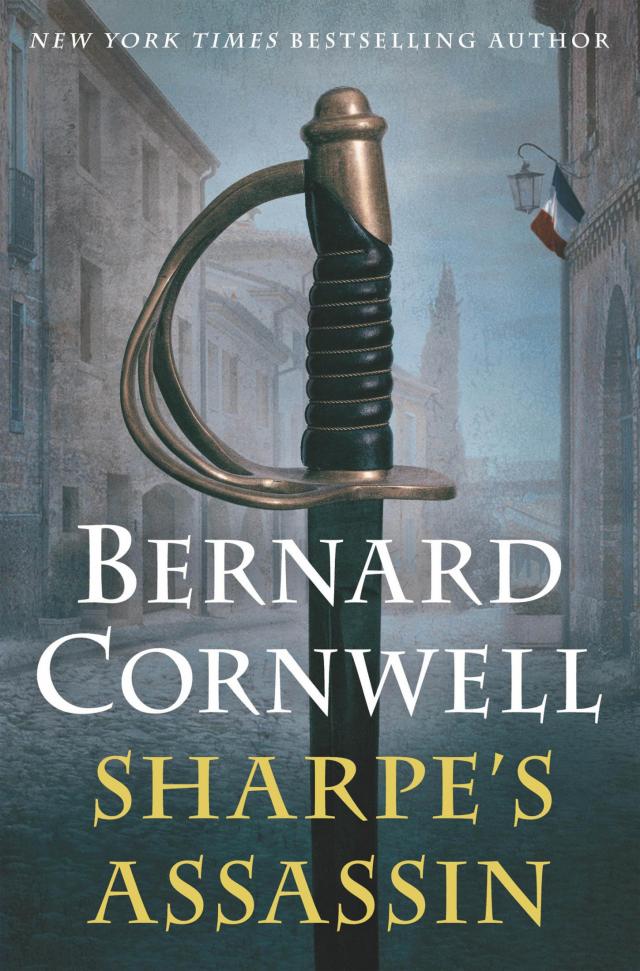
Cover design by Claire Ward
Cover photographs © Drunaa/Trevillion Images (street), © Johnny Ring (sword); © Shutterstock.com
Digital Edition DECEMBER 2021 ISBN: 978-0-06-256328-6
Version 10222021
Print ISBN: 978-0-06-256326-2
About the Publisher
Australia
HarperCollins Publishers Australia Pty. Ltd.
Level 13, 201 Elizabeth Street
Sydney, NSW 2000, Australia
www.harpercollins.com.au
Canada
HarperCollins Publishers Ltd
Bay Adelaide Centre, East Tower
22 Adelaide Street West, 41st Floor
Toronto, Ontario, M5H 4E3
www.harpercollins.ca
India
HarperCollins India
A 75, Sector 57
Noida
Uttar Pradesh 201 301
www.harpercollins.co.in
New Zealand
HarperCollins Publishers New Zealand
Unit D1, 63 Apollo Drive
Rosedale 0632
Auckland, New Zealand
www.harpercollins.co.nz
United Kingdom
HarperCollins Publishers Ltd.
1 London Bridge Street
London SE1 9GF, UK
www.harpercollins.co.uk
United States
HarperCollins Publishers Inc.
195 Broadway
New York, NY 10007
www.harpercollins.com
Bernard Cornwell, Sharpe's Assassin


