

Alone, p.1
Alone, page 1


ALONE
Also by Beverley Farmer
Alone
Milk
Home Time
Place of Birth
A Body of Water
The Seal Woman
The House in the Light
Collected Stories
The Bone House
This Water
ALONE
BEVERLEY FARMER
FICTION
First published in 1980
by Sisters Publishing
This edition first published in 2024
from the Writing and Society Research Centre
at Western Sydney University
by the Giramondo Publishing Company
PO Box 752
Artarmon NSW 1570 Australia
www.giramondopublishing.com
© Beverley Farmer 1980, 2024
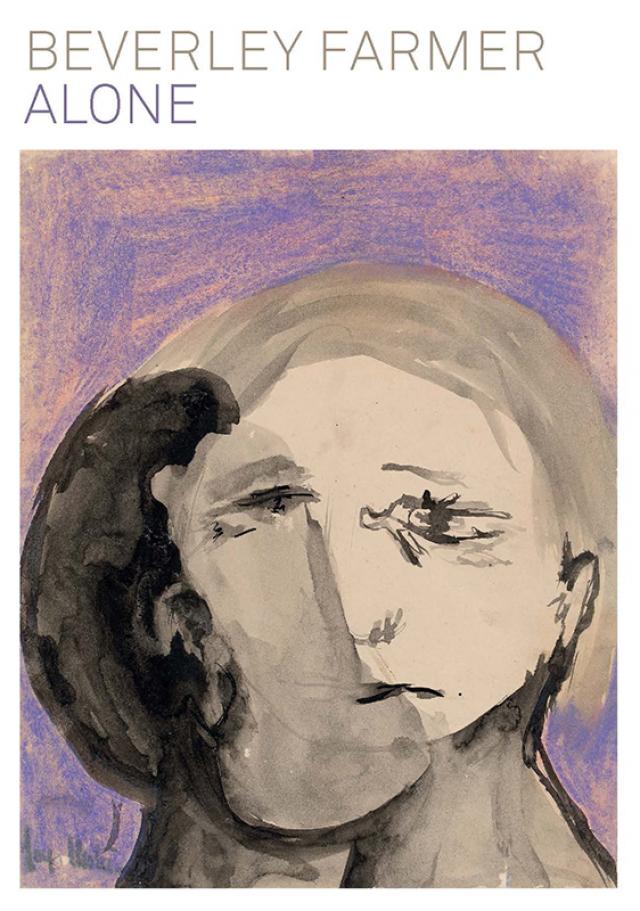
Cover image: Joy Hester, Untitled (1949), from the Love series (1949) brush and ink and mauve pastel, 31.6 x 25.2 cm (image and sheet) National Gallery of Victoria, Melbourne, Purchased, 1976, P126-1976
© Joy Hester Estate/Licensed by Copyright Agency, Australia
Designed by Jenny Grigg
Typeset by Andrew Davies
in Tiempos Regular 9/15pt
Printed and bound by Pegasus Media & Logistics
Distributed in Australia by NewSouth Books
A catalogue record for this book is available from the National Library of Australia.
ISBN 978-1-923106-03-1
All rights reserved.
No part of this publication may be reproduced, stored in a retrieval system or transmitted in any form or by any means electronic, mechanical, photocopying or otherwise without the prior permission of the publisher.
9 8 7 6 5 4 3 2 1
The Giramondo Publishing Company acknowledges the support of Western Sydney University in the implementation of its book publishing program.
This project has been assisted by the Australian Government through Creative Australia, its principal arts investment and advisory body.
For C.M.
1
Slow golden smoke drifts over bare tables, over dusty jars of mussels steeped in brine. Here and there, under the dim lamps, old men sag, sipping rank tea. A far clock tolls a dull nine. Ten. Eleven. Twelve. A gull squalls.
A green tram sails clanking past, a boat of lights on the rainfurred street seamed with four sleek rails.
Beyond the squat tin arch of the café the river and the still street run softly to the silent docks and the marsh-rimmed sea. The moon is up. Long bridges glow and waver in black, slow water. Stars wallow and split. River lights rock on dim panes.
The moon hoists high its yellow bladder, swells, spills shrivelling over the water.
Furled in this haze, in slow goldensmoke, I have sat hour after hour over two tepid coffees, munched a dank pie with sauce, read and reread The Waste Land. She has not come after all, knowing I would be here tonight, to sit opposite me again as she used to, lamplight tangling in her harsh hair.
I am bloody, bold and resolute. I am golden in the dark. This is my dying day.
Gulls squall.
‘Good fer you, Bob! Three cheers fer me ole cobber!’
‘’Ow come yer still on yer pins, Bob?’
Hoots and backslaps for Bob as he swaggers in, burly and tawny, wading through the lamplight.
‘Ged orf yer fat arses,’ he roars. ‘Lazy lod a buggers. Whadda bout them sheilas I got lined up? Yer still game?’
I know Bob of old. He’s my landlady’s fancy man. She fancies she has a mission to seamen. A wag in a cloth cap points me out to Bob, who of course comes reeling up to stumble on to the chair opposite me. He leans forward on his red-furred elbows to stare at me. I fix my blank eyes on the page. Blood shaking my heart.
‘’Ullo, gorgeous. Whad’s yer nime?’
I wish she would come in now and see a man talking to me. ‘Can I buy yer a cup a coffee?’
Red sullen faces are watching, everyone in the dark café. On this bank of the tumid river.
‘Arncher talkun?’
I remain self-possessed. Ruffling his foxy hair, he slouches away at last to his sneering cronies.
‘Nod a hope. Doesun know whad she’s missun, eh, Charl?’
Which is true, as it so happens. They nudge and wink and roar. Their red faces sprouting cigarettes bend glowing over a single match passed round. I hate them.
Stiffly I stalk up to the counter and order another, a hot coffee this time and stand staring out at the glinting street as the sallow, pustular boy pours it from under the thick grey skin in the jug, boils it up on the steam pipe, shoves it spilling across the counter at me and rings my money up. I strut precariously back to my table, not spilling a drop.
‘Watch yerself, gorgeous. Yer don’ wanna go an spill it.’
I stir sugar in and sip my scalding coffee. My heavy eyes are mirrored in it, and my lip, and fragments of one shaking lamp. I take another sip, my face trembling in the cup as if lit by a candle flame. I am bloody. Bold. Irresolute.
‘About them sheilas, see. The joint’s out Collingwood way.’
‘Now yer talkun!’
‘Whadda bout May, Bob?’
‘She’ll keep. Termorrer’s another day.’
I watch them lurch out, yelling for a taxi on the street, leaving a last few huddled dank men at separate, smoke-furled tables. I sip the dregs of my grey coffee before I stand, cram my book into my black woollen bag, and stride into the night. Old Jerry’s great gaunt bicycle leans propped like a mantis at the doorway. I unlock the padlock with the little brass key and cram the padlock and the chain into my bag.
I am, I have been told, and Catherine is the one who ought to know, absurdly preoccupied with the surface details of life.
But where does the surface end? I remember I protested at the time.
Nowhere. Everywhere.
Inside a dark face hunched between shoulder pads still watches me, breathing a slow swathe of smoke, impassive.
I switch on the rusty headlamp and clamber clumsily up on to the saddle, swing one black leg over the bar, clutching the cold handlebars, and push away from the wall. I wobble madly over the footpath on to the street, across the tramlines, and pump the pedals along the splashing gutters, past the dark hulks of shut pubs and warehouses, the blank shop windows, swerving left up Swanston Street, my taut legs aching, timing myself to catch green lights because if I have to stop I will fall off.
I have passed the brick fortress of the brewery, its great gates shut, sour gushes of steam hissing from grilles in the gutters, when a policeman whistles, waves at me.
‘You! Ay, you!’
I stop pedalling, looking over my shoulder.
‘Bloke on the pushbike! Yair, you.’
I stop, and fall off.
‘You orright?’
‘No bones broken.’
‘That’s a bloke’s bike, isn’ it?’
‘Anything wrong with that?’
‘Yours, is it?’
‘It belongs to a friend of mine.’
‘Yair, well, yer’ll hafter walk it ’ome ternight, sister. There’s no lights on it.’
Sure enough, I bend and see the last glimmer of light flicker out in the headlamp and the red tail-lamp. I sigh.
‘Got much further ter go?’
‘No. Just Carlton.’
‘Student, are yer?’
‘Sort of.’
‘Well, it just goes ter show, doesun it? Girl your age oughta have more sense than ter go ridun roun’ on a pushbike on ’er own this late on a Saturdy night. An’ a university student what’s more. ’Ow old are yer?’
‘Eighteen.’ Today.
‘Let alone ridun wivout lights. Get yerself run over before yer know what’s ’it yer.’
I haul the bike upright.
‘Look ’ere, it’s not safe. I’ll walk yer home if yer like.’
‘No, thank you, officer. May I go now?’
‘Suit yerself. ’Syour funeral. On foot, mind.’
I sigh, gazing at the long black street, moonlit, lamplit.
‘Well, ged a move on. Whaddyer waitun for? Shove orf.’
I walk the creaking bike all the way up Swanston Street, prop it against a wooden pole looped with spitting wires and struggle up on to the saddle, launch off with a kick and an insane clatter along the still, yellow-pooled streets of Carlton to the rooming house at last. All the long grey windows are in darkness behind its filigree of balconies.
My legs shaking, aching with tiredness, I wheel the bicycle across the verandah, down the dank carpeted hall with its leaded stained glass, and past the kitchen doorway. Snores and mumbles issue from the greasy darkness. Bloody abos, carn seem ter get rid of ’em, no matter what I do, moans Mrs O’Toole. Bloody boozed-up tribe of ’arf-caste pimps an diri-licks. One lamp above the gully trap glosses the wet cobbles. One window is lit, next door to Jerry’s. As I hesitate, the light snaps on in Jerry’s window, his door swings open and Jerry skips to the gully trap and squirts an arch of piss hissing on to the grating.
‘Jesus!’ he yells, catching sight of me. He fumbles with his fly. ‘Whatcher come creepun up on a man like that for? Give a bloke a bloody ’eart attack, yer will.’
‘Sorry, Jerry. Here’s your bike back.’
‘Me bike? Oh, yair, righto.’
‘Sorry if I gave you a fright.’
I never know what to say to people.
‘Not ter worry, girlie. Me ’eart’s as sound as a bell, as a matter a fack. It’s me prostrate keeps playun up o n me. Didun see yer comun.’
He zips up, turning his back, before opening the door of his yellow room and waving me in with the other knotted hand.
‘Prop it up against the fireplace, will yer, love? That’s it. No doctor can do anythun for it, not one of um. I been through it all. Even ’ad the op once, the works. Jeeze, did that ’urt! Agony, it was. The catheter! An’ after all that, the bloody thing grew back. Even got me a bag of ’erbs from a Chink down Liddle Bourke. Whadda hope. Jus’ afta resign meself to it, I s’pose.’
There are two milk bottles full of his piss propped in the grate of the fireplace. Next door I can hear the creak and thump of a bed, and smothered groans.
‘Well, thanks a lot for the bike.’
‘That’s orright, yer welcome. Hey, yer didun ferget ter get me a pine, did yer, girlie?’
‘Oh, it’s up in my room. Sorry.’
‘Not ter worry. I’ll ged it termorrer.’
‘Well, goodnight, then. Thanks again.’
‘Tooroo.’
The white moon shakes on the cobbled yard. There is lamplight in the warm rooms of the whores. Warm lamplight and love of a sort, or lust, or whatever. The light in Jerry’s window goes out.
I creep with shaking knees up the dark staircase and down the endless passage creak creak to my room, and throw the door open. I snap on the light. In the sudden glare I see that no one has been here. She has not come tonight. I switch the hard light off and fumble my way by dark moonlight to the dressing table, where I bend and strike a match and light the candle in front of the mirror. The flame flares, spires. I puff out the acrid match. The slow mirrored candle wavers. I step out of my clothes and look into my mirror. I am candlelit, moonlit, my tawny teated breasts and downy belly. My grooved back glows. Between my thighs I have gold-bearded lips.
Catherine told me I was obsessed with surface detail, immersed in surface impressions. Life for me has finally acquired the rapt sterility of a work of art. It has come to a standstill. I come alive at mirrors and at windows, in artificial life. Light, I mean, artificial light. A still life, a photograph, is reality congealed in the mind of the artist. A painting by Cézanne is like a reflection in a slowly freezing river, shifting, fragmented. Negatives come to life on immersion. I wanted to make a film last year made up entirely of shots of a room, this room, in morning and afternoon sunlight, in lamplight, candlelight, darkness. I scripted each careful shot. The other script I wrote was for a film in slow motion at the docks: a silent ship leaving port at night, moving away from the wharf over the dark river, rocking on her shaken golden image, turning slowly in midstream and diminishing seaward past moored ships dripping water and light. I was there taking photos when a man came up behind me muttering wannafuck and in my terror, leaping, pedalling off, I let the camera swing and smash against the frame of the bicycle. The film I extracted was pure black.
It’s like everything you do, she said. You think you’re conveying something, when there’s nothing but a blank. No ships, no dripping lights. Your mind’s turned in on itself. What do you think you’ve got to write about?
My peaches smell like golden roses. I could eat a peach. There is a fullblown curly cabbage, and a bristling pineapple for Jerry squats on the floor beside the dish of stained mullets soaked in vinegar. I could eat a peach or two, and have a drink of port; soak a peach in port and eat it. Sweet burning ruby port. Except that I want to stay awake tonight.
A cat squalls.
I pull on my black clothes and shoes to go padding along the shabby passage to the toilet. A hair-fine spider sprawls in one cracked corner of the ceiling. In a room nearby someone screams once, twice, then starts to sob and wail. My flesh creeping with horror, I sit on paper, piss loudly, jerk the clanking chain and barge into the bathroom next door to wash my hands.
Mrs O’Toole sighs, voluminously wrapped in cerise chenille.
‘Gets on yer nerves after a while.’
‘Is it Maria, Mrs O’Toole?’
‘Oh, no, dear. It’s not even in this house. I ’unted ’igh an’ low when it firs’ started, turns out it’s nex’ door all the time.’
Her red hair is screwed tightly into curlers around her glossy face.
‘Oh, I thought it might be Maria. Again.’
‘No, dear. Maria’s in ’ospidal. Didun yer know?’
‘No! What’s wrong with her?’
‘Miscarriage. Bleedun all over the place by the time she decided ter ged ’elp. Shoulda seen the mess. I ’ad ter clean it up, a course. She was bawlun fit ter burst, shriekun ’er ’ead orf. Lord only knows what she was sayun. Greek ter me!’
‘Will she be all right?’
‘Course she will. She was only three munce. A curette’s nothun ter worry aboud in this day an’ age, all in the day’s work. I oughda know. She’ll be right as rain in the mornun. If you arst me, she brung it on on purpose. I mean ter say, what on earth would she do with another baby, now ’er ’ubby’s walked out on ’er?’
‘Maybe she’d want one to replace the one he took?’
Mrs O’Toole purses her grey lips.
‘Look, she carn afford ter feel like that, can she? She’s gotta face facks. Pull ’erself tergether. Stan’s ter reason, a baby’d make things worse fer ’er now all along the line, wouldan it, the way things are. She’s gotta grit ’er teeth an’ pick up the pieces, if yer see what I mean. Poor thing.’
Mrs O’Toole wipes the cold cream off her face and splashes it with warm water. There is a smell of rancid cold cream and rose water. A white mist floats and fuzzes the pane.
‘Aren’t I a sight fer sore eyes? In me curlers an’ face cream. Wouldun bother with it these days, really, ’cept I’m sort of expectun a visitor. Keep the flag flyun an’ so forth an’ fifth. A bid a makeup does a lot fer yer moral, I alwus say. There was somethun I was s’posed ter tell yer, Shirl, an’ I’ve gone an’ fergotten.’
I bend and rinse my huge red hands under the cold tap and wipe them on my black sleeves, turning to go.
‘Well, goodnight, Mrs O’Toole.’
‘’Ang on a sec, will yer, love, an’ I might remember what it was. I lef’ me jacket in Maria’s room, what with all the yellun an’ screamun an’ gettun ’er orf ter the ’ospidal, yer lose yer ’ead. Yer dunno whether yer comun or goun. I’ll walk along the passage with yer.’
Mrs O’Toole struts flopping at my side along the creaking passage to Maria’s door. It is not locked, either. She switches on the dim bulb. There are studio photographs everywhere: Maria alone, Maria’s posing wedding group, Maria with a rabbit-eyed bald baby. In one corner there is a wooden ikon, a gilded Madonna and Child, lit by a candlewick still spluttering, afloat in oil, in its little gold cup.
‘Idolators, the lot of ’em,’ snorts Mrs O’Toole.
‘That’s her little boy, is it?’
‘That’s ’im, yair. I seen ’im now an’ then when she came ter see Tooler, or Cooler, was it, before they split up. I can never remember which is which. ’Is name’s Yannaki, that’s like Johnny in their lingo.’
‘Where is he now?’
‘’Is dad snuk ouda the country with ’im, took ’im ter Greece on the sly. She never found out till they were gone.’
The candle flutters hoarsely and goes out.
‘I wouldn’t have thought that was possible.’
‘’E was a bloody cunnun bastard. Forged ’er signature, got a passport with the kid on it, took all their money outa the bank. I tell yer, jail’s too good fer ’im. She jus’ went outa her mind. She ’asn’ got over it yet, an’ it’s over two munce ago. She cut ’er wrists the other day, but she didun bleed fast enough. Another bloody mess. I’m at me wits’ end. She’s savun up ter go an’ get the kid back, she’s workun like mad an’ ’alf starvun ’erself as well. She ’asn’ paid any rent in six weeks. I ’aven’ got the ’eart ter arst ’er fer it.’
Mrs O’Toole sighs, picks up her jacket, and switches the light off. We walk in sombre darkness to my door.
‘Well, goodnight, Mrs O’Toole.’
‘Goo’night, love. I ’ate ter think what time it must be by now: Oh, well, I done me good deed fer the day, I s’pose. Sleep well.’
I slip into my candlelit room and shut the door softly. The flame flaps on the wick and all over the shut walls. I lie down on my bed as if on golden water, but not to sleep. The inhabitants of the house are asleep. Let me think of the inhabitants of the house. Close my mind to Maria driven mad by loss, and to you, Catherine, who didn’t come back to me even tonight to comfort me by candlelight. Please come.


