Time for frankie coolin, p.1
Time for Frankie Coolin, page 1


The University of Chicago Press, Chicago 60637
Copyright © 1982 by Bill Granger
Foreword © 2014 by the University of Chicago
All rights reserved.
University of Chicago Press edition 2014
Printed in the United States of America
23 22 21 20 19 18 17 16 15 14 1 2 3 4 5
ISBN-13: 978-0-226-20264-8 (paper)
ISBN-13: 978-0-226-20278-5 (e-book)
DOI: 10.728/chicago/9780226202785.001.0001
Originally published in 1982 under the name Bill Griffith.
Library of Congress Cataloging-in-Publication Data:
Granger, Bill, author.
Time for Frankie Coolin / Bill Granger ; foreword by Bill Savage.
pages cm
ISBN 978-0-226-20264-8 (pbk. : alk. paper) — ISBN 978-0-226-20278-5 (e-book)
1. Landlords—Illinois—Chicago—Fiction. 2. Chicago (Ill.)—Fiction. I. Title.
PS3557.R256T56 2014
813'.54—dc23
2014026654
This paper meets the requirements of ANSI/NISO Z39.48-1992 (Permanence of Paper).
BILL GRANGER
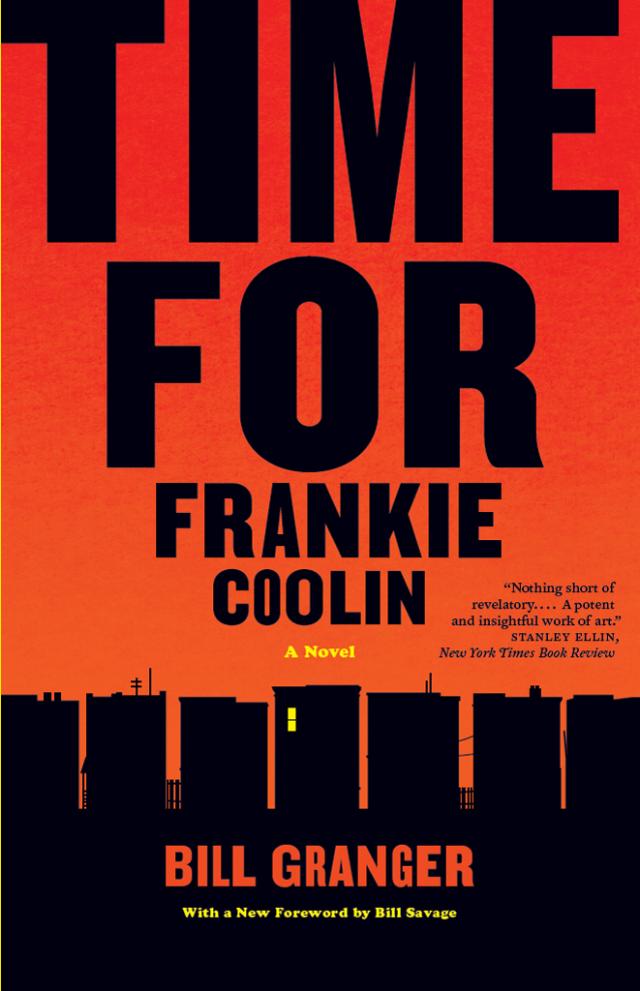
TIME FOR FRANKIE COOLIN
A Novel
With a new Foreword by Bill Savage
The University of Chicago Press
Chicago and London
PRAISE FOR TIME FOR FRANKIE COOLIN
“[Bill Granger] has served up a raw and vivid slice of Chicago.”
—Christopher Lehmann-Haupt, New York Times
“Pseudonymous novelist Griffith, ‘an award-winning writer who lives—obviously—in Chicago,’ demonstrates an uncanny ear for dialogue and a remarkable ability to pull us into the seamy alleys of modern Chicago. This is a gripping novel, a brilliant study of a simple/complex man—who grows on us like an abandoned puppy—and a loving family closing ranks around him almost against his will.”
—Don G. Cambell, Los Angeles Times
“Bill Griffith has painted the picture of a familiar working class type so brilliantly and with such sensitivity that the experience of living with Frankie Coolin for a few critical weeks of his life is nothing short of revelatory. . . . At the end of his story we are all the better for having walked a long mile uphill in his work shoes. Never mind literary categorizations, Time for Frankie Coolin is a potent and insightful work of art.”
—Stanley Ellin, New York Times Book Review
“This story represents [Chicagoans’] experience of ethnic settlement, black migration, suburban flight, economic struggle and confrontation with outside forces that threaten to destroy them. . . . A superb novel, the real thing.”
—John Callaway, Chicago Tribune
ABOUT THE AUTHOR
Bill Granger (June 1, 1941–April 22, 2012) was born in Wisconsin and raised on the South Side of Chicago, where he began his long journalism career as a copy boy at the Chicago Daily News. In his forty years as a reporter, he wrote for United Press International, the Chicago Sun-Times, the Chicago Tribune, and the Daily Herald. In 1969, he also began teaching journalism classes at Columbia College, Chicago.
In the late 1970s, he began writing political thrillers and mystery novels, many of which he set in Chicago. Mr. Granger wrote twenty-five such novels, two under the pseudonym Joe Gash. His most famous books include The November Man (1979) and Public Murders (1981)—which won an Edgar Award from the Mystery Writers of America. Time for Frankie Coolin, Granger’s most literary work of fiction, was first published the following year under the name Bill Griffith. He cowrote three books of nonfiction with his wife, Lori, including Fighting Jane, a history of Chicago’s first woman mayor, and The Magic Feather, about special education and their son, Alec.
Granger wrote his column for the Daily Herald until he retired in 2000 due to ill health.
For those in the trades—
And my father and T. J. H.
The day shall not be up so soon as I,
To try the fair adventure of tomorrow.
—WILLIAM SHAKESPEARE
CONTENTS
Praise for Time for Frankie Coolin
About the Author
Foreword
Chapter 1
Chapter 2
Chapter 3
Chapter 4
Chapter 5
Chapter 6
Chapter 7
Chapter 8
Chapter 9
Chapter 10
Chapter 11
Chapter 12
Chapter 13
Chapter 14
Chapter 15
Chapter 16
Chapter 17
Chapter 18
Chapter 19
Chapter 20
Chapter 21
Chapter 22
Chapter 23
Chapter 24
Chapter 25
Chapter 26
Chapter 27
FOREWORD
When readers sit down to talk about great Chicago writers and great Chicago novels, they should talk about Bill Granger and Time for Frankie Coolin.
Granger’s career parallels those of many Chicago greats, including Finley Peter Dunne, Theodore Dreiser, and Mike Royko. Born in Wisconsin in 1941 and raised on the South Side of Chicago, Granger attended De Paul University and then served stateside in the army for two years. He began his career in journalism as a copyboy at the Washington Post, before moving on to report for UPI, Chicago Tribune, the Sun-Times, and the Daily Herald, with some time off to cover the conflict in Northern Ireland for national newspapers. When he, like so many others, lost his job in the 1978 consolidation of the Daily News and the Sun-Times, he began to write fiction, from award-winning murder mysteries and political thrillers to this novel, a work firmly in the Chicago realist tradition of telling stories about regular people in the city, and the ways the city shaped them.
In Time for Frankie Coolin, Granger tells the story of an Irish-Catholic tradesman whose family was one drop in the flood of white flight from racially changing neighborhoods in Chicago. While this key moment in the city’s history usually comes to us from an African American perspective (think of Raisin in the Sun), Granger uses Frankie to show a point of view that is rarely represented: the working-class white ethnics who fled the West and South Sides after desegregation. He’s a self-employed freelance contractor, hobbling together a living out of one-off construction jobs and ownership of several buildings in what are now African American ghettoes. He lives with his wife and three children: the eldest, a daughter recently married and newly a mother; a son in college, considering law school; the younger daughter in high school and starting to date. His father, now aged and blind, lives with them as well, a ghost of their Irish immigrant past. All of their lives are shaped by larger forces of demographics, economics, and politics.
Granger’s characters feel these forces, personally, in terms of race and ethnicity, and the novel shows the complexities of relationships between and within races without sugarcoating. Every white character is identified by his or her ethnicity, from Frankie’s Polish son-in-law to the owner of his regular bar, Emil “the Bohemian.” Frankie rents to blacks, employs a black janitor to watch his buildings, and claims to be without prejudice, but he speaks and thinks like a white West Sider of his time. Profanity and slurs abound, as part of Granger’s realistic depiction of these people, their ways of thinking and talking, their Chicago. But Frankie also respects the blacks he works with and recognizes their shared attitudes toward doing whatever it takes to get by. Not since James T. Farrell has a writer so thoroughly explored and depicted this sort of Chicago character.
Like other great Chicago realists before him, Granger also makes us understand the essential value, as well as the economic necessity, of work. Work, for Frankie and his family and friends and enemies, makes you who you are. It’s a moral imperative—they have families to take care of—but it also centers their lives. Their time might have passed, in terms of the city’s economy, and their place become newly marginal, but guys like Frankie keep hustling to get by. They line up side jobs repairing the plastering of an old bungalow or paving a new driveway, they grill the other guys at the Bohemian’s bar to find out about subdivisions sprouting in the cornfields, they try to get early word of inside work on a downtown condo conversion for the winter. Getting a job, and getting it done, matters most of all.
And here’s another detail Granger gets just right. Back when Farrell was writing his Studs Lonigan Trilogy, Chicago had been transformed from a frontier outpost to an industrial immigrant metropolis in a few quick decades; it was a city which demanded a new kind of writing. The growth of that city, and then the beginning of its decline, runs all through the fiction of Farrell, and Frankie Coolin, an Irish-American plasterer, could be Studs Lonigan’s great-nephew. Frankie lives, like Studs, at a pivotal moment when people begin to realize that Chicago had fundamentally changed again—and his particular trade symbolizes this change.
Until the 1960s, plastering was a universally in-demand building trade that pretty much ensured a union member a decent living. Although drywall, also known as Sheetrock, had been invented during the First World War, it was considered a shoddy shortcut; most buyers demanded that builders continue to use time-consuming and expensive plaster to finish building interiors. Then, during World War II, faced with labor shortages and wartime construction schedules, builders and consumers began to embrace the much faster and cheaper method. The plasterer’s trade became almost as antique as the horse-shoeing skills o
Granger’s title hints that Frankie Coolin’s time may have passed. His time in Chicago itself certainly has. Granger lets us feel how much guys like Frankie lost in the move, and how it didn’t really buy them security or the sense of belonging they had in the old neighborhood. Early in the novel, Frankie leaves the Bohemian’s bar:
Slowly he pulled out of the lot onto the shoulder of Butterfield Road. He waited for a break in the traffic and then moved into the narrow and busy artery and headed west for Hillside, through the town, under the expressway viaducts into DuPage County.
Coolin had come here from the West Side of the city long before, when the blacks swept through the old neighborhoods, block by block, after the Second World War. The west suburbs had grown up in a hurry after the war and they were visual extensions of the sprawl of Chicago now. It was quitting time in a dozen factories that lined Mannheim and Wolf roads and cars from the factories streamed into the old, narrow suburban roadways that had been built for rural traffic. Overhead, in the darkening sky, minute by minute in relentless march, planes from O’Hare Field boomed above the rooftops.
This landscape, now familiar but once new and strange, expresses the transformed Chicago of White flight and suburban sprawl in a few powerful images. Throughout the novel, Granger’s prose is simply outstanding, with dialogue that crackles and descriptive passages of the city and its landscapes that hearken back to Bellow, Algren, Farrell, Wright, and Sinclair. His plot is as tense and high stakes as any thriller, as will be apparent from the first pages of the book. Granger’s heart is also in the right place; the depiction of Frankie’s marriage, with its economic and personal pressures and its love and sex, and his son’s attempt to climb out of the working class by going to De Paul, is heartrending yet unsentimental, due to Granger’s deft touch.
In Time for Frankie Coolin—with its engaging prose, its taut plot, its subtly drawn and compelling characters, its evocative descriptions of Chicago’s landscape at an underrepresented moment in its history—just like Frankie, Bill Granger got the job done.
—Bill Savage
Chicago, 2014
TIME FOR FRANKIE COOLIN
NOTE
Common ethnic names, real street names, real neighborhoods, real suburbs—all are used in the story that follows. But despite the edge of realism, this story of Frankie Coolin and his time is fiction and is not intended to bear any resemblance to that of any person, living or dead.
— B.G.
1
The G came around again to Frankie Coolin on Thursday, just when he was taking the last of the radiators out of the six-flat he had bought in June.
There had been a dozen other jobs that were more important and now it was October and there really wasn’t much time left to strip the old building of the pipes and radiators. The building was empty at the moment but Frankie Coolin intended to hustle in new black tenants before the weather turned cold.
Two of the G stood there and showed him their plastic cards with their color photographs on them and their names and the outline of the Justice Department seal. Coolin took each card in turn and examined it as though they were showing him three-dollar bills for the first time.
Coolin met them in the vestibule by the front door, which was still not painted. There was sweat in a sheen on his face because he had lugged a radiator down out of the next-to-last bedroom of the south apartment on the second floor. He had figured on heaving the radiator over the railing on the gray, wooden back porch, dumping it in the littered back yard by the alley. The dirt in the yard was pockmarked with other depressions caused by other radiators thrown down in this way. But the back door of the south apartment was jammed shut and when Frankie Coolin started whacking at the jamb with his hammer, the ancient wood began to split and show its white insides. Cursing the door and the radiator and his own bad luck, he had wrestled the radiator down the front stairs.
The G were about the same height. Coolin gave them back their cards. They looked like wallpaper patterns, he thought, stamped out over and over in great sheets at the G school and then rolled up for shipment. They didn’t wear glasses and their hair looked as though it never grew; they were solid without having weight around the middle and their clothes were neither too expensive nor too cheap. The only thing that made them stand out at the moment was their surroundings.
The neighborhood was black, it was black for miles in every direction. It was the middle of the afternoon, the most aimless time of all in the ghetto. Black women, fat and shuffling, walked down the cracked and broken sidewalks and packs of vicious, hungry dogs slouched down the alleys, upsetting garbage cans and casually fighting each other in the search for food. The G had taken up positions in the middle of the narrow vestibule, hemmed in by the unpainted walls and the radiator and now Frankie Coolin himself. They looked as though they did not want to touch the walls. Frankie Coolin smiled as they put the cards back in their pockets and stared at him. He saw how out of place they were, in this slum, in this narrow vestibule. Frankie Coolin owned three buildings on two blocks and this was the fourth. He had picked them up at county tax sales for nothing and slapped bright paint in them and rented them out—after he made sure all the heat radiators and steam pipes were pulled out.
“We talked before.” It was the G in the gray suit who shifted his weight slightly from one black Florsheim to the other.
Frankie Coolin realized he had already forgotten his name. Gribbs or Tibbs, something mushy.
“I seem to remember. You want to talk down here or up in the second floor? I got the north flat finished on the second floor, it’s nicer.”
“How could anything be nicer than this?”
“Whatever.”
Gribbs or Tibbs in the gray suit looked at the steam radiator. He drew back his polished right shoe slightly. “You were carrying out this radiator. I saw a radiator in your truck outside. I thought you owned this building. You doing a wrecking job here instead?”
Gribbs, Coolin thought, deciding. “Winter’s coming.” He touched the pocket of his flannel shirt for a cigarette and found none. That was usual. Gribbs watched the gesture but did not respond to it, even when Coolin looked at him.
“You take out the heat, your tenants are going to freeze,” said the other one. Coolin had talked to him before as well. Coolin had not liked him and vice versa from day one, especially when he found out the guy was from the Des Moines office of the G. Des Moines. A hick, he had hair like hay.
“Space heaters,” Frankie Coolin said.
“What are you talking about?”
Frankie Coolin smiled. “You got slums in Des Moines or only farmers?”
Garwood, that was the name. Gribbs and Garwood. Garwood with hay for hair and a brown suit that came off the same rack as Gribbs in gray.
“I know what space heaters are.”
“Well, if you were looking out the window of your command car coming out here, you probably noticed this is the low-rent district.” Coolin reached at his pocket again, found nothing, and rested his foot on the radiator. “When kids grow up from here, they got something to tell their grandkids about. You know—‘When I was a kid, we were so poor’—that kind of stuff. So what am I going to do about heat? I can’t heat these people. I’m not charging them half a throw a month, you know.”
Garwood blinked and kept staring.
Coolin made a wide gesture. “Look, when gas heat didn’t cost nothing, the gas reader comes around every other month, sometimes he doesn’t come around at all. Heat was practically free. When I was a kid on the West Side, you didn’t pay for gas. Nobody cared about gas. And then the Arabs raise the oil and naturally the wise guys in the gas company said they might as well jack up the gas price too. So that puts me in the middle, see? There’s three people involved. There’s me. I rent flats. There’s them, my brothers out there, they rent from me. And there’s the gas company where there didn’t used to be. I don’t want to be in the middle so I don’t get between them and the gas company. They want to rip off the gas, fine, just don’t involve me in it and I am involved if I give them the heat and the gas company collects from me and I got to collect from them. The way it is now, it’s simple. I pull the boiler out of the basement, radiators, everything and then the guy rents from me wants to sit around in the middle of winter with the windows open and space heaters on full blast, that little meter going around like a Ferris wheel on the Fourth of July, sweat coming down off his face, so hot they make it in here they sit around in their underwear with the windows up, you can grow tropical plants in here—well, it’s up to them. This way the gas man doesn’t come around and say. ‘Hey, schmuck, I got a bill for twenty-three thousand dollars last month for your six-flat, come up with it.’ You see what I mean? I leave my people alone, they don’t bother me and the gas company and them can work it out. I just want to be an innocent bystander.”