

The windows of brimnes, p.1
The Windows of Brimnes, page 1


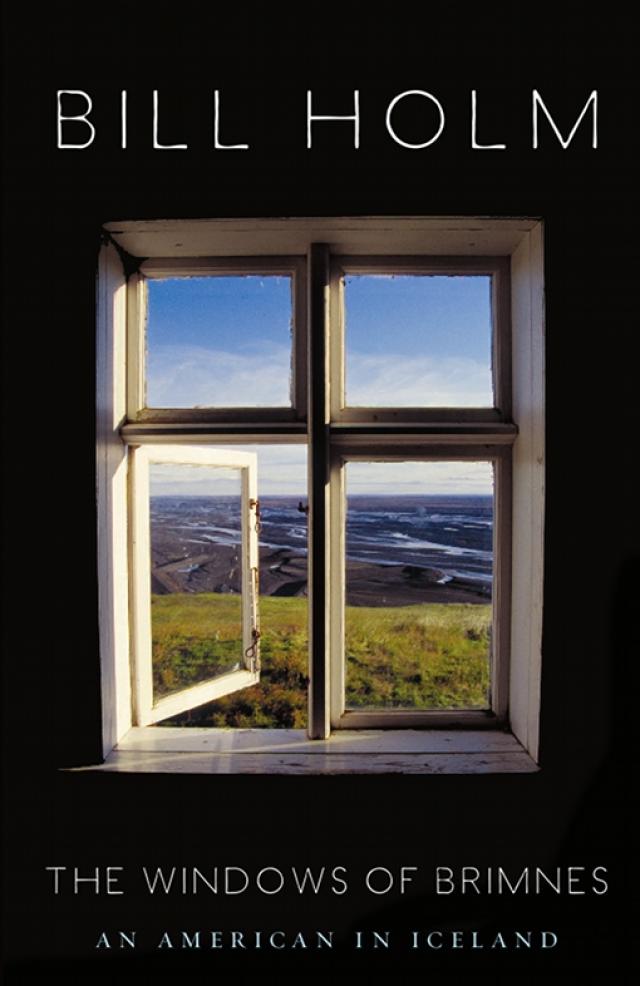
Table of Contents
ALSO BY BILL HOLM
Title Page
Dedication
THE WINDOWS OF BRIMNES
Acknowledgements
BRIMNES: NAME AND PLACE
SKAGAFJÖRÐUR
ETHEREAL FRIENDS
ELVES OUT THE WINDOWS
THE MELANCHOLY QUOTIENT
MINNEOTA: THE EARLY YEARS
SILENCE AND NOISE
A GIFT OF HORSES
CHRISTIANITY UNDER THE GLACIER
THE HOME OF POETRY
FOG
END NOTES
More Books from Bill Holm
Copyright Page
ALSO BY BILL HOLM
NONFICTION
Coming Home Crazy: An Alphabet of China Essays
Eccentric Islands: Travels Real and Imaginary
The Heart Can Be Filled Anywhere on Earth
POETRY
Boxelder Bug Variations
The Dead Get By with Everything
Playing the Black Piano
For Kristján Árnason, poet, carpenter, maker of beauty from wood and words, a representative type of the Icelandic farmer-intellectual who refused to let either isolation or poverty keep him from practicing his art.
THE WINDOWS OF BRIMNES
AN AMERICAN IN ICELAND
Brimnes: Name and Place 3
Skagafjörður 19
Ethereal Friends 31
Elves Out the Windows 63
The Melancholy Quotient 73
Minneota: The Early Years 109
Silence and Noise 131
A Gift of Horses 159
Christianity Under the Glacier 173
The Home of Poetry 189
Fog 203
No book is ever made without the wisdom and generosity of friends. I list them as the alphabet finds them. A thousand thanks.
David Arnason
Kristján Árnason
Margret and Örn Arnar
Sverrir Ásgrímsson
Fred Bjarnason
Carol Bly
Robert Bly
Marcy Brekken
Emilie Buchwald
Nelson Gerrard
Daren Gíslason
Hallgrímur Gunnarsson
Tom Guttormsson
Margret Kólka Haraldsdottir
Jón Baldvin Hannibalsson
Anna Sigga Helgadóttir
Víðar Hreinsson
Wincie Jóhannsdottir
Áslaug Jónsdottir
Cathy Josephson
Charles and Joan Josephson
Les and Donna Josephson
Jón Magnusson
Gail Perrizo
David Pichaske
Bryndís Schram
John and Lorna Rezmerski
Dagmar Ásdis Þorvaldsdottir
Þórnalur Þorvaldsson
Valgeir Þorvaldsson
Doris and Don Wenig
And of course,
Daniel Slager
Hilary Reeves
Emily Cook
Patrick Thomas
Jim Cihlar
And the whole gang at
Milkweed Editions
With particular thanks to the
Icelandic translation squad:
Wincie Jóhannsdottir
Margret Arnar
Margret Kólka Haraldsdottir
Wallgrímur Gunnarsson
Nelson Gerrard
Áslaug Jónsdottir
BRIMNES: NAME AND PLACE
In the summer of 2001, a journalist from St. Paul, Minnesota, a young woman with a sense of adventure, decided to spend a week touring Iceland. I invited her to stop by and see me in Hofsós. There’s no address, I said. There are only a few hundred people, and they will all know how to find the crazy American. Just ask for Brimnes. I’m next to the sea. And if you can’t find the sea, you’re out of luck.
She landed at Keflavík International Airport at 6:00 A.M., rented a car, and decided to drive straight north. She found Highway 1, Esja, the tunnel, the pass, even the country music station, and finally the turn off Highway 1 to Hofsós. The sun shone grandly. Wildflowers bloomed dependably in the ditches, the motor purred, and the sight of the sea and the mountains helped stave off the jet lag.
She drove north with open windows and a glad heart. Soon a drink, lunch, a nap, a friendly and familiar American face. Suddenly she hit the brakes and stopped, ten miles south of Hofsós. By the side of the road was a blue metal sign: ← Brimnes. It pointed toward the fjord to the east. He hadn’t said whether he lived right in town. This must be it. She turned west down a long gravel driveway, passed through a gate which she responsibly closed behind her, and arrived at a farmstead with a real barn, a corral of horses, a stack of hay bales wrapped in plastic, a tractor, but an empty yard. So he’s bought a farm, she thought, and got out to stretch her legs. Out from the barn came a young farmer in black rubber boots and a blood-soaked slicker. Behind him trotted his five- or six-year-old daughter, same rubber boots, same slicker, but smaller, carrying a bleeding sheep’s head.
“Is this Brimnes?” asked a now-confused Amy.
“Brimnes? Já. Þetta er Brimnes,” said the farmer, clearly astonished at the sound of English, a language he probably neither speaks nor understands and also not the lingua franca of the neighborhood. The little girl with the sheep’s head examined the pretty young foreigner in the shiny rental car. “Go to the house and fetch your mother,” said the farmer in Icelandic to his daughter. “She understands a little English.”
Soon the mother emerged, wiping floury hands on her apron. Amy explained again that she was looking for Bill Holm, an American living at Brimnes. “Oh, not this Brimnes,” said the mother in halting English. “Kannski hann býr in town Hofsós, fifteen kilometers north. Brimnes there too, I think.”
Amy thanked the family in her best English, apologizing, with her sweetest American smile, for interrupting the sheep butchering, and drove back down the way she came, carefully closing the gate behind her. Fifteen minutes later she found me, not in Brimnes but rather at the end of a telephone line. She’d stopped at the little general store (the only store in Hofsós), and when she inquired after Bill Holm, Dagný, the blond clerk and postmistress’s daughter, told her I was probably having coffee down at the Icelandic Emigration Center, but that she’d ring there and track me down. All this, much to Amy’s relief, in fluent English. I was summoned to the phone. “Did you have a good trip up? You must be half-dead of jet lag.”
“I had a little adventure,” said Amy.
“Such is life in Iceland. One of its great pleasures, in fact.”
This had been Amy’s first experience with the Icelanders’ habit of naming every farm, every house, and of course every rock, rise, gully, and bay in this mostly empty landscape. Brim means waves or surf breaking on the beach, nes means cape, promontory, or headland, thus Brimnes—a miniature peninsula. Most of the country lives within spitting distance of salt water, which means there must be at least fifty Brimneses scattered over all districts of Iceland. Names repeat themselves endlessly: a hundred Hrauns (lava); farms called Vatn (lake or water), Bær (farmstead), Brú (bridge), and Ós (river’s mouth). The local trolls worship at many churches: the mountain Tröllakirkja. Or perhaps they dine at the west fjord rocks called Trollasamlokur—“troll sandwiches.” And as with places, so with humans. I was once kissed by eight Guðrúns in one night, and shook hands with a dozen Björns. Are Americans short of Johns and Marys?
Without a name, does a place exist? And what is the right name? And who is the right giver of names? Iceland is, if not the last, one of the few countries in the world to use a system of patronymics, in which the first name is the real identifier and the last only a temporary convenience used to establish connections between generations. If you wish to find a Guðrún or a Björn in Iceland, you must consult the telephone directory by first name. You may find twenty Guðrún Björnsdóttirs in Reykjavík alone. Start ringing at the top of the list. Good luck. Eventually one of the Guðrúns will know the one you are looking for and provide you with the right number. With 300,000-odd Icelanders, anonymity may be completely impossible. An American can disappear and invent a new name, a new identity, but don’t try it in Iceland. Someone will know....
Houses in country villages have names as well. Many farms have had the same name for a thousand years, even if the existing turf house has actually been built upon the remains of another. After all, it has been the same old Höfði (headland) since 974.
“Ah, Friðrik from Höfði—just north of Vatn and south of Lónkot.”
“Ah, you have bought Brimnes. Björn Björnsson, the doctor, was born there. Eight children grew up in that tiny house. Their father was a fisherman—so handy to the harbor.”
“You know Sölvi Helgason lived at Skálá the last few years of his life. Died in—what?—1895. Never could get along with the sheriff ’s daughter who owned the farm. Friðrik Þór owns it now.”
“You know a great poet once lived at Sléttuhlíð. When? The eighteenth century.”
These names comprise a sveit—a word, according to my friend Elva Friðriksdóttir, untranslatable into English. The dictionary mumbles about “country, neighborhood, rural district, municipality, community, parish . . . ,” but when she talks about her sveit, Elva does not slap her forehead or stomp her foot. She strikes her heart. Sveit is what connects you to the earth, to history, to nature, to humanity.
Elva’s sveit begins at her father’s farm, Höfði,
Is sveit an impossible notion for Americans, with our tiny history, our broken connections to any past, our indifference to nature (if money is to be made), our internal itchiness to keep moving and reinvent ourselves? An old friend of mine in Minnesota who used to live on a lake miles from any village now lives not at the old Peterson place, or at RR #2, Hawk Lake, but at 15631 469th Ave. SE in the nearest market town of over ten thousand. No use giving his house a name, since the post only arrives with a minimum of twenty anonymous numbers. There are too many of us, and we are too hard to keep track of. We like to put things in numerical order, in case the authorities should need us suddenly.
After the horrors of September 11, Americans became obsessed with security—internal security, or, to use the sentimental euphemism, homeland security. Yet if we examine our true perceptions without fear of hysteria, almost everyone knows that thumbprints, hidden cameras, scanners, national ID’s, armed national guards, wiretaps, X-rayed shoes, and other draconian invasions of personal privacy cannot make us safe. Handing over vast power to a secret police apparatus will not allow us to sleep more soundly in our personal beds or to attend to our daily business without fear. True civilization, true security, depends on a level of trust between neighbors that Americans seem willing to barter away at the summons of any skillful sloganeer.
Neighbors know each other’s names. They know not only the houses but also the history of the houses in their sveit: “The Van Keulens moved out to the old Josephson farm—not J.A.’s—it was S. Frank’s dad, Árni, who built that house.” They know one another’s children and welcome them into their houses, not to protect them from dangerous strangers but to feed them, pat them on the head, or keep them out of the tomatoes. Does this seem cockamamie foolishness to you—some sentimental voice from a long-lost golden age? If so, then our sense of civility has fallen into such disrepair that not even fifty trillion dollars’ worth of electronic guard gizmos and internal security forces can save us.
Not only are we too many, we make our vast numbers worse by clumping. Even worse, we swear fealty to our companies, our employers, rather than to our neighbors. The hand that signs your check (or the electronic substitute for that hand) is not your friend nor your neighbor, no matter how many cheerful greetings or “nice days” it wishes you. On the other hand, your neighbor Bob, who dislikes you, probably wishes that a truck would back into your Chevy or that you’d sprain your ankle in the unfilled pothole in the sidewalk. That, though, is a far friendlier and safer gesture than any anonymous institution will ever give you. At least Bob does not mean to murder you anonymously with some sort of newly invented bomb. Anonymous murder is the vilest of all assaults on civilization. Kill Bob if you please; that’s human. Just be sure to take the trouble to find out his shoe size and his mother’s maiden name before you do it. Otherwise, leave him alone to stew in his own life.
So, having now been properly harangued on the subjects of anonymity and neighborliness, you should begin to discern not only the physical but the psychological virtue of living in a properly named house. Having arrived, like Amy, at the right Brimnes, you should know something of the house, its history, its architecture, its neighbors, its location on the planet, and what can be seen out its windows.
I first saw Hofsós because a choir-mate of an old friend was working there as Director of the Vesturfarasetrið (the Icelandic Emigration Center). A carload of friends arrived on a sunny June midafternoon, the season of endless light. We met Dísa (Vigdís Esradóttir, soprano and Director of the Center). We met Valgeir Þorvaldsson, the impresario of Hofsós who had conceived the notion of a museum and genealogy center in his collapsing though beautiful hometown—his sveit. Farming and fishing no longer keep the district children from disappearing into Reykjavík, or abroad. It is the same, endless story of small, out-of-the-way places. It is the same in America, in Canada, in Europe, and all over the planet: who wants to live in the boondocks, even beautiful boondocks? Even if those boondocks are your sveit? Valgeir, a carpenter by training and inclination, had worked for the county on a couple of historical projects and had now begun buying old, half-collapsed fisherman’s cottages set helter-skelter on a lumpy hillside above the mouth of the Hof River. At the top of the steep little hill, a newer, more modern concrete town had grown up. A few businesses: bank, post office, garage, cooperative store, church, school, community hall, soccer field, and muffler factory. Just another dying small place, thirty miles off the main road.
The original village at the bottom of the hill consisted of fifteen or twenty unmatched houses in various states of repair. Some had been moved there from another site a half mile south, where yet another noisy glacial river, the Grafará, had made a little, sheltered nest of grass at its mouth—now only a few ruined lumps and cavities carpeted with wildflowers. The two sites were thousand-year-old Viking trading posts for the north fjords, and had been a single named village since the sixteenth century. The Viking longboats would bring their goods to anchor at the river’s mouth and trade with the local farmers for dried fish, hides, wool, and smoked meat. Books must have been traded, too, and then carried to the rest of Iceland by water. The first printing press in the country was ten miles away in the prosperous Hólar Valley, site of the northern episcopate of Iceland.
The little fishing harbor on the north side of the river’s mouth has been much improved over the centuries, with the addition of a stone breakwater, regular dredging, and a clearly marked channel. Still, at the outset of the twenty-first century, just four fishing boats called it home—and only one of them was large enough (or in possession of enough valuable fish quotas) to provide a true living. Yet the fjord itself has long been chockablock with cod, along with a nice scattering of haddock, halibut, catfish, and sea trout. At the top of the gravel road going up the hill to the north of the harbor sat a fish-salting station, barrels of cod on their way to becoming twenty-five-dollar-a-plate bacalao served with a coulis of tomatoes and peppers a la Español.
The sveit still kept intact its old economic resources—the sea harvest; the rich, grassy meadows that nourished the sheep and dairy cattle; the cream of Icelandic horse stocks; the cliffs abundant with eggs and tasty seabirds. The neighbors were literate and kindly, and there were overstuffed bookshelves in almost every house. There were local singers of high repute and skill, and even local writers who published small volumes of well-made, old-fashioned verse. One of them, an unschooled carpenter who wrote well in three languages—Icelandic, English, and Danish—had won literary prizes in Reykjavík newspapers.
All this and the majesty out every window: huge mountains, the multicolored sea, the glaciers, noisy rivers surging fjord-ward over a bed of symmetrical columnar basalt, the cliffs, the decorator islands, the wildflowers and sweet grass in season, not to mention the three-month-long daylight. If you had to choose a sveit, this would be a tempting possibility. But usually a sveit chooses you, and so it had chosen Valgeir—thus he carpentered away on the old houses, then put on his necktie to go raise funds from government, business, immigrant groups from North America, anybody who might stock Skagafjörður with cash enough to keep this sveit alive and flourishing.


