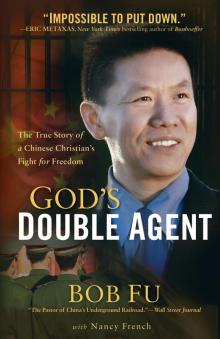
Gods double agent, p.6
God's Double Agent, page 6


My sister and I spent a little more time with her body before we called out to the others that she’d died. Afterward, we all left the hospital and went home. It was the same little house I remembered from my childhood, but it felt oddly vacant without my mother’s presence. There was the courtyard, the sitting room, the stove on which many aromatic meals had been made. And yes, there was the kang, the place she’d spent so much of her life. My little shovel was propped up beside her bed.
When I saw that shovel, I wept. Next to the kang was a hole in the floor. I’d dug it so gradually—cough by cough—over her many years of infirmity, I was surprised when I really looked at the hole.
It was three feet deep.
5
“Read this letter,” Heidi said to me, handing me a piece of paper covered with Chinese lettering. She looked as though she had been crying.
“For me?” I said, a little confused. Heidi had become a good friend and an excellent writer for the newspaper, but we’d never had conversations of a personal nature. She was smart, and could hold her own against any male student.
“Sadly, it’s for me,” she said, looking away so I couldn’t see her eyes fill with tears. I felt slightly panicked when I saw that emotion. I immediately wanted to fix it, to do anything to stop the tears. “Remember the student I liked? Well, I broke down and told him of my affection.”
“And this is his response?” I asked.
She nodded, almost imperceptibly. “Just read it.”
It was an act of trust. As I read the letter, which basically explained that a relationship between the two of them wasn’t possible, my heart softened toward Heidi. Suddenly, instead of looking at the girls sitting near the front of class, I began to see only one girl.
Over the course of the next few weeks, we started talking more.
“I think you’re very gentle,” she told me. “Very down to earth.”
It was against university rules for students to date and against Chinese law for students to marry. But suddenly, I thought of nothing else.
In China, people don’t date one person after another until they find that almost magical “soul mate.” Usually, we would have only a few serious dating relationships before getting married, so dating was a very sober undertaking for us. I began to feel Heidi was my destiny, so I tucked the adoration I felt for her into my heart. There, in privacy, it grew.
“I’m going for a walk,” I’d tell my roommates on the way to meet her downstairs.
For weeks, we’d arrange clandestine meetings across campus, hoping no one would notice we were always together. Having a forbidden romance was pretty invigorating. There was nothing quite like meeting Heidi’s eyes across class and knowing we shared such an intimate secret. I did tell one person, however. In one of my regular letters to my father, I mentioned I was very interested in a girl named Heidi. A few weeks later, I received a note back from him.
“Dear Xiqiu,” he wrote. “Thank you for your letter updating me on all that you’re doing at college. I encourage you, of course, to pay attention to your studies and not to get distracted by extracurricular activities.”
“Extracurricular activities” was apparently my dad’s euphemism for dating, and he seemed willing to tolerate it if I kept it within the right balance.
I figured we weren’t the only ones with a secret romance. Occasionally, I’d notice a couple walking around the school’s racetrack together. If they walked slowly, I knew they weren’t there for the exercise. Sometimes I’d see people holding hands in the quad. At night, under the cover of darkness, couples nuzzled on the steps of the library. In fact, one day, we were all called to a meeting by the party secretary of the English department.
“Apparently, some of you are ignoring the very reasonable rule that dating is not allowed on this campus,” he sternly announced. “In fact, recently campus security discovered several lights knocked over. These lights—which are very expensive, by the way—were put there to make sure our campus is safe. Yet, for the sake of kissing in the quad . . .” He said the word kissing with such distaste that one might have thought he said defecating. “Someone took it upon himself to break our campus lights.”
He paused and looked around the room to intimidate the kissing criminals.
“And so, I’d like to take this opportunity to remind everyone of a simple fact,” he said, straightening his back in indignation. “Dating is not the purpose of college.”
The university made sure the lights were back up within the week, and the campus police began walking around with flashlights, hoping to stem the raging hormones on the library steps and in other dark corners of the campus. Eventually, the students realized we had the upper hand. After all, there were so many covert relationships the university couldn’t punish everybody. Gradually, people began holding hands in public. Then, a few weeks later, people came out and simply announced their relationships.
“Really?” I said, when my roommate told me he was dating a beautiful girl in the Chinese lit department. “You hid it very well!” I didn’t admit my surprise was mainly due to the fact that I assumed she’d find a more attractive mate.
When Heidi and I told our friends that we were dating, their mouths dropped open too. “You?” Joseph said. “And you?”
Apparently, we had hid our affection very well, because people were shocked. The person who was the most shocked was Heidi’s dad, who used to be a teacher too but had been imprisoned for five years during the Cultural Revolution for a crime he didn’t commit. While in jail, he lost his job teaching at a government school. Even though all criminal charges were dropped after the revolution, it was too late. His reputation was forever marred and he was damaged beyond repair. In China, children bear the responsibility for their parents’ care, so his hope for the future of his family was placed squarely on Heidi’s shoulders. He hoped Heidi would marry someone who could make some money.
“Dear Bochun,” he wrote, after she revealed our relationship in a letter home. “I urge you to find someone else. Someone who can work in the capital city of our province, bring home a nice paycheck, and be respected in our community.” We were walking to class together as she read it aloud to me. “That way our family can have a better future.”
“He doesn’t have much confidence in me,” I said, though I understood why her father placed such an emphasis on having a good reputation. “But I promise I’ll go to grad school, focus on international relations, and make a good living for us.”
I smiled as I assured her that I could pull it all off. However, the number of people who were already depending on my future salary was growing. My dad, my sister, Heidi, Heidi’s parents, and possibly her siblings. And that was not including any children Heidi and I might have.
And so, I continued to focus on my international studies during the evening, after doing all of my other English homework. I developed a friendship with a Chinese literature student named Bruce, who was the son of a political leader. Because of his dad’s position, he was more interested in government and could speak more intelligently about it than most people. I enjoyed his company, so I told him of my future plans for grad school, and we spent many hours discussing world affairs.
In 1988, we got to see some political affairs being acted out right there in China. A nationwide outcry against the poor treatment of teachers erupted all over the country, and students began protesting the widespread government corruption.
“Why won’t the government help the teachers?” I asked Bruce one day while we ate lunch in the cafeteria. “Aren’t the teachers the guides of the souls of children?”
“I don’t know,” he responded, thinking while he chewed. “But they don’t have the resources to teach. The whole nation—even the party secretary—admits teachers are paid too little. Want to orchestrate our own protest?”
“You organize the protest route,” I suggested. “I’ll try to come up with some catchy slogans.” We stayed up late, organizing friends from the dorm to help, and thinking of ways to get our message into the community. The next morning, I went to the university’s propaganda department to get the permit.
“We’d like to submit our plan for a protest,” I said at the counter.
“You want to do what?” he said, looking at the signs we’d made, which were leaning up against the wall. “You can’t walk around with those. We’ll solve the problem within the system.”
“The system,” of course, was communism. Though I hadn’t joined the Communist Party yet, I assumed I would one day. We used to say, “Join the party in order to change the party.”
“This is ‘within the system,’” I argued. “Everyone agrees with us,” I said. “We are a teacher’s college. Don’t you think we should stand up for teachers? My professors agree with us, as does the president!”
“If you keep at this,” he said, lowering his voice in a menacing admonition, “you’ll face some real repercussions.”
With slumped shoulders and dashed hopes, Bruce and I walked slowly back to our dorm.
“I don’t understand,” I said. “We had it all planned out. It’s not like we were advocating for the overthrow of the government.”
“Maybe we should,” Bruce said, with an impish grin on his face. “Want to try to fight this?”
That was the last conversation I ever had with my friend. Within days, Bruce was “persuaded” to switch to another school. The school had told his dad, the political leader, that his son was out of control. He feared that his son was jeopardizing his political future, and so—just like that—he was gone. I was left confused and alone. Shouldn’t we fight for what’s right? We’re all future teachers, so why can’t we unite?
I tried to understand the propaganda department’s concern, and figured that the party official was simply confused on how to deal with the unrest. The protests went on for a while, which I followed in the news. Then, on April 15, 1989, the editor of the official school newspaper ran up to me on campus.
“Hu Yaobang is dead!” he said. Yaobang was the former Communist Party secretary who supported the 1986 student movement. My mind flashed back to high school, when I had read news of the story in my stolen newspaper.
“What happened?” I asked.
“It’s mysterious,” he said. “No one knows exactly, but he died right in the middle of a high-level Communist Party leaders’ meeting!”
“What were they discussing?” I asked.
“What else?” he said. “The education budget.”
“He must’ve sided with our teachers!” I said. I envisioned him standing in front of the group, passionately arguing for the rights of teachers. I imagined the hardliners fighting back against his rhetoric and him dropping dead of a heart attack.
The whole nation was shocked over news of Yaobang’s death, especially students. Spontaneous demonstrations of mourning caught the government off guard. After the 1986 student protests, he’d been ousted and had become something of a disgraced icon of reform. Completely bereft, I left my friend and went to be alone in my dorm. There, in the silence of my room, I got out a pen and paper and thought about the legacy of Hu Yaobang.
The words flowed out of me until the sun went down outside my window. By the time I finally turned off the light to go to sleep, I’d created a poignant tribute to the man who’d inspired so many students in China.
“Here,” I said the next day, when I saw my friend again. “For your consideration for publication.”
He took the poem from me, read it silently, and swallowed hard. “It’s perfect,” he said, fighting emotion. The official newspaper had a large distributorship beyond the school, and I smiled when I thought of all the people who’d read my tribute to the fallen leader.
The next day, the editor came to my dorm with a proof of the following day’s newspaper, used to catch typos before the school made the official copies.
“Look,” he said, holding up the proof of the paper. “Your poem will be front page, above the fold!” I grabbed the paper and admired the amazing placement. I read my poem again, this time aloud, enjoying the way the words rolled off my tongue. The poem was an imaginative interpretation of Hu Yaobang’s love of education and the circumstances that surrounded his death. It ended with a simple line: “We should all do more.”
That night, as I drifted off to sleep, I made plans to get several copies of the paper off the stands to show my friends and family. At midnight, however, a harsh banging on the door jolted me from sleep. I jumped out of my bunk bed, stumbled in the darkness, and flung open the door. My friend the editor stood there with a look of horror on his face.
“What have you gotten me into?” he asked.
“What do you mean?”
“We’re in big trouble,” he said. “We printed our newspapers and they’re already ready to be sent out to the school and other cities. But someone in the administration read your poem and recalled them all! We have to redo all of it!”
“Because of a poem?”
“Yes,” he said, exasperated. “I don’t understand it, but apparently they didn’t want to portray Hu Yaobang in such a positive light.”
I rubbed the remaining sleep from my eyes. Was this a dream? Would a teacher’s college really not let me honor the life of an education reformer? And why would they take such draconian steps to stop me?
“And there’s not enough time to do another print run of the paper without it,” he finished.
After he left, I tried to go back to sleep, but the trepidation in my spirit wouldn’t let me. I pulled the covers up to my chin and looked at the ceiling. Why would the administration consider a poem so dangerous?
Without any real answers, I decided I’d try to snatch a copy in the morning and get advice from the university president. Surely, this was some weird oversight or miscommunication. I laid there all night, nervous about what seemed to be a strange tightening of control over the students. When the morning finally came, I jumped down off my bunk bed, threw on some clothes, and headed down to the newspaper rack.
Another student, wearing jogging attire, was standing next to a completely empty newspaper rack. All of the copies had been destroyed during the night.
“Look at that,” he said. “I wonder why there aren’t any papers today.”
A lump caught in my throat as I responded.
“I honestly don’t know.”
After that moment, I was shocked, confused, and more than a little angry. After Hu Yaobang’s mysterious death, some students had gathered at Tiananmen Square to try to get the government to reassess his legacy and to honor the man’s life. One week after his death, there were one hundred thousand students gathered there for his memorial service. But this spontaneous public mourning had turned into a nationwide protest for political reform and against all the Party corruption. The students held hunger strikes and demanded government accountability and freedom of speech and press. Though some of our American professors were nervous about the unrest, no one else really seemed to give the events in Beijing much thought. It didn’t affect their grades, after all.
One evening, as I walked into an auditorium filled with studying students, I got so frustrated that I made a rather rash decision. I reached for the light switch and turned it off.
The lights flickered, then went completely dark. I heard a few gasps coming from the now dark room.
“Do I have your attention?” I yelled into the dark auditorium. “Why are you so numb?”
“Turn the lights back on,” a guy in the back of the room yelled. “Unless you’re going to take my exam for me.”
Some students giggled.
“I’ll turn them back on, after you hear me out,” I said. “Don’t you know the Beijing students are already acting for our country’s future? And yet, you sit here? You, who still have the luxury of studying. But how can you just sit, with your books open on your desks like nothing is going on in the world?”
No one spoke, but I could tell by the silence that the students began listening. I flicked the lights back on. “You’re so concerned about your grades and your future, but you aren’t willing to fight for it. Come on, everyone. Let’s go!”
Amazingly, a student in the back of the auditorium got up. Then, another. And another. Pretty soon, a large number of students followed me right out of the room and out into the campus. This time, I didn’t care about a permit. We were advocating for the right things, and I wasn’t going to be stopped because I didn’t have the right piece of paper.
“Anti-corruption!” we yelled as we walked down the streets. As we marched, our numbers swelled.
“Xiqiu!” I heard from a side street. When I turned around and saw the man from the propaganda department running toward me, I was ready to defend myself. After all, he had previously admonished me in an ominous tone, threatening me. Dread filled me, but I tried to push it out of my mind. They couldn’t make me disappear like they had Bruce. After all, there were even professors walking alongside us!
“You can’t stop me,” I said, preemptively. “What we’re saying is good and right.”
“We don’t want to stop you,” he said, a little out of breath. Behind him, a guy carrying two portable speakers emerged. “We want to join you!” The student protest in Beijing seemed to have softened the whole nation. There was something about the peaceful protest that penetrated the very essence of the nation.
We took the loudspeakers and continued our march, drawing even more people out of the dorms and classrooms. Students from all levels and disciplines joined me. Even more teachers followed.
“Look!” someone yelled, pointing to a university car following slowly behind the parade. “It’s President Ming!” The president of the school, my friend and ally, waved out his window at me. It made me walk even faster and shout even louder. After all, I knew he’d be on our side.
“Higher wages!” we yelled.
The campus the next morning was electrified by the protests. People began to skip classes in solidarity with the Beijing students. One friend hung a bedsheet from his window with the word freedom written in his own blood.
When I saw that shovel, I wept. Next to the kang was a hole in the floor. I’d dug it so gradually—cough by cough—over her many years of infirmity, I was surprised when I really looked at the hole.
It was three feet deep.
5
“Read this letter,” Heidi said to me, handing me a piece of paper covered with Chinese lettering. She looked as though she had been crying.
“For me?” I said, a little confused. Heidi had become a good friend and an excellent writer for the newspaper, but we’d never had conversations of a personal nature. She was smart, and could hold her own against any male student.
“Sadly, it’s for me,” she said, looking away so I couldn’t see her eyes fill with tears. I felt slightly panicked when I saw that emotion. I immediately wanted to fix it, to do anything to stop the tears. “Remember the student I liked? Well, I broke down and told him of my affection.”
“And this is his response?” I asked.
She nodded, almost imperceptibly. “Just read it.”
It was an act of trust. As I read the letter, which basically explained that a relationship between the two of them wasn’t possible, my heart softened toward Heidi. Suddenly, instead of looking at the girls sitting near the front of class, I began to see only one girl.
Over the course of the next few weeks, we started talking more.
“I think you’re very gentle,” she told me. “Very down to earth.”
It was against university rules for students to date and against Chinese law for students to marry. But suddenly, I thought of nothing else.
In China, people don’t date one person after another until they find that almost magical “soul mate.” Usually, we would have only a few serious dating relationships before getting married, so dating was a very sober undertaking for us. I began to feel Heidi was my destiny, so I tucked the adoration I felt for her into my heart. There, in privacy, it grew.
“I’m going for a walk,” I’d tell my roommates on the way to meet her downstairs.
For weeks, we’d arrange clandestine meetings across campus, hoping no one would notice we were always together. Having a forbidden romance was pretty invigorating. There was nothing quite like meeting Heidi’s eyes across class and knowing we shared such an intimate secret. I did tell one person, however. In one of my regular letters to my father, I mentioned I was very interested in a girl named Heidi. A few weeks later, I received a note back from him.
“Dear Xiqiu,” he wrote. “Thank you for your letter updating me on all that you’re doing at college. I encourage you, of course, to pay attention to your studies and not to get distracted by extracurricular activities.”
“Extracurricular activities” was apparently my dad’s euphemism for dating, and he seemed willing to tolerate it if I kept it within the right balance.
I figured we weren’t the only ones with a secret romance. Occasionally, I’d notice a couple walking around the school’s racetrack together. If they walked slowly, I knew they weren’t there for the exercise. Sometimes I’d see people holding hands in the quad. At night, under the cover of darkness, couples nuzzled on the steps of the library. In fact, one day, we were all called to a meeting by the party secretary of the English department.
“Apparently, some of you are ignoring the very reasonable rule that dating is not allowed on this campus,” he sternly announced. “In fact, recently campus security discovered several lights knocked over. These lights—which are very expensive, by the way—were put there to make sure our campus is safe. Yet, for the sake of kissing in the quad . . .” He said the word kissing with such distaste that one might have thought he said defecating. “Someone took it upon himself to break our campus lights.”
He paused and looked around the room to intimidate the kissing criminals.
“And so, I’d like to take this opportunity to remind everyone of a simple fact,” he said, straightening his back in indignation. “Dating is not the purpose of college.”
The university made sure the lights were back up within the week, and the campus police began walking around with flashlights, hoping to stem the raging hormones on the library steps and in other dark corners of the campus. Eventually, the students realized we had the upper hand. After all, there were so many covert relationships the university couldn’t punish everybody. Gradually, people began holding hands in public. Then, a few weeks later, people came out and simply announced their relationships.
“Really?” I said, when my roommate told me he was dating a beautiful girl in the Chinese lit department. “You hid it very well!” I didn’t admit my surprise was mainly due to the fact that I assumed she’d find a more attractive mate.
When Heidi and I told our friends that we were dating, their mouths dropped open too. “You?” Joseph said. “And you?”
Apparently, we had hid our affection very well, because people were shocked. The person who was the most shocked was Heidi’s dad, who used to be a teacher too but had been imprisoned for five years during the Cultural Revolution for a crime he didn’t commit. While in jail, he lost his job teaching at a government school. Even though all criminal charges were dropped after the revolution, it was too late. His reputation was forever marred and he was damaged beyond repair. In China, children bear the responsibility for their parents’ care, so his hope for the future of his family was placed squarely on Heidi’s shoulders. He hoped Heidi would marry someone who could make some money.
“Dear Bochun,” he wrote, after she revealed our relationship in a letter home. “I urge you to find someone else. Someone who can work in the capital city of our province, bring home a nice paycheck, and be respected in our community.” We were walking to class together as she read it aloud to me. “That way our family can have a better future.”
“He doesn’t have much confidence in me,” I said, though I understood why her father placed such an emphasis on having a good reputation. “But I promise I’ll go to grad school, focus on international relations, and make a good living for us.”
I smiled as I assured her that I could pull it all off. However, the number of people who were already depending on my future salary was growing. My dad, my sister, Heidi, Heidi’s parents, and possibly her siblings. And that was not including any children Heidi and I might have.
And so, I continued to focus on my international studies during the evening, after doing all of my other English homework. I developed a friendship with a Chinese literature student named Bruce, who was the son of a political leader. Because of his dad’s position, he was more interested in government and could speak more intelligently about it than most people. I enjoyed his company, so I told him of my future plans for grad school, and we spent many hours discussing world affairs.
In 1988, we got to see some political affairs being acted out right there in China. A nationwide outcry against the poor treatment of teachers erupted all over the country, and students began protesting the widespread government corruption.
“Why won’t the government help the teachers?” I asked Bruce one day while we ate lunch in the cafeteria. “Aren’t the teachers the guides of the souls of children?”
“I don’t know,” he responded, thinking while he chewed. “But they don’t have the resources to teach. The whole nation—even the party secretary—admits teachers are paid too little. Want to orchestrate our own protest?”
“You organize the protest route,” I suggested. “I’ll try to come up with some catchy slogans.” We stayed up late, organizing friends from the dorm to help, and thinking of ways to get our message into the community. The next morning, I went to the university’s propaganda department to get the permit.
“We’d like to submit our plan for a protest,” I said at the counter.
“You want to do what?” he said, looking at the signs we’d made, which were leaning up against the wall. “You can’t walk around with those. We’ll solve the problem within the system.”
“The system,” of course, was communism. Though I hadn’t joined the Communist Party yet, I assumed I would one day. We used to say, “Join the party in order to change the party.”
“This is ‘within the system,’” I argued. “Everyone agrees with us,” I said. “We are a teacher’s college. Don’t you think we should stand up for teachers? My professors agree with us, as does the president!”
“If you keep at this,” he said, lowering his voice in a menacing admonition, “you’ll face some real repercussions.”
With slumped shoulders and dashed hopes, Bruce and I walked slowly back to our dorm.
“I don’t understand,” I said. “We had it all planned out. It’s not like we were advocating for the overthrow of the government.”
“Maybe we should,” Bruce said, with an impish grin on his face. “Want to try to fight this?”
That was the last conversation I ever had with my friend. Within days, Bruce was “persuaded” to switch to another school. The school had told his dad, the political leader, that his son was out of control. He feared that his son was jeopardizing his political future, and so—just like that—he was gone. I was left confused and alone. Shouldn’t we fight for what’s right? We’re all future teachers, so why can’t we unite?
I tried to understand the propaganda department’s concern, and figured that the party official was simply confused on how to deal with the unrest. The protests went on for a while, which I followed in the news. Then, on April 15, 1989, the editor of the official school newspaper ran up to me on campus.
“Hu Yaobang is dead!” he said. Yaobang was the former Communist Party secretary who supported the 1986 student movement. My mind flashed back to high school, when I had read news of the story in my stolen newspaper.
“What happened?” I asked.
“It’s mysterious,” he said. “No one knows exactly, but he died right in the middle of a high-level Communist Party leaders’ meeting!”
“What were they discussing?” I asked.
“What else?” he said. “The education budget.”
“He must’ve sided with our teachers!” I said. I envisioned him standing in front of the group, passionately arguing for the rights of teachers. I imagined the hardliners fighting back against his rhetoric and him dropping dead of a heart attack.
The whole nation was shocked over news of Yaobang’s death, especially students. Spontaneous demonstrations of mourning caught the government off guard. After the 1986 student protests, he’d been ousted and had become something of a disgraced icon of reform. Completely bereft, I left my friend and went to be alone in my dorm. There, in the silence of my room, I got out a pen and paper and thought about the legacy of Hu Yaobang.
The words flowed out of me until the sun went down outside my window. By the time I finally turned off the light to go to sleep, I’d created a poignant tribute to the man who’d inspired so many students in China.
“Here,” I said the next day, when I saw my friend again. “For your consideration for publication.”
He took the poem from me, read it silently, and swallowed hard. “It’s perfect,” he said, fighting emotion. The official newspaper had a large distributorship beyond the school, and I smiled when I thought of all the people who’d read my tribute to the fallen leader.
The next day, the editor came to my dorm with a proof of the following day’s newspaper, used to catch typos before the school made the official copies.
“Look,” he said, holding up the proof of the paper. “Your poem will be front page, above the fold!” I grabbed the paper and admired the amazing placement. I read my poem again, this time aloud, enjoying the way the words rolled off my tongue. The poem was an imaginative interpretation of Hu Yaobang’s love of education and the circumstances that surrounded his death. It ended with a simple line: “We should all do more.”
That night, as I drifted off to sleep, I made plans to get several copies of the paper off the stands to show my friends and family. At midnight, however, a harsh banging on the door jolted me from sleep. I jumped out of my bunk bed, stumbled in the darkness, and flung open the door. My friend the editor stood there with a look of horror on his face.
“What have you gotten me into?” he asked.
“What do you mean?”
“We’re in big trouble,” he said. “We printed our newspapers and they’re already ready to be sent out to the school and other cities. But someone in the administration read your poem and recalled them all! We have to redo all of it!”
“Because of a poem?”
“Yes,” he said, exasperated. “I don’t understand it, but apparently they didn’t want to portray Hu Yaobang in such a positive light.”
I rubbed the remaining sleep from my eyes. Was this a dream? Would a teacher’s college really not let me honor the life of an education reformer? And why would they take such draconian steps to stop me?
“And there’s not enough time to do another print run of the paper without it,” he finished.
After he left, I tried to go back to sleep, but the trepidation in my spirit wouldn’t let me. I pulled the covers up to my chin and looked at the ceiling. Why would the administration consider a poem so dangerous?
Without any real answers, I decided I’d try to snatch a copy in the morning and get advice from the university president. Surely, this was some weird oversight or miscommunication. I laid there all night, nervous about what seemed to be a strange tightening of control over the students. When the morning finally came, I jumped down off my bunk bed, threw on some clothes, and headed down to the newspaper rack.
Another student, wearing jogging attire, was standing next to a completely empty newspaper rack. All of the copies had been destroyed during the night.
“Look at that,” he said. “I wonder why there aren’t any papers today.”
A lump caught in my throat as I responded.
“I honestly don’t know.”
After that moment, I was shocked, confused, and more than a little angry. After Hu Yaobang’s mysterious death, some students had gathered at Tiananmen Square to try to get the government to reassess his legacy and to honor the man’s life. One week after his death, there were one hundred thousand students gathered there for his memorial service. But this spontaneous public mourning had turned into a nationwide protest for political reform and against all the Party corruption. The students held hunger strikes and demanded government accountability and freedom of speech and press. Though some of our American professors were nervous about the unrest, no one else really seemed to give the events in Beijing much thought. It didn’t affect their grades, after all.
One evening, as I walked into an auditorium filled with studying students, I got so frustrated that I made a rather rash decision. I reached for the light switch and turned it off.
The lights flickered, then went completely dark. I heard a few gasps coming from the now dark room.
“Do I have your attention?” I yelled into the dark auditorium. “Why are you so numb?”
“Turn the lights back on,” a guy in the back of the room yelled. “Unless you’re going to take my exam for me.”
Some students giggled.
“I’ll turn them back on, after you hear me out,” I said. “Don’t you know the Beijing students are already acting for our country’s future? And yet, you sit here? You, who still have the luxury of studying. But how can you just sit, with your books open on your desks like nothing is going on in the world?”
No one spoke, but I could tell by the silence that the students began listening. I flicked the lights back on. “You’re so concerned about your grades and your future, but you aren’t willing to fight for it. Come on, everyone. Let’s go!”
Amazingly, a student in the back of the auditorium got up. Then, another. And another. Pretty soon, a large number of students followed me right out of the room and out into the campus. This time, I didn’t care about a permit. We were advocating for the right things, and I wasn’t going to be stopped because I didn’t have the right piece of paper.
“Anti-corruption!” we yelled as we walked down the streets. As we marched, our numbers swelled.
“Xiqiu!” I heard from a side street. When I turned around and saw the man from the propaganda department running toward me, I was ready to defend myself. After all, he had previously admonished me in an ominous tone, threatening me. Dread filled me, but I tried to push it out of my mind. They couldn’t make me disappear like they had Bruce. After all, there were even professors walking alongside us!
“You can’t stop me,” I said, preemptively. “What we’re saying is good and right.”
“We don’t want to stop you,” he said, a little out of breath. Behind him, a guy carrying two portable speakers emerged. “We want to join you!” The student protest in Beijing seemed to have softened the whole nation. There was something about the peaceful protest that penetrated the very essence of the nation.
We took the loudspeakers and continued our march, drawing even more people out of the dorms and classrooms. Students from all levels and disciplines joined me. Even more teachers followed.
“Look!” someone yelled, pointing to a university car following slowly behind the parade. “It’s President Ming!” The president of the school, my friend and ally, waved out his window at me. It made me walk even faster and shout even louder. After all, I knew he’d be on our side.
“Higher wages!” we yelled.
The campus the next morning was electrified by the protests. People began to skip classes in solidarity with the Beijing students. One friend hung a bedsheet from his window with the word freedom written in his own blood.