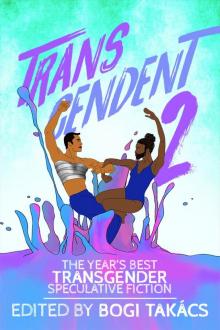
Transcendent 3, p.1
Transcendent 3, page 1


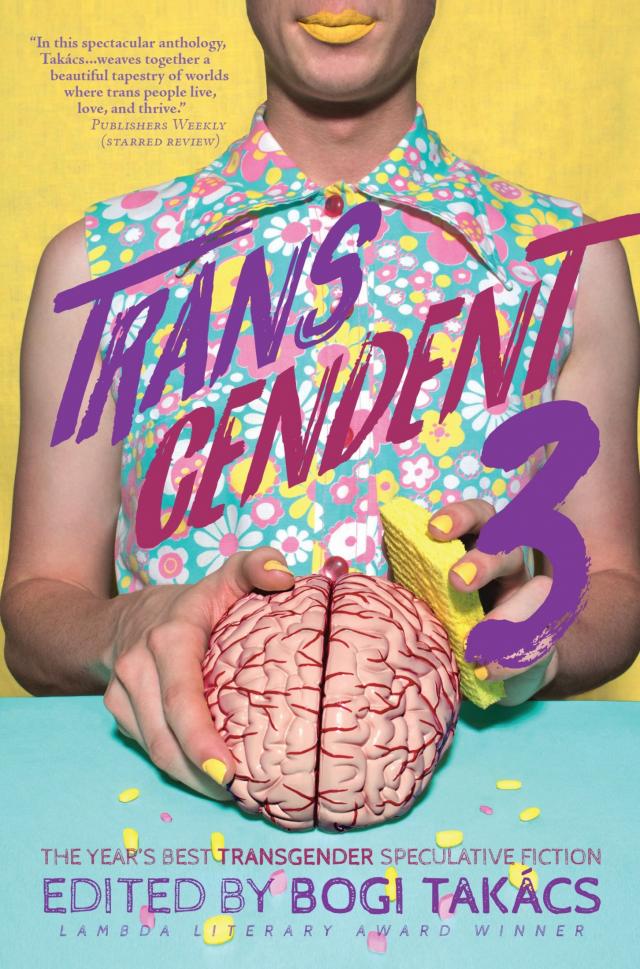
Table of Contents
Transcendent 3
Copyright
Foreword | Bogi Takács
The Chameleon's Gloves | Yoon Ha Lee
Death You Deserve | Ryley Knowles
Fire Filles the Belly | Noa Josef Sperber
Small Changes over Long Periods of Time | K.M. Szpara
Heath Death of Western Human Arrogance | M. Téllez
Praying to the God of Small Chances | L Chan
The Mouse | Larissa Glasser
Cooking with Closed Mouths | Kerry Truong
World of the Three | Shweta Narayan
A Spell to Signal Home | A.C. Buchanan
Feed | Rivers Solomon
Hello, World! | Polenth Blake
A Splendid Goat Adventure | Rose Lemberg
A Complex Filament of Light | S. Qiouyi Lu
Minor Heresies | Ada Hoffmann
The Heavy Things | Julian K. Jarboe
Don't Press Charges and I Won't Sue | Charlie Jane Anders
The Worldless | Indapramit Das
The Heart's Cartographer | Susan Jane Bigelow
The Contributors
About the Editor
Publication Credits
Transcendent 3
Transcendent 3
The Year’s Best Transgender Speculative Fiction
Edited by Bogi Takács
Lethe Press
Amherst, Massachusetts
Transcendent 3
Compilation copyright © 2018 Lethe Press, Inc. Introduction copyright © 2018 Bogi Takács. ALL RIGHTS RESERVED. No part of this work may be reproduced or utilized in any form or by any means, electronic or mechanical, including photocopying, microfilm, and recording, or by any information storage and retrieval system, without permission in writing from the publisher.
Published in 2018 by Lethe Press, Inc. at Smashwords.com
www.lethepressbooks.com • lethepress@aol.com
ISBN: 978-1-59021-706-1 / 1-59021-706-3
Credits for previous publication appear here, which constitutes an extension of this copyright page.
These stories are works of fiction. Names, characters, places, and incidents are either products of the authors’ imaginations or are used fictitiously. Any resemblance to actual persons, living or dead, organizations, events, or locales is entirely coincidental.
Cover art: “Perfect Housewife” by L. Stiegman.
Cover design: Inkspiral Design.
Foreword
• Bogi Takács •
Welcome to the permanent revolution.
Speculative fiction with transgender themes has undergone an explosion in recent years, with dozens upon dozens of new stories every year. I considered eighty-eight stories while editing the previous volume of the Transcendent series, but in 2017 I found one hundred and forty-two eligible works—a huge increase. (This book is slightly longer than the preceding two volumes, to reflect this very welcome change.)
Trans themes are here to stay, trans writers are also here to stay. This is not a superficial trend. Work that has previously been excluded and repressed is now coming to light, and writers are creating with great enthusiasm and vehemence.
The stories in this year’s selection are sometimes grim, sometimes cheerful, sometimes quirky—but always full of emotion. From the dynamic space opera art thefts of “A Chameleon’s Gloves” to the devastating dystopia of “Don’t Press Charges and I Won’t Sue” to the hilarity of “A Splendid Goat Adventure,” a wide range of non-cis experiences are represented. Authors are expressing more and more of how transness can relate to other marginalizations, like diasporan existence in “Cooking with Closed Mouths” or mental illness in “A Complex Filament of Light.” The possibilities are endless—we can read about a neuroatypical genderfluid accountant in “Minor Heresies,” Mughal steampunk mechanical beings in “World of the Three,” or dysphoric trans vampires in “Small Changes over Large Periods of Time.” We can even see actual deities make appearance, as in “Praying to the God of Small Chances.”
Trans stories engage with and subvert an ever-wider variety of themes in speculative fiction. “The Heart’s Cartography” presents a unique take on time travel (I never expect to say ‘unique’ and ‘time travel’ in the same sentence!), while “Heat Death of Western Human Arrogance” takes colonialism head-on, and “Fire Fills the Belly” reflects on the underside of solarpunk-esque futures. “Feed” examines the intersection of assistive technology, internet privacy and multiple marginalizations in a surprisingly small footprint.
Sometimes these genre-collisions are brutal: “The Heavy Things” shows bodily changes with gutwrenching literary ease, while “Death You Deserve” skillfully reinterprets the everyday life of a trans woman through the lens of horror movies. “The Mouse” is a ghost story in which you know right away that the protagonist dies. But there are also many lighter moments you will find all throughout the book, and many examples of support and love, and family ties of all sorts—for example supportive siblings in “A Spell to Signal Home,” or nonbinary parenting in the space future in “The Worldless.”
This year most of the stories are about explicitly trans characters and/or issues, but I did include one story that features a sentient nonhuman being learning about life, including gender, sex and sexuality—”Hello, World!” offers a very much non-cisgender perspective on life, the universe and talking robots.
To provide you with more resources, this year I also added a section on year-to-year changes in transgender SFF, and assembled my longer-form trans highlights.
Good reading!
Changes this year
There are more and more stories, but are there tendencies in transgender speculative fiction beyond the quantitative increase? Readers sometimes ask me if there were more apocalypse stories in 2017 due to changes in the American political landscape. Even though I do see such a trend in speculative fiction generally, I’m not sure there has been an increase in trans apocalyptic and post-apocalyptic stories, in particular—there have always been many. Trans authors have always found disasters, even fictional and speculative disasters, highly relatable; probably due to the oppression and discrimination many of us face in everyday life.
An unrelated topic that does seem to come up much more frequently in 2017 is the relationship of transness and disability and/or chronic illness. There have been stories like this in previous Transcendent anthologies too—one of my personal favorites is Toby MacNutt’s “The Way You Say Good-Night” from Transcendent 2—, but by now there are so many that I could not even reprint them all if I tried. This anthology also contains a few, and to increase general accessibility, we now also include a list of content notices at the end, on reader request.
Intersex people are further marginalized inside the QUILTBAG+, but this year I also had the privilege of considering several stories by intersex authors. Ethnic and racial diversity also seems to be increasing. Previously this was predominantly due to the presence of minority writers from Western countries, but now there are more and more authors from non-Western countries getting their English-language trans work successfully published—and reprinted, as you can see in this table of contents. Unfortunately translations still lag behind, and present one of the biggest current gaps in trans speculative literature.
There are publishing trends that go beyond subject matter or author identity. I see a rapidly increasing amount of trans stories that were self-published by their authors on Patreon—or, in more rare cases, published on Patreon by small presses. Patreon submissions tend to be on average higher quality than other sources, which seems sharply in contrast with stereotypes about self-publishing. As far as I can tell, this is at least in part due to traditionally published trans authors increasingly putting their trans-related work on Patreon, or moving from small presses to self-publishing. Authors such as RoAnna Sylver (featured in the previous Transcendent with a novelette) continue to enjoy success with Patreon, and more and more trans writers are taking notice.
There are also more and more trans anthologies—I remember the time when publishers openly stated “there has already been one.” Just in 2017, there have been several SFF anthologies with substantial trans content, or trans anthologies with substantial SFF content: Brave Boy World: A Transman Anthology edited by Michael D. Takeda, Nerve Endings: The New Trans Erotic edited by Tobi Hill-Meyer, and Meanwhile, Elsewhere: Speculative Fiction from Transgender Writers edited by Casey Plett and Cat Fitzpatrick. In case you are wondering if this is just a chance occurrence, in 2018 there have already been more, just in the first few months of the year. Nameless Woman: Fiction by Trans Women of Color edited by Jamie Berrout, Ellyn Peña, and Venus Selenite includes several SFF stories (one of them is a reprint that also appeared in the previous Transcendent), Capricious SF edited by A.C. Buchanan has published a book-length special issue on Gender Diverse Pronouns, and Strange Horizons also released a trans and nonbinary special issue.
Longer-form trans speculative highlights
There are more and more trans novellas and novels in speculative fiction; to the extent that I will hopefully need to make this highlights section into a recurring feature.
2017 has seen so many excellent trans novellas that they could fill a hypothetical novellas year’s best. JY Yang’s highly immersive silkpunk novellas The Red Threads of Fortune and The Black Tides of Heaven, with Tor.com, are currently finalists for multiple awards. Margaret Killjoy also started a new novella series with Tor.com: the first volume The Lamb Will Slaughter the Lion appeared in 2017 too, showing us anarchist queer punks fighting monsters. Rose Lemberg’s epic fantasy Portrait of the Desert in Personages of Power was published in Beneath Ceaseless Skies, and they also have a cheerful short story set in the same world in this anthology. I also enjoyed Possibilities by Nicole Field self-published on Patreon, a fantasy romance with multiple trans and nonbinary characters. Finally, Agents of Dreamland by Caitlín R. Kiernan did not have trans themes, but as a new release from a high profile trans author, it is also very much worth mentioning here—it cannily combines Lovecraftian themes with the Men in Black.
There were so many trans-related SFF novels that I can only highlight a few of my favorites. Rivers Solomon’s debut novel An Unkindness of Ghosts was successful even beyond speculative circles, gaining accolades from NPR and The Guardian among others. In this book, the young intersex and neuroatypical Black protagonist fights against the system of a slaveholding colony ship lost in space; it is also exceptional for offering a deeply heartfelt and personal portrayal of multiple interacting marginalizations. Rivers Solomon also appears in Transcendent 3 with an unrelated but likewise striking short story.
Another science fiction success: Yoon Ha Lee’s Raven Stratagem expanded the space opera universe of the Hexarchate, and is currently a finalist for the Hugo award. It also had much more explicitly trans themes than the first volume, Ninefox Gambit. You can find a story from in the world of the Hexarchate in Transcendent 3 too!
The short novel Peter Darling by Austin Chant offered a very new trans take on the classic Peter Pan story, examining the toxic masculinity inherent in the original and providing a touching romance at the same time.
My self-publishing surprise of the year was Margins and Murmurations by Otter Lieffe, a near future dystopian novel presenting the lives of political activists and sex workers in a way that feels less and less fictional. This novel also features an aromantic trans woman protagonist in a lifelong friendship that is not portrayed as less than a romantic relationship.
Most of the best novels with trans characters are unsurprisingly written by trans authors, but I was also very glad to see an exception this year: the surreal science-fantasy Prey of Gods by Nicky Drayden featured a trans character with a striking and impactful storyline in a larger ensemble cast.
I’m looking forward to what the next year will bring, and in the meanwhile, we have plenty of great work from 2017 to read.
Acknowledgments
I worked on this anthology in the traditional lands of the Kanza and Osage people, who were forcibly removed from their homes in the late nineteenth century. Today this land is still a home to people from many Indigenous nations, and I would like to acknowledge their presence and express my gratitude toward them.
I would like to express my thanks to the following people for their story recommendations, writer referrals and all manner of kind help (in alphabetic order by first name): Ada Hoffmann, Brontë Wieland, Casey Plett, Charles Payseur, Corey Alexander, Jeanne Thornton, Julian K. Jarboe, Keith Manuel, Rose Lemberg, S. Qiouyi Lu, Shira Glassman, Steve Berman, TS Porter, and Phoebe Wagner. Additional thanks to Steve Berman for his continued publishing support, and to Rose Lemberg and Mati for the gardening adventures!
Content Notices
“The Chameleon’s Gloves”: The author chooses not to warn for specific content.
“Death You Deserve”: Panic attacks, murder, transmisogynist violence, non-explicit sex; brief mentions of drugs, poverty, anti-gay slurs, internalized ableism.
“Fire Fills the Belly”: Classism, poverty. Brief mentions of death, incarceration, misgendering, alcohol.
“Small Changes over Long Periods of Time”: nonconsensual vampirism, blood, death, vomiting, menstruation, dysphoria, cissexism, non-graphic physical violence, suffocation, explicit sex; brief mentions of drunkenness, mind control.
“Heat Death of Western Human Arrogance”: Death, colonialism, indentured labor, non-explicit sex; brief mentions of genitals.
“Praying to the God of Small Chances”: Hospitalization, cancer; brief mentions of self-injury, alcohol.
“The Mouse”: Death, murder, transmisogynist violence, blood, harm to animals, self-harm, panic attacks, misgendering, family conflict; brief mentions of drugs, suicide, ableist insults.
“Cooking with Closed Mouths”: Blood, racism; brief mention of eating humans.
“World of the Three”: Death, grief. Brief mentions of murder, warfare, misgendering, drunkenness.
“A Spell to Signal Home”: Injury, animal attack, vomiting; brief mentions of blood, medical gatekeeping, pregnancy, warfare, drunkenness.
“Feed”: Ableism; brief mention of murder.
“Hello, World!”: Brief mentions of discrimination, illness, harm to animals.
“A Splendid Goat Adventure”: Drunkenness; brief mentions of drugs, warfare, blood, injury.
“A Complex Filament of Light”: Mental illness, ableism with a racial/cultural element, family conflict, suicide, medication, self-harm.
“Minor Heresies”: Ableism, gender-related coercion, torture, murder; brief mentions of mind control, blood.
“The Heavy Things”: Menstruation, injury, eating disorders, medication, cissexism.
“Don’t Press Charges and I Won’t Sue”: Medical coercion, cissexism, physical restraint, injury, panic attacks, misgendering, poverty, surgery, ableism, drunkenness, partner abuse; brief mentions of genitals, vomiting, drugs, colonialism, blood.
“The Worldless”: Poverty, illness. Brief mentions of death, animal death, incarceration, sex, exoticization.
“The Heart’s Cartography”: Brief mentions of misgendering, injury, ableism.
The Chameleon’s Gloves
• Yoon Ha Lee •
Rhehan hated museums, but their partner Liyeusse had done unmentionable things to the ship’s stardrive the last time the two of them had fled the authorities, and the repairs had drained their savings. Which was why Rhehan was on a station too close to the more civilized regions of the dustways, flirting with a tall, pale woman decked in jewels while they feigned interest in pre-Devolutionist art.
In spite of themselves, Rhehan was impressed by colonists who had carved pictures into the soles of worn-out space boots: so useless that it had to be art, not that they planned to say that to the woman.
“—wonderful evocation of the Festival of the Vines using that repeated motif,” the woman was saying. She brushed a long curl of hair out of her face and toyed with one of her dangling earrings as she looked sideways at Rhehan.
“I was just thinking that myself,” Rhehan lied. The Festival of the Vines, with its accompanying cheerful inebriation and sex, would be less agonizing than having to pretend to care about the aesthetics of this piece. Too bad Rhehan and Liyeusse planned to disappear in the next couple hours. The woman was pretty enough, despite her obsession with circuitscapes. Rhehan was of the opinion that if you wanted to look at a circuit, nothing beat the real thing.
A tinny voice said in Rhehan’s ear, “Are you on location yet?”
Rhehan faked a cough and subvocalized over the link to Liyeusse. “Been in position for the last half-hour. You sure you didn’t screw up the prep?”
She snorted disdainfully. “Just hurry it—”
At last the alarms clanged. The jeweled woman jumped, her astonishing blue eyes going wide. Rhehan put out a steadying arm and, in the process, relieved her of a jade ring, slipping it in their pocket. Not high-value stuff, but no one with sense wore expensive items as removables. They weren’t wearing gloves on this outing—had avoided wearing gloves since their exile—but the persistent awareness of their naked hands never faded. At least, small consolation, the added sensation made legerdemain easier, even if they had to endure the distastefulness of skin touching skin.
A loud, staticky voice came over the public address system. “All patrons, please proceed to the nearest exit. There is no need for alarm”—exactly the last thing you wanted to say if you didn’t want people to panic, or gossip for that matter—“but due to an incident, the museum needs to close for maintenance.”