

The lawbringers 2, p.1
The Lawbringers 2, page 1


The Home of Great Western Fiction!
THEY WERE MISFITS.
COWBOYS WITH NO CATTLE.
RANCHERS WITH NO LAND.
REBELS WITH NO WAR.
In 1890, America was closing in on them. So there, on a piece of Arizonan land fit only for misfits, they built Ocotillo. And for that town of a thousand desperate men and women there was only one man for the High Sheriff of Mogollon County—Farris Rand. Tough enough to keep them in line and smart enough to keep the rest of the world out. But Farris Rand had something to hide. A mistake he’d made years ago. A mistake that one day rode into town with a gun and a vengeance. A mistake a man can pay for in only one way—with his life.
THE LAWBRINGERS 2: ARIZONA
By Brian Garfield
First Published in 1968
Copyright © 1968, 2019 by Brian Garfield
First Digital Edition: November 2020
Names, characters and incidents in this book are fictional, and any resemblance to actual events, locales, organizations, or persons living or dead is purely coincidental. All rights reserved. No part of this book may be reproduced or transmitted in any form or by any means, electronic or mechanical, including photocopying, recording or by any information or storage and retrieval system, without the written permission of the author, except where permitted by law.
This is a Piccadilly Publishing Book
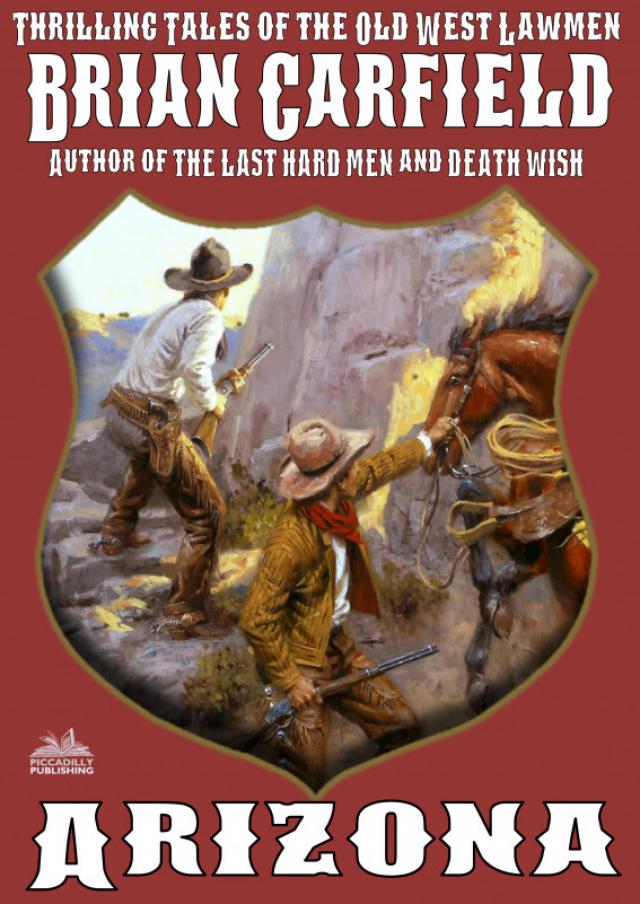
Our cover features a detail from A Break for Higher Ground, painted by Andy Thomas, and used by permission.
Andy Thomas Artist, Carthage Missouri. Andy is known for his action westerns and storytelling paintings and documenting historical events through history.
Text © Piccadilly Publishing
Published by Arrangement with the Author’s Agent.
Chapter One
South of the Grand Canyon the plateau glides toward California. Across this sudden country of heroic proportions, Irishmen and Cornishmen and coolies in pantaloons and pigtails laid down the Santa Fe rails in ’85, throwing open to settlement a vast grassland.
The sweeping Mogollon pastures became refuge and retreat for the last of the armadillo cattlemen, those crusty brawling Texans who had erupted into the West with a volcanic flow of cantankerous cattle. By 1870 they felt overcrowded in Texas; by 1880 the central West and Montana filled up; by 1890 there remained only Wyoming, Arizona, and the Indian Territory in Oklahoma. But the sodbusters, emboldened by farmers’ laws, crouched around the edges of Oklahoma like hungry camp dogs around a tent, waiting for scraps. Land barons moved their sprawling herds into Wyoming, pickings for Butch Cassidy’s Wild Bunch. And only Arizona remained open for the taking.
The armadillo rancher was not an old man, but the young West grew too fast for him. Trail-driving across the Red was only a recollection to be revived over a jug of sour mash. A man weaned on thicket beating, his teeth cut on thousand-mile trail driving, was a man who felt crowded when his nearest neighbor settled within twenty-five miles. He had grown up in a place where he could sit his saddle, look in any direction, and see nothing but cobalt sky across two hundred thousand unobstructed acres—and not a single plume of smoke in sight.
In the Mogollon country the grass remained free. Denying the times, the cattlemen moved into Arizona on horseback, making the long drives from home for the last time. Brown-bellied cattle worked their way up every hillside and canyon, spreading across the virgin yellowgrass, and a mossyhorn Texan could stand on his front porch and survey a panorama that might have been the Texas of his youth—untrammeled, unordered, unsettled, and unlawed.
Might have been, but was not. While the East turned out its Boss Tweeds, the West put on long pants. By 1895 gas lamps and Ediphones had found their way into the Mogollon grass country. Barbed wire appeared. A telephone line ran from Mogollon Junction to the post office at Ocotillo, and the longest cattle drive anyone had to make was from Pariaville to Williams Junction—a distance of one hundred miles.
Clay Rand lived in Ocotillo, and he was not a cowboy, but he rode in the roundup of ’96 and ate dust in the drag on the trail drive from Pariaville. He was not especially needed on the drive. But his father was High Sheriff of Mogollon County, and Clay had turned nineteen, and his father said it would make a man of him.
Sheriff Rand was neither Texan nor cattleman. That did not matter; he was the High Sheriff, perhaps the most important official of all in the county seat at Ocotillo.
Ocotillo was the Spanish word for coach whip. Capt. Ed Partridge, the first Texan to settle in the valley, had followed his great herd like an Arab nomad. He had moved from the Pecos country into New Mexico, and that had gotten crowded, and he had gone on west to Sonoita. West of Sonoita lay the Sonora desert which sprouted nothing but bleached bones, and Partridge’s search for elbowroom turned him north. His only possessions were his cattle, then numbering ten thousand, and his rope and gun. And one other thing: a small soft spot in his iron-hooped toughness, a soft spot for a living thing that Ed Partridge thought beautiful.
He brought that living thing with him from Sonoita, where it grows in abundance: the ocotillo, which is neither bush nor tree, neither cactus nor quite coach whip. In the spring its ten-foot-high stalks are clothed full-length in blossoms of brilliant color, like painted lightning bolts. Capt. Ed Partridge brought a wagon load of ocotillos north with him, up over the Tonto Rim into the high grass country.
Ed Partridge died in 1888, trying to save his cattle in the blizzard. He left no heirs. The enormous ranch was duly auctioned by the Territory. In the end it was divided into segments and distributed among three dozen bidders. The smallest of the resulting parcels amounted to twenty-four thousand acres.
A community appeared, to serve the new ranch populations. It was called Partridgeville until the new county government was organized in 1890 and the citizens gave the town its permanent name of Ocotillo. Ed Partridge’s beloved plants were transplanted to the yard of the new courthouse, but the severe high-country winter of ’91 did for most of them, and the others were all dead by ’94, when their carcasses were uprooted and burned in Mayor Foster’s fireplace. The wood of the Ocotillo gives off a faintly sweet-scented smoke.
The founder of the town had been an itinerant trader who had called himself Simon Vermilion. Within six months of his arrival, his trading post had three competitors, and Simon Vermilion took to drink. An inexperienced horseman, he had the habit of riding home at night at full speed. In January, 1892, Simon Vermilion rode his mount to its death and was killed in the horse’s plunge.
The citizens dutifully erected a monument to Simon Vermilion and went on building. Around the monument grew the settlement, as lonely and monochromatic as the land around it. By 1896 Octotillo boasted a population of eight thousand. That figure was reached by including in the census the considerable population of the graveyard, as well as a small tribe of Indians who came to town twice a year to trade and get drunk.
Fortunes in gold and silver contributed greatly to the economy; Ocotillo was the main point of supply for the mines of the Rim country to the south. But it was, in outlook and character, a cattle town. It was built to last; it did not tolerate lawlessness.
In 1892, the year of Simon Vermilion’s death, a cluster of fugitive Jack-Mormons migrated from north of the River and settled a few miles from Ocotillo. Their scatter of dugouts became headquarters for a cattle-stealing enterprise that supported fourteen large families. A year later the Cattlemen’s Association wearied of these parasites, and as a result Farris Rand arrived with his wife and sixteen-year-old son.
Rand, a former soldier, town marshal, and railroad detective, employed in his service a revolver with a weighted club-handle, and a deputy named Harry Greiff. Within a month the Jack-Mormon village stood empty, its branding pens razed and its shacks caved in.
Since Farris Rand survived this adventure, the town did not erect a monument to him. Instead, he was elected sheriff by a two-thousand-vote majority and immediately appointed Harry Greiff his deputy.
Born to a line of military officers, Farris Rand had behind him thirty years’ experience as a lawman, most of it on the post-Civil War frontier. He had a rigid code and a steel-bound sense of duty; he was a proud man.
That hardly made him unique. Ocotillo had been settled by proud men. Chief among them was probably Rand, the High Sheriff of Mogollon County, but humility was in short supply all around. Hannah Early had never been known to step off the sidewalk to let respectable ladies pass. Abner Dinwiddie never closed his mouth, ever, anywhere. Clyde Littlejack, the village blacksmith, was too proud to admit how stupid he was.
Even Billy Cordell was proud, although he was not an important man, not even to himself. His disgusted face was shaped by a dour knowledge of life’s endless iniquities; he had long ago given up trying to live and let live. Billy Cordell was another kind of Texan—not cattleman, not gunman, but simply wild man. By profession he hunted wild horses in the far mountains, but his avocation was drinking, and when he was drunk his arrogance became casual, so that he fought absently and without malice.
As for Col. Stanton McAffee, he was as proud as any and quicker to demonstrate it. McAffee was an East Texan, yet another variety of armadillo. He practiced law as if it were a piano with stiff keys—loudly, bluntly, and often striking wrong notes.
The people of Ocotillo were old-fashioned in the world of the mauve ’90s. But Ocotillo sheltered them; from Ocotillo they could watch the world go by, on the Santa Fe rails, without being swept along. In 1895 high winds snapped the telephone line that c onnected Ocotillo with the rest of the country, and it was eight months before anyone troubled to repair it.
The peculiar citizens recognized, by instinct, that they needed their peculiar town. For that reason they all learned to suffer each other, proudly but courteously, like rival stallions when the horse herd is endangered. Ocotillo was an 1870 town endangered by the 1890s.
The 1890s arrived in the spring of 1896, in the person of Philip X. Shoumacher.
Shoumacher came to town quietly with his quiet wife. He quietly took over the Territorial Enterprise, and at first he published it quietly. Soon, however, the temptation to preach became too much for him. With all the zealous righteousness of a reformed character, Shoumacher launched a crusade against Ocotillo’s roughshod ways.
Like William Jennings Bryan, Shoumacher held his nose and jumped in bodily without testing the water. And like Bryan, he sometimes preferred a ringing phrase to a sensible idea. Shoumacher’s ringing phrases almost always included the word “civilization,” and that was unfortunate; Ocotillo felt it was civilized enough.
Friction caused heat between Shoumacher and the rest of the community, notably Sheriff Rand. Barricaded behind his printing press, Shoumacher prepared for siege, nervously confident that in the end the right would triumph.
Then, in the fall, another newcomer arrived quietly—young Ben Harmony.
At first it appeared that footloose drifting brought him to Ocotillo. Ben Harmony was a Negro cowboy—more accurately, a dark mulatto, one of many sons of former slaves who had made a place in the West. He had hired on with the Pariaville roundup crew and helped drive the Association herd to the Santa Fe shipping pens at Williams Junction. During those weeks he had met young Clay Rand, and at the end of the drive he had taken a job with Clay.
The sheriff’s son had a quarter section of land outside Ocotillo and had taken his pay in the form of beef on the hoof. With his small inheritance he had bought breeding stock, and when Clay started home from the railroad junction, he had a little herd of cattle with him. It was not strange that he might employ his black saddle partner to help drive home his two bulls, eight cows, and twenty-six yearling steers.
In the beginning, like the newspaper editor, Ben Harmony arrived quietly.
Chapter Two
The wind touched Clay’s face. He could feel with his cheeks the direction from which it came, dry and warm against his brick-red skin. Thirty-six cattle waddled down the road ahead of him, docile and obedient after several days on the trail.
The wind, coming up from the long grass basin, was autumn-hot, but nothing like the raking saws that sliced the farther deserts. You could tell a lot about a country by its wind. Every breeze had its own smell. This one carried grass scent, the clean virgin smell of unbroken land. Somewhere in its particles hung a waft of flowing clear water that stirred his horse and encouraged the cattle to walk faster. Clay couldn’t separate things out, but the smell of this wind was unique; you couldn’t mistake it: the smell of home.
Ben Harmony pulled off the road ahead and let the lead steer plod ahead, following the ruts. Ben Harmony waited for Clay to catch up. Impatience chased impudence across his dark face, and he said, “I thought it was only horses and cows that sleep upright.”
“Aagh,” said Clay, dismissing it. He wiped grit off his lips with the back of his hand. Bit chains jingled like coins in a man’s pocket
Ben Harmony said, “I see we’re just about there.”
“How do you know? What makes you so damn smart?”
“I was born smart, Chico.”
Saddle leather squeaked. Hooves kicked up tufts of powder; looking forward along the humping backs of the cattle was like looking at a heaving river flow. Clay said, “You sure you never saw this country before?”
“Never did.”
“Then how’d you know?”
“Maybe I smelled it,” Ben Harmony said.
“You can relax. We’ve still got three hours to home.”
“I can hardly wait.” Ben Harmony had a dry, melodious laugh.
The wind shifted, bringing strong cattle smell. Beyond leagues of rippled satin grass, haze-blue mountains lofted to summits of perpetual snows. This was home country, and Clay knew every hill and crease after almost five years of growing up in the valley, but to a stranger it must have seemed all a sameness. Dark spots on the slopes were Texas cattle grazing. The heavier mass of the foothills represented dark pine groves, but here on the high plain the meadows ran on for miles without a tree. Almost twenty miles north of the road, made pale by distance, red-cliffed monoliths soared and loomed, the beginnings of the broken butte country, inhabited only by scattered Indian shepherds. But the Mogollon’s uniqueness was not in its plains or in its mountains; it was in its sky. Nowhere else was the sky quite so vast. Its crystal dome enfolded the land, shading evenly from deep cobalt overhead to a mist of thin azure above the far horizons.
The coach road meandered along the easiest course, as naturally carved as a river bed. Deep ruts testified to the passage of freighters behind long tandems of oxen and mules. The crushed ground was deep and rich in color, rouged by portions of clay. Here and there a tiny autumn blossom made a dot of brilliant hue.
Clay threw his head back to drain his canteen. He worked his tongue around; he was thinking of the chili-pepper sauce Ben Harmony had persuaded him to eat last night at the way station. His throat still flamed. He’d had the feeling he could have belched and lit someone’s cigar across the room; he was surprised his shirt buttons had not dissolved.
The cattle plodded earnestly toward the promise of water. A tired cow lagged, and Ben Harmony tapped its haunch with the tip of his saddle rope. The cow plunged forward indignantly and took its place in line.
They were good cattle, sound stock to start Clay’s ranch.
His grandfather, back in North Carolina, had died a year ago. Among the various bequests had been fifteen hundred dollars for Clay.
At five dollars an acre, not a low price, he had bought a quarter section of grass on the lip of Blind Squaw Creek. It was about three miles northwest of town, and there wasn’t a single tree on the property. Brush clogged the bottoms around the creek, and it had taken him a week in the spring to clear the bank. He had only sixty feet of creek bank where the stream sliced across the corner of his land, but that was as much as he’d need for some time. When the time came, he would dig a well.
It was as if he’d hung out a shingle: “Clay Rand, cattle rancher.”
He’d wanted to buy his stock from Udray, whose ranch was just across the creek. But his father had called him to his office in the courthouse.
“A smooth sea never made a good sailor. Your trouble is you have too many dreams and not enough muscle. Before you can play in the game you’re headed into, you’ve got to learn the rules, son. Go on the drive. Build your muscles and learn a few rules.”
Now, home from the drive, he had a few new muscles and maybe he’d learned some rules. He’d learned a thing or two about cowboying from Ben Harmony, that was for sure.
He said, “You never did say where you came from, Ben.”
“East.”
“Or where you’re heading.”
“West.”
“Sometimes you talk a fellow’s ear off, don’t you?”
Instead of answering, Ben Harmony pointed ahead. “This drove of yours is about to pull freight for that water. Might be a good idea if we ride on up to the point and keep them settled back. Unless you want to give them exercise.”
They rode around ahead of the little herd and eased onto the road. The cattle moved faster all the time, like a freight train on a downhill grade. They would hold until they got within strong-smell distance of the creek; then there would be no point in keeping them back. They’d been two days on the trail without water.
Ben Harmony lifted the flap of his saddlebag, took out a cartridge belt, buckled it around his waist, and settled the holstered revolver against his hip.
Clay said, “What’s that for?”
“Peace of mind.”
“You won’t need that. Nobody wears guns in Ocotillo.”


