Black robe, p.21
Black Robe, page 21


‘May I enter?’
Laforgue rose. ‘Yes, come in.’
The council leader walked into the kitchen and looked around as though afraid. He went to the doorway of the dead priest’s room and stared at the kneeling figure. ‘Does this grieve you?’ he said.
‘Why do you ask?’
‘Because there are some who say that you Blackrobes are not men but witches. And witches feel no grief.’
‘We are men,’ Laforgue said.
‘Who can believe you? What sort of men are you? You don’t come here, as other Normans do, to trade for furs. You ask to live with us in our villages, and yet you stay apart in this house. No one may sleep here and you hide your nakedness from us. Why? If you are men why do you not fuck women? Why do you keep a corpse in that room and eat it to give you strength? Why did you bring this sickness which was never seen here before? And why do you use it to kill us, if we refuse to bow down to your god?’
‘We do not use it to kill you.’
‘No. The dead one, in there, Andehoua, didn’t he tell us what we must do? That we must give up our ways? Well, we have told our people and they are agreed. We will do what you want, all the things you asked. All of them. That is what I came to tell you. We are ready. Baptize us.’
‘No,’ Laforgue said.
Taretandé sat down heavily at the table, facing Laforgue. ‘Why? Because we killed Andehoua?’
‘No.’
‘Then why do you want us to die?’
‘I do not want you to die.’
‘But without the water sorcery we will die.’
‘I didn’t say that.’ Laforgue put his head in his hands and sat for a long moment, in silence. ‘The water sorcery will not cure you.’
‘Then what will cure us? Last night and this morning some have been cured. That is your doing, isn’t it? Well, isn’t it! Fuck it! Answer me!’
‘It’s not my doing,’ Laforgue said.
‘Then why did it happen today? Why?’
There was a silence. ‘It – it was the will of God,’ Laforgue said.
‘Your god?’
‘Yes.’
‘Then we are ready,’ Taretandé said. ‘Our people are waiting. You say you are a man and not a witch, and I believe you. I ask you now, are you our enemy?’
‘No.’
‘Do you love us?’
‘Yes.’
‘Then baptize us.’
The council leader rose and went out of the house. In the street, the murmuring of the crowd grew louder. Laforgue got up and went into the chapel. He looked again at the blank eyes of the statuette and thought of the prayer half finished on his lips when Aenons came. Had that statement of belief in God any more meaning than Taretandé’s promise to do God’s will? What was God’s will? He looked at the tabernacle. He felt the silence.
Do you love us?
Yes.
He went to the chest in which vestments were stored and took out a linen alb, pulling the long white smocklike garment over his black cassock. He took up a gold-embroidered stole and, from habit, touched his lips to it before putting it around his neck. He walked past the dead priest, going to the door.
Outside, a cold wind came from the great lake. Before him, huddled in the village street, were four rows of litters containing the sick. Behind them stood the children of the village, and behind the children were the men and women not yet stricken by fever. He saw, standing to his right, Taretandé and Ondesson, with the other members of the council. And, close by, he saw Daniel and Annuka. He signalled to Daniel, who came up at once.
‘Take the kettle,’ Laforgue said. ‘Help me.’
He faced the crowd. Slowly, he raised his fingers, making the sign of the cross, touching his brow, his chest, his right shoulder, then his left. All watched this sorcery. Then, with Daniel carrying the kettle, he went down to the first row of the sick. He took a small ladle from the kettle’s rim, filled it and poured a trickle of water on a woman’s fevered brow, saying in the Huron tongue, ‘I baptize you in the name of the Father, and of the Son, and of the Holy Spirit.’ The Savage woman stared up at him, sick, uncomprehending. He moved on, saying over and over the words to make them Christians and forgive their sins. Was this the will of God? Was this true baptism or a mockery? Would these children of darkness ever enter heaven?
He looked up at the sky. Soon, winter snows would cover this vast, empty land. Here, among these Savages, he would spend his life. He poured water on a sick brow, saying again the words of salvation. And a prayer came to him, a true prayer at last. Spare them. Spare them, O Lord.
Do you love us?
Yes.
We hope you enjoyed this book.
Find out more
Find out more
Find out more
For more information, click the following links
About Brian Moore
About the Introducer
Endpapers
About the cover and endpapers
More from Apollo
About Apollo
About Brian Moore
BRIAN MOORE, whom Graham Greene has called his ‘favourite living novelist’, was born in Belfast in 1921 and was educated there at St Malachy’s College. He served with the British Ministry of War Transport during the latter part of the Second World War in North Africa, Italy and France. After the war he worked for the United Nations in Europe before emigrating to Canada in 1948, where he became a journalist and adopted Canadian citizenship. He spent some time in New York and then moved to California. Many of his novels, including The Lonely Passion of Judith Hearne, The Temptation of Eileen Hughes, and Black Robe have been made into films, and his screen-writing has included work with Alfred Hitchcock and Claude Chabrol.
He won the Authors’ Club First Novel Award for The Lonely Passion of Judith Hearne, the W.H. Smith Literary Award for Catholics, and the James Tait Black Memorial Prize for The Great Victorian Collection. Brian Moore has been shortlisted for the Booker Prize three times, in 1976 for The Doctor’s Wife, in 1987 for The Colour of Blood and in 1990 for Lies of Silence.
About the Introducer
COLM TÓIBÍN was born in Enniscorthy in 1955. He is the author of nine novels including The Master, Brooklyn, The Testament of Mary and Nora Webster. His work has been shortlisted for the Booker three times, has won the Costa Novel Award and the Impac Award. His most recent novel is House of Names. He has also published two collections of stories and many works of non-fiction. He lives in Dublin.
Endpapers
About the cover and endpapers
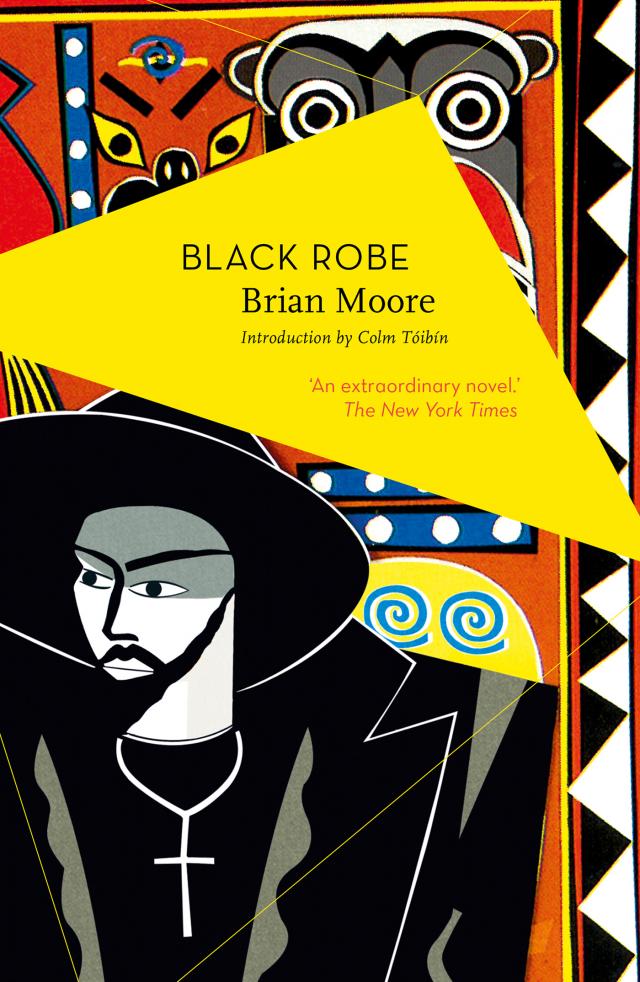
John Clementson (1959–), Black Robe, 1987. Cut paper collage. John Clementson is a published author and an illustrator of children’s books.
More from Apollo
Find out more
Find out more
Find out more
Find out more
Find out more
Find out more
APOLLO LIBRARY
Find out more
Find out more
Find out more
Find out more
Find out more
Find out more
Find out more
Find out more
Find out more
Visit Apollo now
About Apollo
The Apollo Lost Library list reflects in various ways the extremity of our time, and the ways in which novelists responded to the vertiginous changes that the world went through as the great empires declined, relations between men and women were transformed and formerly subject peoples found their voice. It makes great forgotten works of fiction available to a new generation of readers, challenging the established canon and surprising and moving readers with its choice of books.
Get in touch: apollo@headofzeus.com
Visit Apollo now
Find us on Twitter
Find us on BookGrail
Apollo Librarian | Michael Schmidt || Series Editor | Neil Belton
Text Design | Lindsay Nash || Artwork | Jessie Price
www.apollo-classics.com | www.headofzeus.com
First published in 1985 as Black Robe by Jonathan Cape Ltd
This paperback edition published in the United Kingdom in 2017 by Apollo, an imprint of Head of Zeus Ltd
Copyright © Brian Moore 1985
Introduction © Colm Tóibín 2017
The moral right of Brian Moore to be identified as the author of this work has been asserted in accordance with the Copyright, Designs and Patents Act of 1988.
All rights reserved. No part of this publication may be reproduced, stored in a retrieval system, or transmitted in any form or by any means, electronic, mechanical, photocopying, recording, or otherwise, without the prior permission of both the copyright owner and the above publisher of this book.
1 3 5 7 9 10 8 6 4 2
A CIP catalogue record for this book is available from the British Library.
ISBN (PB) 9781786695031
ISBN (E) 9781786695024
Apollo
c/o Head of Zeus
First Floor East
5–8 Hardwick Street
London EC1R 4RG
www.read-apollo.com
www.apollo-classics.com
Brian Moore, Black Robe