

After a dance, p.11
After a Dance, page 11


A note wouldn’t do. He drew a sketch of a lobster and wrote ME next to it and an arrow pointing down.
—You choose, she said.
He chose the smallest one.
—My favourite, Sumi said. I cook now.
He followed her into the kitchen, padding in her shadow, with the intention of doing her harm. He would puncture her and she would deflate like the Reverend Steerforth. He thought of the good Reverend deflating on the cliff face, spread out under the night sky, as though wide awake but really not, raindrops splashing the blue colour from his eyes. Later, he supposed, he would have to bury him, then track back to the car park and take care of the car. Otherwise? Helicopters. I failed you, Reverend Steerforth, he thought. I am not, after all, he felt his throat thicken with – premature – remorse, capable of love or, he drew his hand back the better to stab the girl, a suitable candidate for day release. Sumi turned round. She looked at the fork clenched in his hand. She looked at him. They listened to the water bubble on the stove. Then Sumi took the fork from him – the strange thing was he let her – and speared the lobster into the pot.
—They scream, she said. It is upsetting but it is over quickly.
—Yes, he said. For he did know that.
The lobster screamed once, faintly, like a girl in a park.
*
—Elizabetha, she said, in the silence that followed.
—Colin.
—Tonight, she said, Colin, I invite you to eat. For free.
Colin and Elizabetha sat at a table at the centre of the vast and derelict cafe. In front of them three candles, rammed into ketchup bottles, threw a bronzed and trembling sheen over the feast. Colin looked about him, trying to commit the scene to memory. The lobsters slid a little on their burnished field of lettuce. Some hundred yards away a Black Forest gateau revolved slowly in a green lit-glass cabinet. The cafe smelt of cooked lobster and burnt-out plugs. And outside the wind blew and shook the window frames and rustled the notices along the walls. Perhaps, Colin thought, if I find myself once more incarcerated (as does seem likely), in a prison cell, I will recall this most perfect of nights. Taking his cue from the girl he tucked a napkin decorated with ancient reindeers under his chin. He picked up his pen and wrote, I feel strangely at peace with this giant – unblinking – girl. Will we live happily ever after?
—Tonight, the girl said, reaching for a lobster, she lowered her huge head so their eyes met, she lowered her voice so he could barely hear her, I . . .
She said something he couldn’t quite catch.
—What?
—I kill myself.
He was so surprised his hand took notes. She spoke quickly, gesturing with a claw to the windows churning with weather.
He wrote:
E intends to fling herself off cliff face. Fuck.
Reason? E has watched many customers do this . . .
Question: Is suicide contagious? Will find out.
Revelation: Explains coat rack and limited menu.
First E tries to help . . . She talks. They talk. All night, talk . . . They eat her . . . business . . . Ruined. They use her pen to write their suicide notes.
They jump anyway. They fucking jump.
Elizabetha sucked meat between her teeth. He rested with her. Then she went on.
He wrote. E now so fucking depressed she eats.
Explains: Gigantism. But now E knows they have right idea. Convinced she will feel no pain. This is because E has drunk many painkillers not because fat ass will protect against rocks. Now, all E feels is . . . hungry.
They ate. The girls’s appetite was enormous. Colin chewed his food slowly, pushing his portions towards her, because he didn’t want the meal to end. He watched Elizabetha’s mouth chomping through the lobster meat; a shine gather on her horse jaw, gloves of silver grease build on her hands so her black chipped nail varnish glistened. He saw his tiny self reflected in her tiny tiny tiny eyes. At the end of the meal Elizabetha burped grandly.
—Now, she said, I ready.
She lumbered to the door and flung it open. She was nearly knocked back by the wind. Above her head a couple of seagulls flashed their silver undersides.
—Nooo, Colin said, before he knew he would say anything.
He had time to note this new sensation: he had never wanted someone to live before.
—Give me one reason, Elizabetha said, not turning round, why not?
—Because . . . Colin said. He thought of all the reasons he had heard why life should be allowed to just go on . . . And? None of them would do. A green phosphorous light strobed his boots . . . and he had it.
—Because you haven’t had your pudding yet!
Elizabetha nodded, this was true.
Closer inspection of the Black Forest gateau revealed a terminal disease. Colin ransacked the cupboards and found wrinkled bags of banana-flavoured Angel’s Delight. He sat on Elizabetha’ s lap and fed her yellow teaspoons. I am feeding her sunshine, he thought. She smiled sleepily, showing him a tongue so grooved he thought, in his erotic stupor, I could lay my palm in it. My whole head. Maybe even my . . . Elizabetha’s eyes began to roll. He had to twang her cerise bra strap to wake her. Hey, he said. Wake up. He said, the only thing he could say. Something he had never said to another human before.
*
—Elizabetha, will you dance?
They danced to a Christmas compilation tape he found at the back of a drawer snappy with mousetraps, turning together at the same speed as the Black Forest gateau; Colin’s head pressed into Elizabetha’s solar plexus; her giant chin resting on his bald spot: one cerise breast, heavy as a postbag, on each of his shoulders. They turned until the windows ran with their condensation and the candles burned down to their ketchupped socks. When the jingle bells gave their last tinkle, Elizabetha lifted Colin up like a child and kissed him. It was the sweetest kiss, tasting of sugared banana sandwiches from long ago. Am I happy? Colin thought, feet swinging. Am I? He opened his eyes. It took him a few moments to recognize the face, pale as the moon, pressed against the black window, a face familiar from visiting hours, bloodless lips mouthing, not homilies this time, just the two words: HELP . . . ME.
Three words: HELP ME COLIN.
The Reverend Steerforth.
So.
Not dead after all.
Elizabetha followed his gaze. Her expression hardened.
—Another one, she said. She pointed at a notice he couldn’t read on the wall.
—NO, she yelled, MORE TIME WASTERS. She dropped Colin and opened the door. Before he could stop her, did he want to stop her? To his joy, he found that yes, yes he did! He grabbed his pen, as Elizabetha hauled the Reverend Steerforth over her shoulder and – at a run – despatched him into the inky blue blackness beyond the cliff.
You were right, Colin wrote rapidly and faster than a man could fall, you were right to befriend me after all, my dear Reverend Steerforth, your faith in me was justified because look at me now. Look at me. At last I feel your love.
By Bridget O’Connor
Here Comes John
Tell Her You Love Her
The Flags
First published 2024 by Picador
This electronic edition published 2024 by Picador
an imprint of Pan Macmillan
The Smithson, 6 Briset Street, London EC1M 5NR
EU representative: Macmillan Publishers Ireland Ltd, 1st Floor,
The Liffey Trust Centre, 117–126 Sheriff Street Upper,
Dublin 1, D01 YC43
Associated companies throughout the world
www.panmacmillan.com
ISBN 978-1-0350-2487-2
Copyright © Bridget O’Connor 1993, 1997, 1998, 2015, 2024
Introduction copyright © Constance Straughan 2024
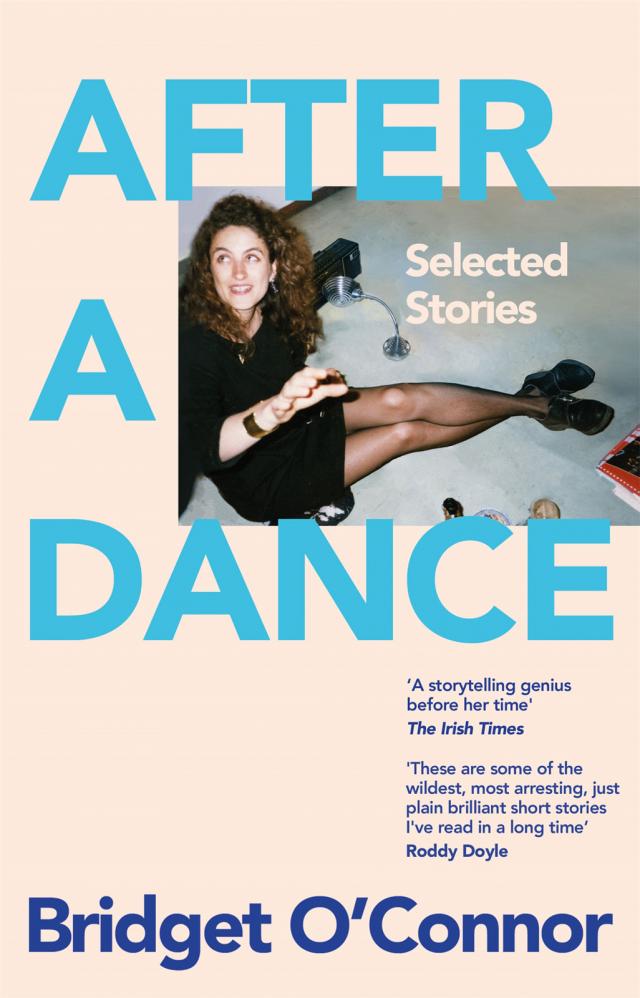
Cover credits: Jacket and author image: © The Estate of Bridget O’Connor Design: Tiana Dunlop, Picador Art Department
These stories were previously published in Here Comes John (Jonathan Cape, 1993; Picador, 1995) and Tell Her You Love Her (Picador, 1997). ‘Heavy Petting’ originally appeared in Intoxication: an anthology of stimulant-based writing, edited by Toni Davidson (Serpent’s Tail, 1998). ‘At least pull your jumper up’ originally appeared in Five Dials, number 24 (Hamish Hamilton, 2015).
Pan Macmillan does not have any control over, or any responsibility for, any author or third-party websites referred to in or on this book.
You may not copy, store, distribute, transmit, reproduce or otherwise make available this publication (or any part of it) in any form, or by any means (electronic, digital, optical, mechanical, photocopying, recording or otherwise), without the prior written permission of the publisher. Any person who does any unauthorized act in relation to this publication may be liable to criminal prosecution and civil claims for damages.
A CIP catalogue record for this book is available from the British Library.
Visit www.picador.com to read more about all our books and to buy them. You will also find features, author interviews and news of any author events, and you can sign up for e-newsletters so that you’re always first to hear about our new releases.
Bridget O'Connor, After a Dance





