

Wrong on race, p.1
Wrong on Race, page 1
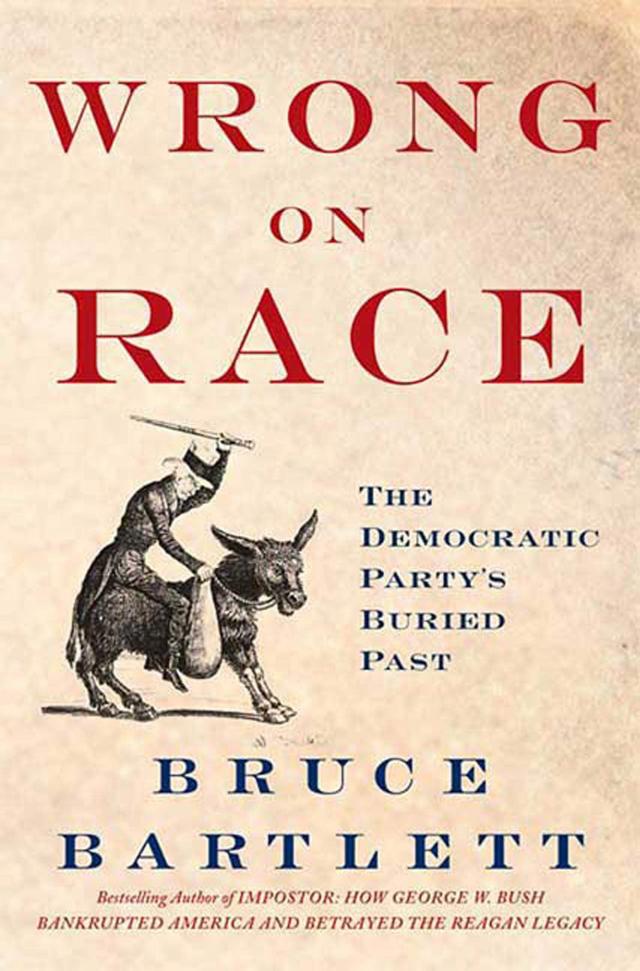


WRONG ON RACE
WRONG ON RACE
The Democratic Party's Buried Past
Bruce Bartlett
The author and publisher have provided this e-book to you for your personal use only. You may not make this e-book publicly available in any way. Copyright infringement is against the law. If you believe the copy of this e-book you are reading infringes on the author’s copyright, please notify the publisher at: us.macmillanusa.com/piracy.
EXPLANATORY NOTE
This book contains racially insensitive words and language. However, they are not used gratuitously, but only in direct quotations from prominent figures and are essential to the accurate portrayal of important historical persons and events. I apologize in advance to anyone who may be offended. However, I would remind readers that the offense was perpetrated by those who said these words, not by the historian who accurately quoted them.
CONTENTS
Explanatory Note
Introduction
SECTION I
THE RACIST ORIGINS OF THE DEMOCRATIC PARTY
1 Thomas Jefferson, Andrew Jackson, and Stephen A. Douglas Sow the Seeds of Civil War
2 Andrew Johnson: The Democrat Who Tried to Wreck Reconstruction and Paved the Way for Jim Crow
SECTION II
SOUTHERN DEMOCRATS: RACIST TO THE CORE
3 Ben Tillman, Cole Blease, and James F. Byrnes: Democrats of South Carolina
4 Tom Watson, Hoke Smith, Eugene Talmadge, and Richard B. Russell: Democrats of Georgia
5 James Vardaman and Theodore Bilbo: Democrats of Mississippi
SECTION III
DEMOCRATS IN THE WHITE HOUSE: BLACKS SENT TO THE BACK DOOR
6 Woodrow Wilson: Reactionary Progressive
7 Franklin D. Roosevelt: Insensitive Liberal
SECTION IV
DEMOCRATIC RACISM FINALLY REPUDIATED
8 Harry S. Truman: Unsung Civil Rights Hero
9 Democrats Jump on the Civil Rights Bandwagon
10 Since the Civil Rights Act: A Racial Double Standard?
Conclusion: A Time for Reassessment?
A Note on Sources
Appendix I: Percentage of Blacks in the Population by Region and State, 1790–1990
Appendix II: Presidential Vote of Black Americans 1936–2004
Appendix III: Per Capita Regional Income Relative to U.S. Average
Notes
Index
INTRODUCTION
Like everyone, I learned about slavery in grammar school and about Jim Crow laws in high school and college. I'm old enough to have seen separate counters for black and white customers in restaurants while growing up. Even today, I sometimes go into old federal office buildings that have two sets of restrooms and drinking fountains on each floor. They are a reminder that, in the not-too-distant past, blacks and whites were required to use separate facilities in government buildings.
Still, all of this knowledge was cordoned off in the analytical side of my brain. I didn't start to understand what slavery and institutionalized racism really meant until I began to study nineteenth-century political history intensively. I was taken aback to read speeches by important national leaders—presidential nominees, long-serving senators, chairmen of congressional committees, and so on—hurling racial epithets that were crude and tasteless even by the standards of that era.
But it was the content of those speeches that was most appalling: displaying an utter disregard for the humanity of black people, they included justifications for treating them worse than we treat farm animals today and spirited defenses of the barbaric practice of lynching. When I discovered that some of those holding these views were people like Thomas Jefferson, whom I've always admired as one of the greatest thinkers of all time, I wanted to know more.
So I began studying the political history of race in America. Having worked in Congress and at the White House, I have some familiarity with the nature of politics and how politicians think. I thought I could use this knowledge to illuminate this one aspect of the race problem in America in ways that might help us better deal with its long, sordid history.
What quickly jumped out at me is a fact that seems obvious in retrospect, but which I had never really thought about: virtually every significant racist in American political history was a Democrat. Before the Civil War, the Democratic Party was the party of slavery. It was based largely in the South and almost all of its leaders were slave owners, including Andrew Jackson and Thomas Jefferson, considered by Democrats to be the co-founders of their party.
It was illuminating to discover how many debates in American history about the federal government's taxing power, some of its lesser wars, and its westward expansion were fundamentally about the race issue. For example, I never thought carefully before about the clause of the Constitution that counted slaves as three-fifths of a man for purposes of apportionment. Had they been counted as whole persons, it would have increased the South's power in the House of Representatives and the Electoral College. Thus, rather than being a provision that disparaged black people, it actually was an effort to diminish the power of their oppressors.
Having lived in Texas as a youth and been forced to study Texas history, I thought I knew the story of its admission to the Union pretty well. But I never knew the profound importance of race to that history. In particular, I did not know that Mexico had abolished slavery and that this was a key reason for the war for Texas independence. The Texans were determined to keep their slaves and were willing to fight to the death for that right. And of course, the admission of Texas as a state was critical to the maintenance of slavery in the United States, which was threatened both economically and politically in the 1840s.
Like all Republicans, I knew that my party was founded in opposition to slavery. But I hadn't understood why this was so necessary until I came to realize how deeply entrenched racism was in Congress and just how critical the power of the South was in presidential politics. I came to greatly admire Martin Van Buren, whom I had always thought to be a political hack, for breaking with the Democratic Party, which he virtually created in its modern form, over its unwillingness to reject slavery. I also came to really admire John Quincy Adams. I knew that he had been a member of Congress after being president, but I didn't know what a heroic figure he was in the antislavery fight.
Until I studied Andrew Johnson's presidency more deeply, it had never occurred to me that he was always a Democrat. I just assumed that he belonged to the party of Abraham Lincoln. Like most people, I knew he had been impeached by the House of Representatives and saved from conviction in the Senate by a single vote. But I never really understood what that was all about. It, too, was really about the race issue, with Johnson taking such an extreme Southern position that it made the sacrifices of all those who died to end slavery seem in vain.
Like most college history majors, I read C. Vann Woodward's great book, The Strange Career of Jim Crow, but it wasn't until I began reading biographies of some of the Southern Democrats of that era—including Woodward's own book on Georgia's Tom Watson—that I came to appreciate just how vicious and nasty these people were.
This led me to write several chapters on some of the worst Southern Democrats of the late nineteenth and early twentieth centuries—people like James Vardaman and Ben Tillman, who are largely forgotten today but were very important in their time. Some may wonder why I wasted the space on such obscure figures. I did it for the same reason that those on the political left never let us forget Senator Joe McCarthy. It's a rare year when there isn't yet another Hollywood film about him or a new biography because those on the left want to ensure that no one like McCarthy ever gains political power in this country again. Not coincidentally, they also want to remind us that McCarthy was a Republican.
The Democrats, however, have skeletons in their own closet and it's worth remembering them, too. For example, Democrat Woodrow Wilson's Attorney General, A. Mitchell Palmer, who was just as rabid an anti-Communist as McCarthy, did far more to repress free speech and political freedom than McCarthy ever attempted. It wasn't a Republican president who locked up thousands of loyal Americans of Japanese descent in concentration camps for years; it was Democrat Franklin D. Roosevelt. And it wasn't a Republican who wiretapped and snooped on Dr. Martin Luther King Jr., but Democrats John F. Kennedy and his brother Robert, who signed the order as Attorney General.
In the twentieth century, the Democratic Party has been largely identified with political liberalism or progressivism—conscious efforts to expand government and use its power to better the human condition. The first of the party's great liberal leaders was Woodrow Wilson, who was probably the best qualified man ever elected president in our history, at least on paper. He implemented many progressive reforms, such as the income tax and the Federal Reserve System, that are still with us today. And most of us learned in school about his strenuous yet futile effort to get America into the League of Nations, which cemented for all time our image of Wilson as a modern liberal.
I had this image as well before looking more carefully into Wilson's record. It was disturbing to discover just what an overt racist he was. It will probably come as a revelation to most readers that one of Wilson's very first acts in office was to institute comprehensive racial segregation throughout the federal government, a policy that had not previously existed under Republican presidents. Where Wilson's appointees were unable to put blacks and whites into separate offices and buildings, room dividers were installed to prevent whites from even having to gaze upon the
Franklin Roosevelt was not much better. He wouldn't even allow his black and white servants at the White House to eat together. Although he has a reputation for being a progressive on the race issue, it is undeserved. Roosevelt sat on his hands for twelve years, never lifting a finger to redress racial injustice, never offering a word of support for antilynching legislation or any other measure that would materially aid black people in America. The reason was that the center of the Democratic Party still lay in the South and Roosevelt worried more about losing its support than doing what was right for the descendents of slaves.
I started my chapter on Harry Truman thinking that he was a Roosevelt clone in this regard—someone who really did nothing to advance civil rights. Careful study of Truman's record, however, forced me to change my opinion. His accomplishments in terms of improving the condition of blacks are very much underrated. More important, they were taken at great political risk to himself. I can find no other explanation for Truman's actions except that he thought they were the right things to do, and I came to admire him greatly for it.
Truman's politically risky efforts to help blacks led to establishment of the Dixiecrats, a rebellious group of racist Southern Democrats who nominated Strom Thurmond to run against him in 1948. Though they knew they could not win the presidency, they ran to split the vote and thereby bring about Truman's defeat. There was every reason to believe it would work, which makes Truman's victory that year all the more miraculous. I think it is telling that the Democratic Party never punished the Dixiecrats or their supporters in Congress in any way. The South was still viewed as the Democrats' political base. Consequently, its national leaders pretended that the Dixiecrats weren't traitors to the party, just as post-Civil War Democrats pretended that those who fought for the Confederacy weren't traitors to their country.
Although this book is primarily about the Democratic Party, I found that I could not discuss its history without also considering the Republicans. This led me to look more carefully into Dwight Eisenhower's record, which I'd believed was devoid of any real accomplishment on racial issues. I thought Eisenhower had been too preoccupied with foreign policy and other matters throughout his presidency.
I was intrigued to discover how much was done on the race issue during the Eisenhower years. He made key appointments to the Supreme Court, especially Chief Justice Earl Warren, knowing that they held liberal views on race and expecting that they would make rulings like Brown v. Board of Education that would fundamentally alter the political landscape. Eisenhower also passed the first civil rights bills since Reconstruction over very intense Southern Democratic opposition. These bills tend to be dismissed by historians as insubstantial, at least compared to those enacted in the mid-1960s. But Eisenhower's efforts were critical in showing that it was possible to get some civil rights legislation enacted—no small feat when every civil rights bill after 1875 was systematically torpedoed by Southern Democrats.
While Eisenhower has been underrated in terms of what he did on civil rights, John F. Kennedy has been grossly overrated. Like FDR, he was a master of the symbolic gesture, which disguised the fact that he did absolutely nothing of substance in the area of civil rights. Kennedy's reason for inaction was the same as FDR's—he feared the power of racist Southern Democrats, especially in the Senate, and needed their votes to get elected and reelected, and to enact his program. Only extreme outside pressure from the growing civil rights movement pushed Kennedy into doing anything on civil rights beyond appointing a few token blacks to his administration.
Lyndon Johnson deserves credit for ensuring passage of the Civil Rights Act of 1964 and the Voting Rights Act of 1965. As a Southerner who toed the segregationist line throughout most of his political career, it was not easy for him to break with his closest friends, such as Senator Richard B. Russell of Georgia, or to repudiate his own past. But Johnson was too good a politician not to see that the racial landscape was changing. As a leader, he saw which way the troops were running and ran to get in front of them.
Richard Nixon's reputation continues to suffer for his alleged implementation of the infamous "Southern strategy," which is often said to have turned the South into a bastion of Republicanism by skillfully using code phrases like "law and order" to appeal to racist Southern Democrats. In reality, Nixon had an excellent record on civil rights. He did more to integrate the public schools than any other president in history, and also initiated affirmative action and minority set-asides for government contracts.
As a consequence of the mythology surrounding the alleged Southern strategy, the Republican Party has been unfairly tagged as the party of racism in America today—a view commonly expressed by liberals and black leaders to the point where it has become the conventional wisdom. The simple logic seems to be that since the Republican Party is now based in the South, and since Southerners are presumed to be racists, then the Republican Party must be the party of racism. In the process, the Democratic Party's long and deep history of racism has been largely expunged from the national consciousness. Implicitly, people have come to think that since the Democratic Party has been good on civil rights since the 1960s, it must have always been the party of racial tolerance and equality.
As this book amply proves, nothing could be further from the truth. The Democratic Party was the party of slavery and Jim Crow, and the "Solid South" was solidly Democratic for one hundred years. All of the racism that we associate with that region of the country originated with and was enforced by elected Democrats. It could not have been otherwise—there were virtually no Republicans in power in the South for a century after the end of Reconstruction.
Democrats undoubtedly will charge that this book is unbalanced, that I have spotlighted their party's rotten eggs and understated Democrats' positive accomplishments. Perhaps, but my purpose is to redress a larger historical imbalance in the way people perceive the two major political parties. Democrats have been effectively cleansed of their racist past, their sins implicitly transferred to the Republicans.
I especially hope that Republicans will read this book. They may not be the quasi-racists that they are often made out to be in the mainstream media, but neither have they made any real effort to reach out to African Americans, politically, for a very long time. This is bad for the Republican Party, bad for black people, and bad for the country. It would be much better for everyone if the black vote was "in play" and both major parties had to compete for it. As virtual captives of the Democrats since 1936, blacks have ended up being taken for granted by them and mostly ignored by Republicans.
I think Republicans should fight for the black vote and blacks should fight for a place in the Republican Party, just as they fought for their civil rights in the last century. It's a necessary thing and each may find more in common with the other than they imagine. Blacks will be in a far stronger position if both parties must compete for their votes. And the Republican Party is going to need black votes to compensate for the loss of Hispanic votes resulting from the strongly anti-immigrant views of its base—views that many blacks are in sympathy with.
The passing of the generation of black leaders who led the struggle for civil rights in the 1960s and the rise of a new generation of black leaders like Barack Obama and others, who have lived their whole lives in a post-civil rights society, may make possible an alliance that was unthinkable just a few years ago.
In closing, I would urge Republicans to do as I have done and study this nation's racial history. They need to know—I mean really know—things about slavery and racism that they think they know, but really don't. It will make it easier for them to empathize with African Americans, who have really suffered very badly during most of their history in this country in ways that the nation has barely started to acknowledge, let alone compensate for. For too long, white America has taken the view that it is sufficient simply to stop being racist to make things right for blacks. But the long, long legacy of past racism has never been redressed by either party.


