

The secret of skeleton i.., p.1
The Secret of Skeleton Island, page 1
part #1 of Ken Holt Series


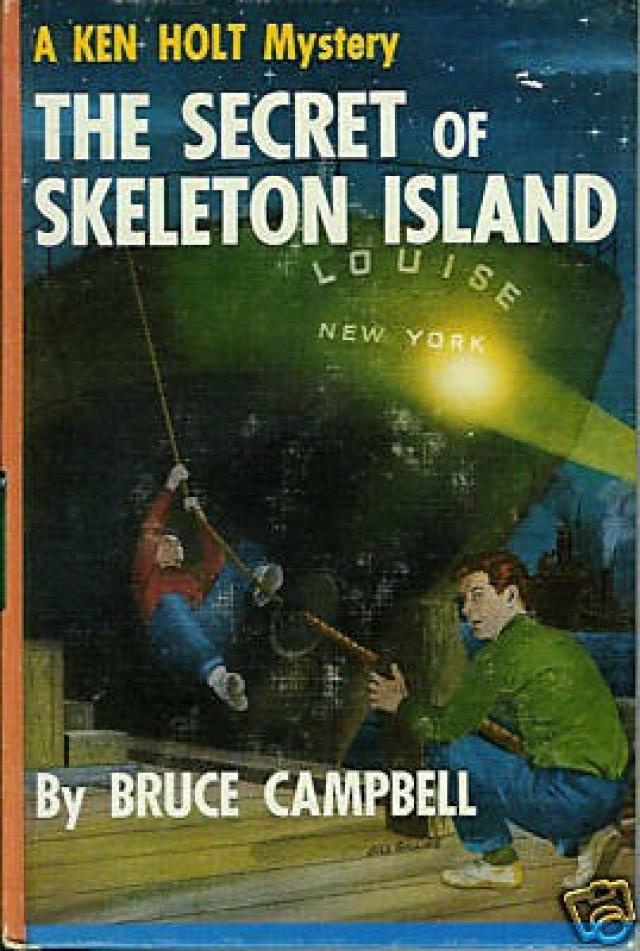
THE SECRET OF SKELETON ISLAND
By Bruce Campbell
A KEN HOLT Mystery, No. 1
Version 1.1, Nov 2008
The KEN HOLT Mystery Stories
1 The Secret of Skeleton Island
2 The Riddle of the Stone Elephant
3 The Black Thumb Mystery
4 The Clue of the Marked Claw
5 The Clue of the Coiled Cobra
6 The Secret of Hangman’s Inn
7 The Mystery of the Iron Box
8 The Clue of the Phantom Car
9 The Mystery of the Galloping Horse
10 The Mystery of the Green Flame
11 The Mystery of the Grinning Tiger
12 The Mystery of the Vanishing Magician
13 The Mystery of the Shattered Glass
14 The Mystery of the Invisible Enemy
15 The Mystery of Gallows Cliff
16 The Clue of the Silver Scorpion
17 The Mystery of the Plumed Serpent
18 The Mystery of the Sultan’s Scimitar
GROSSET & DUNLAP Publishers
NEW YORK
COPYRIGHT, 1949, BY BRUCE CAMPBELL
ALL RIGHTS RESERVED
PRINTED IN THE UNITED STATES OF AMERICA
CHAPTER I
AN OFFER OF A RIDE
The phone booth was hot and stuffy, and Ken Holt wiped the moisture off his forehead for the third time. He opened the door slightly to get some fresh air and just then the phone came alive.
“Here’s your party,” the operator intoned.
“Hello,” Ken said loudly. “Hello.”
“Global News,” came the answer. “Granger speaking.”
“This is Ken Holt, Mr. Granger. I’m out at school.”
“What’s up, Ken?” Granger asked. “Need some money?”
“It’s not that. I just wanted to know if my father had come in.”
“Your father?” There was a pause before Granger continued. “Why, kid? He’s not expected so far as the office knows. He’s still in France.”
“I got a letter from him last week saying he’d be in on the eighteenth and that he’d call me. I haven’t heard from him since. And today’s the twentieth.”
Some hundred miles of telephone wire carried Granger’s booming laugh from the busy offices of an international news agency to the quiet corridor of Galeton Preparatory School.
“That’s pretty good,” Granger said, after he had stopped laughing. “He’s only two days overdue and you’re worried. He’s famous for that, son. We’ve lost track of him for weeks, but finally he’d let us know where he was or what he was doing. Forget it. He’ll turn up when he gets good and ready.”
Ken blinked to get the perspiration out of his eyes. He moved a little closer to the mouthpiece as if that would help Granger understand better.
“But you see, Mr. Granger, Dad wrote me that he’d be in on the eighteenth. He’s never missed a date with me.
“There’s always a first time, son,” Granger answered. “This might be it.”
“Your three minutes are up,” the operator interrupted.
“Tell you what, Ken. I’ll wire the Paris office and see what they know. I’ll call you back later tliis evening. Don’t worry. Richard Holt can take care of himself.”
The phone went dead on Ken’s “thank you.” Ken dropped the receiver on its cradle and stepped out of the steamy booth into the cool air of the corridor. He turned toward the stairs that led to the second floor and his room, thinking over Granger’s words and trying to get some comfort from them. By the time he got to his door he’d given that up. As his father Richard Holt, the famous foreign correspondent, had taught him, Ken always faced the facts. And the facts here weren’t calculated to allay his fears.
He closed the door of his room behind him and sat on the bed to reread the letter for the tenth time.
#
Dear Ken:
Spring is breaking out all over, and if I didn’t know that I was permanently infected with the bug, I’d say I was getting spring fever. How’s about you and me cutting loose and going up to Maine for a week of fishing? And that’s no idle chatter, either.
Things here are winding up—I hope—and I’ll be home on the eighteenth. I’ll call you as soon as I get my feet on the ground again and we’ll make some plans for playing hooky.
And while you’re planning the excuse you’ll have to give old Doc Berdine, you might be trying that alleged brain of yours on the story I’m running down. It’s big, and I don’t think it’s pretty. I’ll give it to you just as I got it, and I won’t give you my conclusions—partly because I’m not at all sure I’m right and partly because I feel it’s a parent’s responsibility to help develop his child’s cerebral activity.
Here goes: On a routine assignment to Marseille I noticed a freighter (the Lenore) coming into port high out of the water—in other words empty. That’s kind of strange these days when ships are scarce. I hung around on the assignment for two weeks, and before I’d left, another freighter (the Louise) had come in empty. I remarked on it casually to a friend of mine who lives in Marseille, and he said that these two ships almost always came in empty.
The well-known Holt-nose-for-news (which I hope you inherit) went to work then and dug up some more facts, to wit: Both of these ships take several days longer to make the trip between New York and Marseille than other ships of their class; both ships leave New York with practically no cargo; the captain of neither ship will accept bulky cargo at New York even at premium rates.
Well, there you have it. What do you make of it? You can give me your opinion when I call you on the eighteenth—which I will, rain or shine, or my name isn’t
Richard Holt.
#
Ken folded the letter and slipped it into his wallet. Only one thing impressed him in what he had read—the eighteenth. Despite Granger’s assurances, Ken was worried. If his father had arrived on the eighteenth he would have called. If he had been unavoidably detained he would have wired. Ken got to his feet and began to walk up and down. There was no doubt about it, he should have heard in any case.
It was all right for Granger to say Richard Holt could take care of himself, but accidents did happen. Suppose he had been hit by a car and taken to the emergency ward of a hospital? And suppose he had no identification papers on him at the time? Then what? Pictures began to go through Ken’s head in rapid succession—and none of them was pleasant.
Abruptly he stopped his aimless pacing and, swooping swiftly, pulled the bottom drawer of his bureau open. In a moment he had scanned the timetable he found there, and in another he was out in the hall again, heading toward the headmaster’s office as rapidly as his legs could carry him.
Ken was glad, as he waited in the anteroom, that Dr. Berdine was a man one could talk to. He was fully aware that his fears were based on very slight grounds. He was completely understanding of Granger’s attitude: sure, Richard Holt had always been the enigma of Global News, but he’d never been unpredictable so far as his son was concerned.
It took Ken only a few minutes to state his case to the headmaster. Dr. Berdine leaned back in his swivel chair and looked out of the window for a moment before speaking.
“Ken,” he said swinging around again, “my first impression would be to agree with Granger. I think it entirely possible—and even probable—that he’s right. On the other hand, I’ve known you for several years now, and I’ve never seen you so disturbed. I know your father pretty well, too. That’s how he came to place you under our care.”
Ken fidgeted in his hard chair. He didn’t have much time, and he hoped Doc wasn’t going to embark on a lengthy lecture.
“You see, Ken,” the headmaster continued, “you are a great responsibility to us—more so than the other boys here. They have families they always can find. Your father is all the family you’ve got, and he’s away most of the time.”
“But, sir,” Ken broke in, “I’ve gone to New York by myself many times.”
Dr. Berdine nodded. “And always at the request of your father, and with the knowledge that he was there waiting for you.” He paused again. Then he got to his feet. “You’re a pretty smart boy, Ken. I’d say you could take care of yourself as well as the next man. I also know that this is Friday and that there will be no classes until next Monday, so I guess you can go.”
Ken was out of his chair before the headmaster had finished speaking. “Thank you, sir.”
“One moment.” The headmaster looked at his student carefully. There was no doubt of it—Ken looked as if he could easily take care of himself. A little short of six feet, with broad shoulders, he looked the athlete he had proved to be. And even a stranger could easily have guessed by looking at his intelligent dark eyes that Ken was as good a student as he was a football player. The smooth light skin of his rather rugged face was a strong contrast to his jet-black hair. He looked, as he stood there waiting for the headmaster’s next words, like a steel spring ready to leap into action.
Dr. Berdine smiled a little. He was very fond of Ken. “Take care of yourself, and call us the minute you find anything.” He opened his desk drawer. “Got enough money to carry you through?”
“I think so, sir.”
“Better take this.” The headmaster handed two ten-dollar bills across the desk. “Hurry along, or you’ll miss the eight-thirty train.”
It was ten minutes to eight when Ken reached his room again, and about ten minutes after
The early-evening dusk was darkening the tree-shaded streets of Galeton as Ken loped along toward the railroad station three blocks away. By the time the station came into view it was quarter after eight. There was no agent on duty when he got to the ticket window so he went outside to sit on a bench until the train pulled in.
The platform was deserted except for himself, Ken noticed. Well, that wasn’t unusual. Galeton folks didn’t make a habit of running into New York. He glanced at his watch: five more minutes to go. Just then he heard the crunch of tires on the gravel roadway, and through the windows of the little station he could see the headlights of a car that parked on the other side of the building. As Ken was idly wondering who was meeting the train, he heard footsteps and a man appeared around the corner. The stranger looked around, and then, seeing Ken sitting in the near-darkness, approached him.
He was a man of medium height, a little on the plump side. Ken found himself thinking that a couple of daily turns around the track wouldn’t do the dumpy figure any harm.
“Are you Ken Holt?” The voice was pleasant and friendly.
Ken got to his feet. “Yes.”
The man extended his hand. “I’m Turner—Joe to the boys at Global.”
Ken took the extended hand and shook it.
“I was just driving past,” Turner went on, “when it suddenly occurred to me that Dick Holt’s son went to school around here some place. I looked it up, and since it was right on my way, I decided to drop in and see you.”
Ken didn’t quite know what to answer. “It’s nice of you, Mr. Turner,” he said finally.
Turner waved his hand negligently. “Nothing at all. Thought it would be nice to tell your father that I found you in good shape.” He scrambled in his pocket and pulled out a cigarette. “Dr. Berdine told me you were heading toward New York. That right?”
“Yes,” Ken said.
“That’s luck.” Turner flipped the match across the platform onto the tracks. “I’m heading back home myself. You can come along.”
Far down the track a pin point of light appeared. It was the train coming in. Turner swung slightly to follow Ken’s gaze.
“It’ll take the train about six hours to make it—if it’s on time,” he said. “We can make it in less than five in the car.”
In Ken’s mind the prospect of saving more than an hour loomed large and important. He made his decision quickly. “Sure. I’d like to go.”
Turner grunted for answer and led the way around to the back of the station. A big car was parked there—a sedan. Turner crawled in behind the wheel and motioned Ken to get in beside him. It wasn’t until he’d closed the door that Ken realized that there was another man in the car, seated unobtrusively in the corner of the back seat.
Turner nodded in the direction of the back. “Meet Willie,” he said. “He’s one of the boys.” He leaned forward, turned the key, and the motor throbbed into life. Turner swung the car out into the street smoothly and turned toward the highway.
“Some wagon, huh, Ken?” Turner faced toward him. “She’ll do better than a hundred if she has to.”
“Sure looks like it,” Ken agreed, but he was not paying much attention. Something about the entire business seemed wrong. He leaned toward the driver. “I just remembered something, Mr. Turner. I have to make a call to Granger.”
Turner looked puzzled. “Who?”
The uneasiness that had been bothering Ken solidified. Something was wrong. If Turner worked for Global he would certainly know who Granger was. Ken didn’t understand what he had gotten into, but he certainly had gotten into something.
“Granger,” he said, stalling for time. They were almost out of the town now, and he had to act fast if he were going to act at all. “You know, manager of the New York office.” Ken pointed ahead to a gas station that was looming up. “Would you stop a moment, please?” He put his hand on the door handle, although Turner had shown no sign of slowing up.
“Let go of the door.” The voice from the rear seat was quiet but icy cold. It meant business.
“Better listen to Willie, son,” Turner said. He was grinning slightly. “He usually means what he says.”
Ken let go of the handle and turned toward the rear. The man was still slumped in the corner, but he lifted his hand to show Ken what it held. Ken swallowed hard once or twice and then turned back to face ahead. The gas station whizzed by, but Ken made no further effort to get the car to stop.
What Willie held in his hand was a dull, snub-nosed automatic!
CHAPTER II
A DASH OF PEPPER
A mile clicked off on the speedometer without a single word spoken to disturb the smooth throb of the motor and the soft rush of wind past the open windows. As the first shock passed off, Ken could feel his muscles relax. Gradually the impulse to rip the door open and jump receded from his mind.
Very clearly he could remember the advice his father had given him a few years ago. “You see, Ken,” Richard Holt had said at the conclusion of a story about a tight spot he had found himself in, “when you’re hemmed in that’s the time to figure your odds carefully. Closing your eyes and butting ahead will only give you a headache.”
The odds, Ken conceded to himself, were definitely against him now. He compared his own solid frame with the pudginess of Turner beside him and the small, ferretlike Willie in the back seat. Those two he might be able to handle. But what he couldn’t handle was the gun Willie held loosely but competently in his hand.
So cutting and running for it was out—at least for the present. And running blindly was no solution, anyway. Why was he here? That was the first question to be answered.
What did these men want? Ken was sure they weren’t kidnapping him for ransom: Richard Holt wasn’t wealthy enough to merit such attention. Revenge? Had his father found out something about some gang or other? That was a possibility, Ken admitted. Holt had often written stories that had resulted in drastic police action. But not recently—not for several years. Or was Richard Holt on the track of something that would … ?
Ken’s mind jerked to a halt. What was it his father had written in that letter? Something about empty freighters that plied between New York and Marseille. Was he getting too close to something? Did someone think he could stop further investigation by kidnapping Holt’s son?
“Answer when we speak to you, kid.” The flat voice came from the back and was accompanied by a poke from the muzzle of the gun.
“What?” Ken stopped speculating to bring his thoughts back to the present situation. “What did you say?”
“I wouldn’t waste my time doing that if I were you,” Turner said.
“Doing what?”
“Planning on how to get away.” Turner laughed briefly. “Willie wouldn’t like that.”
“What were you going to New York for, kid?” Willie was repeating his question.
“To see my father.” Ken decided to play it safe—and dumb. The less he admitted knowing at this point, the less these men could find out. And maybe by making them ask a lot of questions he could get something out of them—something he could use when and if he got away.
Turner laughed again. “Then you ought to thank us. We’re saving you the train fare.”
“Are we going to New York?”
“Don’t be too nosy.” That was from Willie in the back.
“Not to New York,” Turner admitted, “but we’re taking you to your father.”
“Where is he?” The question popped out before Ken could stop it. Now he knew why his father hadn’t called. He forced himself to sit still, but inside he was seething.
Willie spoke up again, his voice even nastier this time. “I told you not to ask questions, didn’t I?”
“Take it easy, Willie,” Turner cautioned, and by the way the man in the rear seat subsided it was plain to see who was head man here. Turner spoke to Ken again. “We’ve got your pop safe and sound. He’s all right, except he’s been getting in our hair. We want him to stop snooping around where he’s not wanted.”


