

The riddle of the stone.., p.1
The Riddle of the Stone Elephant, page 1
part #2 of Ken Holt Series


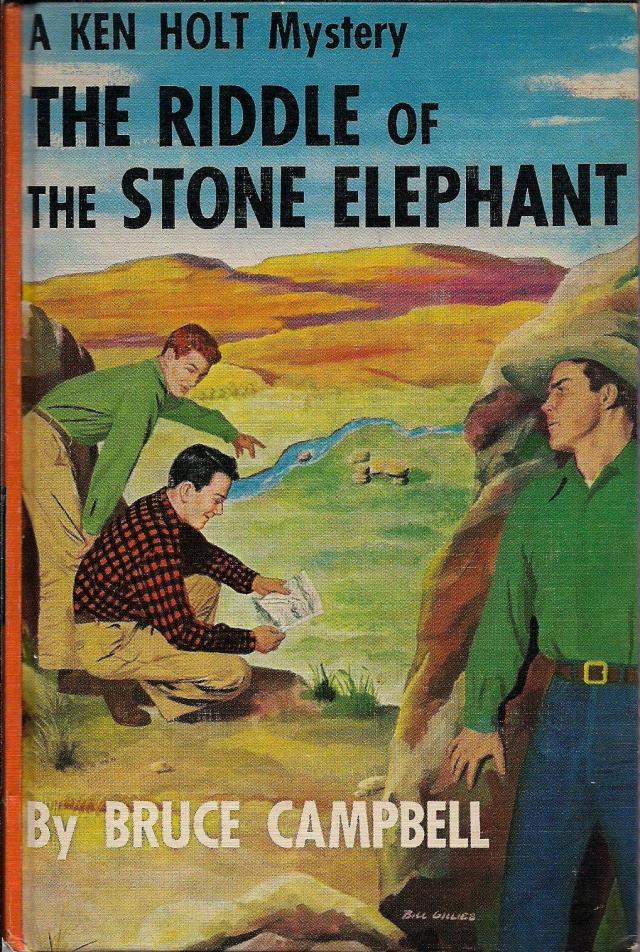
The Riddle of the Stone Elephant
A KEN HOLT Mystery
By Bruce Campbell
GROSSET & DUNLAP Publishers
New York
The KEN HOLT Mystery Stories
1 The Secret of Skeleton Island
2 The Riddle of the Stone Elephant
3 The Black Thumb Mystery
4 The Clue of the Marked Claw
5 The Clue of the Coiled Cobra
6 The Secret of Hangman’s Inn
7 The Mystery of the Iron Box
8 The Clue of the Phantom Car
9 The Mystery of the Galloping Horse
10 The Mystery of the Green Flame
11 The Mystery of the Grinning Tiger
12 The Mystery of the Vanishing Magician
13 The Mystery of the Shattered Glass
14 The Mystery of the Invisible Enemy
15 The Mystery of Gallows Cliff
16 The Clue of the Silver Scorpion
17 The Mystery of the Plumed Serpent
18 The Mystery of the Sultan’s Scimitar
COPYBICHT, 1949, BY BRUCE CAMPBELL
IN THE UNITED STATES OF AMERICA
CHAPTER I
A MIXED WELCOME
The sleek new red convertible, its top down, purred smoothly over the crest of the long hill and dipped its hood for the descent. Before Sandy Allen could ease off the accelerator, the speedometer needle brushed past the seventy-mile mark and then dropped to sixty as the powerful engine acted as a brake.
Sandy shot a quick glance at his companion, Ken Holt, who was slouched comfortably on the soft leather seat. “Want to take her the rest of the way in?”
Ken turned and grinned. “Not me. Driving down Pike’s Peak this morning was enough.”
“That was a cinch.” Sandy laughed. “You should have driven up.”
Ken slouched even lower in the deep seat to get his head out of the slip stream. “Why should I drive up that mule trail when my two-hundred-pound muscle-bound pal offers to do it?” He shook his head. “I know when I’m well off—with you at the wheel I don’t have a thing to worry about.”
“Oh, no?” Sandy raised his eyebrows. “Seems to me you had plenty to worry about the last time I drove you around.”
The words sent Ken’s thoughts back a month to the time he had first met the Aliens. There were Sandy, his older brother Bert, and Pop Allen—all giants and all redheaded. And there was tiny, motherly Mrs. Allen, whose word was law in everything but the operation of the Allen newspaper, the Brentwood Advance. Ken’s face grew grim as he remembered the breath-taking hunt he and Sandy had made for Ken’s father, the famous foreign correspondent, Richard Holt, when Holt’s nose for news had led him into deadly danger. He had been rescued from it only when the boys had solved “The Secret of Skeleton Island.”
But it hadn’t all been bad, Ken remembered. He’d found some friends; the Allen household had virtually adopted him, and had become, in a sense, the first real family he had known since his mother’s death some years before. After that event, Holt’s far-flung assignments had made it necessary for Ken to live in boarding schools. But from now on he would live with the Aliens, and already it seemed as if he and Sandy were brothers. This vacation they were taking together in the Rockies was a joint present from Ken’s father.
They were going to do a little work, too, while they were out there—a little digging for material for a feature story Richard Holt was to write about a twenty-year-old Colorado land feud. But they would both enjoy that, and in a week, when Ken’s father joined them and finished the job, they’d all have the rest of the month for loafing and fishing. It was going to be a good lazy summer, despite its exciting beginning, Ken thought.
As the car reached the top of a climb Sandy whistled. “Look at that!” He pulled off to one side of the road and stopped. Stretched out before them was a magnificent valley at least twenty-five miles across. And at the far end, their peaks almost out of sight in the clouds, stood a wall of mountains as if to block all exit. Even though it was early July the upper slopes were still covered with snow.
“Here,” Ken said after a moment.
Sandy turned to find Ken offering him a camera—a beautifully designed 35-millimeter job that had enough gadgets to satisfy even Sandy. He took it absently and turned to get out of the car before he realized that Ken was laughing at him.
“Go ahead—laugh your head off. Just because you have no appreciation of beauty—”
“I can take beauty,” Ken said. “But in reasonable amounts. I’ll bet this is the fiftieth mountain shot you’ve made—and they’ll all look alike when you develop them.”
“Phooey!” Sandy bent over the camera to attach a filter. With his eye glued to the finder, he swept the horizon until he found the view that pleased him best. His index finger pressed the shutter release gently.
“O.K.,” he said, when he was back in the car again. “But I hope you’re used to this by now. I’ve brought twenty rolls of film with me—not counting two of infrared.”
Ken groaned. “And I suppose you’ll spend half of every night under a blanket developing what you took during the day.”
“Check!” Sandy said cheerfully. “And you can help.” He slowed the car down as they passed a small village, “Where are we?”
“Wait a minute.” Ken bent over the map, following the road with a pencil. “Here we are. We go almost to the base of those mountains and then turn north.” He began to compute the mileage. “About seventy-five miles, I make it.”
“Less than two hours.” Sandy looked at his wrist watch. “We ought to be in Mesa Alta by five.” He grinned. “Just in time for supper, I hope.”
“Did you read those notes Dad gave us?” Ken asked, ignoring Sandy’s comment.
Sandy nodded. “I looked them over.” He shrugged. “Sounds like a simple enough case to me. It’s even happened back East—and land boundaries are older and better known there.”
“Sounds simple enough,” Ken agreed. “But it’s an interesting yarn, anyway. Here are two big ranches, both sharing water rights to a stream. Then one rancher decides to fence in his land and they find that the property line cuts the other ranch out of any water. So what happens?”
“So the other ranch has no water,” Sandy said. “So what? They should have surveyed the property better in the first place.”
“Must have been tough on the one ranch. You can’t raise much stock without lots of water.”
“Well, he took it to court and lost, so I guess there was nothing he could do about it. The funny thing is he’s still mad about it—after twenty years. He didn’t even answer your father’s letter, did he?”
Ken shook his head. “The other man—Raymond— did. But he didn’t sound happy about Dad doing a story, either. Said it would open old scars or something.”
Sandy shrugged. “Well, let’s not worry about it. So far as anybody in town is concerned, we’re just up here for the fishing. When your father comes, it’ll be time enough to figure how to get some co-operation.”
In another half hour they had crossed the valley and the road swung northward. On their left were the huge snow-capped mountains, closer now and more forbidding because of their nearness. On their right, lower hills began to appear as they progressed toward their destination, hills that closed in on them until they were driving at the bottom of a narrow valley. At times it seemed as if they could almost reach out their arms and touch either side. Then the valley would widen until there were five miles between the ranges.
A railroad—a single-track line—appeared suddenly to run beside the road, and when they were still thirty miles from Mesa Alta, a small river joined them. It ran first on one side of the highway and then on the other, crossing beneath the concrete like a winding snake.
They could see the sun still hitting the tops of the hills, but along the road it was rapidly darkening when they pulled into the little crossroad gas station bearing the sign:
Mesa Alta Gas Station
Ken swung open the door, and was getting out to seek directions when the attendant appeared.
“Howdy,” he said. “What’ll it be?”
Sandy looked at the gasoline gauge on the dashboard. “Might as well fill it up,” he said to Ken. “We could use about ten, I guess.”
“Can you tell us how to get to the inn?” Ken asked.
“Sure. This is Main Street crossing the highway here. Follow It left about half a mile.” He shut off the nozzle as the tank filled, and replaced the gas cap.
“Say!” he said a moment later as he counted out the change into Sandy’s hand. “You must be the two reporters who are going to write up a story about the old Wilson land case.”
Ken and Sandy exchanged a quick glance.
“My father’s going to do the writing,” Ken replied. “We just came out for a vacation while he does the story.”
“Yep. Remember now. Mrs. Purdy was talking about it over at the post office the other day.” He leaned comfortably against the car. “Quite a case that must have been.”
“Do you remember it?” Ken asked.
“No. I’m not old enough for that. I must have been about six when it happened. My father used to talk about it, though. He always said that if it had happened ten years earlier there’d ‘a’ been shooting over it. Guess people were too civilized by the time the trouble started.” He chuckled. “Never can tell, though. Some of the looks Wilson gives Raymond make me glad men
They found the inn without trouble. Its neat white sign swung gently from a huge cottonwood whose branches seemed to spread over the entire width of the roadway.
MESA ALTA INN Mrs. John Purdy, Prop.
Sandy swung the car into the wide driveway and drove slowly up the grade and around the house several hundred feet back from the road.
“Looks pretty nice,” Ken said.
The building was only one story high, and the eaves extending several feet beyond the rough white walls helped give it a low, comfortable appearance. A porch ran all around, and a barn and several sheds partially enclosed almost an acre behind the house.
Just as the car stopped, one of the several back doors opened and a woman came toward them. She was tall and thin, and her hair was gray, but there was no sign of age in her walk or in her handshake.
“I’m Ma Purdy,” she boomed in a nasal voice that bounced off the walls of the buildings and came back at them hardly diminished in volume. “You must be Ken Holt and Sandy Allen.” She stood off a pace and looked them up and down. “Now, let’s see. Which is which?”
“I’m Ken Holt, Mrs. Purdy.”
“Never mind that Missus, son. Call me Ma like everybody else.” She turned toward Sandy. “That makes you Sandy, I reckon.” She laughed loud and cheerfully. “There sure is a lot of you, son, isn’t there?”
Sandy grinned right back at her. “Just wait until you see what I can do to a tableful of food, Mrs. Purdy … I mean Ma. Maybe you’ll be sorry there is so much of me.”
“Nothing I like better than seeing a man eat.” She reached inside the car and lifted one of their bags— the fifty-pound one full of Sandy’s photographic equipment—swinging it out as if it were a ten-pound sack of potatoes.
“Here,” Sandy said, taking it from her. “Let me carry that.”
“I’ve toted heavier things than that, son.” She reached for another of the suitcases on the back seat but Ken got there first.
“We’ll go in this way,” she said over her shoulder as she strode toward the house. “I’m going to put you in the corner room—it’s the biggest, and there’s no one else staying here now, anyway. When’s your father coming?” she asked Ken.
“About a week, I think.”
“Good. I’ll save the room next to yours for him.”
She stepped up on the porch and led the way to the far end of the building. There was a door there which she opened.
They entered a huge room with a low ceiling. It was almost twenty feet square and two of its walls were pierced by windows. There were two chests of drawers, a large table that served as a desk, two leather-covered easy chairs, and several straight ones. In the far corner there were two beds with colorful Mexican spreads.
Mrs. Purdy pointed to a door. “That’s your bath. When your father comes you two can share it with him. This other door leads to the hall and to the rest of the house.” She thought a moment. “We don’t have many house rules around here. No formality at all. Breakfast is at eight, dinner at one, and supper at six. But if you get hungry in between those times, I’ll show you where the refrigerator is.”
When she was half out of the room she turned to speak again. “Supper’ll be a mite late tonight, so when you get settled come on out in the kitchen. There might be a hot biscuit lying around loose.”
“That’s a woman after my own heart,” Sandy said. “She knows what food is meant for.” He smiled. “I’ll have to write Mom about this right away. She was worried about us not getting enough to eat.”
“Let’s put our stuff away,” Ken said, “and then meet the rest of the establishment.”
Fifteen minutes later they wandered out into the hall, which seemed to split the house in two lengthwise, and finally found themselves in a kitchen occupying the entire width of the building at the end near the driveway. Mrs. Purdy was busy at a great electric range. She pulled the oven door open and disclosed several biscuit tins.
“Not quite ready yet.” She swung around to face them. “Tell you what. You’ve got another half hour of light. Why don’t you take a run over the old Narrow Gauge Road. It’ll take you past the Sleeping Indian, Camel Rock, Eagle Rock, and the Elephant Rock. You can see the Needle from there, too.”
“Where is it?” Ken asked.
“Why is it called the Narrow Gauge Road?” Sandy t wanted to know.
“It’s on the other side of town—across the highway. And it’s called the Narrow Gauge Road because the old railroad used to run there before the wide gauge came through some time back.”
The door to the outside banged open just then and a small, wiry man in blue denims came through carrying an armful of groceries.
“Here you are, Ma. I think I got everything.”
“Thanks, Bowleg.” Mrs. Purdy turned back to the boys. “This is Bowleg Watson—Bowleg for short. He’s been around here so long we couldn’t manage without him.” She turned to Bowleg. “These are the boys— Ken Holt and Sandy Allen. The big one’s Sandy.”
“Howdy.” Bowleg walked forward and shook their hands.
He couldn’t have been much taller than five feet four inches even in the high-heeled boots he wore. Though he was obviously well over middle age, his weather-beaten face was unwrinkled and there was lots of muscle in the small frame.
“I was telling the boys they ought to take a look at our famous rocks while it’s still light,” Mrs. Purdy said.
Bowleg’s grin showed a gap where several of his teeth were missing. “Sure. Go ahead. If you’ve got enough imagination you can see any kind of rock you want to back there. Why, just the other day I saw two new stallion rocks, three cow rocks, and a little cow-pony rock. Just as plain as day.”
“Go along with you, Bowleg. You’re never going to admit those rocks look like anything.”
“What about Elephant Rock and the Needle?” Ken asked. “Is there any doubt about those?”
The grin vanished from Bowleg’s face instantly, and the friendly eyes narrowed. “They’re there,” he said curtly. Then he turned and stalked from the room.
CHAPTER II
THE NEEDLE AND THE ELEPHANT
Ken and Sandy stared blankly after the stiffly retreating figure of Bowleg.
“Pshaw!” Ma Purdy muttered. “I forgot to warn you. That’s the one thing Bowleg’s not good-natured about —the Wilson case. Elephant Rock and the Needle are Wilson’s boundary markers, you know. Bowleg won’t even talk about it. He still thinks after all these years that Raymond cheated Chet Wilson, and no court decision is going to make him think otherwise.” She busied herself again at the stove.
“If everybody always knew where the boundary was, how did the disagreement ever happen?” Ken asked.
Ma sighed. “Well, you see nobody bothered much about boundary lines twenty years back. Cattle just wandered around and ranged where they wanted to. Come roundup time, they were all sorted out and each outfit got its own. But when Raymond bought up the old Wright ranch, after Wright died, he decided to put up fences. That’s when they found the line cut the Wilson place out of water.”
“What made him fence his land?” Sandy asked.
“He began to raise pedigreed beef cattle—animals too valuable to be allowed to roam loose.”
“Didn’t Wilson have any water at all then?”
“A little creek—not near big enough for all his stock.”
“But couldn’t they have come to some sort of an agreement?” Ken wondered.
“Lots of people thought so. But by the time the lawsuit was finished they were both pretty stiff-necked.” Ma bent down to look at the oven thermometer. “Sometimes I wonder if these newfangled gadgets are worth the trouble.”
“Let’s go take a look at the road,” Ken suggested.
“O.K.”
“Go across the highway and down Main Street to the first street on your left,” Ma directed. “Don’t worry about those old railroad tunnels the road goes through. They may look dangerous, but they’ve been there a long time without caving in.”
Ken took the wheel and drove slowly down the lane and into the street. They turned right toward the highway, Ken holding their speed down to keep the dust clouds fiom billowing up too thickly behind them.


